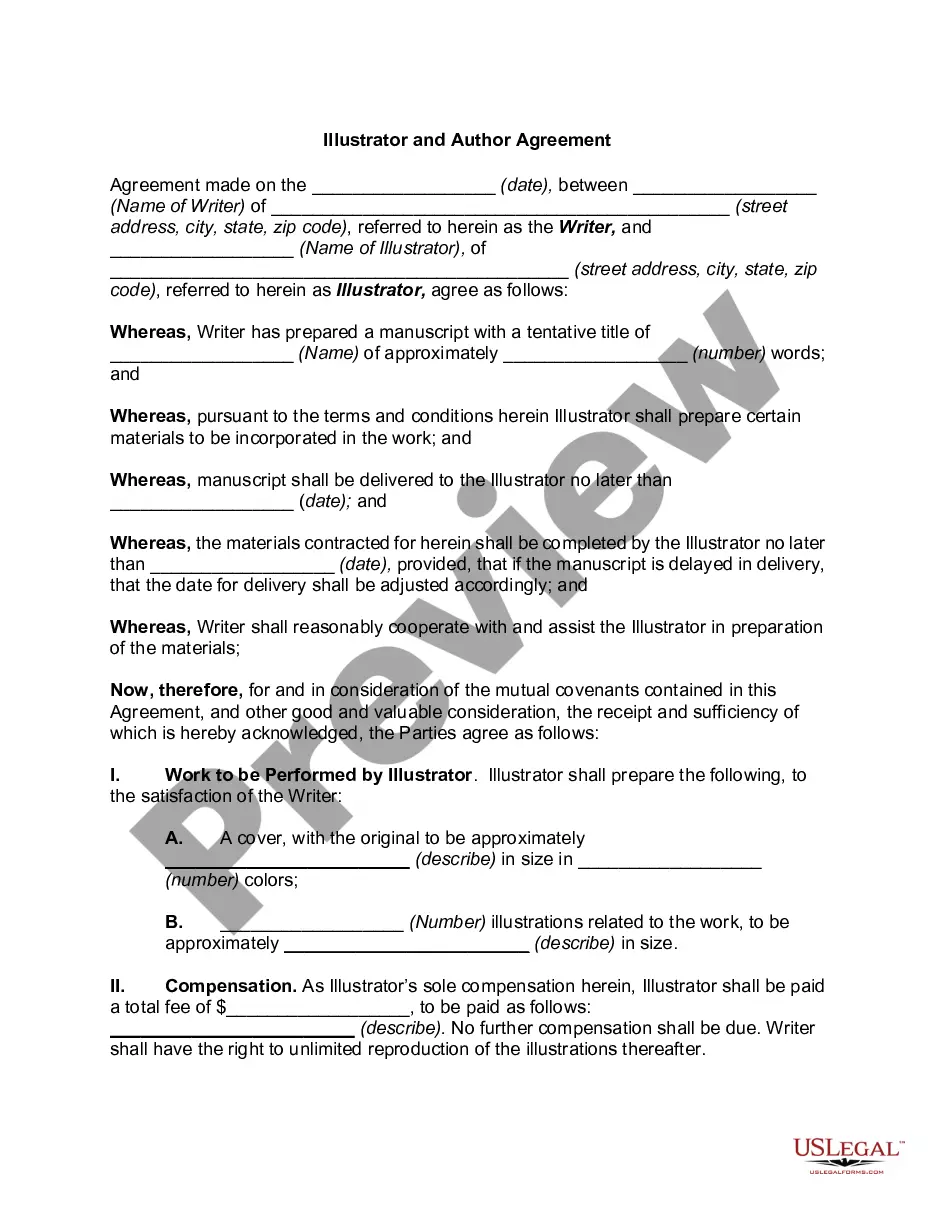
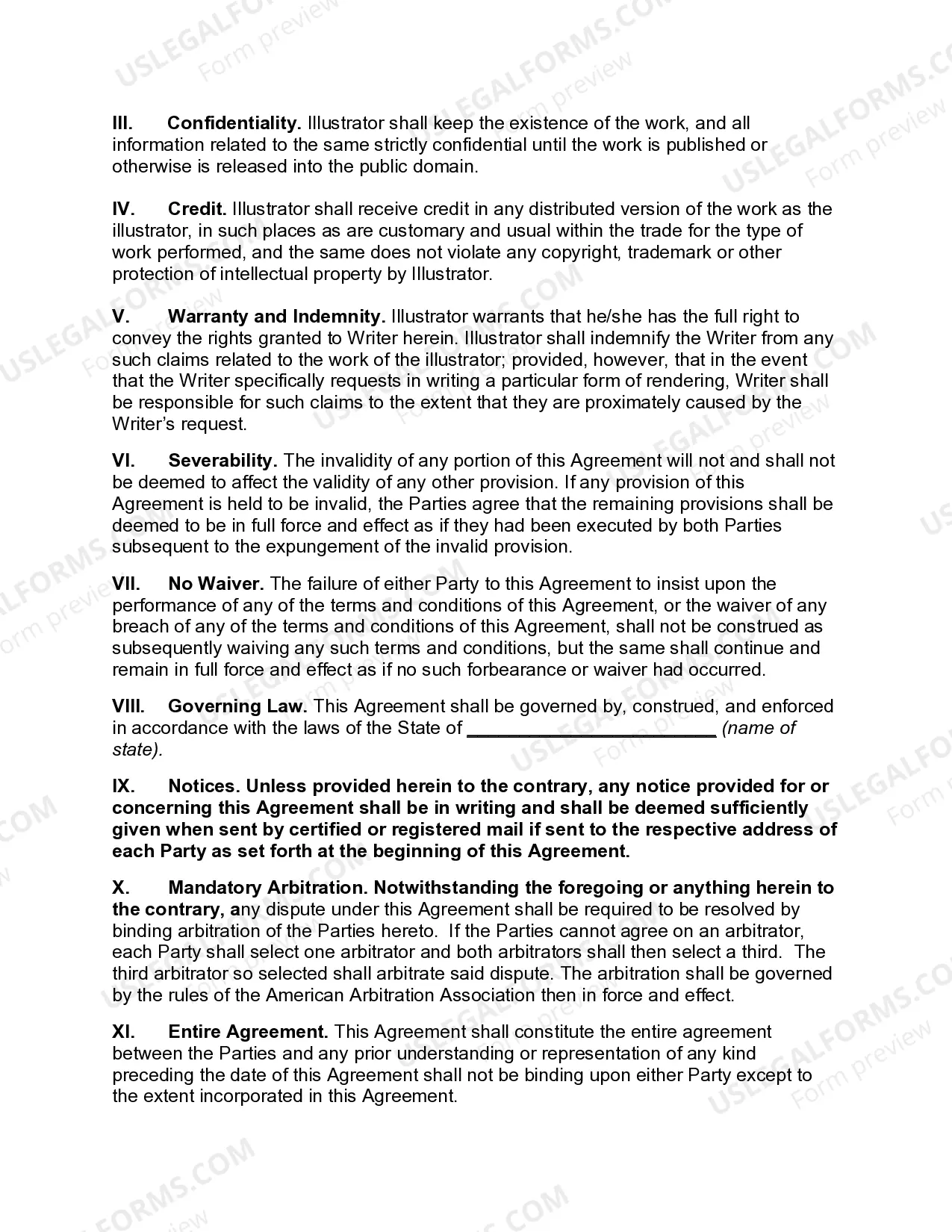
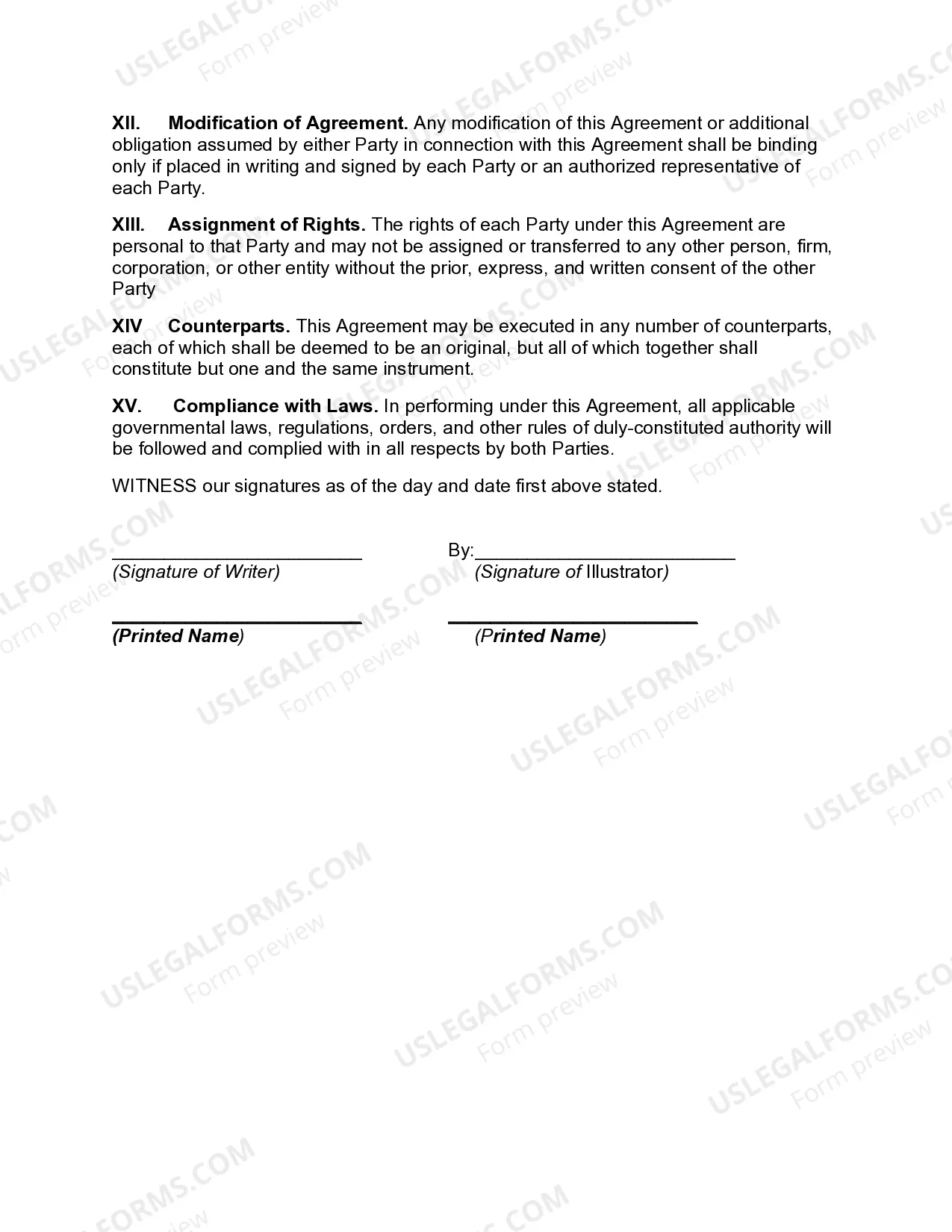
Dallas Texas Illustrator and Author Agreement
Description
Get your form ready online
Our built-in tools help you complete, sign, share, and store your documents in one place.
Make edits, fill in missing information, and update formatting in US Legal Forms—just like you would in MS Word.
Download a copy, print it, send it by email, or mail it via USPS—whatever works best for your next step.
Sign and collect signatures with our SignNow integration. Send to multiple recipients, set reminders, and more. Go Premium to unlock E-Sign.
If this form requires notarization, complete it online through a secure video call—no need to meet a notary in person or wait for an appointment.
We protect your documents and personal data by following strict security and privacy standards.

Make edits, fill in missing information, and update formatting in US Legal Forms—just like you would in MS Word.

Download a copy, print it, send it by email, or mail it via USPS—whatever works best for your next step.

Sign and collect signatures with our SignNow integration. Send to multiple recipients, set reminders, and more. Go Premium to unlock E-Sign.

If this form requires notarization, complete it online through a secure video call—no need to meet a notary in person or wait for an appointment.

We protect your documents and personal data by following strict security and privacy standards.
Looking for another form?
How to fill out Illustrator And Author Agreement?
Are you seeking to swiftly compose a legally-enforceable Dallas Illustrator and Author Agreement or perhaps any other document to manage your personal or corporate affairs.
You have two choices: employ a legal expert to draft a legal document on your behalf or create it entirely independently. Fortunately, there's an additional option - US Legal Forms.
Initially, verify if the Dallas Illustrator and Author Agreement aligns with your state’s or county’s regulations.
If the form contains a description, ensure to check what it is applicable for.
- It assists you in obtaining professionally drafted legal documents without incurring exorbitant fees for legal services.
- US Legal Forms features an extensive catalog of over 85,000 state-compliant document templates, comprising the Dallas Illustrator and Author Agreement and form groups.
- We provide documentation for a multitude of life scenarios: from divorce forms to real estate document templates.
- With over 25 years in the business, we've established a flawless reputation among our clientele.
- Here’s how you can join their ranks and acquire the required template with minimal hassle.
Form popularity
FAQ
In a typical contract the author or self publisher pays a one-off fee for services rendered. This would include the book illustrator granting all rights of the project illustrations to the author or self publisher. In this case this would also include such terms as 'worldwide copyright rights'.
An illustration contract must have introduction has the date the agreement was made, both parties (that is the client and the freelancer) that agreeing to the terms and conditions, and their addresses.
If you're the author or author/illustrator, you'll get the full royalty rate. This is typically 10% but could be lower or higher depending on the publisher and negotiations. There may even be a step clause in the contract where the royalty amount gets higher when you hit certain benchmarks.
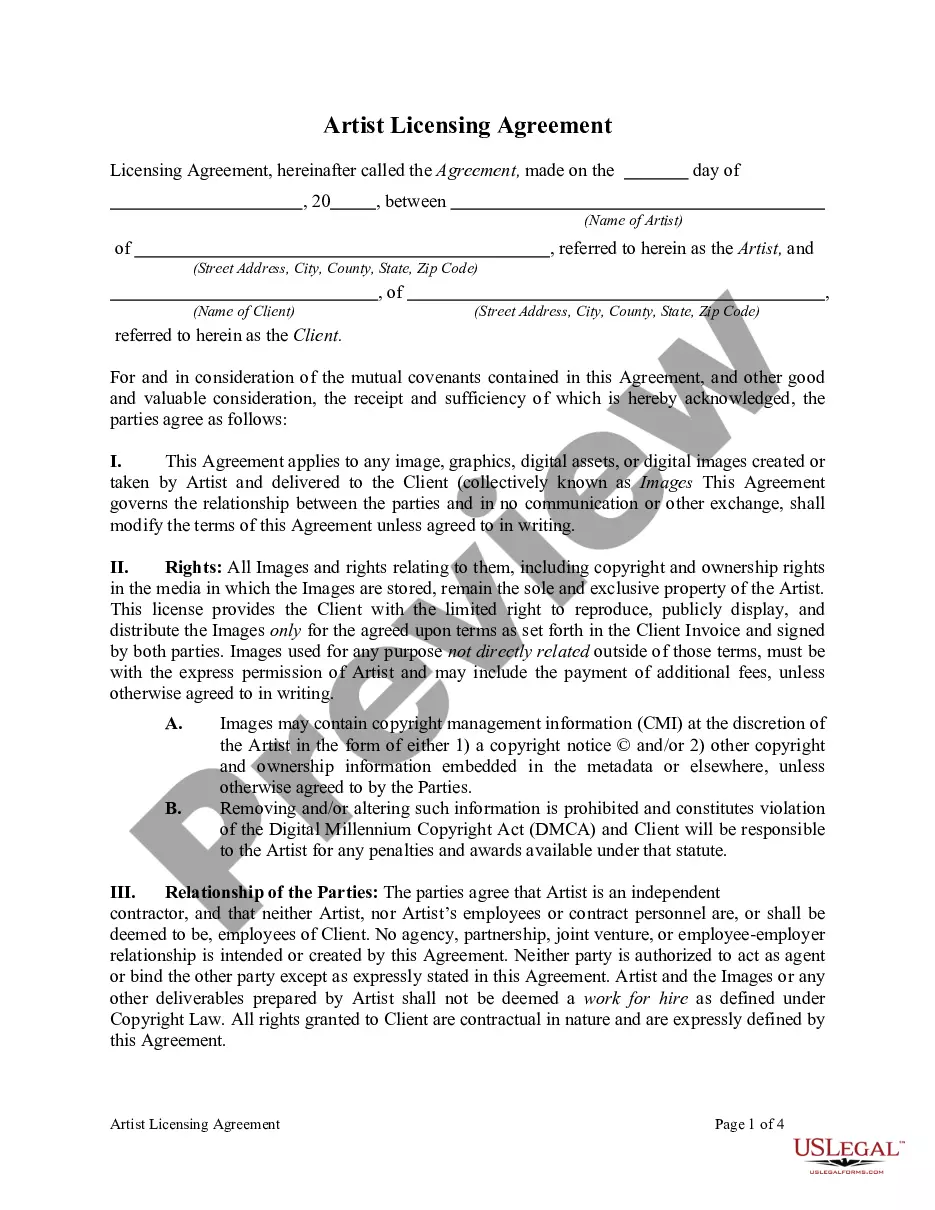
In the event that Artwork is not deemed a work made for hire under § 101 of the 1976 Copyright Act, the Artist assigns and transfers to the Author, one-hundred percent (100%) of all the rights, title, and interest, including copyrights throughout the world to the Artwork.
You don't have to pay royalties if you pay the illustrator an agreed straight fee. I've worked with illustrators from big publishing houses that prefer a straight fee as they never know how a book is going to sell.
If you're the author and illustrator, you'll get to keep the full royalty rate, which would be similar to above: around 10% with possible benchmarks that will raise it to around 15%. If you're only the illustrator, the royalties will be split equally between you and the author.
Having a contract is essential for any illustration assignment. But what should go into that contract can oftentimes be confusing and downright scary, particularly for those of us who are more artistic-minded rather than business-minded.
If you're the author or author/illustrator, you'll get the full royalty rate. This is typically 10% but could be lower or higher depending on the publisher and negotiations. There may even be a step clause in the contract where the royalty amount gets higher when you hit certain benchmarks.
Your illustrations are automatically copyrighted and that copyright belongs to you unless you transfer that copyright to the author in exchange for some kind of payment spelled out in a contract.
In the United States, most publishers offer a 10% royalty on the retail price of a picture book against the advance. If the illustrator is also the author, they receive the full 10%. If there was a different author, the author and illustrator split the 10% royalty, which means they each receive 5% of the retail price.