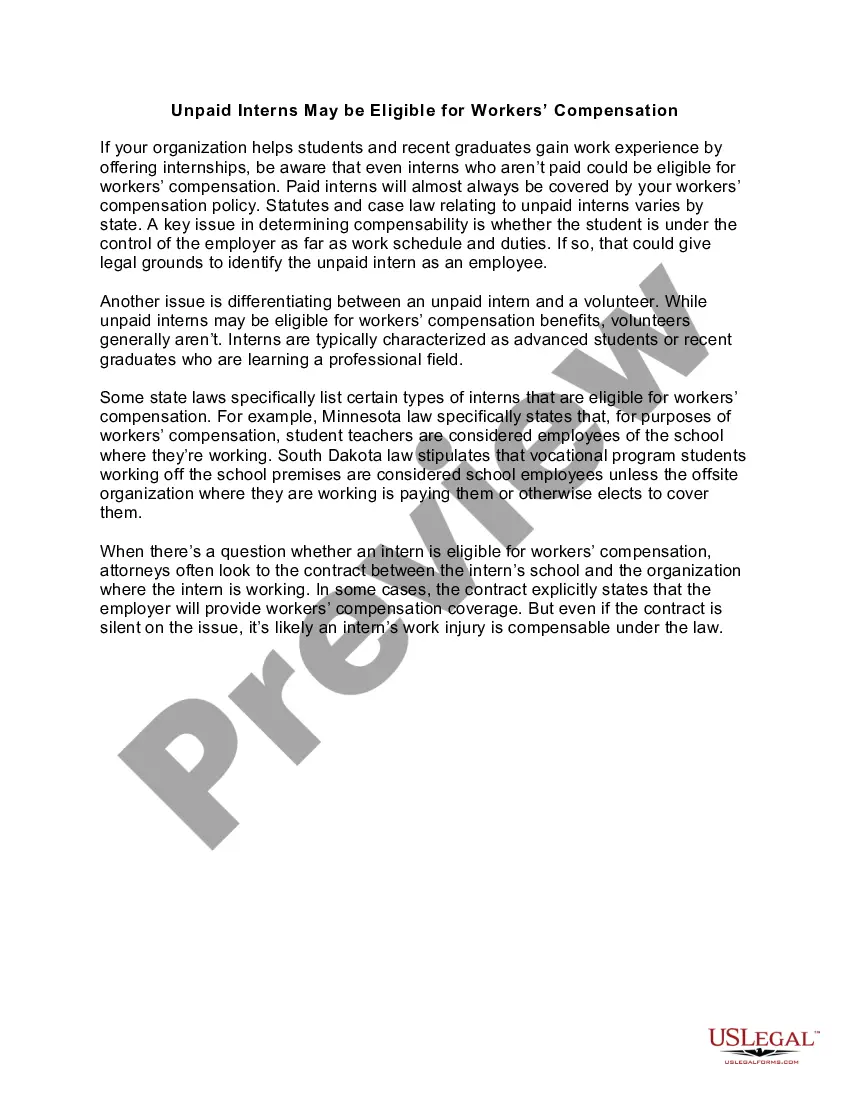
Hillsborough Florida Unpaid Interns May be Eligible for Worker's Compensation
Description
Get your form ready online
Our built-in tools help you complete, sign, share, and store your documents in one place.
Make edits, fill in missing information, and update formatting in US Legal Forms—just like you would in MS Word.
Download a copy, print it, send it by email, or mail it via USPS—whatever works best for your next step.
Sign and collect signatures with our SignNow integration. Send to multiple recipients, set reminders, and more. Go Premium to unlock E-Sign.
If this form requires notarization, complete it online through a secure video call—no need to meet a notary in person or wait for an appointment.
We protect your documents and personal data by following strict security and privacy standards.

Make edits, fill in missing information, and update formatting in US Legal Forms—just like you would in MS Word.

Download a copy, print it, send it by email, or mail it via USPS—whatever works best for your next step.

Sign and collect signatures with our SignNow integration. Send to multiple recipients, set reminders, and more. Go Premium to unlock E-Sign.

If this form requires notarization, complete it online through a secure video call—no need to meet a notary in person or wait for an appointment.

We protect your documents and personal data by following strict security and privacy standards.
Looking for another form?
How to fill out Unpaid Interns May Be Eligible For Worker's Compensation?
Statutes and rules in each sector vary across the nation.
If you're not an attorney, it’s straightforward to become confused by the multitude of standards when it comes to creating legal documents.
To prevent costly legal support when drafting the Hillsborough Unpaid Interns May be Eligible for Worker's Compensation, you require a validated template applicable in your jurisdiction.
Once you identify the correct document, click the Buy Now button to acquire it.
- That’s where utilizing the US Legal Forms platform proves to be advantageous.
- US Legal Forms is a reputable online compilation of over 85,000 state-specific legal templates.
- It serves as an ideal solution for both professionals and individuals seeking do-it-yourself formats for various personal and business situations.
- All templates can be reused: once you select a sample, it remains available in your account for future use.
- Therefore, if you hold an account with an active subscription, you can easily sign in and re-download the Hillsborough Unpaid Interns May be Eligible for Worker's Compensation from the My documents section.
- For newcomers, a few additional steps are required to access the Hillsborough Unpaid Interns May be Eligible for Worker's Compensation.
- Review the content on the page to ensure you selected the appropriate sample.
- Utilize the Preview feature or read the form explanation if provided.
Form popularity
FAQ
Accordingly, whether an intern or student is an employee under the FLSA necessarily depends on the unique circumstances of each case. Although it is natural to assume that because President Trump is pro-business, this means that Florida businesses can now use interns freely without paying them.
Under the Fair Labor Standards Act (FLSA) of 1938, any employee of a for-profit company must be paid for their work. However, interns are not considered employees under the FLSA.
The federal courts and the U.S. Equal Employment Opportunities Commission have historically held that civil rights protections under Title VII of the Civil Rights Act of 1964 do not extend to unpaid interns.
Paid interns are almost always covered by your workers' compensation policy.
Several interns have successfully filed California underpaid internship lawsuits against employers for making them perform the same job as full-time employees without equal pay or benefits.
Because unpaid interns are not technically employees, they are not covered by the Fair Labor Standards Act (FLSA) or Florida minimum wage laws. This means that they have no right to a certain hourly wageor any wage at all, for that matterin exchange for their work.
The stringency of laws about what constitutes an acceptable unpaid internship has waxed and waned. Broadly speaking, however, unpaid internships are legal. The logic is that the intern is learning marketable skills on the job, and an unpaid internship substitutes for formal higher education.
The NACE study that found unpaid internships negatively impact how long it takes a student to find a job after graduation, also found positive results. The study found that unpaid internships help confirm or reject interest in a career, help set career goals, and positively benefit networking.
Unpaid internships are legal if the intern is the primary beneficiary of the arrangement as determined by the seven-point primary beneficiary test. If an employer is the primary beneficiary, the intern is considered an employee under the Fair Labor Standards Act and entitled to at least minimum wage.