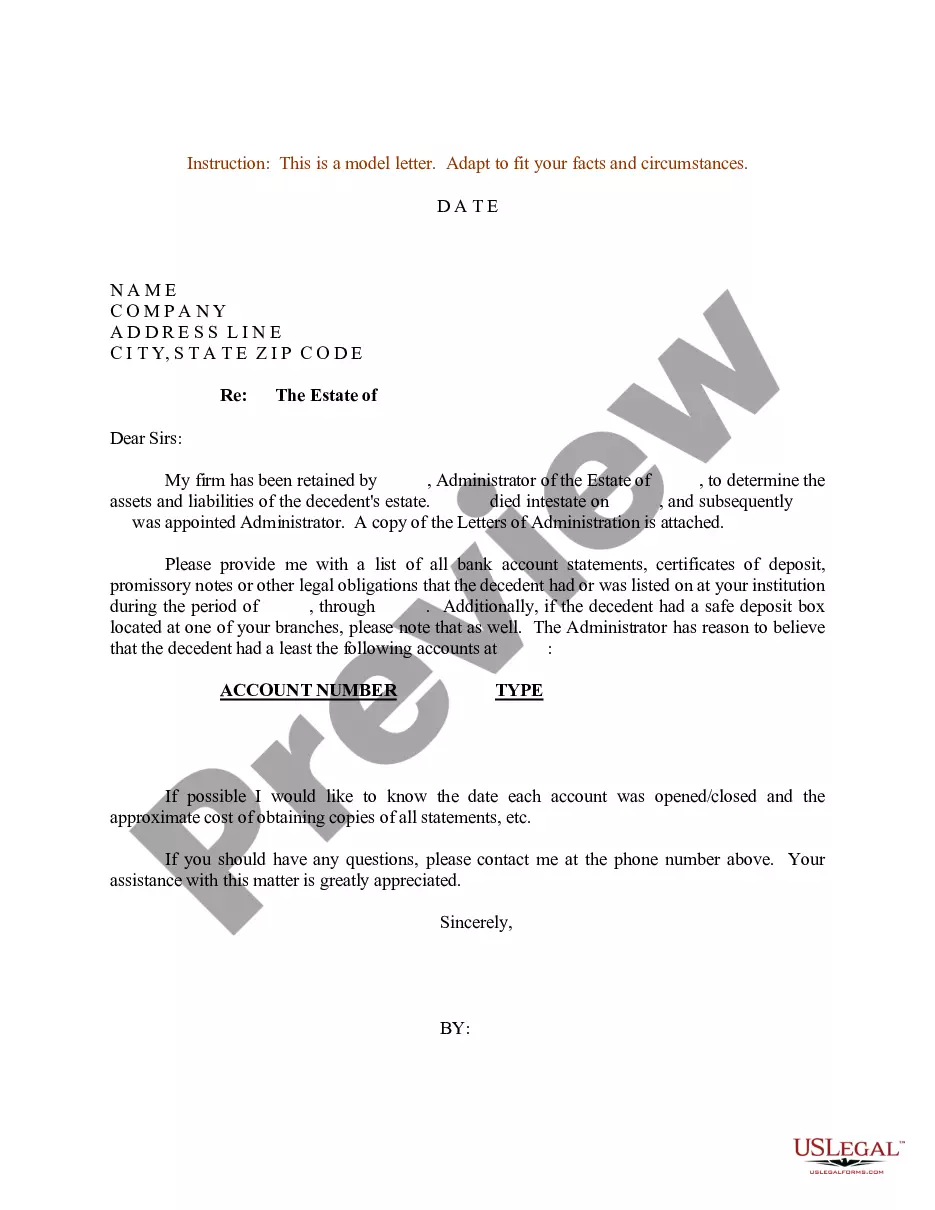
Los Angeles California Sample Letter for Assets and Liabilities of Decedent's Estate
Description
Get your form ready online
Our built-in tools help you complete, sign, share, and store your documents in one place.
Make edits, fill in missing information, and update formatting in US Legal Forms—just like you would in MS Word.
Download a copy, print it, send it by email, or mail it via USPS—whatever works best for your next step.
Sign and collect signatures with our SignNow integration. Send to multiple recipients, set reminders, and more. Go Premium to unlock E-Sign.
If this form requires notarization, complete it online through a secure video call—no need to meet a notary in person or wait for an appointment.
We protect your documents and personal data by following strict security and privacy standards.

Make edits, fill in missing information, and update formatting in US Legal Forms—just like you would in MS Word.

Download a copy, print it, send it by email, or mail it via USPS—whatever works best for your next step.

Sign and collect signatures with our SignNow integration. Send to multiple recipients, set reminders, and more. Go Premium to unlock E-Sign.

If this form requires notarization, complete it online through a secure video call—no need to meet a notary in person or wait for an appointment.

We protect your documents and personal data by following strict security and privacy standards.
Looking for another form?
How to fill out Sample Letter For Assets And Liabilities Of Decedent's Estate?
Preparing legal documents is essential in the current world. However, you don't always have to pursue professional help to compose some of them from scratch, such as the Los Angeles Example Letter for Assets and Liabilities of a Deceased Person's Estate, using a service like US Legal Forms.
US Legal Forms offers more than 85,000 documents to select from across various categories, including healthcare directives, property documentation, and divorce agreements. All documents are categorized according to their respective state, simplifying the search process.
Here’s how to locate and acquire the Los Angeles Example Letter for Assets and Liabilities of a Deceased Person's Estate.
If you’re already subscribed to US Legal Forms, you can find the required Los Angeles Example Letter for Assets and Liabilities of a Deceased Person's Estate, Log In to your account, and download it. Of course, our platform can’t entirely replace a lawyer. If you encounter an exceptionally complex issue, we suggest hiring an attorney to review your document before signing and filing it.
With over 25 years of existence, US Legal Forms has become a primary source for a wide array of legal documents for millions of individuals. Become a member today and acquire your state-specific paperwork with ease!
- Review the document's preview and overview (if provided) to understand what you’ll receive upon downloading the document.
- Verify that your chosen template is suitable for your state/county/region, as state laws can influence the validity of certain papers.
- Examine the related document templates or restart the search to locate the correct file.
- Click Buy now and create your account. If you already possess an account, opt to Log In.
- Select the pricing {plan, then an appropriate payment option, and purchase the Los Angeles Example Letter for Assets and Liabilities of a Deceased Person's Estate.
- Decide to save the form template in any offered format.
- Navigate to the My documents section to re-download the document.
Form popularity
FAQ
Assets that are not part of an estate Co-owned assets held on a joint basis. Assets held by Private Companies. Assets held in Family Trusts. Life Insurance Policies. Superannuation.
During a person's lifetime s/he will gather assets, in other words, belongings such as a house or a motor vehicle. A person will also gather liabilities, in other words, credit such as a home or motor vehicle loan. These assets and liabilities will form part of a person's estate.
Place your name, address and phone number at the top of the letter, followed by the date, then the name, address and phone number of the individual or agency handling your deceased relative's estate.
Identify persons the executor should notify of your death. Include family members, close friends and business associates, including your attorney. Provide contact information for each person, as well as any final message or instructions to be given. Describe your important estate documents and their exact location.
Preparing a Letter of Last Instructions Instructions about the funeral, memorial service, and preferred disposition of the body. Your loved one should also include any specific instructions for clergy and funeral directors. Location of his or her will. Names of friends and relatives who should be informed of the death.
An Estate can be divided in any number of ways in the terms of the Will. It could be that the deceased wants their Estate to be divided equally between their 6 grandchildren, for example, or that 40% should go to their brother, with the rest divided equally between their 3 cousins.
An estate asset is property that was owned by the deceased at the time of death. Examples include bank accounts, investments, retirement savings, real estate, artwork, jewellery, a business, a corporation, household furnishings, vehicles, computers, smartphones, and any debts owed to the deceased.
Give the letter a personal touch and address each of your heirs and beneficiaries personally. Tell them any last wishes you may have or any hopes you have for their future. Write as clearly as possible. Use specific details and avoid using shorthand.
A good letter of instruction should contain the following information: A complete list of all assets. The whereabouts of any tangible assets that are not readily accessible. Necessary information about all liquid assets, including bank, brokerage, retirement, and investment accounts.
There are certain kinds of information executors are generally required to provide to beneficiaries, including an inventory and appraisal of estate assets and an estate accounting, which should include such information as: An inventory of estate assets and their value at the time of the decedent's death.