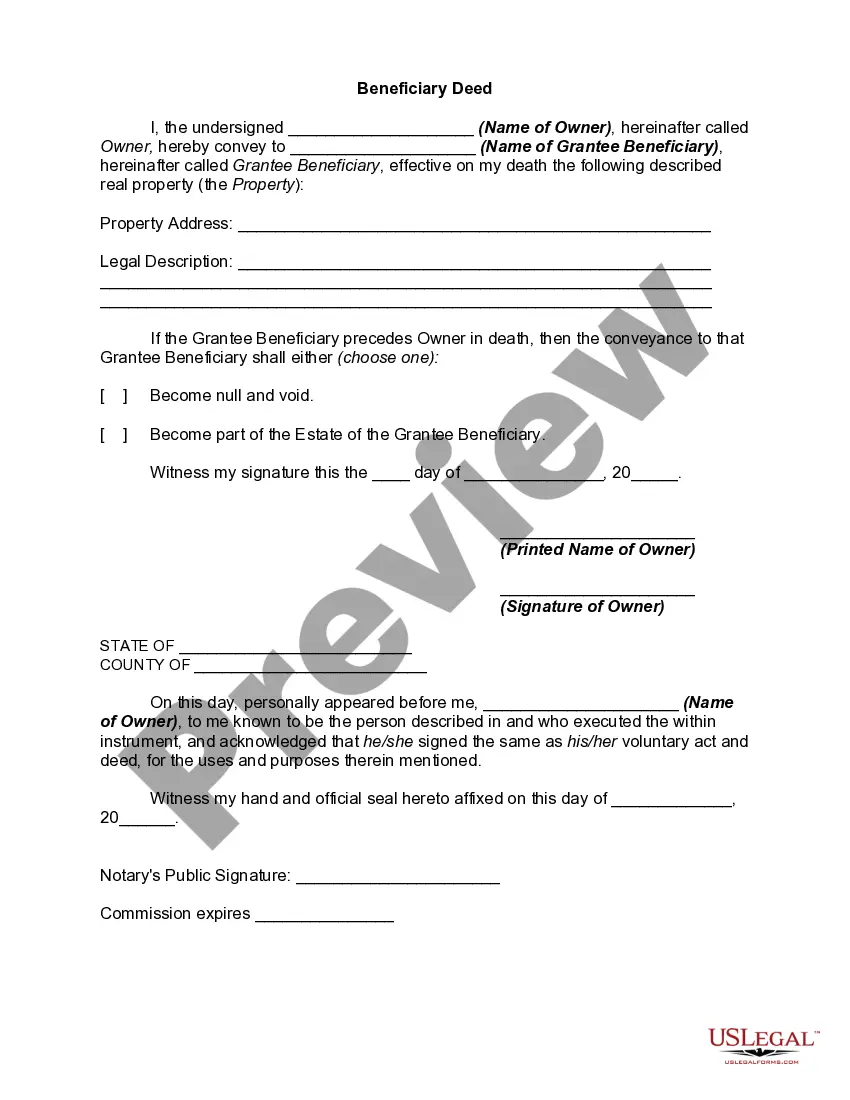
Mecklenburg North Carolina Beneficiary Deed

State:
Multi-State
County:
Mecklenburg
Control #:
US-03279BG
Format:
Word; 
Rich Text
Instant download

Description

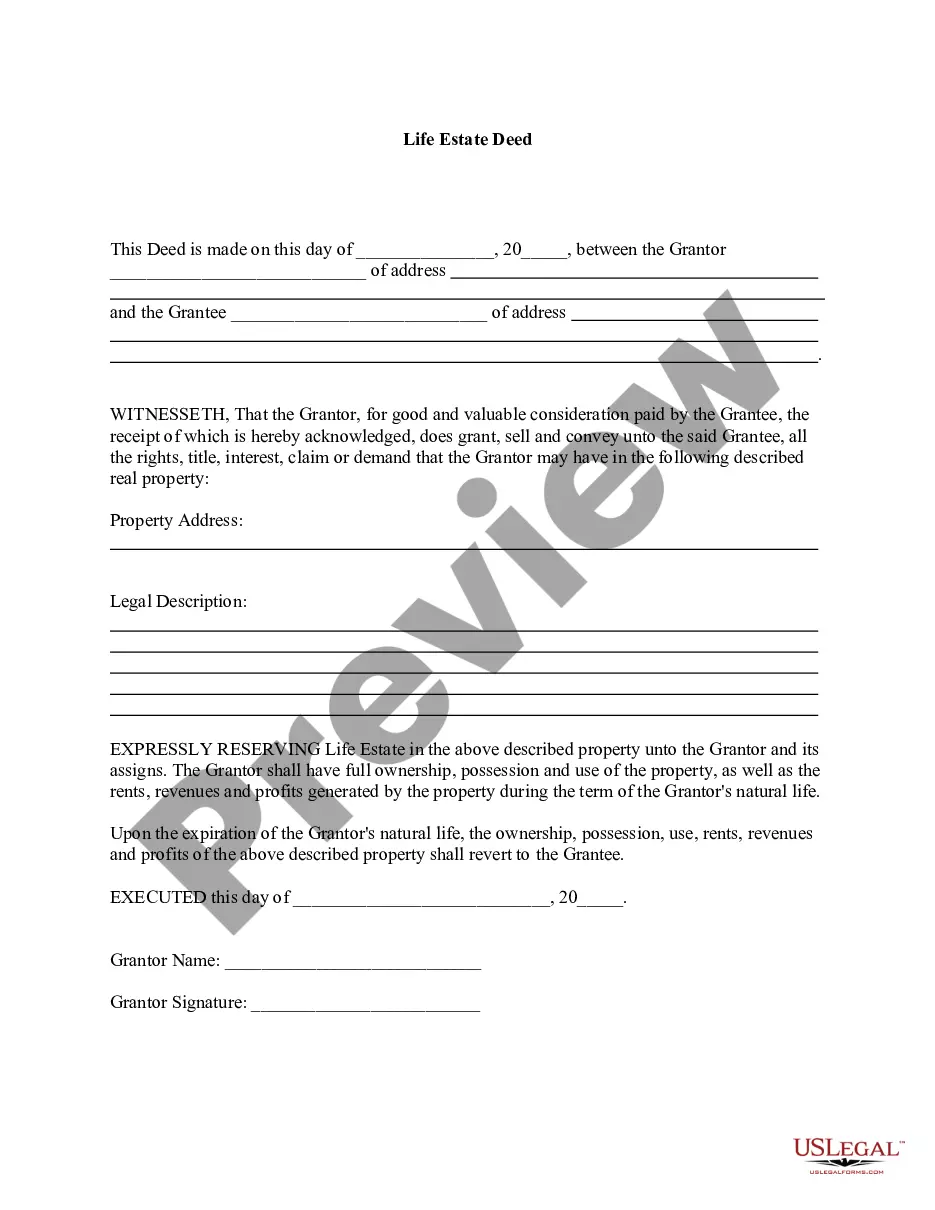
A beneficiary deed is a another type of real property deed used to transfer property. By signing and recording a beneficiary deed, an owner of an interest in real property may cause the owner's interest in the real property to be conveyed to people or entities upon the owner's death. The interest in real property conveyed by a beneficiary deed does not take effect until the death of the owner, at which time that interest transfers automatically by law to the designated grantee named in the beneficiary deed.


This form is a generic example that may be referred to when preparing such a form for your particular state. It is for illustrative purposes only. Local laws should be consulted to determine any specific requirements for such a form in a particular jurisdiction.

Get your form ready online

Our built-in tools help you complete, sign, share, and store your documents in one place.

Built-in online Word editor

Make edits, fill in missing information, and update formatting in US Legal Forms—just like you would in MS Word.

Export easily

Download a copy, print it, send it by email, or mail it via USPS—whatever works best for your next step.

E-sign your document

Sign and collect signatures with our SignNow integration. Send to multiple recipients, set reminders, and more. Go Premium to unlock E-Sign.

Notarize online 24/7

If this form requires notarization, complete it online through a secure video call—no need to meet a notary in person or wait for an appointment.

Store your document securely

We protect your documents and personal data by following strict security and privacy standards.

Form selector

Make edits, fill in missing information, and update formatting in US Legal Forms—just like you would in MS Word.

Form selector

Download a copy, print it, send it by email, or mail it via USPS—whatever works best for your next step.

Form selector

Sign and collect signatures with our SignNow integration. Send to multiple recipients, set reminders, and more. Go Premium to unlock E-Sign.

Form selector

If this form requires notarization, complete it online through a secure video call—no need to meet a notary in person or wait for an appointment.

Form selector

We protect your documents and personal data by following strict security and privacy standards.

Looking for another form?

This field is required
Ohio
Select state

How to fill out Beneficiary Deed?

Preparing documentation, such as the Mecklenburg Beneficiary Deed, to oversee your legal matters is a challenging and time-consuming endeavor.

Numerous situations necessitate an attorney’s involvement, which also renders this task not particularly cost-effective.

However, you can take charge of your legal concerns and handle them independently.

The onboarding process for new clients is equally seamless! Here’s what you should do before obtaining the Mecklenburg Beneficiary Deed: Ensure that your form is tailored to your specific state or county since the requirements for drafting legal documents can vary from state to state.

  1. US Legal Forms is here to assist you.
  2. Our platform offers over 85,000 legal documents tailored for various scenarios and life situations.
  3. We guarantee that each document adheres to the laws of every state, relieving you of concerns about potential compliance issues.
  4. If you're already familiar with our offerings and hold a subscription with US Legal Forms, you understand how uncomplicated it is to access the Mecklenburg Beneficiary Deed template.
  5. Feel free to Log In to your account, retrieve the template, and adapt it to your specifications.
  6. Lost your form? Don't fret. You can locate it in the My documents section of your account - available on both desktop and mobile.

Form popularity

FAQ

When does North Carolina require probate? Only assets owned solely by the person who has died must go through probate. Assets that do not require North Carolina probate and transfer directly to the person's named beneficiary or co-owner include the following: Real estate owned jointly with a spouse.

Key Takeaways. Transfer on death applies to certain assets that have a named beneficiary. The beneficiaries (or a spouse) receive the assets without having to go through probate. Beneficiaries of the TOD don't have access to the assets prior to the owner's death.

A North Carolina Transfer on Death Deed is a legally binding document that certifies the property owner's intention to transfer the items indicated in writing to their beneficiary upon the death of the grantor.

Because TOD accounts are still part of the decedent's estate (although not the probate estate that the Last Will establishes), they may be subject to income, estate and/or inheritance tax. TOD accounts are also not out of reach for the decedent's creditors or other relatives.

Unlike South Carolina and many other states, real property in North Carolina does not typically pass through probate. When a decedent dies intestate (without a Will), title to the decedent's non-survivorship real property is vested in his or heir heirs as of the time of death G.S. 28A-15-2(b).

A survivorship affidavit (sometimes called an affidavit of death or affidavit of continuous marriage) is a legal document used to remove a deceased owner from title to property by recording evidence of the deceased owner's death in the land records.

Disadvantage of Transfer-on-Death Beneficiary Deeds Or, beneficiaries and family members can sue each other to take the property entirely. In this case, a court proceeding may be required to resolve the issue. Another disadvantage is that the beneficiary won't be able to sell the property immediately upon the transfer.

A transfer on death deed can be a useful addition to your estate plan, but it may not address other concerns, like minimizing estate tax or creditor protection, for which you need a trust. In addition to a will or trust, you can also transfer property by making someone else a joint owner, or using a life estate deed.

Unless a) the decedent wills the realty to the executor or directs to the executor to sell the realty with only the proceeds of the sale directed to devisees, or b) the will confers a power of sale upon the executor and devises the property to the estate (and not a devisee), heirs must execute the deed for a valid

With regard to transfer or real property by beneficiary designation, as of the date of this writing, North Carolina (unlike some other states) does not allow real property to transfer through a beneficiary designation - transfer on death deeds.

Trusted and secure by over 3 million people of the world’s leading companies

Mecklenburg North Carolina Beneficiary Deed