Houston Texas Complaint to Quiet Title by Adverse Possessor with Unknown Defendants

State:
Multi-State
City:
Houston
Control #:
US-02716BG
Format:
Word; 
Rich Text
872 downloads
Jayne Welch, Content Attorney and Legal Editor at US Legal Forms
Reviewed by
Jayne Welch
Content Attorney / Legal Editor, US Legal Forms

Description

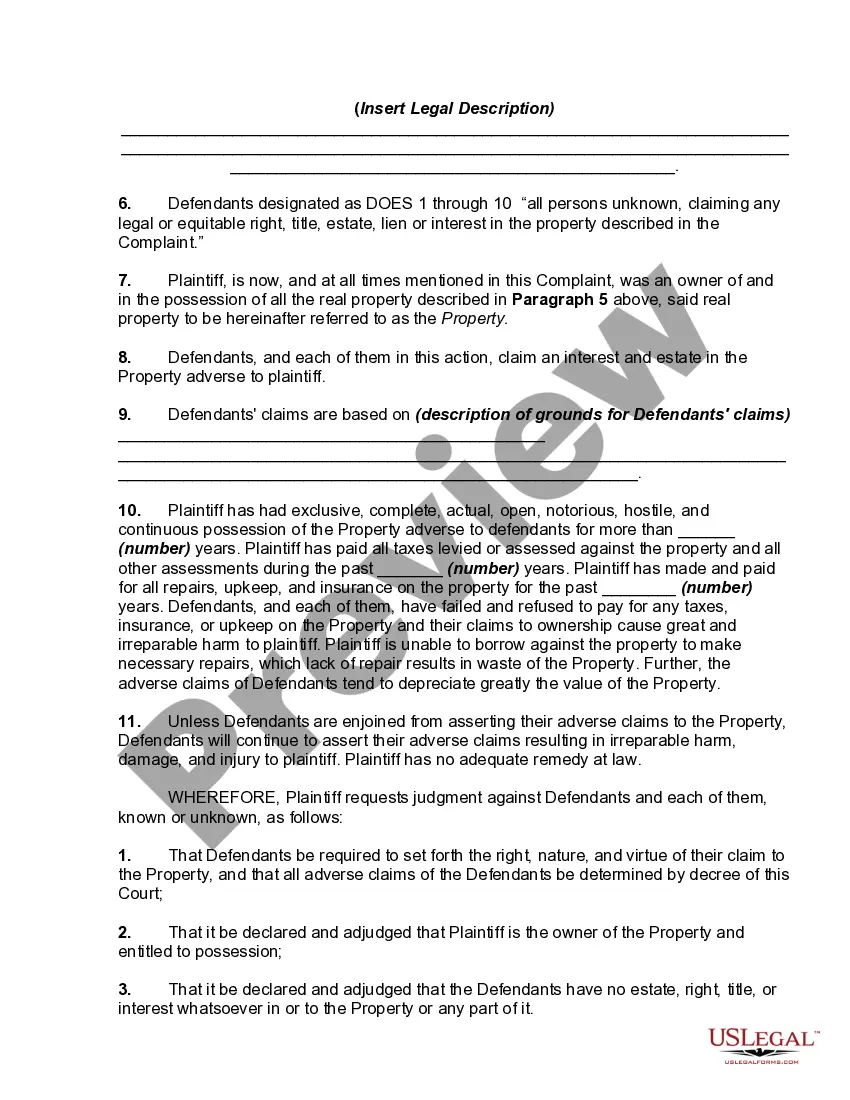
A quiet title action is a civil lawsuit brought for the purpose of determining conflicting claims to real property. The action affects only those properties identified in the complaint. The action can target specific individuals who have or may claim an interest in the property (sometimes referred to as a quasi in rem proceeding); and it can sometimes be expanded to include all persons, known and unknown, who might have some interest in the property (an in rem action). A quiet title action, when properly conducted in accordance with statutory and constitu¬tional requirements, can resolve all claims and conflicts regarding the property in a single proceeding.


Most quiet title actions are based on adverse posses¬sion, in which the plaintiff alleges that he and his predecessors-in-interest have openly and notoriously claimed the property over a period of years and have paid the property taxes. Title to land can be acquired by holding it adversely to the true owner for a certain period of time. In this case, the person in possession gains title by adverse possession. The person in possession automatically becomes the owner of the property even though the person had no lawful claim to the land. In order to acquire title in this manner, possession must be actual, visible, exclusive, and continuous for a period of time. In Mississippi, the period of time is ten years. State statutes vary with regard to this period of time.


In addition to identifying adverse claimants, the plaintiff must undertake a diligent effort to give them notice of the action so that they can defend themselves. Since courts do not favor forfeitures of property interests, the plaintiff must satisfy both statutory and constitutional requirements for notice and due process. The best form of notice is personal service on the defendant(s). If a defendant cannot be served personally, states have enacted laws outlining the minimum procedures to be followed for constructive service of process on unknown or claimants that cannot be located. These minimum procedures may require mailing notice by certified mail, return receipt requested, to the last known address of a claimant; giving notice to the secretary of state for a defunct corporation; posting notice on the land; and publishing notice of the complaint in a local newspaper.
Free preview
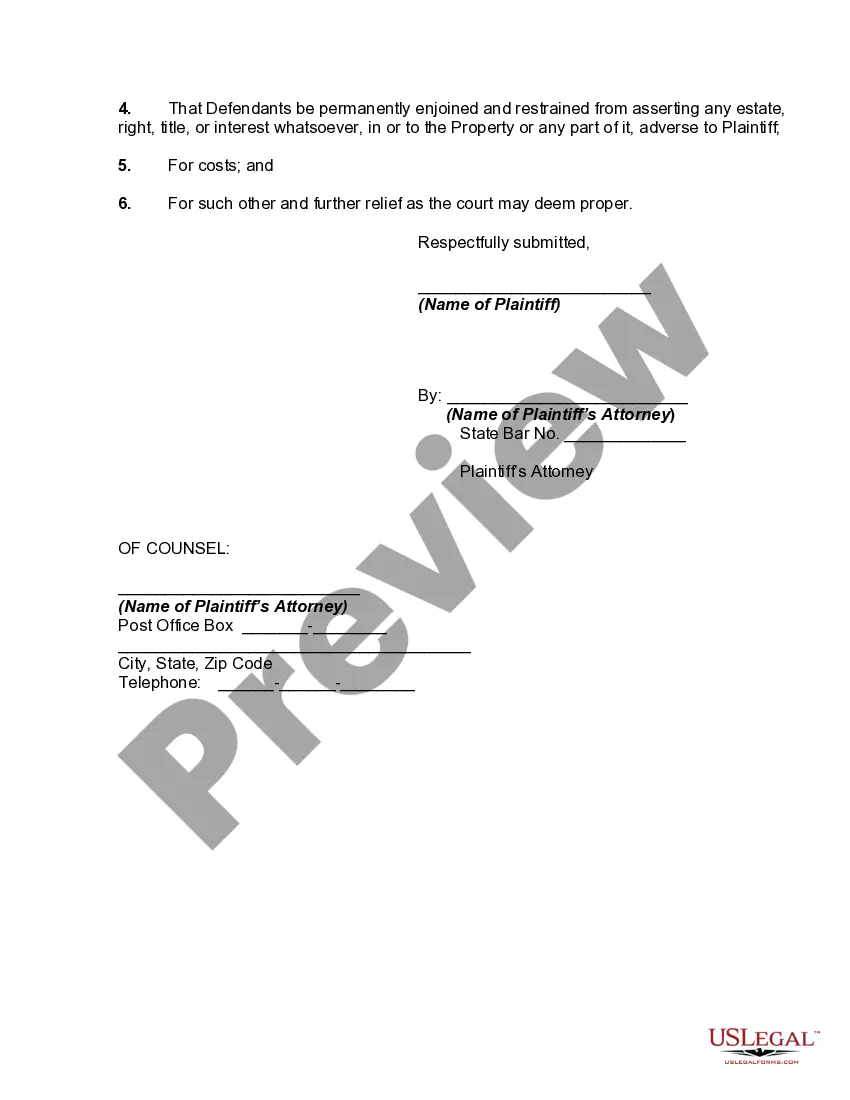
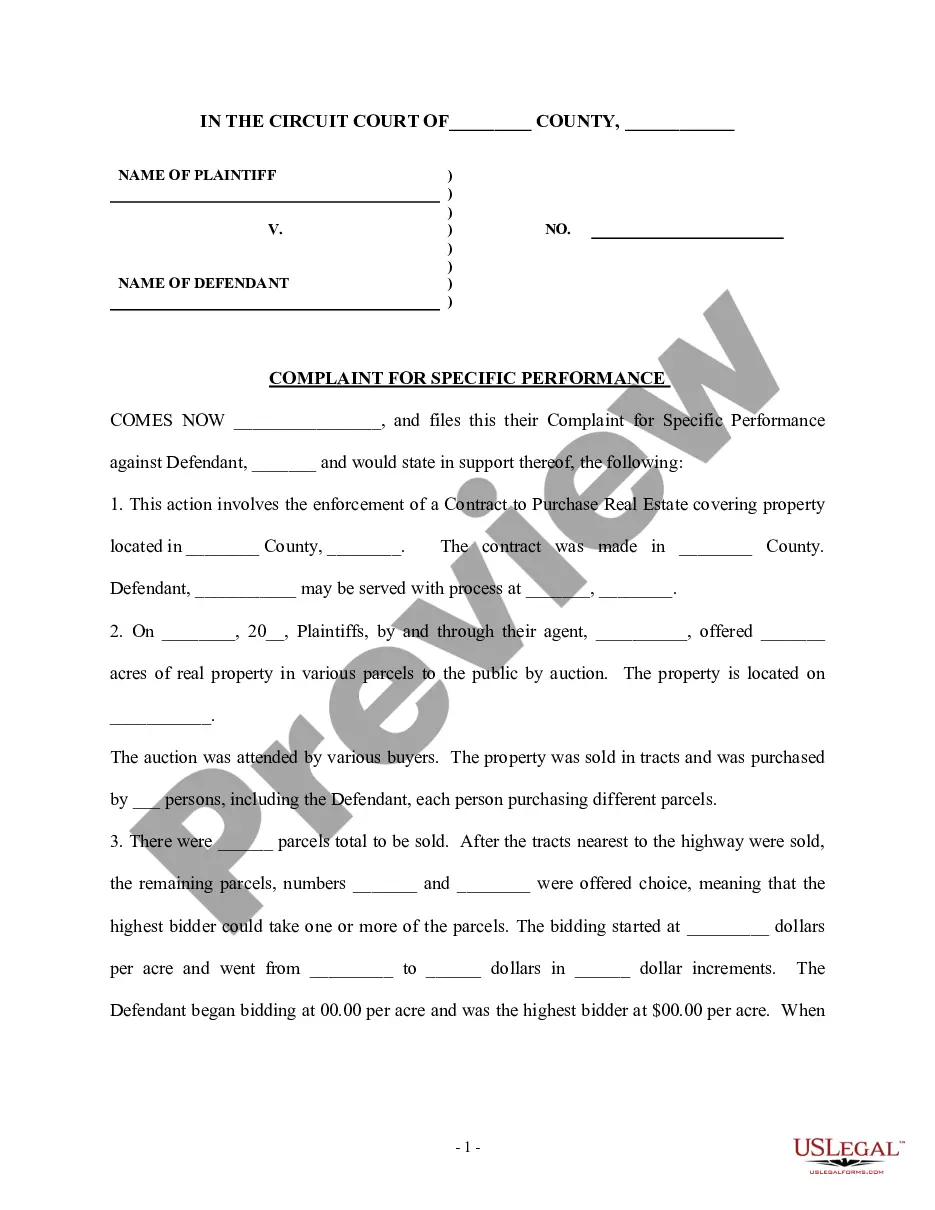
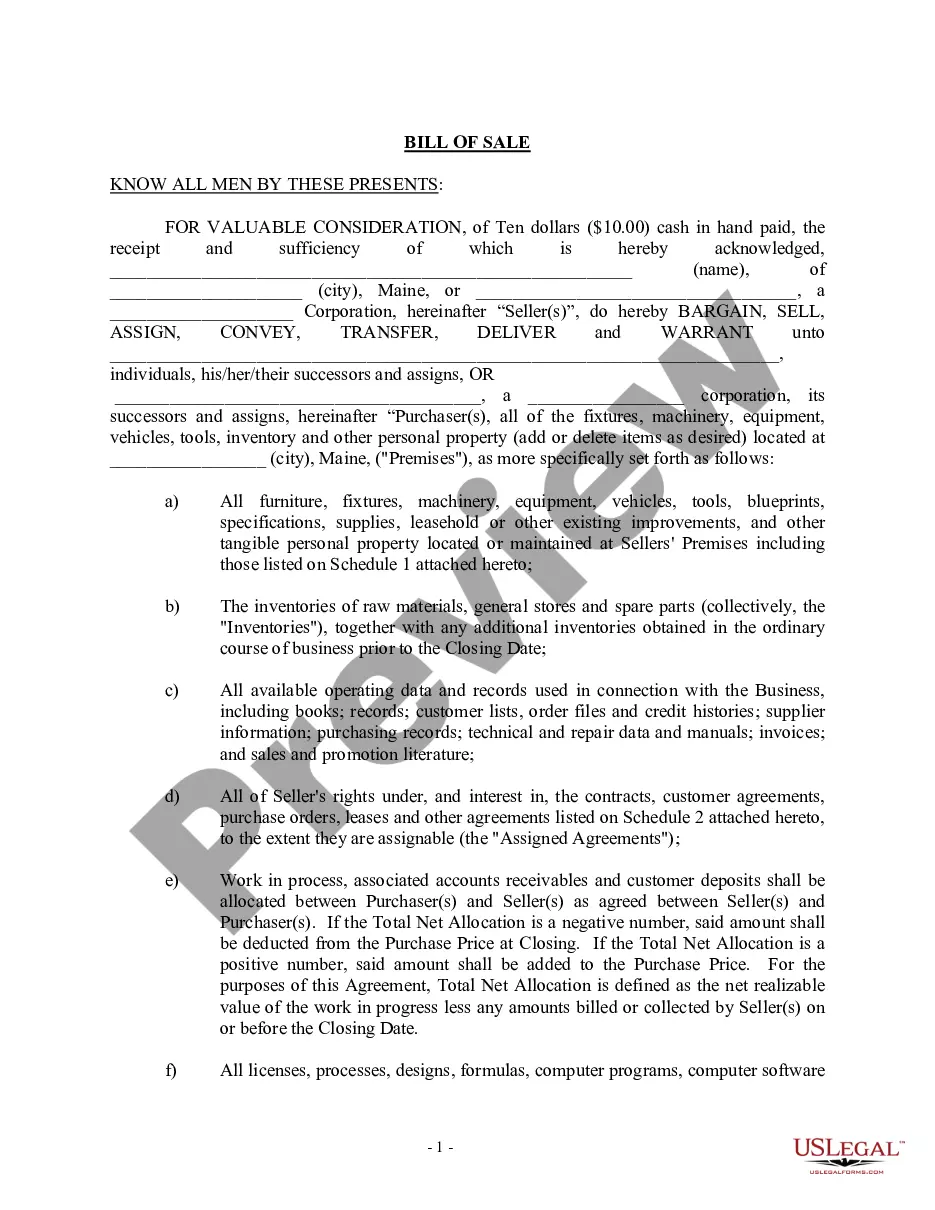
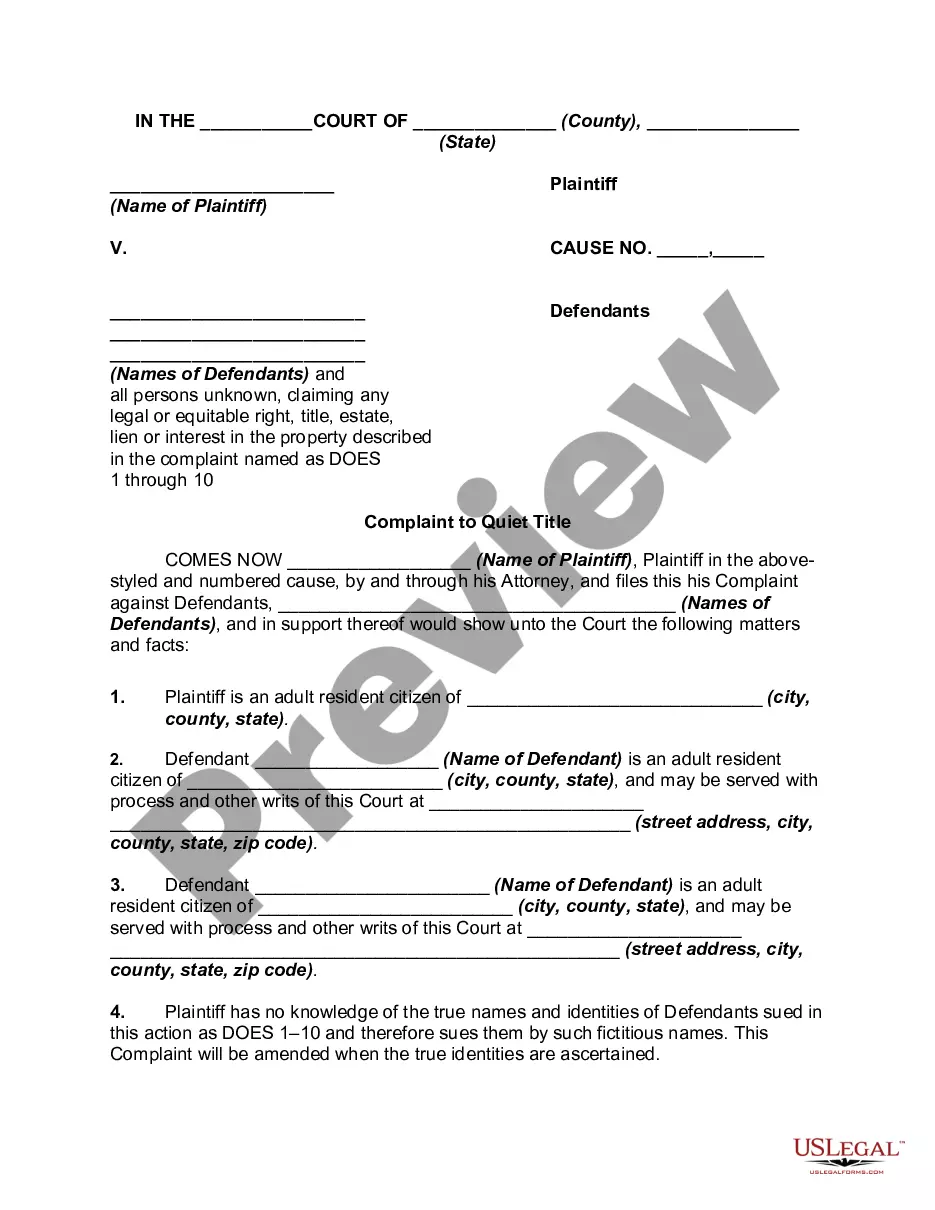
  • Preview Complaint to Quiet Title by Adverse Possessor with Unknown Defendants
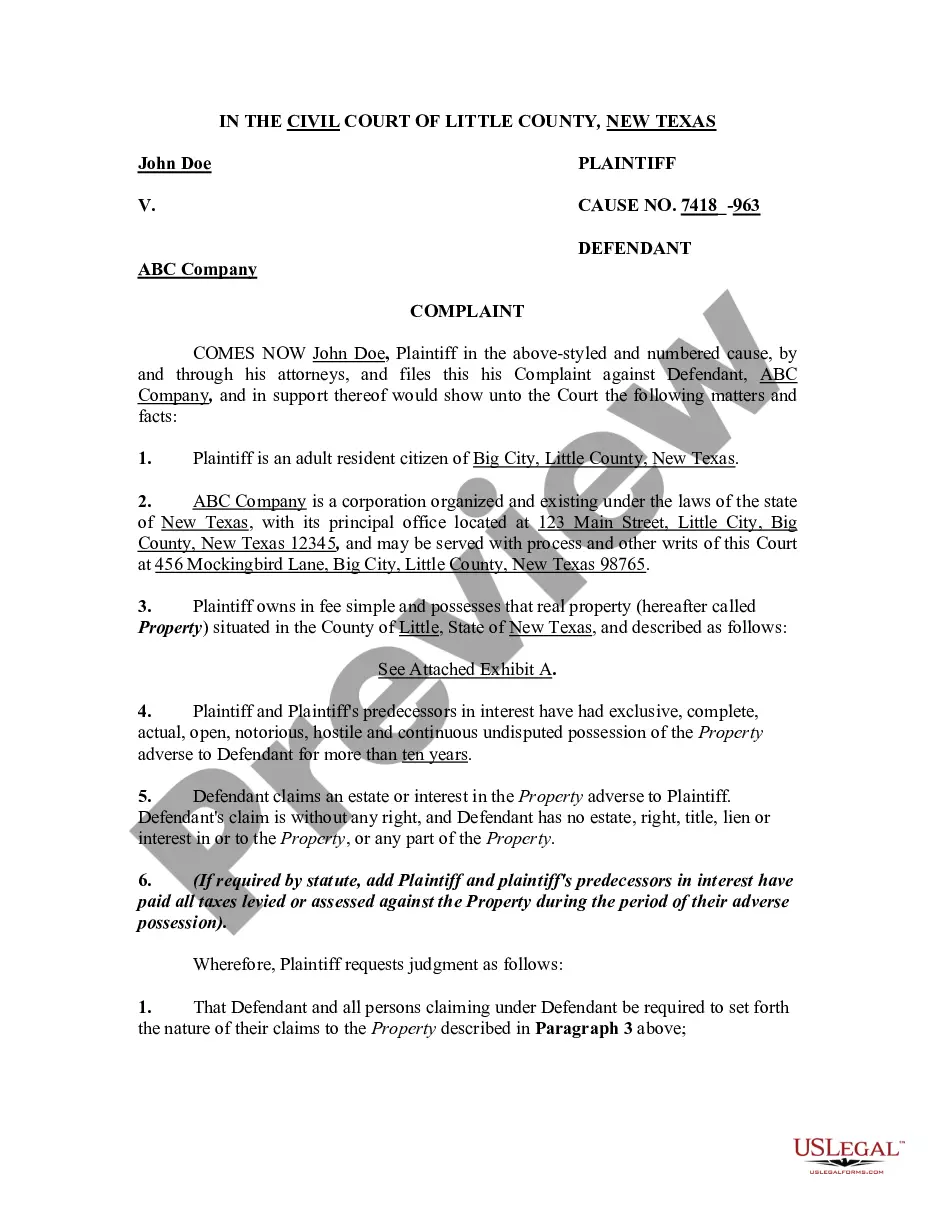
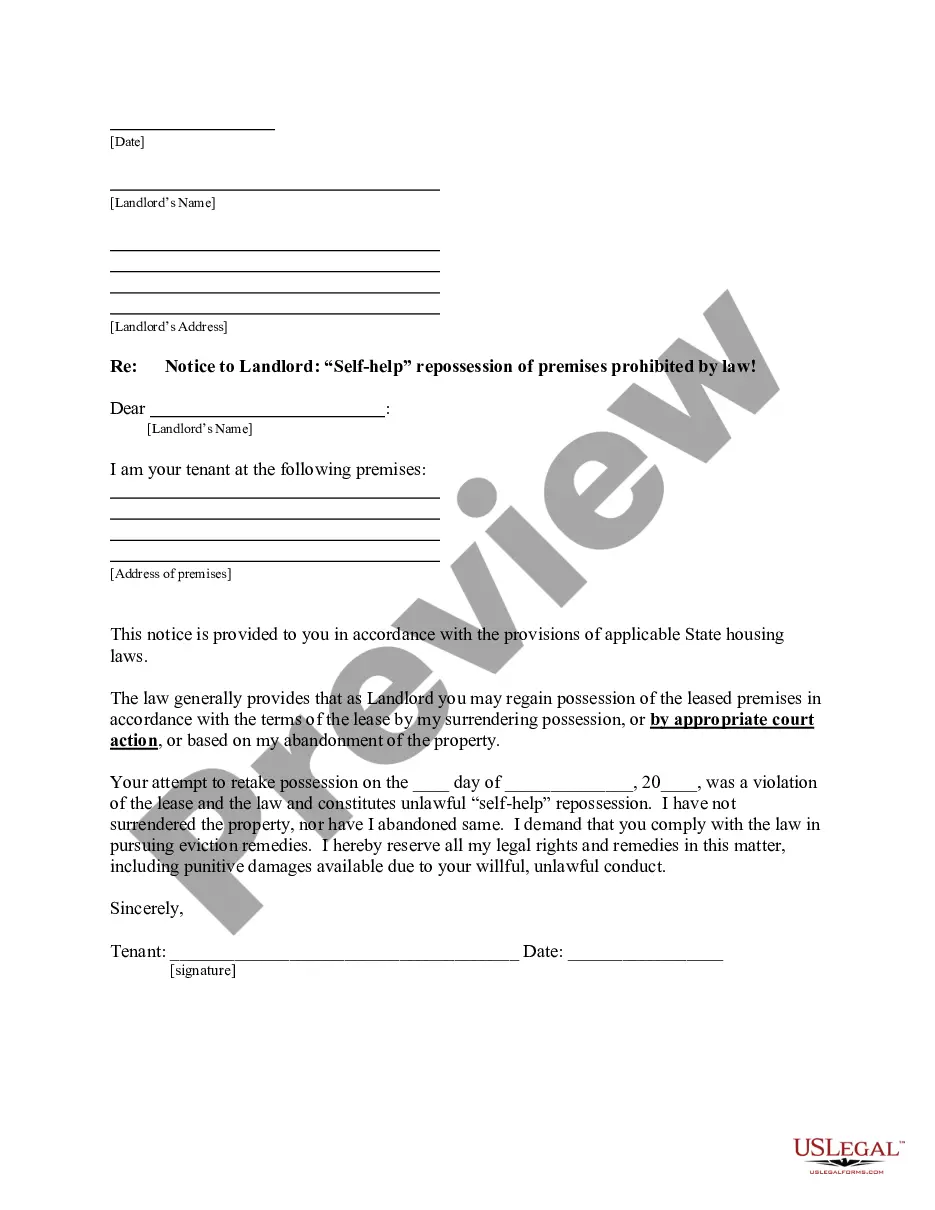
  • Preview Complaint to Quiet Title by Adverse Possessor with Unknown Defendants
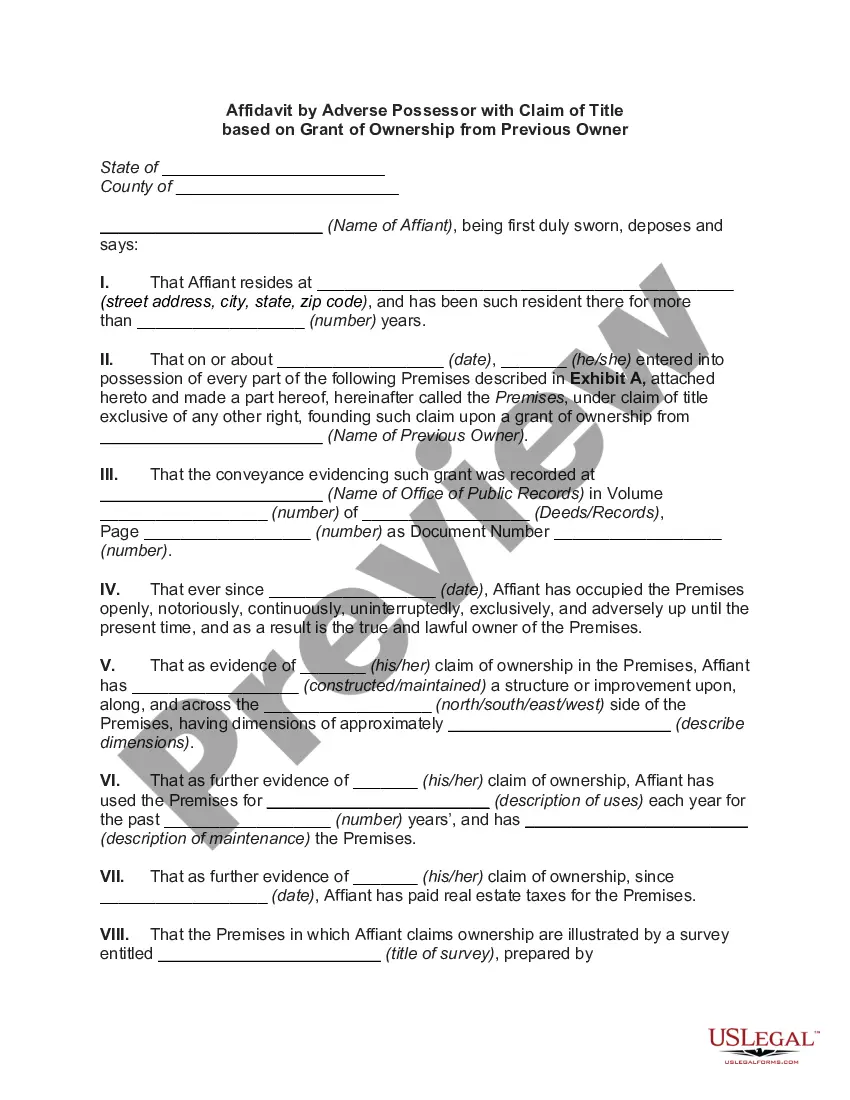
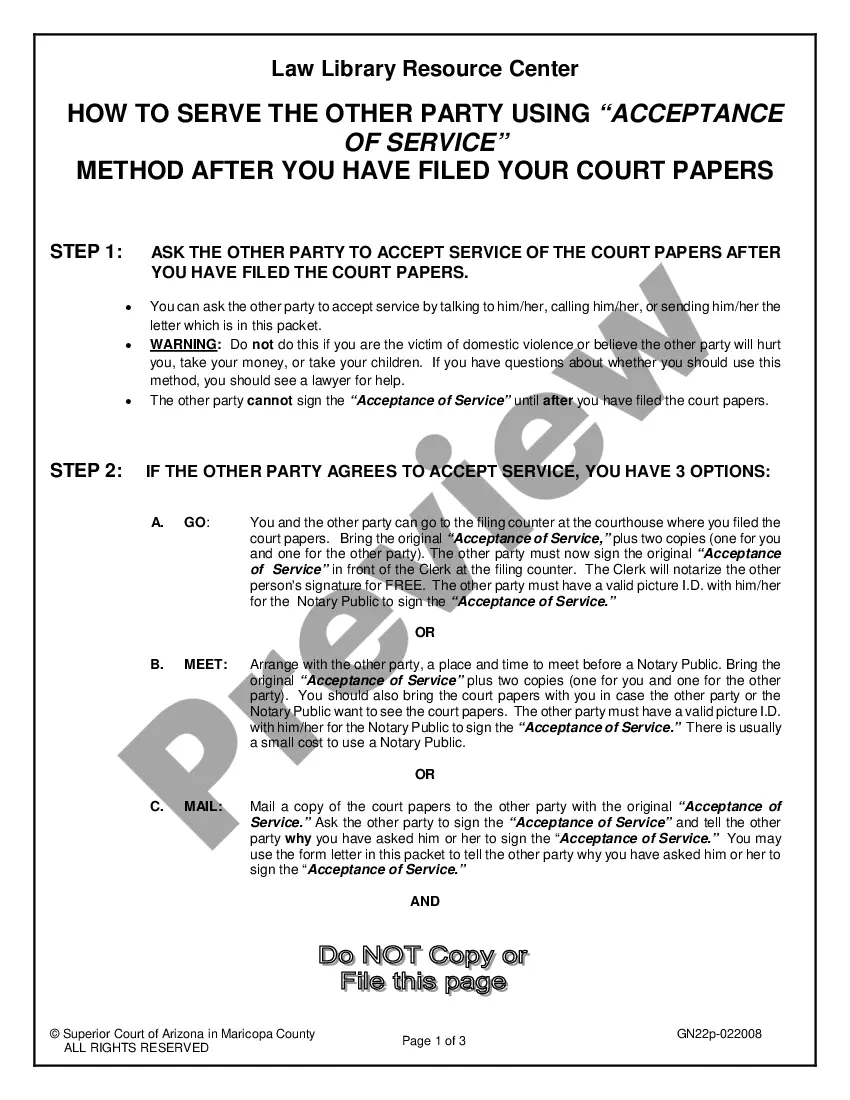
  • Preview Complaint to Quiet Title by Adverse Possessor with Unknown Defendants

Get your form ready online

Our built-in tools help you complete, sign, share, and store your documents in one place.

Built-in online Word editor

Make edits, fill in missing information, and update formatting in US Legal Forms—just like you would in MS Word.

Export easily

Download a copy, print it, send it by email, or mail it via USPS—whatever works best for your next step.

E-sign your document

Sign and collect signatures with our SignNow integration. Send to multiple recipients, set reminders, and more. Go Premium to unlock E-Sign.

Notarize online 24/7

If this form requires notarization, complete it online through a secure video call—no need to meet a notary in person or wait for an appointment.

Store your document securely

We protect your documents and personal data by following strict security and privacy standards.

Form selector

Make edits, fill in missing information, and update formatting in US Legal Forms—just like you would in MS Word.

Form selector

Download a copy, print it, send it by email, or mail it via USPS—whatever works best for your next step.

Form selector

Sign and collect signatures with our SignNow integration. Send to multiple recipients, set reminders, and more. Go Premium to unlock E-Sign.

Form selector

If this form requires notarization, complete it online through a secure video call—no need to meet a notary in person or wait for an appointment.

Form selector

We protect your documents and personal data by following strict security and privacy standards.

Looking for another form?

This field is required
Ohio
Select state

How to fill out Complaint To Quiet Title By Adverse Possessor With Unknown Defendants?

Drafting legal documents can be taxing. Additionally, if you opt to consult a lawyer to create a business contract, paperwork for asset transfer, prenuptial agreement, dissolution documents, or the Houston Complaint to Quiet Title by Adverse Possessor with Unknown Defendants, it could incur significant expenses.

So, what is the most sensible approach to conserve time and finances while producing valid forms fully compliant with your local and state regulations.

Avoid altering or discarding any HTML tags. Only substitute plain text outside of the HTML tags.

  1. US Legal Forms serves as an ideal resolution, whether you are seeking templates for personal or professional requirements.
  2. US Legal Forms constitutes the largest online repository of state-specific legal documents, offering users access to the latest and expertly verified templates for any application all gathered in a single location.
  3. Thus, if you require the latest iteration of the Houston Complaint to Quiet Title by Adverse Possessor with Unknown Defendants, you can swiftly find it on our site.
  4. Acquiring the documents typically demands minimal time.
  5. Existing account holders should verify the validity of their subscription, Log In, and choose the template by clicking on the Download button.
  6. If you are not yet subscribed, here's how to acquire the Houston Complaint to Quiet Title by Adverse Possessor with Unknown Defendants.
  7. 1. Browse the page and confirm a sample exists for your area.
  8. 2. Review the form description and utilize the Preview option, if it’s available, to ensure it is the template you require.
  9. 3. If the form does not meet your needs, search for the appropriate one in the header.
  10. 4. Click Buy Now upon finding the required sample and select the most suitable subscription.
  11. 5. Log In or create an account to process your subscription payment.
  12. 6. Complete payment via credit card or PayPal.
  13. 7. Choose the format for your Houston Complaint to Quiet Title by Adverse Possessor with Unknown Defendants and download it.
  14. 8. Once completed, you can either print it out and fill it in by hand or upload the template to an online editor for quicker and more convenient completion.
  15. US Legal Forms enables you to repeatedly use all documents you’ve obtained - you can access your templates in the My documents section in your profile.
  16. Give it a try now!

Form popularity

FAQ

The 3-year rule in Texas allows a person to claim ownership of real property if they have been in continuous possession of that property for three years without the permission of the true owner. This rule applies mainly to certain scenarios, such as when there is a recorded deed or when the rightful owner is not actively using the property. If you're navigating a complex situation involving a Houston Texas Complaint to Quiet Title by Adverse Possessor with Unknown Defendants, understanding this rule can be crucial to your case.

To prove adverse possession in Texas, you must demonstrate seven crucial elements: actual possession, open and notorious use, exclusive possession, adverse use, continuous use for the required period, and claim of right. This proof helps establish your legal claim when filing a Houston Texas Complaint to Quiet Title by Adverse Possessor with Unknown Defendants. Gathering proper documentation and evidence is vital, and platforms like US Legal Forms can offer valuable resources and templates tailored to your specific needs.

In Texas, the duration for acquiring real property by adverse possession typically spans a minimum of 10 years, provided that the possessor has continuously occupied the property in a manner that is open and notorious. For certain types of claims, such as when the property is under a recorded deed, the term may shorten to just three years. Therefore, if you are considering a Houston Texas Complaint to Quiet Title by Adverse Possessor with Unknown Defendants, it is essential to understand these timelines and prepare accordingly.

To file a Houston Texas Complaint to Quiet Title by Adverse Possessor with Unknown Defendants, you first need to gather documentation proving your possession of the property. After that, you can prepare your complaint, detailing your claim and the parties involved. Next, file the complaint in the appropriate Texas court and serve it to all involved parties. Consider using the UsLegalForms platform to obtain the necessary forms and guidance for your specific situation.

An example of a quiet title action might involve an individual who has lived on a property for several years without formal ownership records. They might file a Houston Texas Complaint to Quiet Title by Adverse Possessor with Unknown Defendants to claim legal ownership against any potential unknown heirs or parties that could dispute their claim. This legal action seeks to eliminate any uncertainty regarding ownership, allowing the claimant to obtain a clear title. This process reinforces their rights and can eliminate future disputes.

Filing a quiet title action on your own is possible, but it often involves navigating a complex legal landscape. In a Houston Texas Complaint to Quiet Title by Adverse Possessor with Unknown Defendants, you need to draft accurate pleadings and comply with various procedural rules. While self-filing can save costs, utilizing platforms like USLegalForms can simplify the process, offering ready-to-use templates that ensure all necessary details are included in your filing.

In Texas, the five requirements for claiming adverse possession include actual possession, exclusive possession, open and notorious usage, adverse and under claim of right, and continuous possession for a specified duration, typically 10 years. These elements must be clearly established in a Houston Texas Complaint to Quiet Title by Adverse Possessor with Unknown Defendants. Understanding these requirements can guide you in collecting the right evidence to support your claim. Addressing each element thoughtfully can significantly impact the outcome of your case.

Yes, you can initiate a quiet title action yourself, but it requires careful consideration and understanding of legal procedures. In a Houston Texas Complaint to Quiet Title by Adverse Possessor with Unknown Defendants, you must accurately file the necessary documents and comply with court requirements. If your situation involves complexity or if unknown defendants are involved, using resources like USLegalForms can provide templates and guidance to help ensure that you follow the correct process.

In a Houston Texas Complaint to Quiet Title by Adverse Possessor with Unknown Defendants, the burden of proof lies with the party seeking the quiet title. This party must prove their claim to the property by presenting evidence that supports their legal right to ownership. Typically, this involves showing continuous possession and other relevant factors that establish their case. Strong documentation and a clear presentation of facts can significantly strengthen your position.

Filing a quiet title action in Texas involves several steps. First, prepare the necessary documents, including your own Houston Texas Complaint to Quiet Title by Adverse Possessor with Unknown Defendants. Next, file the complaint with the appropriate court and serve it to all concerned parties. Consulting with a knowledgeable attorney can streamline this process and ensure that you meet all legal requirements efficiently.

Interesting Questions

Trusted and secure by over 3 million people of the world’s leading companies

Houston Texas Complaint to Quiet Title by Adverse Possessor with Unknown Defendants