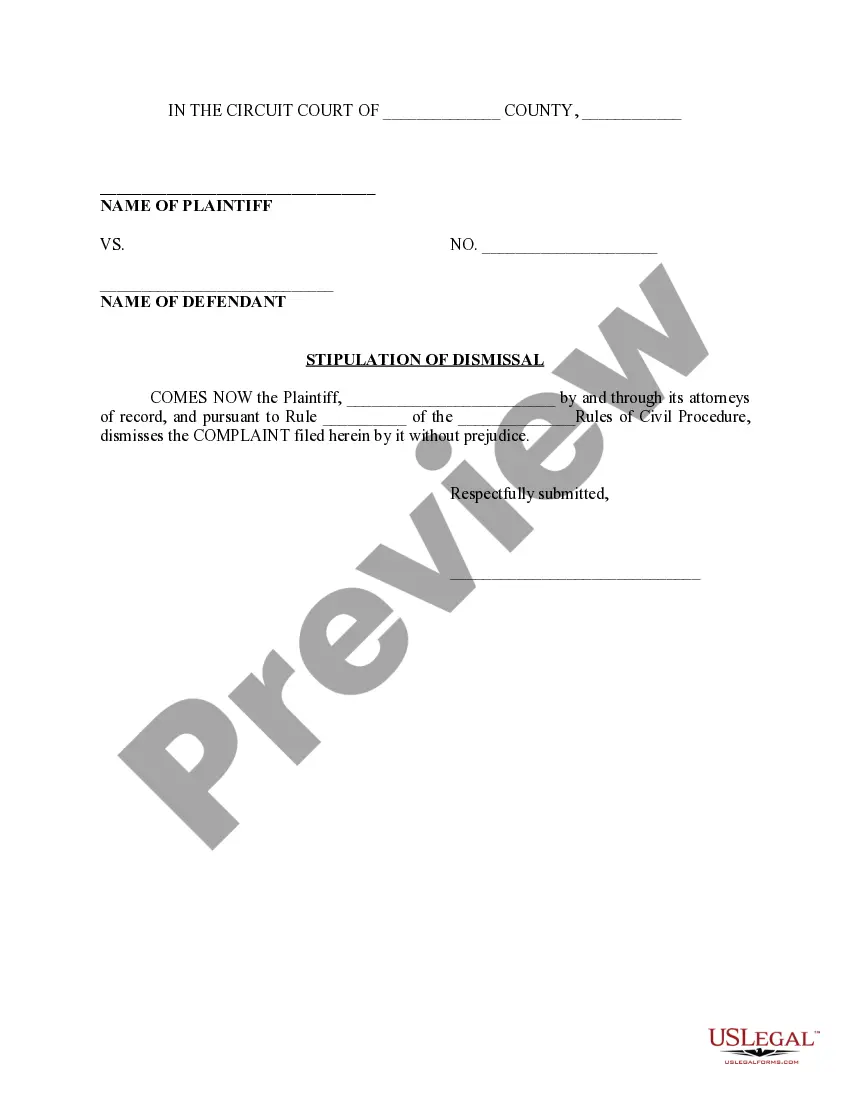
Orange Florida Stipulation for Dismissal
Description





How to fill out Stipulation For Dismissal?
If you need to discover a dependable legal document provider to obtain the Orange Stipulation for Dismissal, look no further than US Legal Forms. Whether you are looking to launch your LLC business or manage the distribution of your assets, we have you covered. You don't need to be well-versed in the law to find and download the necessary form.
You can simply enter a search for or navigate to the Orange Stipulation for Dismissal, either by a keyword or by the state/county for which the form was created.
After locating the required form, you can Log In and download it or keep it in the My documents section.
Don't have an account? It's simple to get started! Just find the Orange Stipulation for Dismissal template and view the form's preview and description (if available). If you're satisfied with the template’s wording, proceed and click Buy now. Create an account and select a subscription plan. The template will be instantly available for download once the payment is processed. Now you can complete the form.
Managing your law-related matters doesn’t have to be costly or time-consuming. US Legal Forms is here to show you it can be different. Our vast collection of legal documents makes this process more affordable and accessible. Launch your first company, organize your advance care planning, draft a real estate contract, or finish the Orange Stipulation for Dismissal - all from the comfort of your couch. Sign up for US Legal Forms today!
- You can explore over 85,000 forms organized by state/county and case.
- The user-friendly interface, wealth of resources, and dedicated assistance make it easy to obtain and complete various documents.
- US Legal Forms has been a trustworthy service delivering legal forms to millions of users since 1997.
Form popularity
FAQ
A stipulation of dismissal is a legal agreement between the parties to voluntarily dismiss a case. This agreement often resolves the dispute without requiring a trial. Once both parties sign the stipulation, the court will dismiss the case as agreed. If you're navigating this process, uslegalforms can provide templates that streamline the Orange Florida Stipulation for Dismissal.
(b) An action may be dismissed in any of the following instances: (1) With or without prejudice, upon written request of the plaintiff to the clerk, filed with papers in the case, or by oral or written request to the court at any time before the actual commencement of trial, upon payment of the costs, if any.
One option is to request that the case be dismissed, known as a request for dismissal. This term is essentially asking the court to terminate or dismiss your case. In some cases, a plaintiff might request for a case to be dismissed. There are a few reasons why they might do this. The debt was settled out of court.
To sustain the original complaint, the plaintiff is obliged to respond to a Motion to Dismiss. Carefully Read the Motion to Dismiss.Draft a Response to the Motion to Dismiss.Try to Show the Jurisdiction is Proper.Cite the Laws That Support Your Claim to Relief.Prove That the Venue is Proper.
Primary tabs. When a court dismisses an action, they can either do so with prejudice or without prejudice. Dismissal with prejudice means that the plaintiff cannot refile the same claim again in that court.
A judge may dismiss a case without prejudice in order to allow for errors in the case presented to be addressed before it is brought back to court. A judge will dismiss a case with prejudice if he or she finds reason why the case should not move forward and should be permanently closed.
A case dismissed with prejudice is over and done with, once and for all, and can't be brought back to court. A case dismissed without prejudice means the opposite. It's not dismissed forever. The person whose case it is can try again.
(b) Dismissal of case If the plaintiff or other party required to serve and file the request for dismissal does not do so, the court must dismiss the entire case 45 days after it receives notice of settlement unless good cause is shown why the case should not be dismissed.
The termination of a civil action at the motion of the defendant.
How do you get a stipulated dismissal? A stipulated dismissal is always a voluntary agreement between the parties. After the court makes a determination of how much the defendant should pay, the parties can enter into the agreement and have it entered as an order by the judge.