Franklin Ohio Testamentary Trust Provision with Stock to Held in Trust for Grandchild and no Distributions to be Made until a Certain Age is Reached

State:
Multi-State
County:
Franklin
Control #:
US-01481BG
Format:
Word; 
Rich Text
Instant download

Description

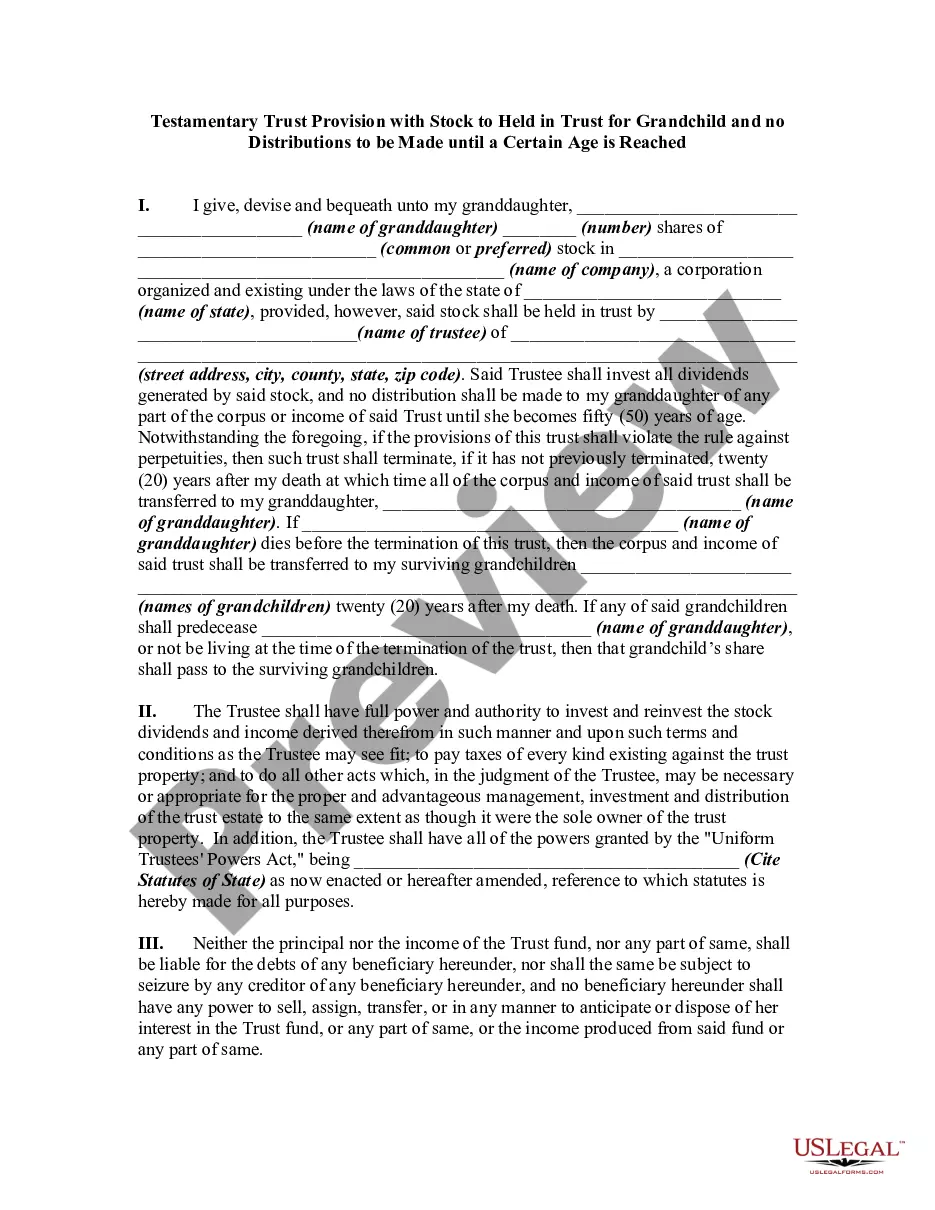
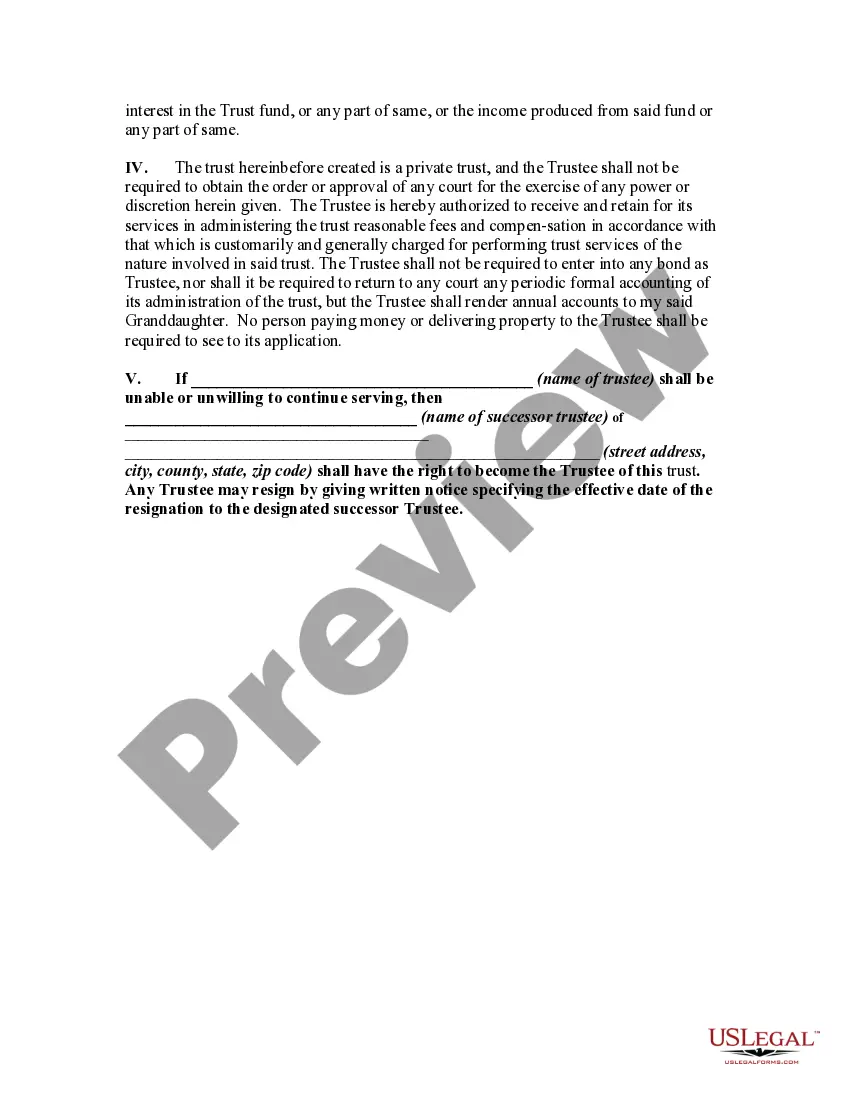
A testamentary trust is a trust in which the trust property is bequeathed or devised by will to the trustee for the benefit of the beneficiaries. Statutes in effect in the various jurisdictions prescribe certain formalities which must be observed in connection with the execution of a will in order to give validity to the instrument and make it eligible to be probated. A valid testamentary trust is created only when the will attempting to create it complies with the formalities of the state's statutes covering wills. An instrument will be denied probate where it fails to conform at least substantially to the controlling statutory provisions governing the execution of wills.


This form is a generic example that may be referred to when preparing such a form for your particular state. It is for illustrative purposes only. Local laws should be consulted to determine any specific requirements for such a form in a particular jurisdiction.
Free preview
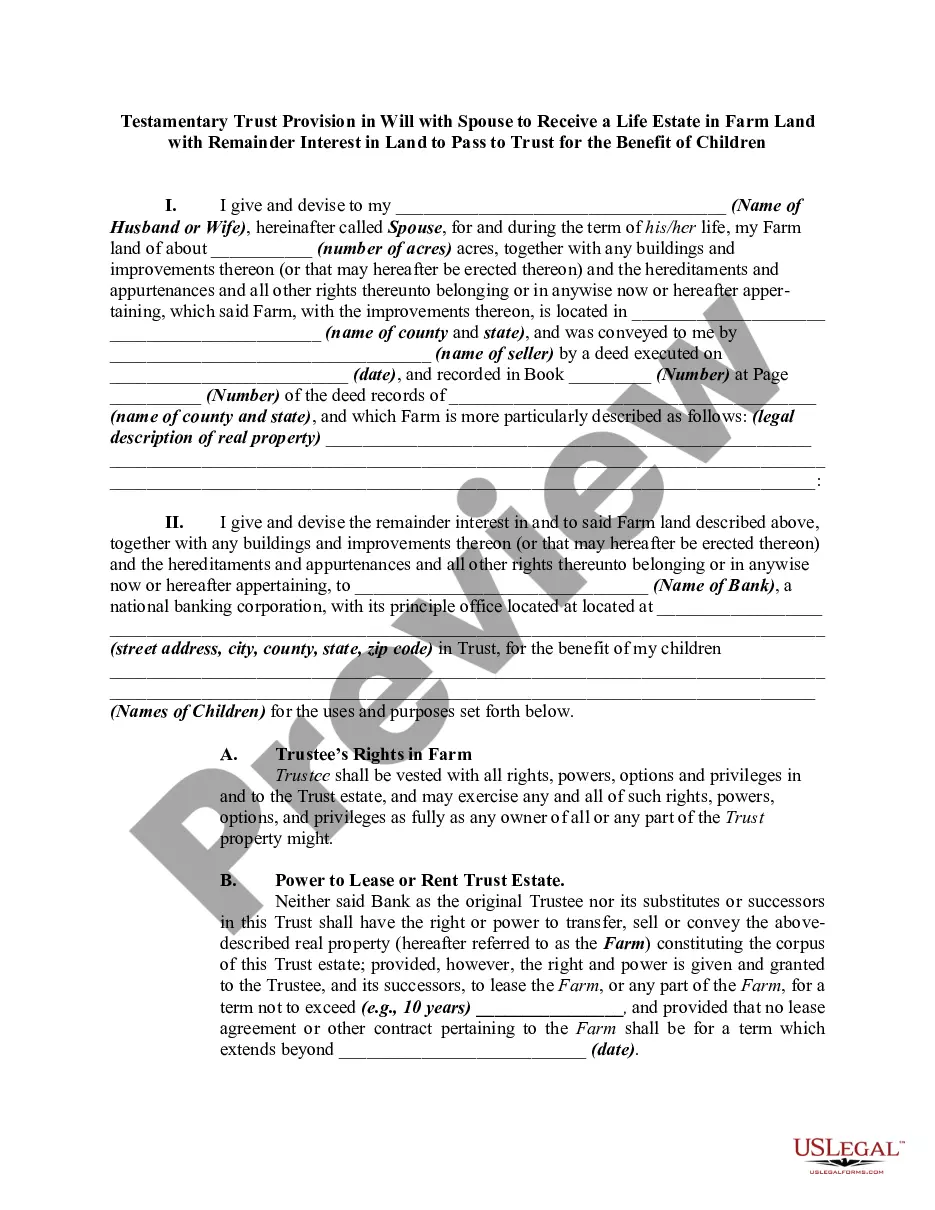
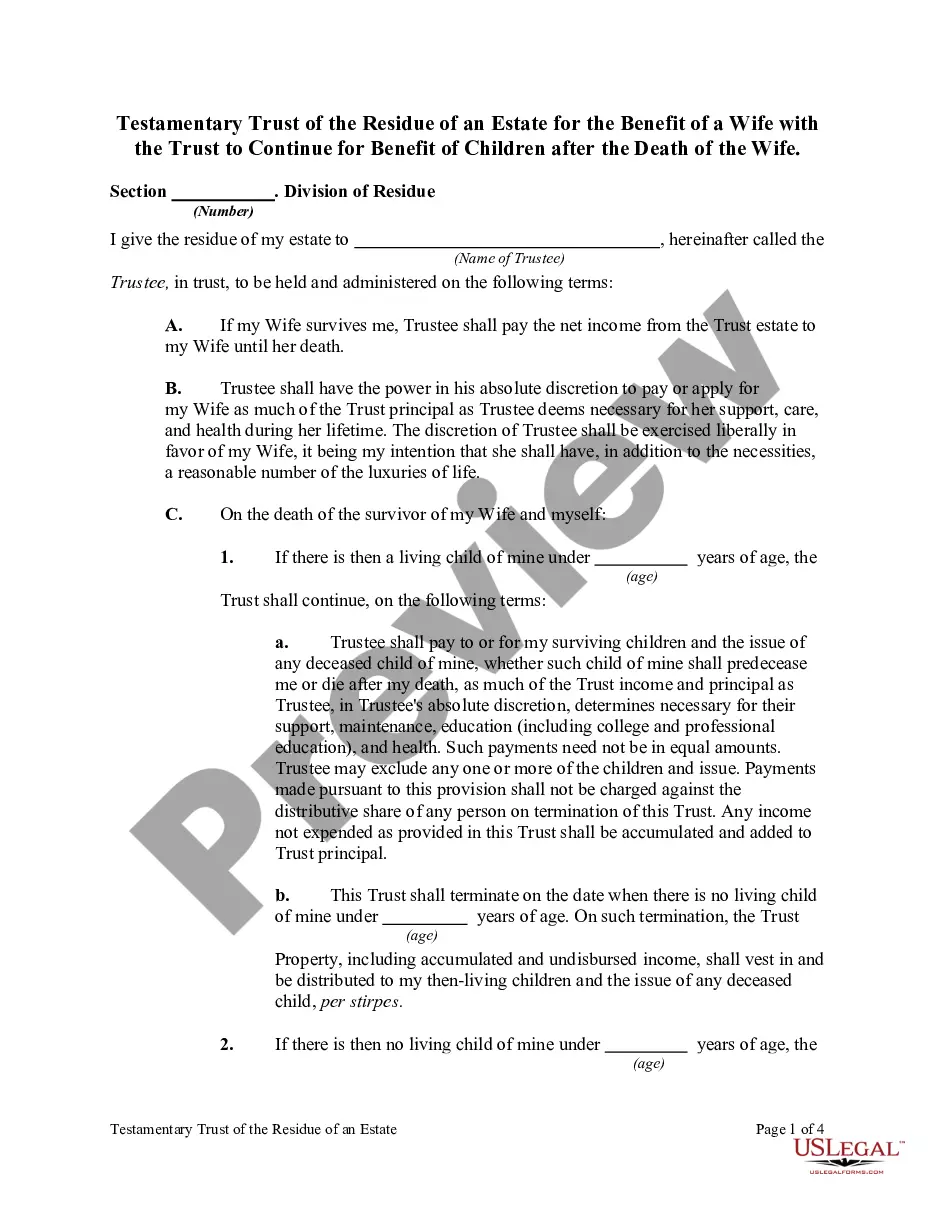
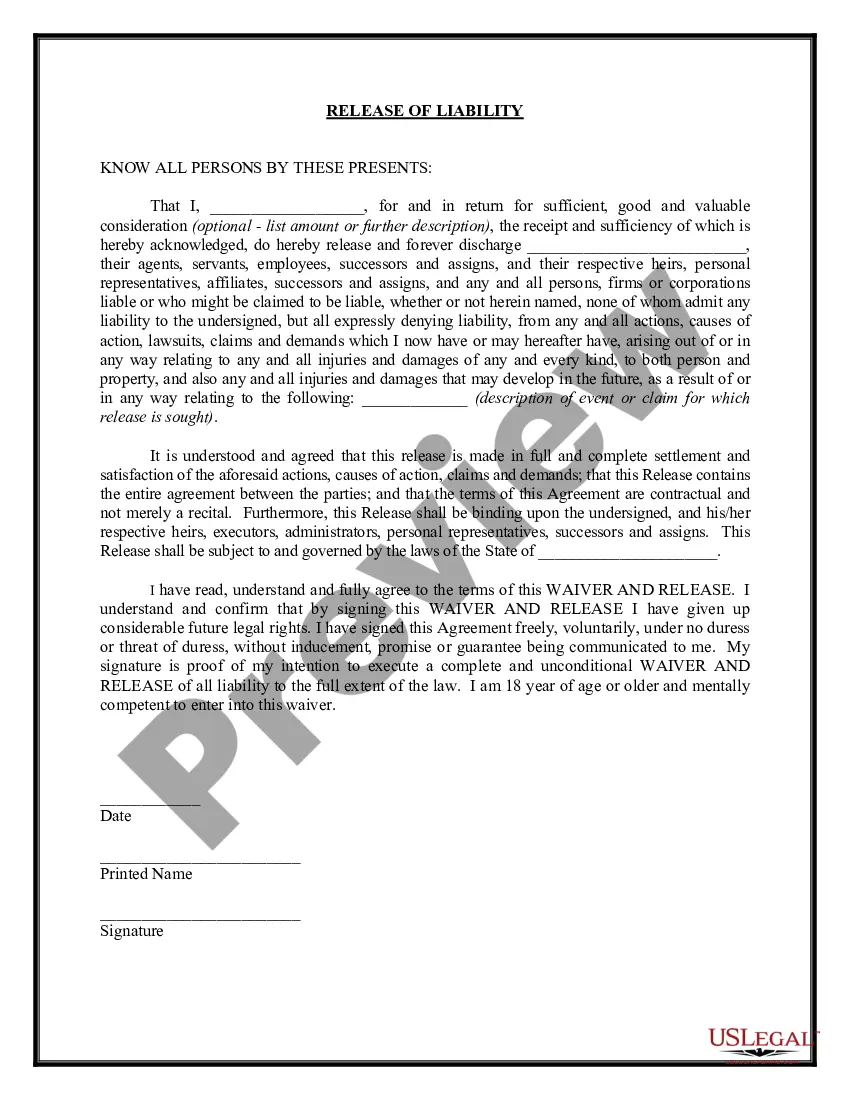
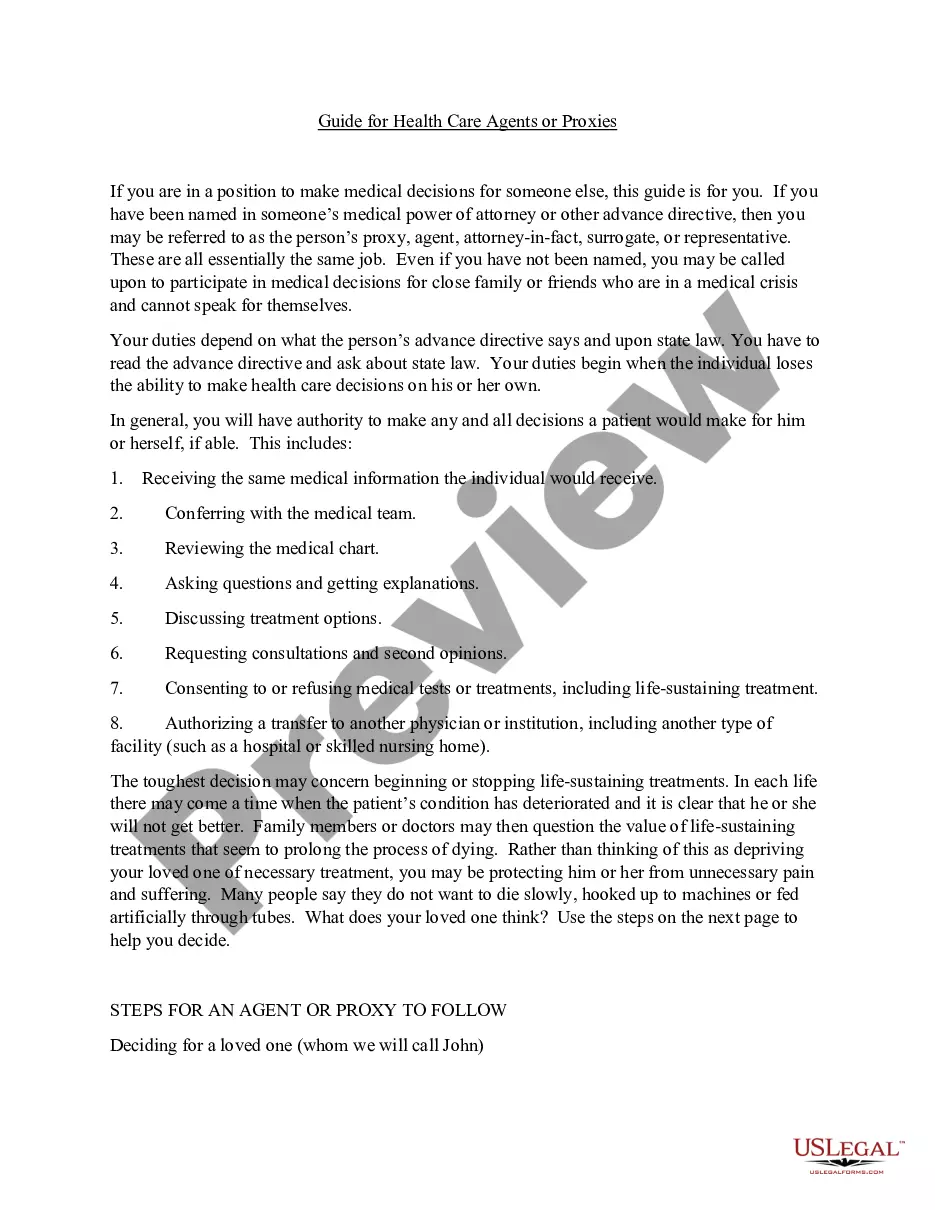
  • Preview Testamentary Trust Provision with Stock to Held in Trust for Grandchild and no Distributions to be Made until a Certain Age is Reached
  • Preview Testamentary Trust Provision with Stock to Held in Trust for Grandchild and no Distributions to be Made until a Certain Age is Reached

How to fill out Testamentary Trust Provision With Stock To Held In Trust For Grandchild And No Distributions To Be Made Until A Certain Age Is Reached?

Drafting legal paperwork can be challenging.

Moreover, if you choose to engage an attorney to create a business agreement, documents for ownership transfer, pre-nuptial contract, divorce documents, or the Franklin Testamentary Trust Provision with Stock to be Held in Trust for Grandchild and no Distributions to be Made until a Specific Age is Achieved, it might cost you a significant amount.

Browse the page and ensure there is a sample for your locality.

  1. How can you effectively save both time and money while creating valid documents that fully comply with your state and local laws.
  2. US Legal Forms offers an excellent resolution, regardless of whether you're in need of templates for personal or commercial purposes.
  3. US Legal Forms is the largest online collection of state-specific legal forms, supplying users with recent and professionally validated documents for any situation gathered in one location.
  4. Thus, if you are seeking the latest version of the Franklin Testamentary Trust Provision with Stock to be Held in Trust for Grandchild and no Distributions to be Made until a Specific Age is Achieved, you can conveniently locate it on our site.
  5. Fetching the documents takes only a short amount of time.
  6. Users with an existing account should confirm that their subscription is active, Log In, and choose the sample using the Download button.
  7. If you haven't yet registered, here's how to acquire the Franklin Testamentary Trust Provision with Stock to be Held in Trust for Grandchild and no Distributions to be Made until a Specific Age is Achieved.

Form popularity

FAQ

Taxation of Testamentary Trusts Once a testamentary trust has been created, it becomes a taxable entity in its own right and is thus subject to income taxes. If it has $600 or more in annual income, it must file a U.S. Income Tax Return for Estates and Trusts (Form 1041) for that year.

A Bare Trust can also be used to gift money into Trust for grandchildren. The gift into a Bare Trust is classed as a Potentially Exempt Transfer rather than a 'Chargeable Lifetime Transfer' as with Discretionary Trusts.

When can your child use his or her trust? Generally, a child can access their trust at the age of eighteen. It is sometimes possible to create different age restrictions, but the default is that a child can use their trust once they've become a legal adult.

Income Tax Perks: Testamentary Trusts do not require beneficiaries to pay taxes on income distributed from the trust. There are, however, income taxes to consider on undistributed income. No Limit On Beneficiaries: There is not a limit to the number of acceptable beneficiaries when creating Testamentary Trusts.

A beneficiary of a bare trust is entitled to take control of the trust assets (or their share of them) at 18. Many 18-year olds are happy to leave the assets with the trustees and follow their advice on how best to use the income and capital.

In a trust, assets are held and managed by one person or people (the trustee) to benefit another person or people (the beneficiary). The person providing the assets is called the settlor. Different kinds of assets can be put in trust, including: cash. property.

A bare trust holding very valuable assets isn't a good choice for a child with limited life expectancy. The value of the trust assets is included in their estate, so if the child dies young and is intestate (which is most likely), there's the potential for a substantial inheritance tax charge.

Generally, testamentary trusts are created for young children, relatives with disabilities, or others who may inherit a large sum of money that enters the estate upon the testator's death.

Some possible disadvantages are: There is no actual benefit for you, the will maker, although there may be benefits for your beneficiaries. Cost testamentary trusts are often more complex, they generally cost more to produce and they generally involve ongoing accountancy and other fees during their operation.

Testamentary trusts can be helpful as a part of an overall wealth management strategy since they provide instructions for distributing the assets within a decedent's estate.

Trusted and secure by over 3 million people of the world’s leading companies

Franklin Ohio Testamentary Trust Provision with Stock to Held in Trust for Grandchild and no Distributions to be Made until a Certain Age is Reached