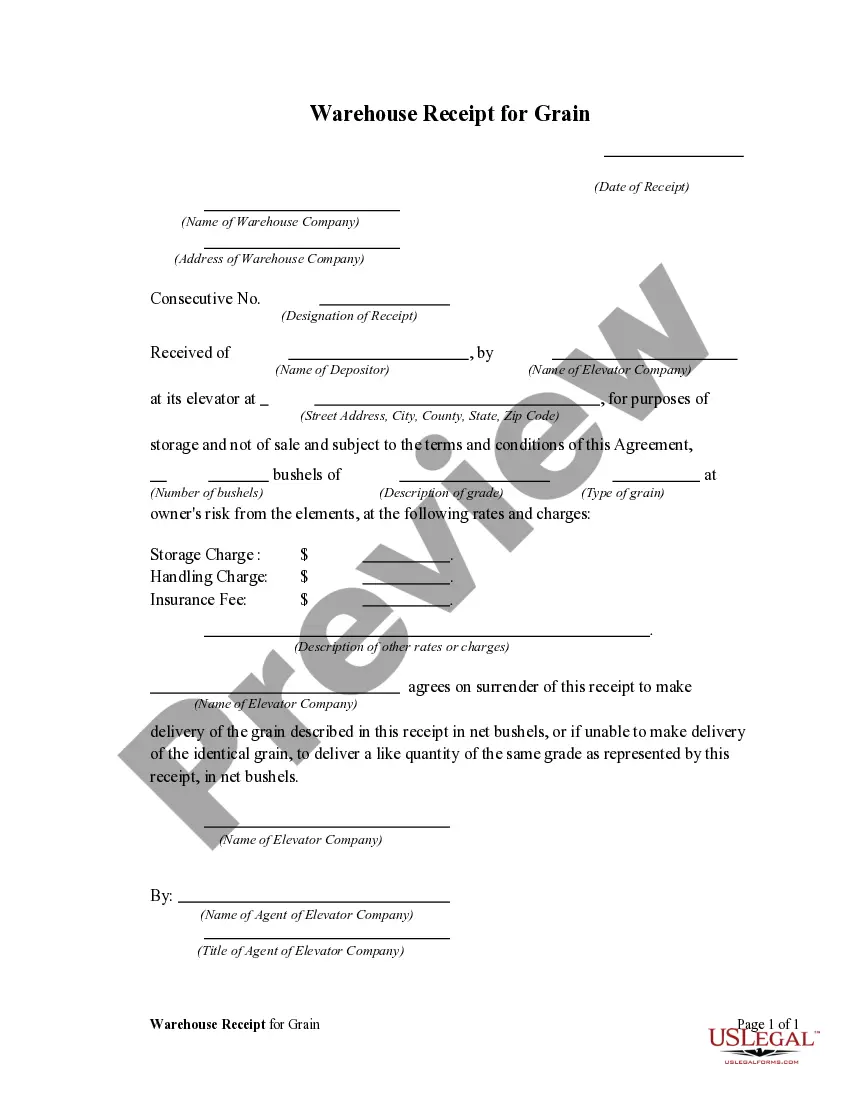
A warehouse receipt is a document that provides proof of ownership of commodities (e.g., bars of copper) that are stored in a warehouse, vault, or depository for safekeeping.
Warehouse receipts may be negotiable or non-negotiable. Negotiable warehouse receipts allow transfer of ownership of that commodity without having to deliver the physical commodity.
Most warehouse receipts are issued in negotiable form, making them eligible as collateral for loans. Non-negotiable receipts must be endorsed upon transfer.
In the United States, warehouse receipts are generally regulated by Article 7 of the Uniform Commercial Code as adopted by the various jurisdictions.
Omaha Nebraska Warehouse Receipt for Grain
State:
Multi-State
City:
Omaha
Control #:
US-0089BG
Format:
Word;
Rich Text
Instant download
Description




Form popularity
FAQ
Omaha Is the Steak Capital of Nebraska The state of Nebraska is known for its beef, and is even nicknamed the "Beef State." Omaha is Nebraska's steak capital, as it's home to one of the country's largest producers of beef, Omaha Steaks.
Prostitution was a major component of the city's flourishing vice industry during the late 1800s and early 1900s, when Omaha was known as a ?dirty wicked town.? Today's Wilson and Washburn Bar downtown is named for its two leading madams.
Omaha is Nebraska's biggest city and a regional manufacturing, transportation, trade, and service hub. From the 1890s through the mid-20th century Omaha emerged as one of the top livestock markets in the world and a leader in the meat-processing industry.
Presently, Omaha is the home to the headquarters of four Fortune 500 companies: conglomerate Berkshire Hathaway; one of the world's largest construction companies, Kiewit Corporation; insurance and financial firm Mutual of Omaha; and the United States' largest railroad operator, Union Pacific Corporation.
Steak. Omaha is known around the country as one of the best sources for steak. This is mostly due to the fact that beef is Nebraska's single largest industry, and Omaha has been the country's meatpacking center since the 1950s.
The cost of living in Omaha, NE is 3% higher than the state average and 7% lower than the national average. Omaha, NE housing is 15% cheaper than the U.S average, while utilities are about 5% less pricey.