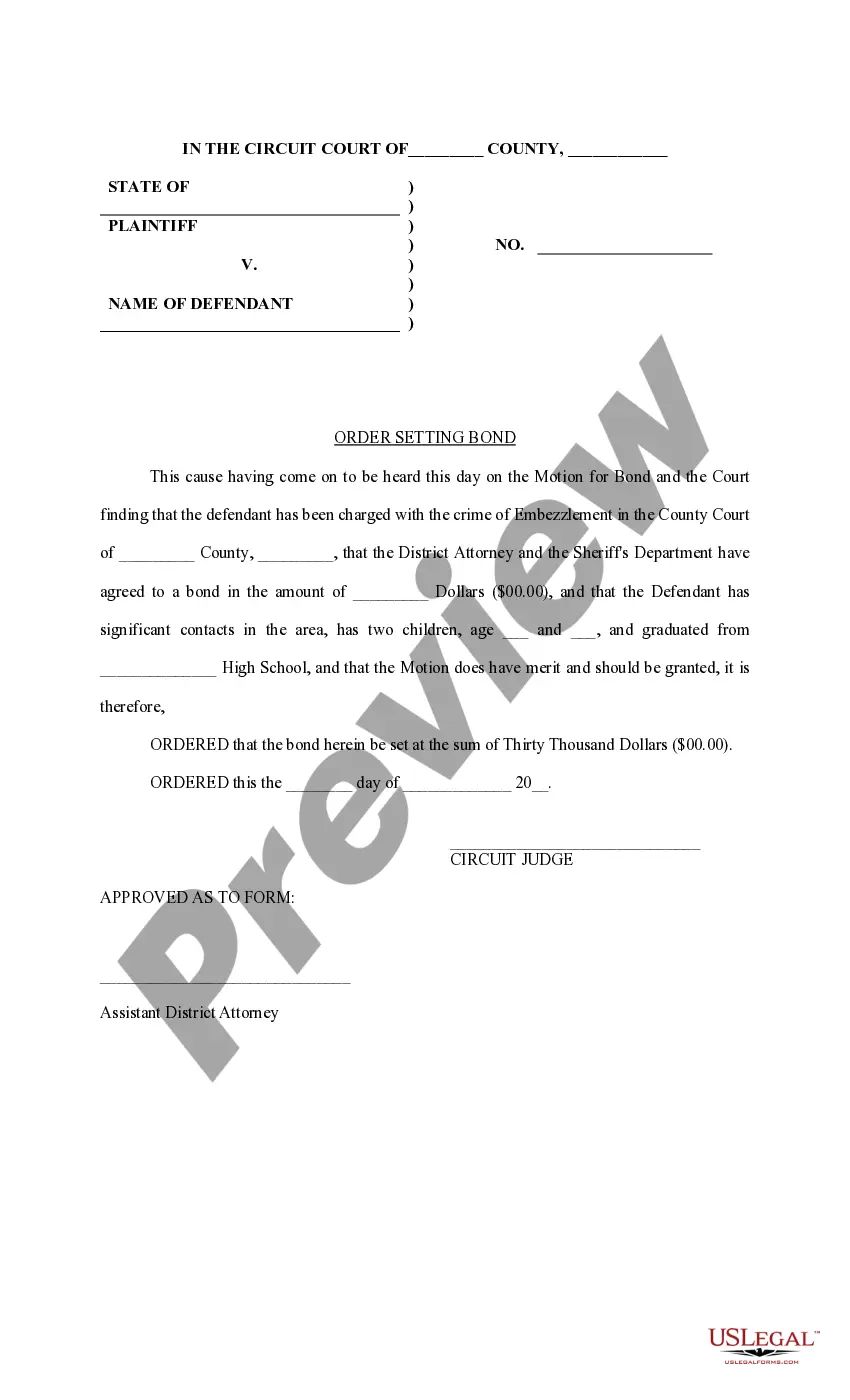
Dallas Texas Order Setting Bond
Description
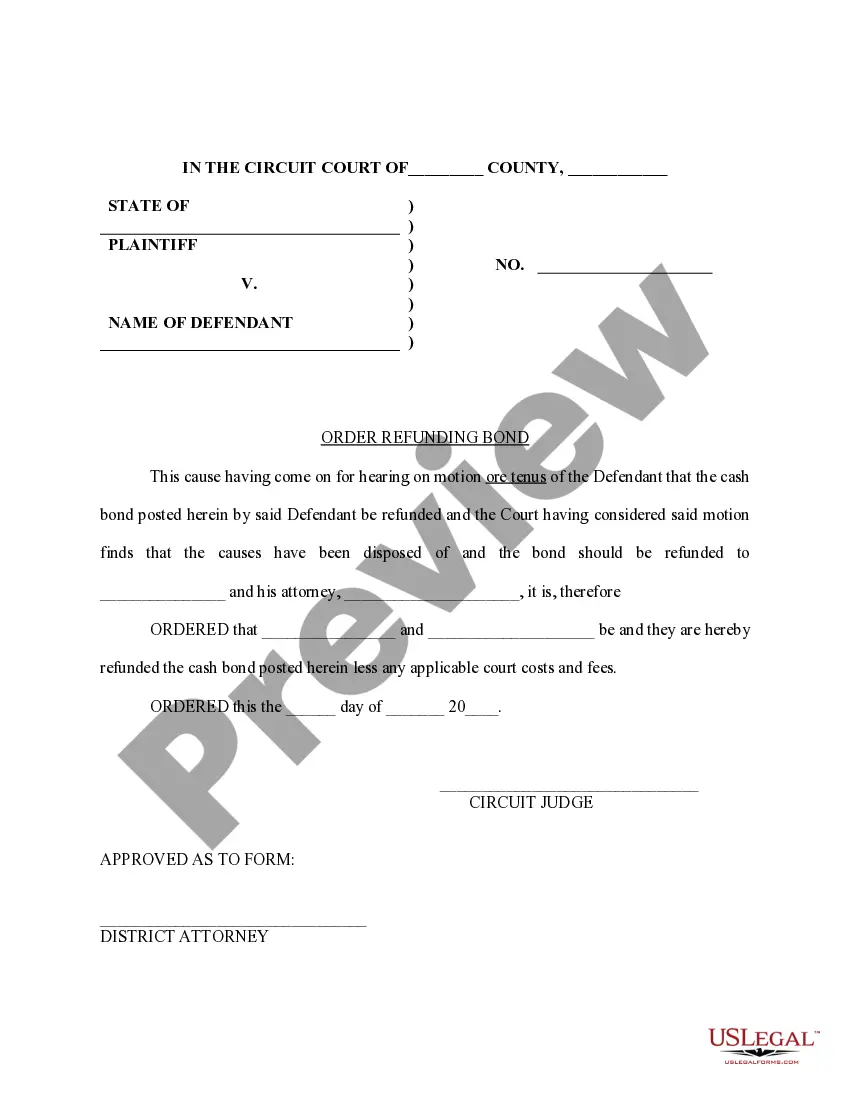
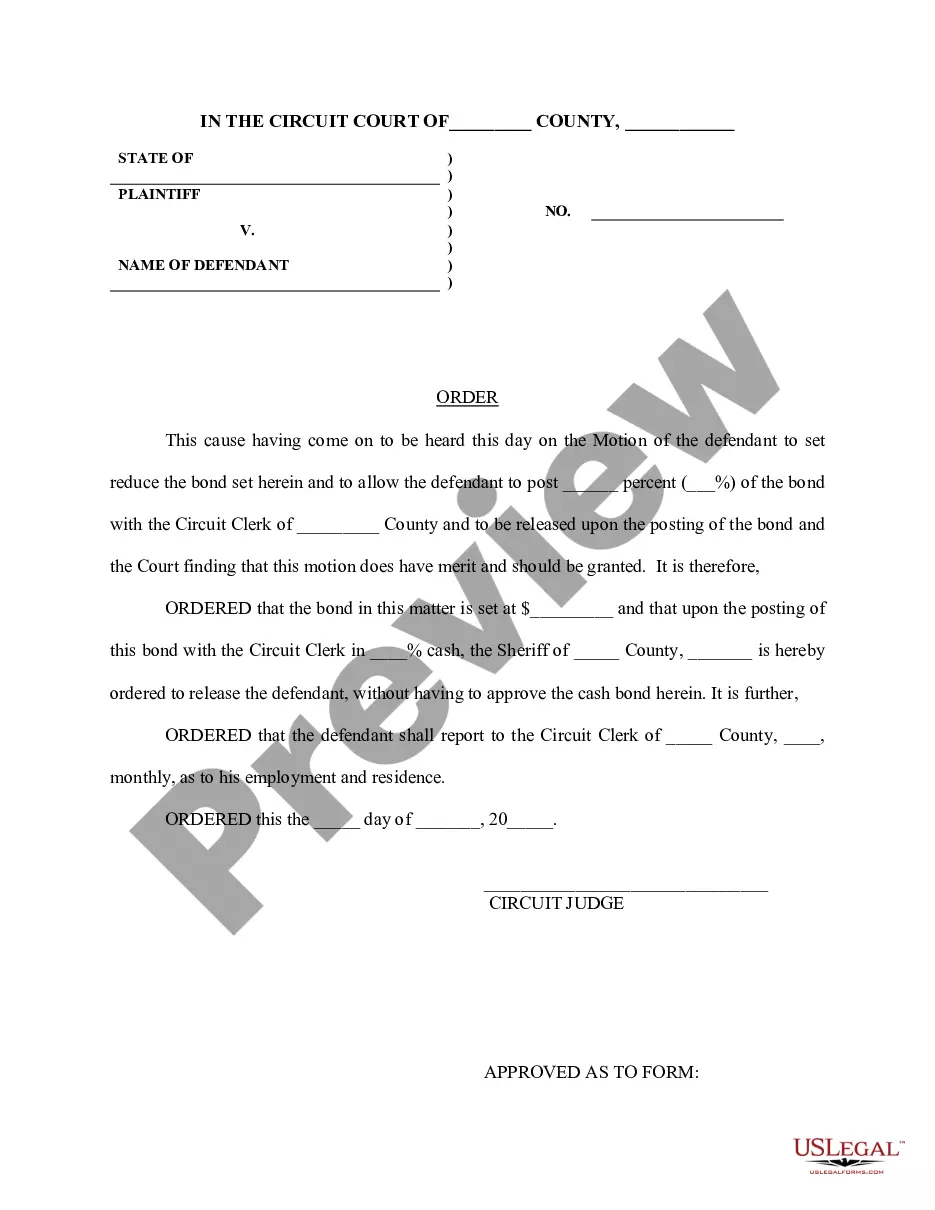
Get your form ready online
Our built-in tools help you complete, sign, share, and store your documents in one place.
Make edits, fill in missing information, and update formatting in US Legal Forms—just like you would in MS Word.
Download a copy, print it, send it by email, or mail it via USPS—whatever works best for your next step.
Sign and collect signatures with our SignNow integration. Send to multiple recipients, set reminders, and more. Go Premium to unlock E-Sign.
If this form requires notarization, complete it online through a secure video call—no need to meet a notary in person or wait for an appointment.
We protect your documents and personal data by following strict security and privacy standards.

Make edits, fill in missing information, and update formatting in US Legal Forms—just like you would in MS Word.

Download a copy, print it, send it by email, or mail it via USPS—whatever works best for your next step.

Sign and collect signatures with our SignNow integration. Send to multiple recipients, set reminders, and more. Go Premium to unlock E-Sign.

If this form requires notarization, complete it online through a secure video call—no need to meet a notary in person or wait for an appointment.

We protect your documents and personal data by following strict security and privacy standards.
Looking for another form?




How to fill out Order Setting Bond?
Drafting legal paperwork can be challenging. Furthermore, if you opt to hire a lawyer to create a business agreement, documents for title transfer, prenuptial contract, divorce filings, or the Dallas Order Setting Bond, it could be quite expensive.
So, what is the most effective way to conserve time and funds while preparing legitimate documents fully compliant with your state and local regulations? US Legal Forms is an outstanding option, whether you need templates for individual or commercial purposes.
Don't stress if the form doesn't meet your needs - search for the correct one in the header. Click Buy Now when you locate the necessary sample and select the most appropriate subscription. Log In or register for an account to complete your subscription payment. Make a payment using a credit card or via PayPal. Choose the document format for your Dallas Order Setting Bond and save it. Once completed, you can either print it out and fill it out by hand or import the documents into an online editor for a quicker and more convenient completion. US Legal Forms permits you to utilize all previously acquired documents on multiple occasions - you can access your templates in the My documents section of your profile. Give it a shot today!
- US Legal Forms boasts the largest online collection of state-specific legal documents, offering users the latest and professionally verified forms for any situation, all consolidated in one location.
- Thus, if you require the latest version of the Dallas Order Setting Bond, you can conveniently find it on our website.
- Acquiring the documents takes minimal time.
- Those who already possess an account should confirm their subscription is active, Log In, and choose the template by clicking the Download button.
- If you have not subscribed yet, here's how to obtain the Dallas Order Setting Bond.
- Browse through the page and confirm that a sample exists for your region.
- Review the form description and utilize the Preview option when available to ensure it is the document you require.
Form popularity
FAQ
This story is part of "Bonding Out," an investigative series on crime in Harris County. You can read the first in the series here. What happens in probable cause court sets the pace of a criminal case, with Harris County magistrates setting bonds for dozens of defendants in one sitting.
The police can hold you in jail if you don't post bonds for a long span of time, up to 90 days (3 months) or until your court hearing is completed. You will remain in prison and be detained for as long as your trial is in the process.
According to Texas Code of Criminal Procedure §17.151, the state must either release you on a personal bond or reduce your bail if it is not ready to proceed to trial in a specified length of time. You must have a bond set or have your bail amount reduced if you have been held for: 90 days if accused of a felony.
A bail bond is entered into either before a magistrate, upon an examination of a criminal accusation, or before a judge upon an application under habeas corpus; or it is taken from the defendant by a peace officer or jailer if authorized by Article 17.20, 17.21, or 17.22.
A bail bond is an agreement by a criminal defendant to appear for trial or pay a sum of money set by the court. The bail bond is cosigned by a bail bondsman, who charges the defendant a fee in return for guaranteeing the payment.
Texas bail bonds laws are not so different when compared to other states. When charged with a crime in Texas, the court arrests the accused, books the trial date and the judge sets the bail amount. The defendant can either choose to stay in custody until the day of trial or post bail.
The District Attorney's Office would accept charges and set a recommended bail amount according to a written bail schedule. The bail schedule, which was written by the judges, set recommended bail amounts based almost entirely on the level of misdemeanor or felony the person was charged with and the person's criminal
When you are taken into custody, the police can legally hold you for up to 72 hours without filing charges.
Judge Discretion It is very much within the decision of the judge to decide the amount of bail set in your case, within range. In Texas, bail bonds are set at lower rates in the $1,000-$3,500 for misdemeanors or less serious crimes.