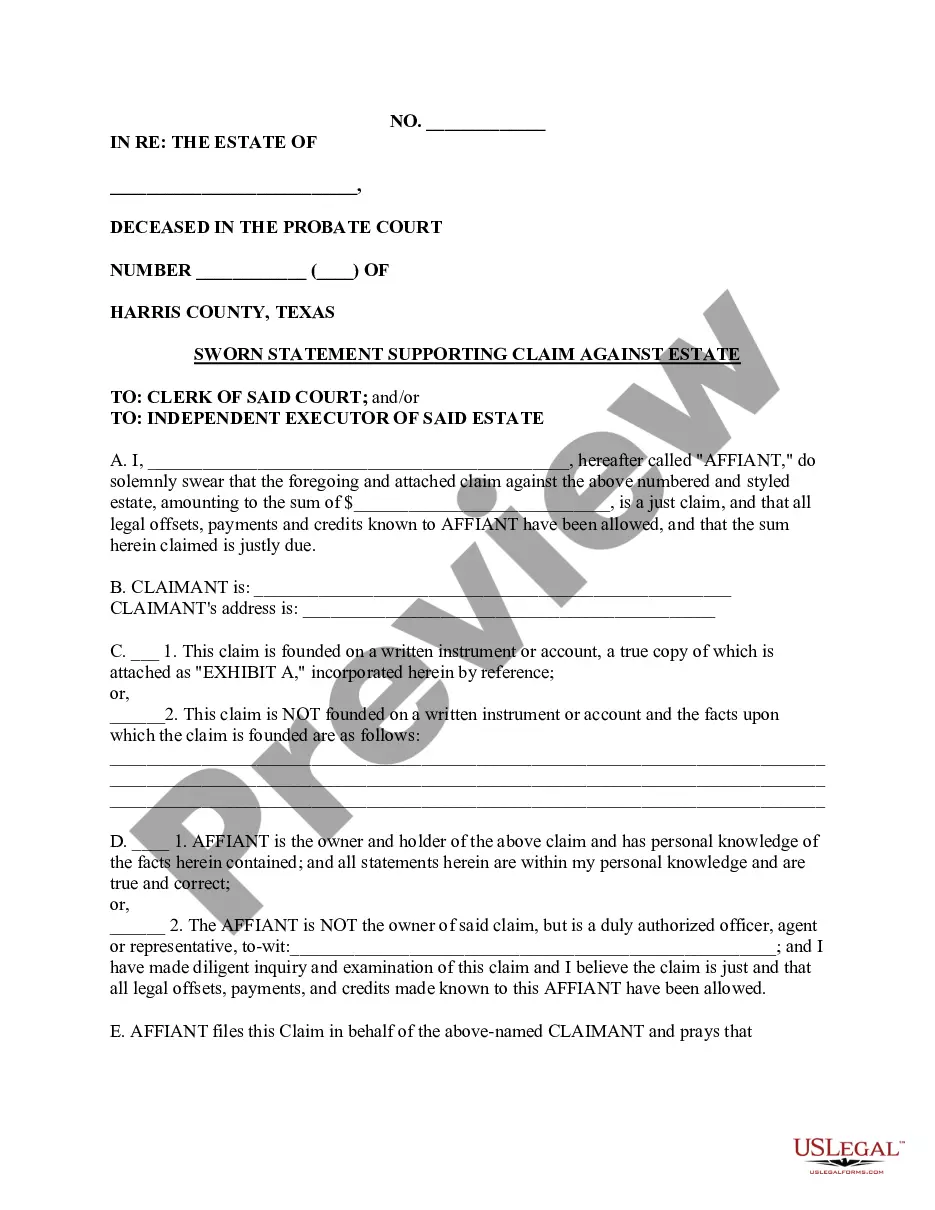
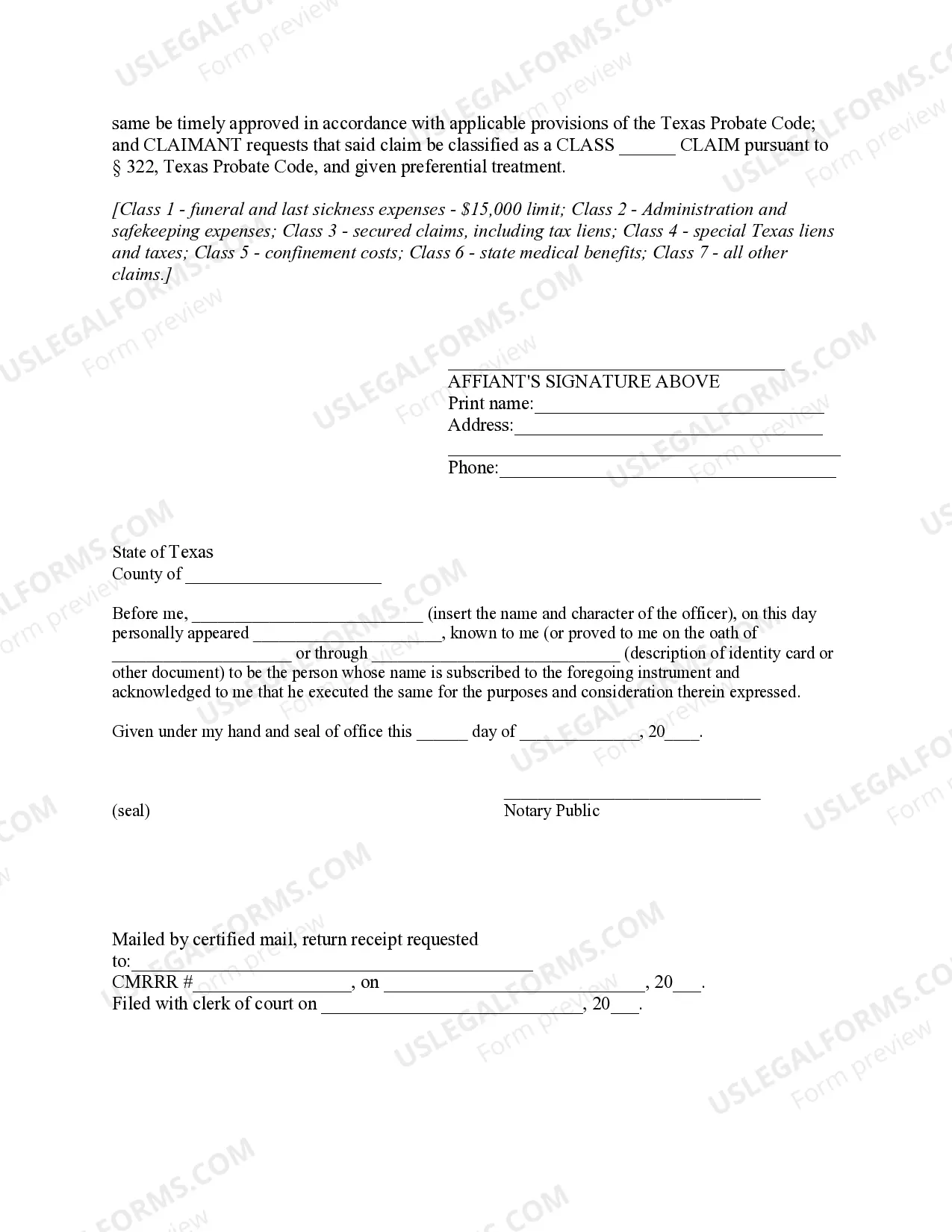
Collin Texas Sworn Statement Supporting Claim Against Estate
Description

Get your form ready online
Our built-in tools help you complete, sign, share, and store your documents in one place.
Make edits, fill in missing information, and update formatting in US Legal Forms—just like you would in MS Word.
Download a copy, print it, send it by email, or mail it via USPS—whatever works best for your next step.
Sign and collect signatures with our SignNow integration. Send to multiple recipients, set reminders, and more. Go Premium to unlock E-Sign.
If this form requires notarization, complete it online through a secure video call—no need to meet a notary in person or wait for an appointment.
We protect your documents and personal data by following strict security and privacy standards.

Make edits, fill in missing information, and update formatting in US Legal Forms—just like you would in MS Word.

Download a copy, print it, send it by email, or mail it via USPS—whatever works best for your next step.

Sign and collect signatures with our SignNow integration. Send to multiple recipients, set reminders, and more. Go Premium to unlock E-Sign.

If this form requires notarization, complete it online through a secure video call—no need to meet a notary in person or wait for an appointment.

We protect your documents and personal data by following strict security and privacy standards.
Looking for another form?
How to fill out Texas Sworn Statement Supporting Claim Against Estate?
Regardless of one's social or occupational rank, completing legal paperwork is a regrettable requirement in the contemporary workplace.
Frequently, it’s nearly unattainable for someone lacking legal education to create such documents from the ground up, primarily due to the intricate vocabulary and legal nuances they entail.
This is where US Legal Forms can come to the rescue.
Verify that the form you have located is tailored to your locality, as the laws of one state or county do not apply to another.
Review the document and examine a brief summary (if provided) of scenarios for which the document can be utilized.
- Our service provides an extensive collection of over 85,000 ready-to-use state-specific forms that are applicable in nearly any legal context.
- US Legal Forms also acts as a valuable resource for associates or legal advisors aiming to enhance their efficiency with our DIY forms.
- Regardless of whether you need the Collin Sworn Statement Supporting Claim Against Estate - Texas or any alternative documents that will be valid in your region or county, with US Legal Forms, everything is readily available.
- Here’s how to swiftly acquire the Collin Sworn Statement Supporting Claim Against Estate - Texas using our trustworthy service.
- If you are already a customer, feel free to Log In to your account to access the required form.
- However, if you are new to our database, make sure to follow these guidelines before obtaining the Collin Sworn Statement Supporting Claim Against Estate - Texas.
Form popularity
FAQ
In Texas, creditors have a specific time frame to file a claim against an estate, usually four months from the date of the death or from the date letters testamentary are issued. This timeline emphasizes the importance of the Collin Texas Sworn Statement Supporting Claim Against Estate, as early submission can help resolve claims efficiently. Understanding this timeframe can guide heirs on managing debts effectively. For clarity and support, the uslegalforms platform offers resources that can assist in navigating this process.
Yes, you can sell a house with an affidavit of heirship in Texas, provided the affidavit accurately identifies the heirs. This document serves as a Collin Texas Sworn Statement Supporting Claim Against Estate, which can help clarify ownership. However, buyers may want additional documentation, so it's best to consult a real estate professional. Ensuring all heirs agree will also make the sale smoother.
You can obtain proof of executorship from the probate court that issued the Letters Testamentary. This official document serves as legal evidence of your role. Moreover, you might find it beneficial to file a Collin Texas Sworn Statement Supporting Claim Against Estate to provide a clearer picture of your responsibilities and authority in managing the estate.
To prove your executor status, you can present the Letters Testamentary issued by the probate court. This document confirms your authority to handle estate affairs on behalf of the deceased. Additionally, the Collin Texas Sworn Statement Supporting Claim Against Estate can serve to bolster your claims and clarify your position.
In Texas, you file a small estate affidavit in the probate court located in the county where the deceased person lived. This process allows the assets of the estate to be transferred without formal probate proceedings. If necessary, attaching a Collin Texas Sworn Statement Supporting Claim Against Estate can strengthen your case in the small estate process.
To file a claim against an estate in Texas, you need to submit a written claim to the executor within the timeframe set by law. Include all relevant documentation to support your claim, including your reasons for claiming and any debts owed. Utilizing the Collin Texas Sworn Statement Supporting Claim Against Estate can provide a structured approach to presenting your claim.
In Texas, you can prove you are the executor of an estate by presenting the Letters Testamentary or the court's Order Appointing Executor. These documents clearly establish your legal authority to act on behalf of the estate. If you face challenges, a Collin Texas Sworn Statement Supporting Claim Against Estate can provide necessary support in substantiating your claims.
A Letter stating you are the executor of the estate is an official document that verifies your role in managing the estate's assets and obligations. This letter, issued by the probate court, confirms your legal authority. To enhance your position, you may also include the Collin Texas Sworn Statement Supporting Claim Against Estate, which adds weight to your claims.
The document that proves you are an executor is typically called Letters Testamentary. This formal document is issued by the probate court and gives you the authority to manage the estate. If you need to support your claim, you might also consider using the Collin Texas Sworn Statement Supporting Claim Against Estate to provide additional documentation.
Claims against an estate can consist of various types of debts, such as unpaid loans, medical expenses, or certain unpaid taxes. Additionally, claims may arise from contractual obligations or damages from personal injury owed to the deceased. Including the Collin Texas Sworn Statement Supporting Claim Against Estate in your submissions can lend authority to your claim. Clearly documenting your claims can help avoid disputes and smooth the settlement process.