Thornton Colorado Request for Translation in Dependency and Neglect Cases
Description
Get your form ready online
Our built-in tools help you complete, sign, share, and store your documents in one place.
Make edits, fill in missing information, and update formatting in US Legal Forms—just like you would in MS Word.
Download a copy, print it, send it by email, or mail it via USPS—whatever works best for your next step.
Sign and collect signatures with our SignNow integration. Send to multiple recipients, set reminders, and more. Go Premium to unlock E-Sign.
If this form requires notarization, complete it online through a secure video call—no need to meet a notary in person or wait for an appointment.
We protect your documents and personal data by following strict security and privacy standards.

Make edits, fill in missing information, and update formatting in US Legal Forms—just like you would in MS Word.

Download a copy, print it, send it by email, or mail it via USPS—whatever works best for your next step.

Sign and collect signatures with our SignNow integration. Send to multiple recipients, set reminders, and more. Go Premium to unlock E-Sign.

If this form requires notarization, complete it online through a secure video call—no need to meet a notary in person or wait for an appointment.

We protect your documents and personal data by following strict security and privacy standards.
Looking for another form?

How to fill out Colorado Request For Translation In Dependency And Neglect Cases?
We always strive to reduce or avoid legal damage when dealing with nuanced legal or financial affairs. To do so, we apply for attorney solutions that, as a rule, are extremely costly. Nevertheless, not all legal issues are as just complex. Most of them can be dealt with by ourselves.
US Legal Forms is a web-based collection of updated DIY legal forms covering anything from wills and powers of attorney to articles of incorporation and petitions for dissolution. Our platform helps you take your affairs into your own hands without turning to legal counsel. We offer access to legal document templates that aren’t always openly accessible. Our templates are state- and area-specific, which significantly facilitates the search process.
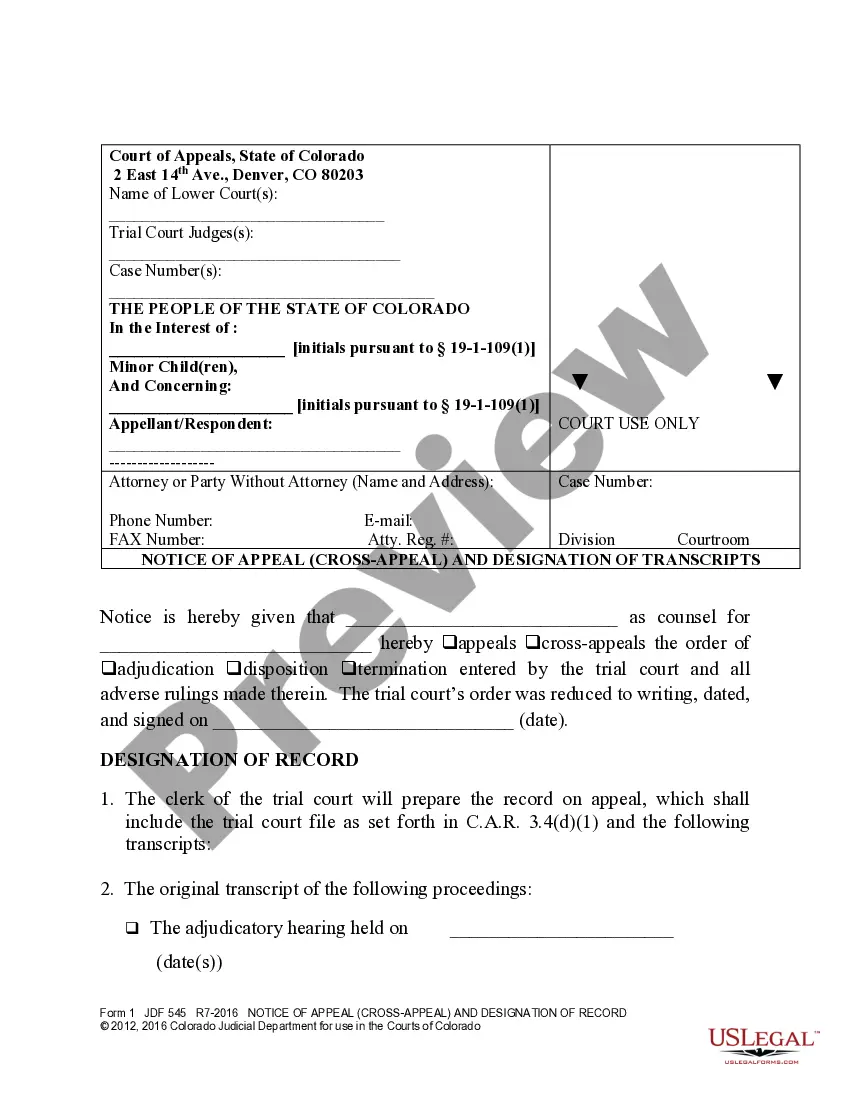
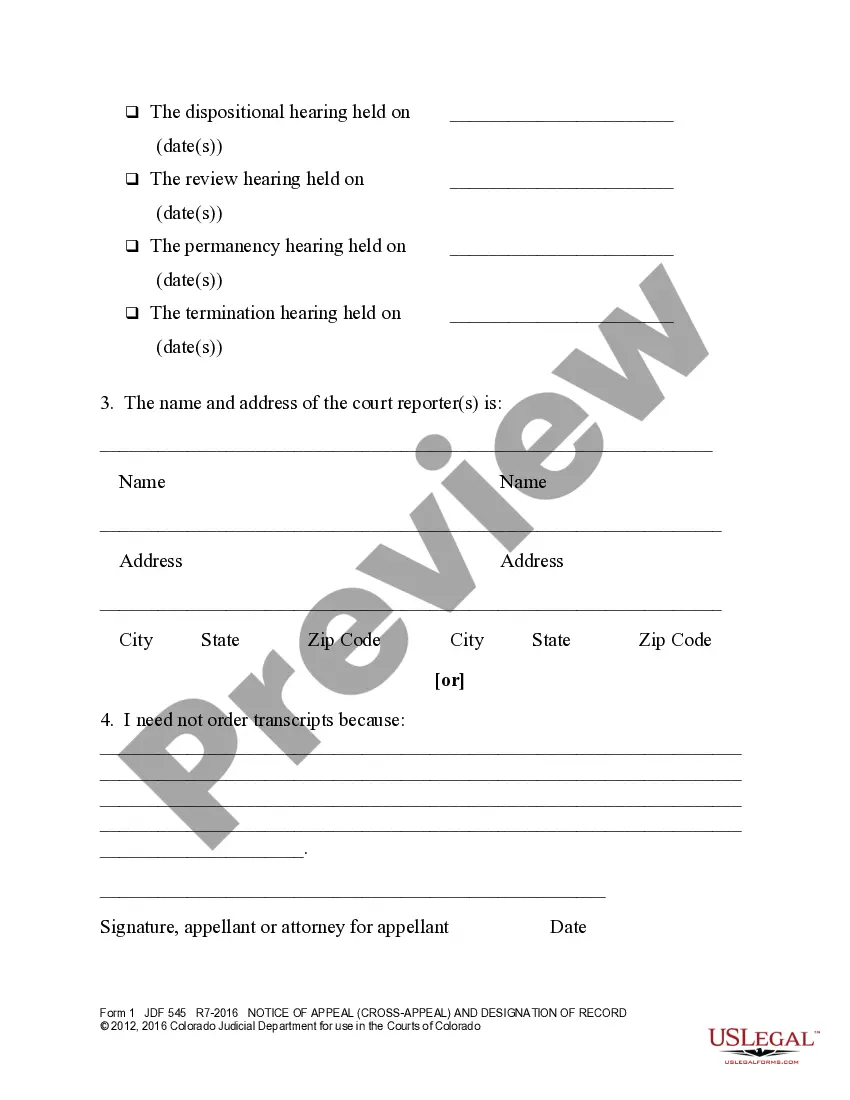
Benefit from US Legal Forms whenever you need to get and download the Thornton Colorado Notice of Appeal - Cross Appeal - and Designation of Record or any other document easily and safely. Simply log in to your account and click the Get button next to it. If you happened to lose the document, you can always re-download it from within the My Forms tab.
The process is just as straightforward if you’re new to the platform! You can create your account in a matter of minutes.
- Make sure to check if the Thornton Colorado Notice of Appeal - Cross Appeal - and Designation of Record adheres to the laws and regulations of your your state and area.
- Also, it’s imperative that you check out the form’s description (if available), and if you notice any discrepancies with what you were looking for in the first place, search for a different form.
- As soon as you’ve ensured that the Thornton Colorado Notice of Appeal - Cross Appeal - and Designation of Record is proper for you, you can pick the subscription plan and proceed to payment.
- Then you can download the document in any suitable file format.
For over 24 years of our presence on the market, we’ve served millions of people by providing ready to customize and up-to-date legal forms. Take advantage of US Legal Forms now to save time and resources!
Form popularity
FAQ
Deadline: The Notice of Appeal is generally due 49 days after a final written and signed order by the District Court. When an appeal is due may vary. Please read Colorado Appellate Rule (C.A.R.) 4 to determine the due date in your type of case.
If you have lost your case before a civil court or tribunal you may be considering appealing (or, if you have won, your opponent might appeal). Appeals may be heard by, for example, the Upper Tribunal, the High Court, the Court of Appeal, or by the Supreme Court.
- The appeal to the Court of Appeals in cases decided by the Regional Trial Court in the exercise of its original jurisdiction shall be taken by filing a notice of appeal with the court which rendered the judgment or final order appealed from and serving a copy thereof upon the adverse party.
Can You Look up Court Cases in Colorado? Yes, Colorado court records are accessible online. Access to trial court case information is available through the Docket Search tool on the Colorado judicial branch website.
Filing: You must file the Notice of Appeal in the Court of Appeals and in your District Court case. You may file in-person or by mail. If you file by mail, be aware that post-marked dates do not count toward the filing deadline. Rather, the courts must receive the Notice of Appeal by the filing deadline.
(1) (a) If either party in a civil action believes that the judgment of the county court is in error, he or she may appeal to the district court by filing notice of appeal in the county court within fourteen days after the date of entry of judgment and by filing within the said fourteen days an appeal bond with the
--(1) Any party aggrieved by any decision or order of the Appellate Tribunal may file an appeal to the High Court within a period of sixty days from the date of communication of the decision or order of the Appellate Tribunal to him on any question of law arising out of such order.
For civil cases you have 30 days from the date that the order was entered to file a Notice of Appeal. If the U.S. Government is a party to the action, the time for filing a Notice of Appeal is 60 days from the date the order was entered.
How long does an appeal take? Most appeals take about a year from start to finish. Many criminal cases can take 2-3 years.
Step 1: File the Notice of Appeal. Step 2: Pay the filing fee. Step 3: Determine if/when additional information must be provided to the appeals court as part of opening your case. Step 4: Order the trial transcripts.