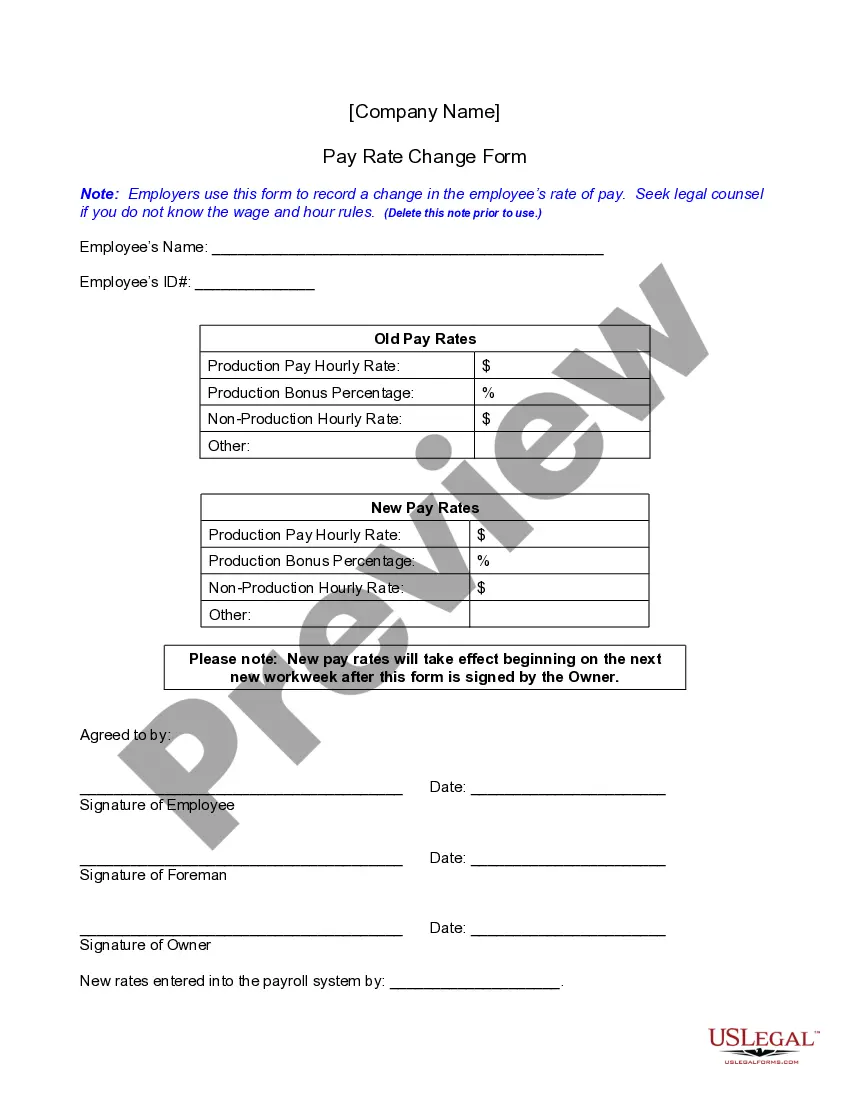
Employers use this form to record a change in the employee’s rate of pay.
Rancho Cucamonga California Pay Rate Change Form
State:
California
City:
Rancho Cucamonga
Control #:
CA-JM-0054
Format:
Word
45 downloads
Description
Get your form ready online
Our built-in tools help you complete, sign, share, and store your documents in one place.
Built-in online Word editor
Make edits, fill in missing information, and update formatting in US Legal Forms—just like you would in MS Word.
Export easily
Download a copy, print it, send it by email, or mail it via USPS—whatever works best for your next step.
E-sign your document
Sign and collect signatures with our SignNow integration. Send to multiple recipients, set reminders, and more. Go Premium to unlock E-Sign.
Notarize online 24/7
If this form requires notarization, complete it online through a secure video call—no need to meet a notary in person or wait for an appointment.
Store your document securely
We protect your documents and personal data by following strict security and privacy standards.

Make edits, fill in missing information, and update formatting in US Legal Forms—just like you would in MS Word.

Download a copy, print it, send it by email, or mail it via USPS—whatever works best for your next step.

Sign and collect signatures with our SignNow integration. Send to multiple recipients, set reminders, and more. Go Premium to unlock E-Sign.

If this form requires notarization, complete it online through a secure video call—no need to meet a notary in person or wait for an appointment.

We protect your documents and personal data by following strict security and privacy standards.
Looking for another form?
How to fill out California Pay Rate Change Form?
If you are seeking a pertinent form, it’s unfeasible to discover a more suitable platform than the US Legal Forms website – likely the most extensive collections on the web.
With this collection, you can locate thousands of templates for organizational and personal needs by categories and regions, or keywords.
With our premium search option, finding the latest Rancho Cucamonga California Pay Rate Change Form is as straightforward as 1-2-3.
Complete the payment process. Use your credit card or PayPal account to finalize the registration procedure.
Obtain the template. Choose the format and download it to your device.
- Additionally, the relevance of each document is validated by a team of professional attorneys who frequently examine the templates on our site and refresh them according to the latest state and county regulations.
- If you are already familiar with our platform and possess a registered account, all you need to acquire the Rancho Cucamonga California Pay Rate Change Form is to Log In to your user profile and click the Download button.
- If you utilize US Legal Forms for the first time, just adhere to the instructions below.
- Ensure you have accessed the sample you require. Review its description and utilize the Preview feature (if available) to view its content. If it doesn’t meet your requirements, use the Search bar at the top of the page to find the appropriate file.
- Confirm your choice. Hit the Buy now button. After that, select your preferred pricing plan and provide details to register for an account.
Form popularity
FAQ
California law requires that for non-exempt employees (except those covered by a collective bargaining agreement), notice must be signed by the employee at the time of hire AND upon any change, providing the worker with applicable rates of pay and any changes.
The California Wage Theft Protection Act does require notice within seven days of making a change to a pay date or period, but it has no notice requirements prior to the change.
In general, your employer can reduce your salary for any lawful reason. There is no specific California labor law that prohibits an employer from reducing an employee's compensation. However, your employer cannot reduce your salary to a rate below the minimum wage.
If your employer asks you to work fewer hours or take a pay cut, this is a change to your contract of employment. Any change to your contract of employment must be agreed by both you and your employer.
California Enacts Pay Transparency and Disclosure Requirements Effective January 1, 2023. On September 27, 2022, Governor Newsom signed California's new pay transparency and pay scale disclosure law.
Effective January 1, 2023, the California minimum wage will increase to $15.50 an hour for all employers. The rate reflects an adjustment to the large employer minimum wage (currently $15 an hour) based on inflation, as determined by the state Director of Finance.
1. What is the minimum wage? Effective January 1, 2021, the minimum wage increases to $14 per hour for employers with 26 or more employees and $13 per hour for employees with 25 or fewer employees.
The statewide minimum wage increases are as follows: Effective January 1, 2022, minimum wage for small employers (25 or fewer employees) in the state will be $14.00 an hour. Effective January 1, 2022, minimum wage for large employers (26 or more employees) will be $15.00 an hour.
What Is California's Minimum Wage Today? For the remainder of 2022, the current minimum wage in the state will stay at $14 per hour for California employers with 25 employees or less. If your business employs 26 or more people, you've already been subject to a $15 per hour minimum wage rate as of January 1, 2022.
California's current statewide hourly minimum wage is $15 for employers with at least 26 employees and $14 for employers with fewer than 26 employees. The state minimum wage will rise to $15.50 for all employers effective Jan. 1, 2023.