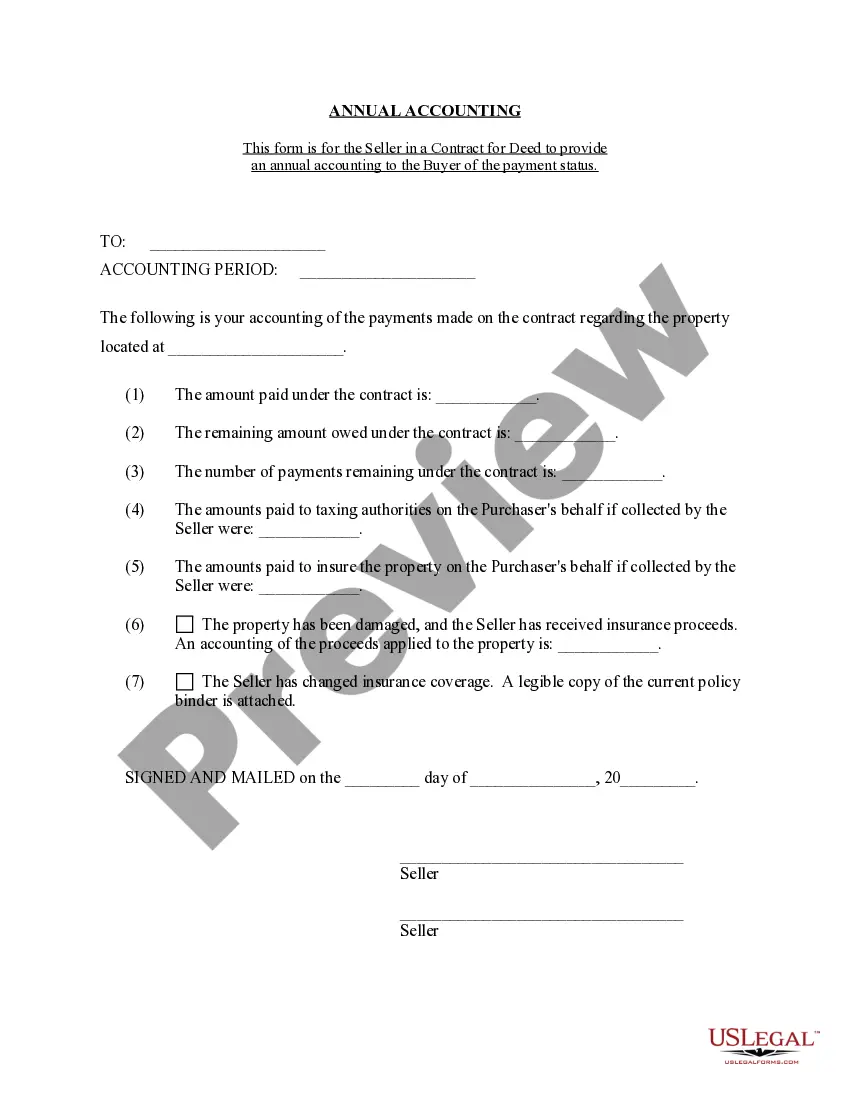
Kentucky Contract for Deed Seller's Annual Accounting Statement
About this form
The Contract for Deed Seller's Annual Accounting Statement is a document that informs the purchaser about the payments received towards the purchase price and interest of a contract for deed. It simplifies the seller's obligation by summarizing financial transactions annually. This form stands apart from other financial statements by specifically addressing the unique structure of a contract for deed arrangement.
Key components of this form
- Payment summary: Details the number and amount of payments received.
- Interest calculation: Specifies the interest charged on the outstanding balance.
- Year-end totals: Provides cumulative totals for the contract term.
- Seller's contact information: Identifies the seller for any queries regarding the statement.
- Purchaser's information: Confirms the identity of the recipient of the statement.

When to use this form
This form should be used annually by sellers who have entered into a contract for deed with a purchaser. It is essential when tracking and reporting payments received, ensuring transparency in the financial aspect of the contract, and maintaining accurate records for tax purposes.
Intended users of this form
This form is intended for:
- Property sellers who offer financing through a contract for deed.
- Purchasers seeking clear records of their payment history and outstanding balances.
- Accountants or financial advisors assisting sellers in maintaining accurate financial statements related to real estate transactions.
Completing this form step by step
- Gather payment records for the contract year.
- Calculate the total number of payments received.
- Determine the total amount of principal and interest collected.
- Fill in the seller's and purchaser's information accurately.
- Prepare the document for delivery to the purchaser by the end of the accounting year.
Does this document require notarization?
This form needs to be notarized to ensure legal validity. US Legal Forms provides secure online notarization powered by Notarize, allowing you to complete the process through a verified video call, available anytime.
Get your form ready online
Our built-in tools help you complete, sign, share, and store your documents in one place.
Make edits, fill in missing information, and update formatting in US Legal Forms—just like you would in MS Word.
Download a copy, print it, send it by email, or mail it via USPS—whatever works best for your next step.
Sign and collect signatures with our SignNow integration. Send to multiple recipients, set reminders, and more. Go Premium to unlock E-Sign.
If this form requires notarization, complete it online through a secure video call—no need to meet a notary in person or wait for an appointment.
We protect your documents and personal data by following strict security and privacy standards.

Make edits, fill in missing information, and update formatting in US Legal Forms—just like you would in MS Word.

Download a copy, print it, send it by email, or mail it via USPS—whatever works best for your next step.

Sign and collect signatures with our SignNow integration. Send to multiple recipients, set reminders, and more. Go Premium to unlock E-Sign.

If this form requires notarization, complete it online through a secure video call—no need to meet a notary in person or wait for an appointment.

We protect your documents and personal data by following strict security and privacy standards.
Mistakes to watch out for
- Failing to include all payment transactions, leading to incomplete financial reporting.
- Not specifying the period the statement covers.
- Neglecting to update the purchaser's information when it changes.
- Omitting the total interest calculation from the statement.
Advantages of online completion
- Convenience of downloading and completing the form at your own pace.
- Editability allows for easy adjustments based on financial changes.
- Reliable templates ensure accuracy in legal language and formatting.
Legal use & context
- This form is legally recognized as evidence of payment history in contract for deed transactions.
- It aids in tracking the financial obligations of the purchaser over time.
- Failure to provide this statement may lead to misunderstandings or disputes regarding payment status.
Quick recap
- The form is essential for annual accounting in a contract for deed arrangement.
- It ensures transparency between seller and purchaser regarding payments made.
- Using this form can help avoid common financial and communication errors.
Looking for another form?







Form popularity
FAQ
As a general rule, Ohio follows the doctrine of caveat emptor in all real estate transactions, which precludes a purchaser from recovering for a structural defect if: (1) the condition complained of is open to observation or discoverable upon reasonable inspection; (2) the purchaser had the unimpeded opportunity to
Buyer beware, also known as the doctrine of caveat emptor, is an age-old doctrine. It means that, if you intend to buy property, you generally bear the responsibility for finding out about the property's condition before purchasing it.
On average, sellers will have to pay about 1%-3% of their home's sale price in closing costs. This is on top of the typical 6% real estate commission. All this money due at closing can add up quickly, so if you have a low amount of equity in your home be sure to prepare yourself.
While there's no hard-and-fast list of which states follow caveat emptor and which don't, Alabama, Arkansas, Georgia, North Dakota, Virginia, and Wyoming are largely known as caveat emptor states. In others, courts have upheld the principle only some of the time.
Kentucky's stigmatized property law does not require the disclosure of murders, suicides or ghosts in a home unless asked.
The Kentucky Supreme Court cited the doctrine of caveat emptor (let the buyer beware) and rejected the buyer's case.The Supreme Court, however, stated that the rules of equity were not established to protect those who simply make unwise decisions.
According to data from ClosingCorp, the average closing cost in Kentucky is $2,276 after taxes, or approximately 1.14% to 2.28% of the final home sale price.
According to data from ClosingCorp, the average closing cost in Kentucky is $2,276 after taxes, or approximately 1.14% to 2.28% of the final home sale price.