- US Legal Forms
- Forms Catalog
- Landlord Tenant
-
Kansas Residential Rental Lease Agreement
Kansas Residential Rental Lease Agreement
-
No results found.
-
Kansas
-
Alabama
-
Alaska
-
Arizona
-
Arkansas
-
California
-
Colorado
-
Connecticut
-
Delaware
-
District of Columbia
-
Florida
-
Georgia
-
Hawaii
-
Idaho
-
Illinois
-
Indiana
-
Iowa
-
Kentucky
-
Louisiana
-
Maine
-
Maryland
-
Massachusetts
-
Michigan
-
Minnesota
-
Mississippi
-
Missouri
-
Montana
-
Multi-State
-
Nebraska
-
Nevada
-
New Hampshire
-
New Jersey
-
New Mexico
-
New York
-
North Carolina
-
North Dakota
-
Ohio
-
Oklahoma
-
Oregon
-
Pennsylvania
-
Rhode Island
-
South Carolina
-
South Dakota
-
Tennessee
-
Texas
-
Utah
-
Vermont
-
Virginia
-
Washington
-
West Virginia
-
Wisconsin
-
Wyoming

This form is part of a form package!
Get all related documents in one bundle, so you don’t have to search separately.
About this form
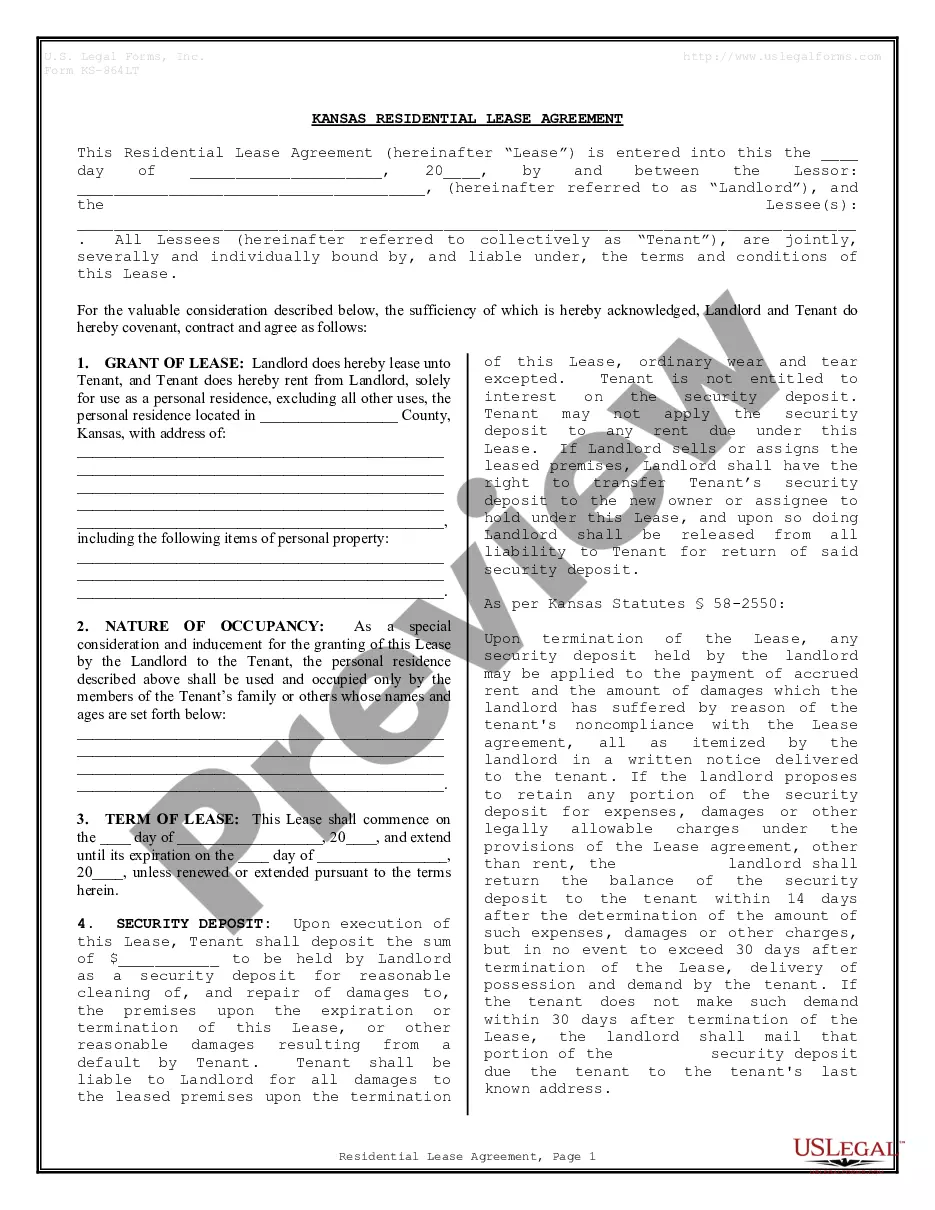
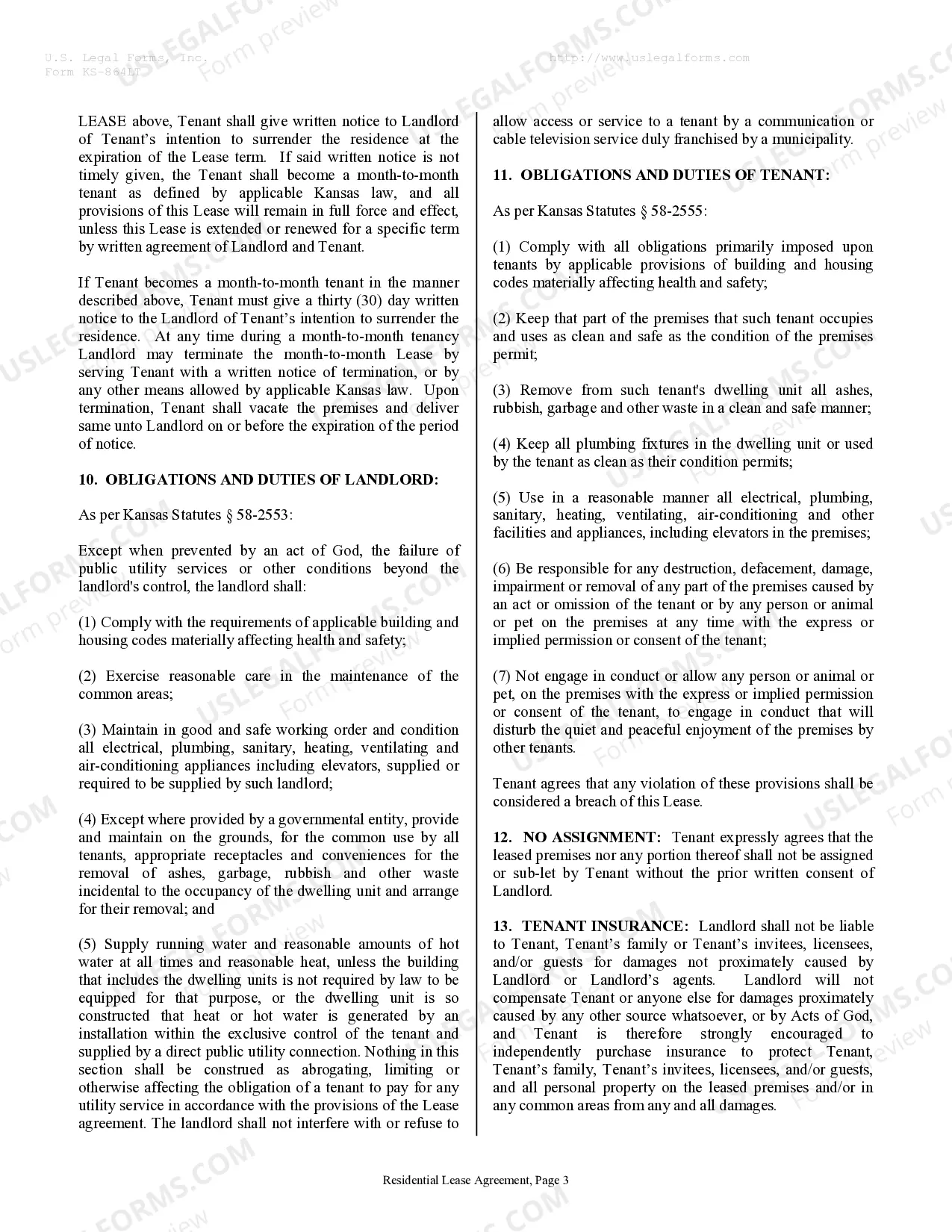
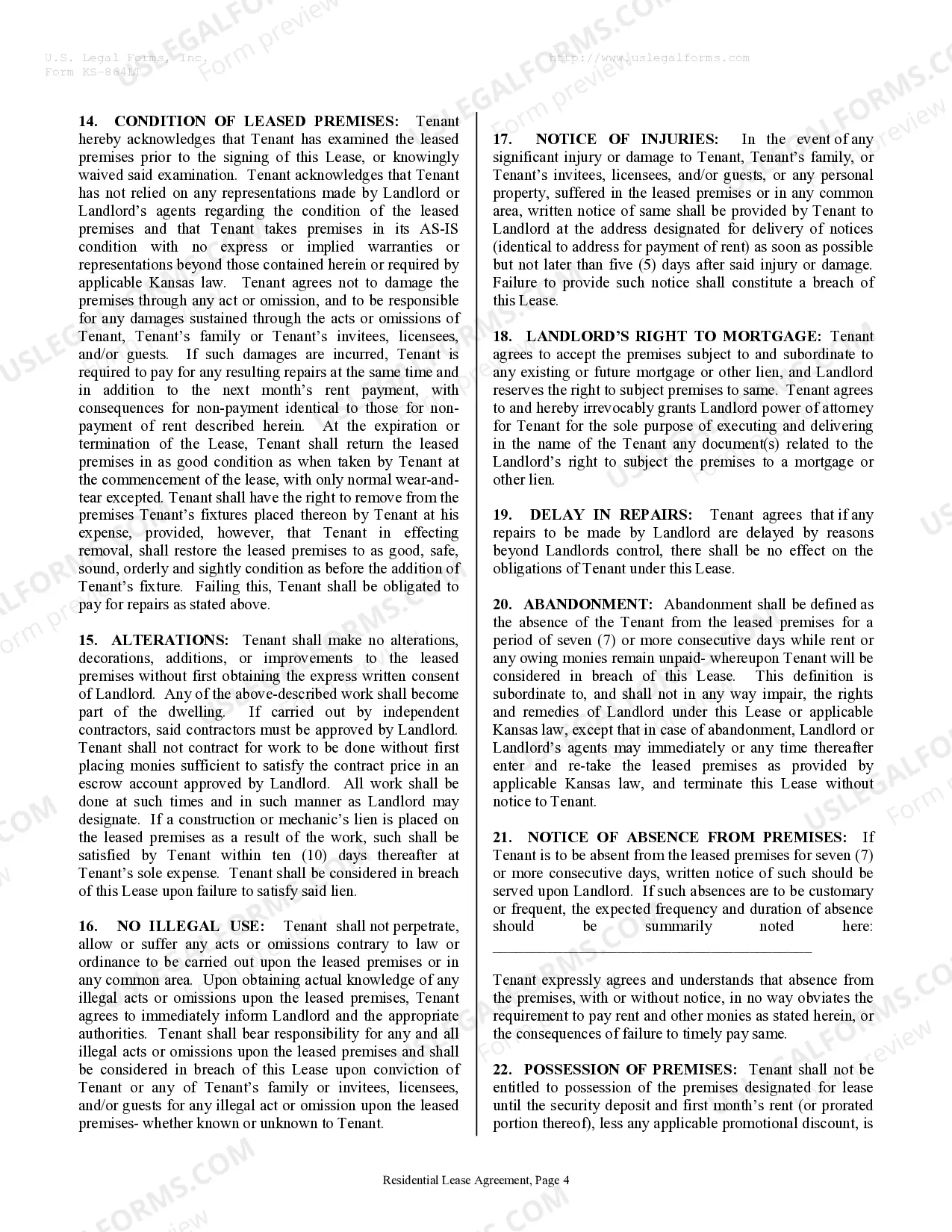
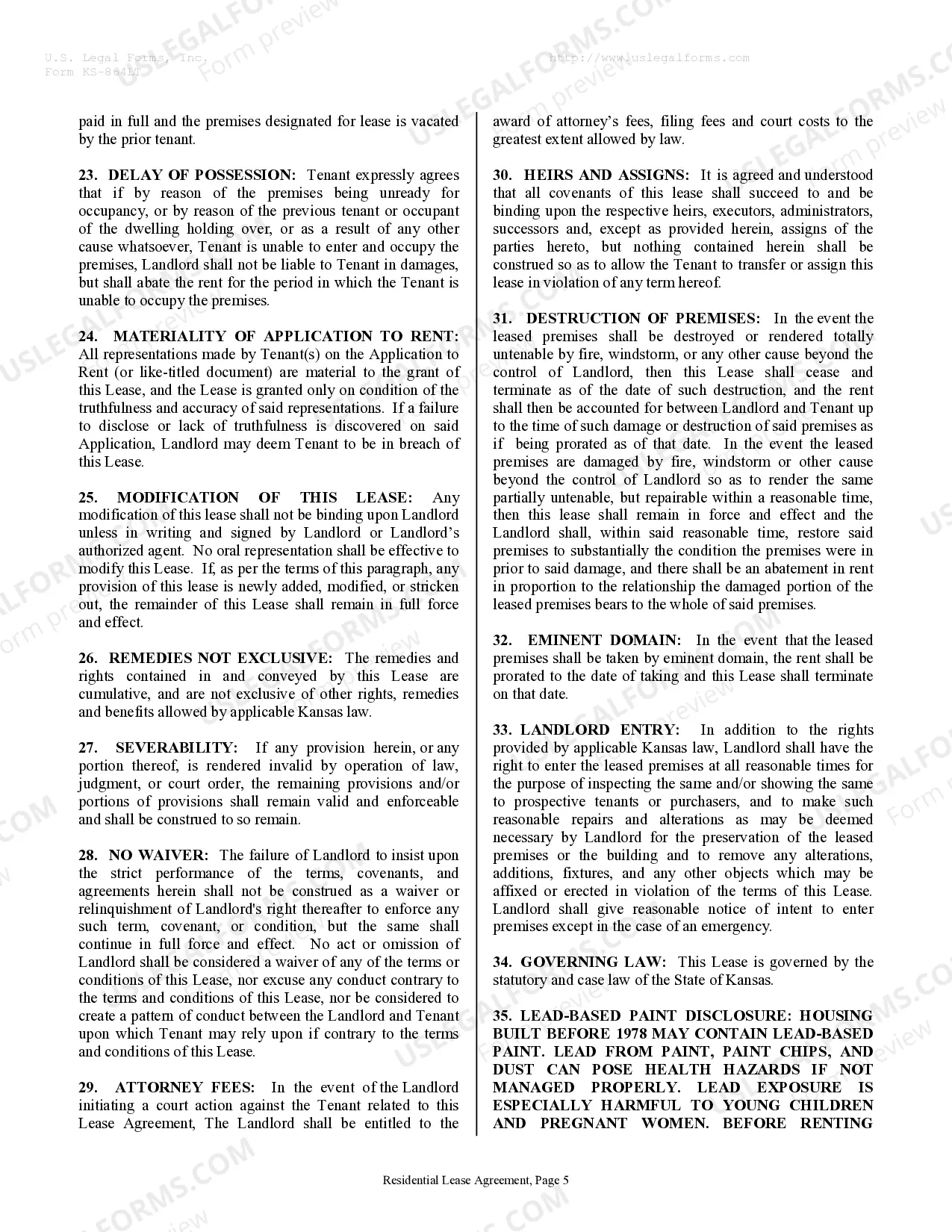
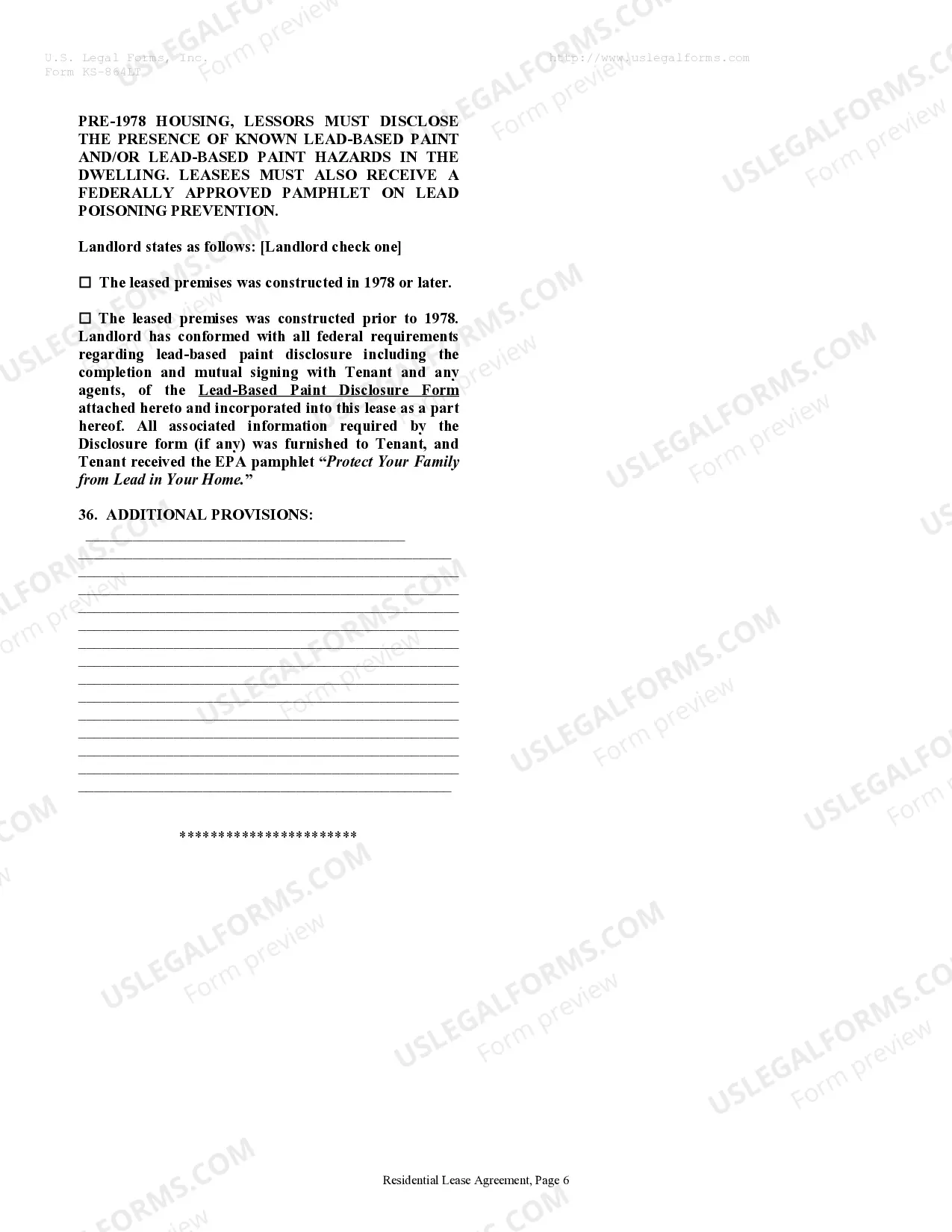
The Residential Rental Lease Agreement is a legal document that formalizes the rental arrangement between a landlord and a tenant. This lease is designed for a specific term, such as six months or one year, and outlines the responsibilities and rights of both parties. It differs from other rental agreements in that it includes detailed clauses concerning the security deposit, rent payment, utilities, and the consequences of breach of agreement. This document provides clarity and protection for both landlords and tenants when renting a property.
Form components explained
- Grant of lease: Specifies the property being rented and its use.
- Term of lease: Indicates the beginning and end dates of the lease.
- Security deposit: Details the amount, usage, and return of the deposit.
- Rent payments: Outlines the rent amount, due dates, and payment methods.
- Consequences of breach: Describes what constitutes a breach and the subsequent landlord actions.
- Obligations and duties: Clarifies responsibilities for both landlord and tenant regarding maintenance and utilities.

Related forms
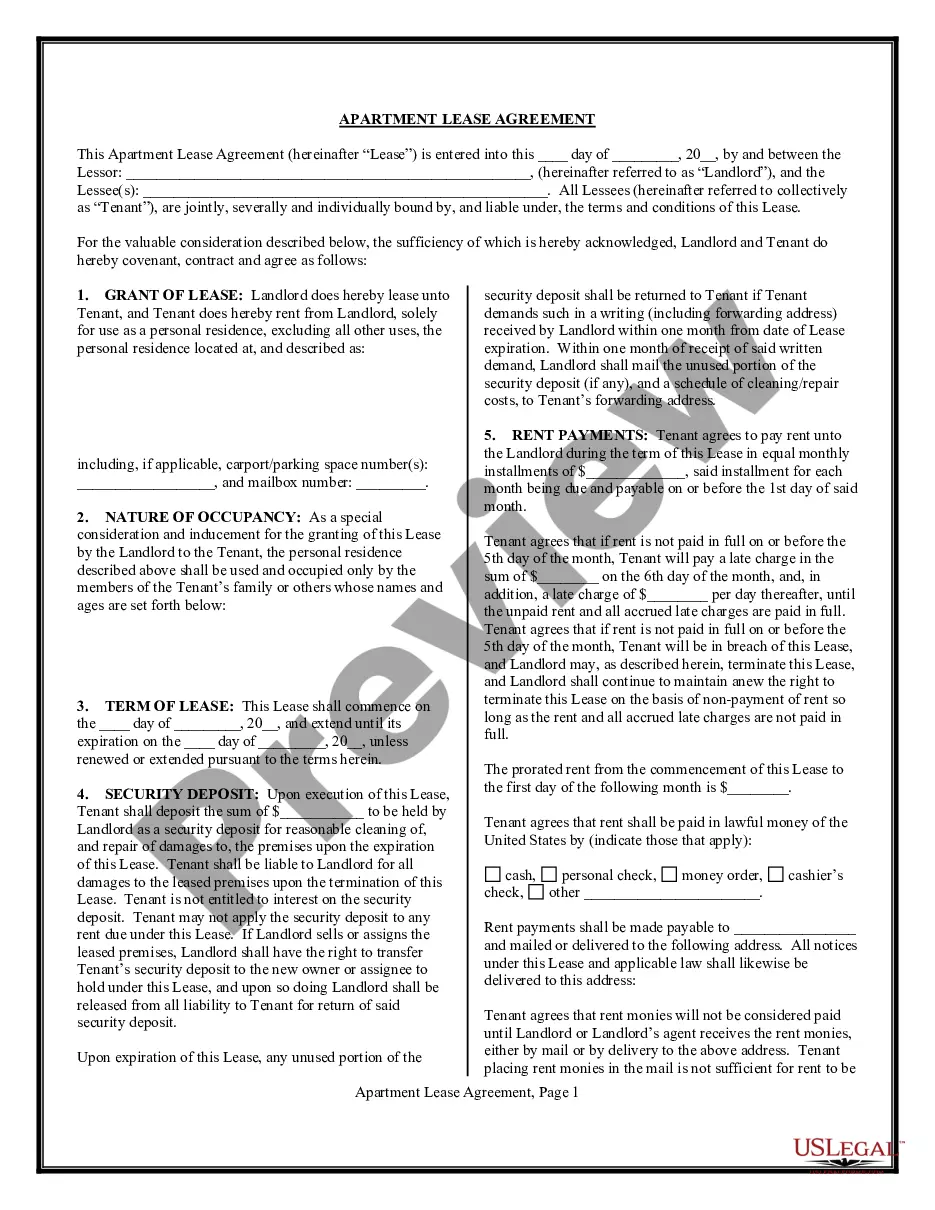
Apartment Lease Agreement
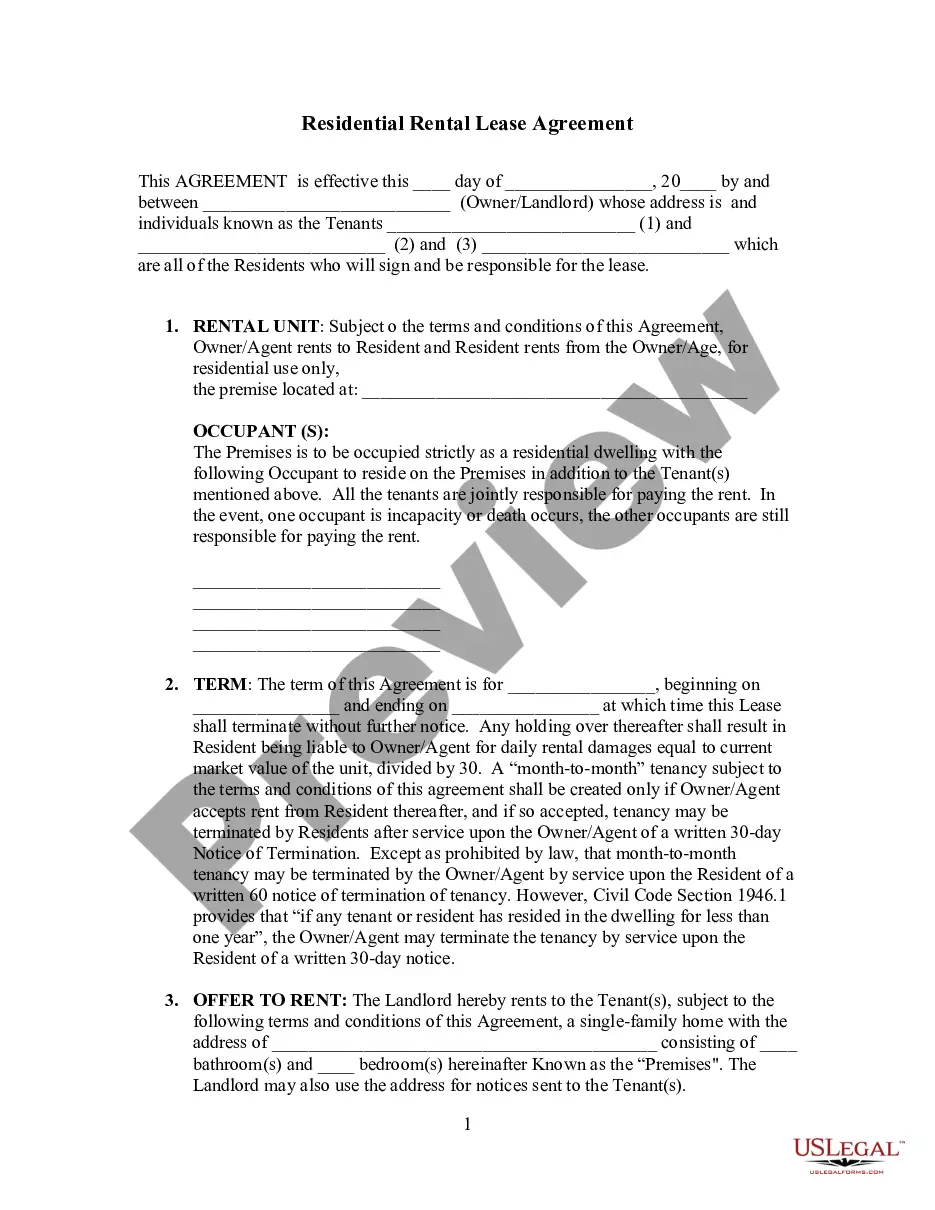
Residential Lease Agreement
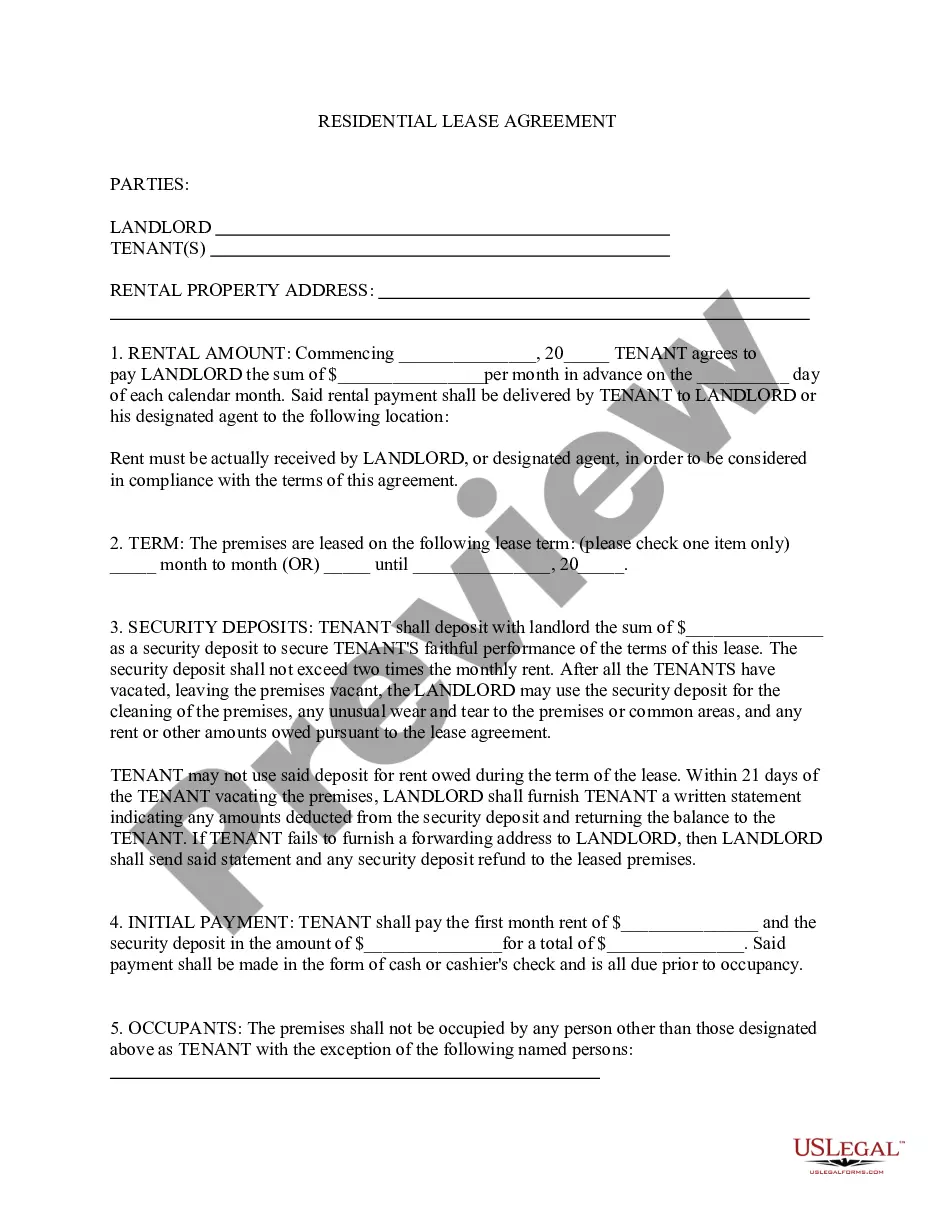
Residential Lease Agreement
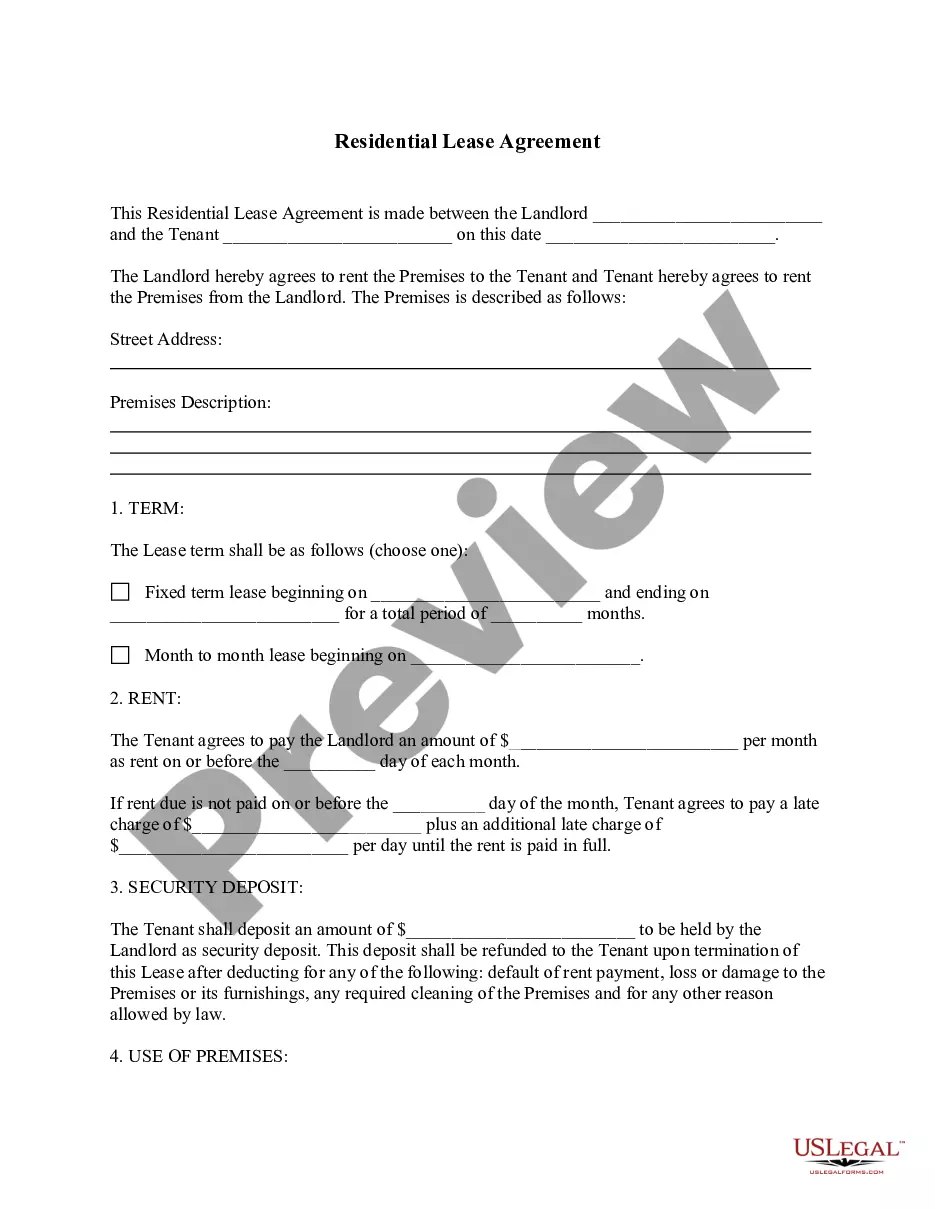
Basic Residential Lease Agreement
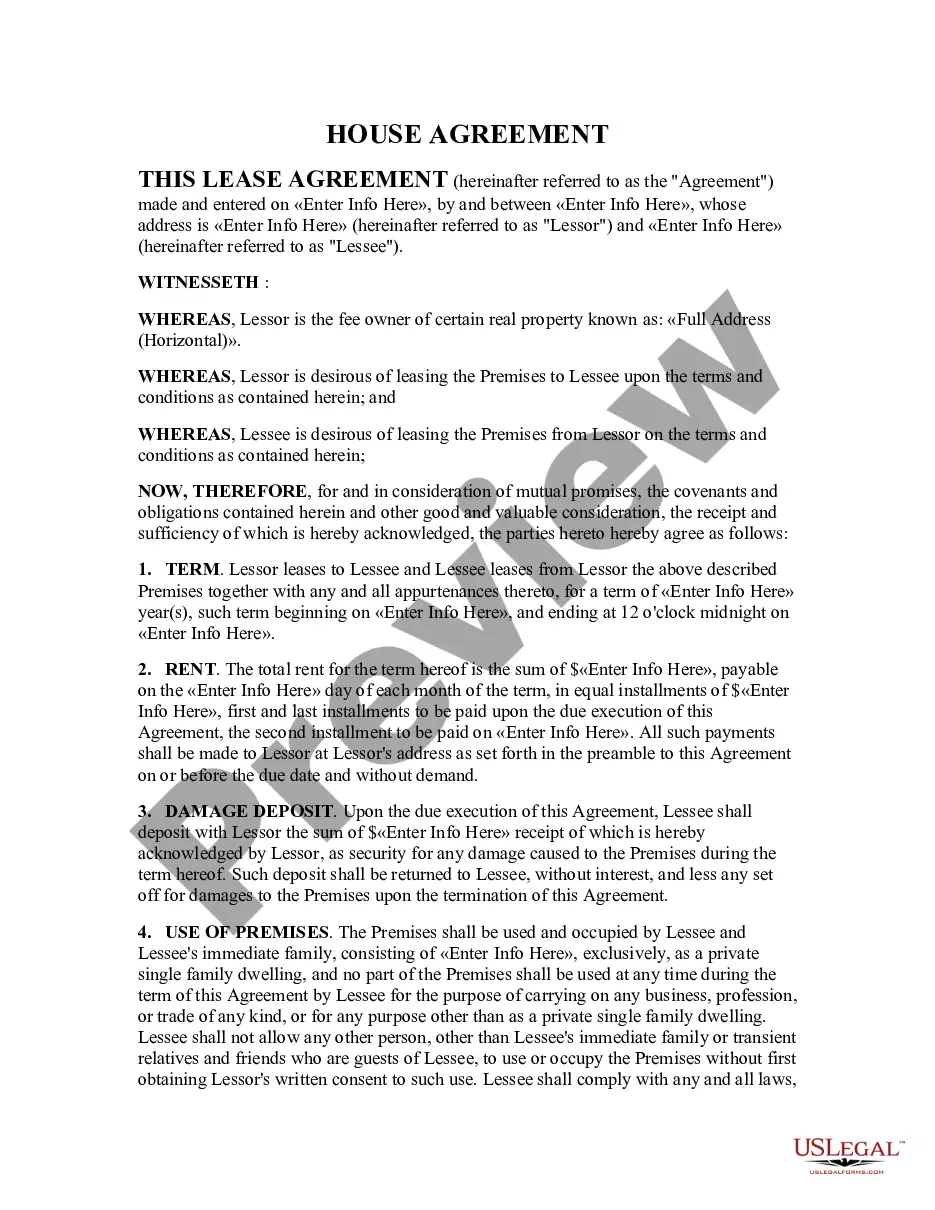
House Lease Agreement
When to use this document
This residential rental lease agreement should be utilized when a property owner or landlord wishes to lease their property to a tenant for a fixed term. It is useful when entering or renewing a rental agreement and helps ensure both parties understand their rights and responsibilities. Use this form to protect your interests, whether you are renting out a single-family home, apartment, or room within a property.
Who should use this form
This form is intended for:
- Landlords looking to establish a rental agreement with tenants.
- Tenants seeking to understand their rights and obligations before signing a lease.
- Property managers managing rental agreements on behalf of property owners.
Instructions for completing this form
- Identify the parties: Enter the names of the landlord and tenants.
- Specify the property: Fill in the address of the rental property and any included furnishings.
- Enter dates: Clearly indicate the start and end dates of the lease term.
- Outline the rent details: State the monthly rent amount and payment due dates.
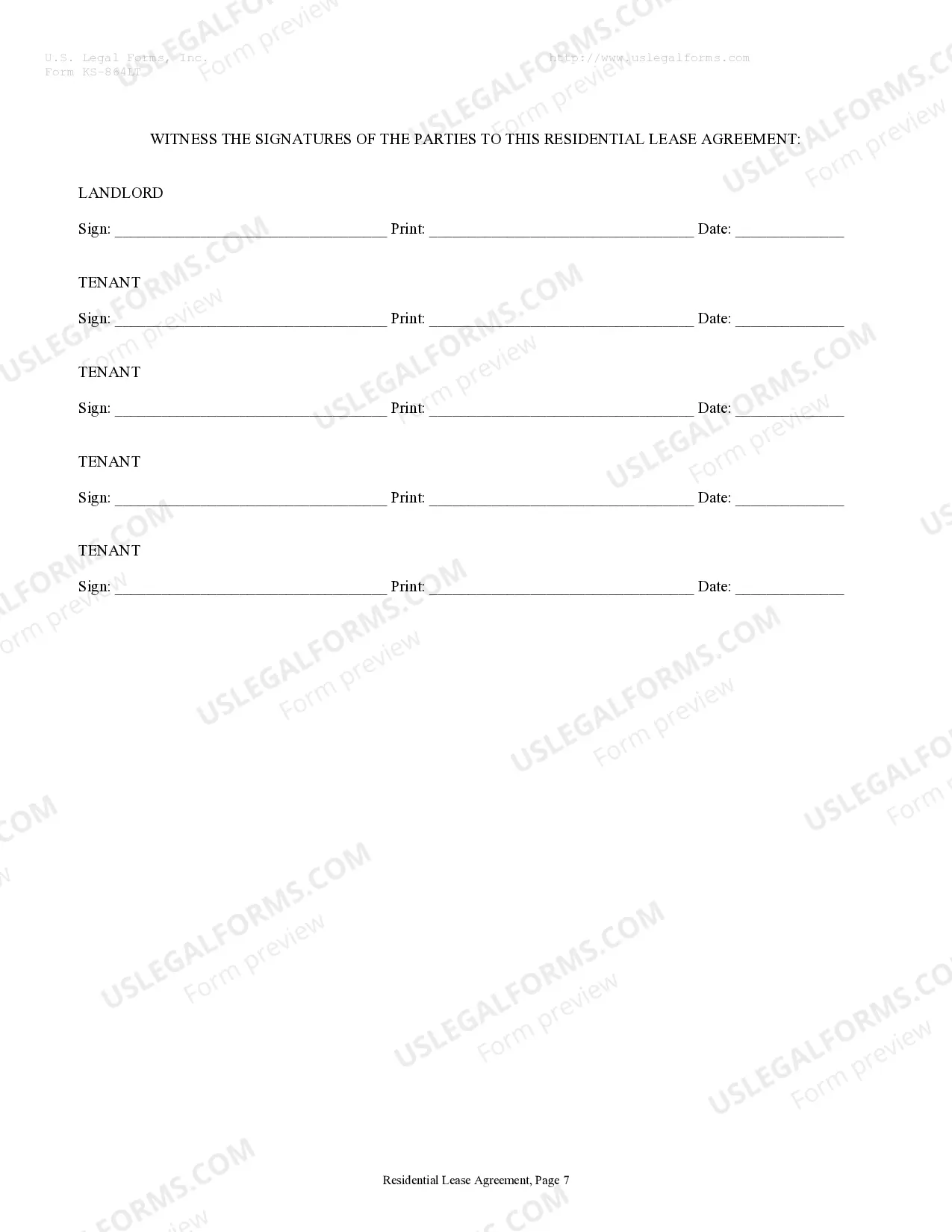
- Sign and date: Ensure all parties sign and date the lease agreement to make it legally binding.
Notarization requirements for this form
This form does not typically require notarization unless specified by local law. However, it is recommended to have the lease reviewed by a legal professional for additional guidance.
Get your form ready online
Our built-in tools help you complete, sign, share, and store your documents in one place.
Make edits, fill in missing information, and update formatting in US Legal Forms—just like you would in MS Word.
Download a copy, print it, send it by email, or mail it via USPS—whatever works best for your next step.
Sign and collect signatures with our SignNow integration. Send to multiple recipients, set reminders, and more. Go Premium to unlock E-Sign.
If this form requires notarization, complete it online through a secure video call—no need to meet a notary in person or wait for an appointment.
We protect your documents and personal data by following strict security and privacy standards.

Make edits, fill in missing information, and update formatting in US Legal Forms—just like you would in MS Word.

Download a copy, print it, send it by email, or mail it via USPS—whatever works best for your next step.

Sign and collect signatures with our SignNow integration. Send to multiple recipients, set reminders, and more. Go Premium to unlock E-Sign.

If this form requires notarization, complete it online through a secure video call—no need to meet a notary in person or wait for an appointment.

We protect your documents and personal data by following strict security and privacy standards.
Common mistakes to avoid
- Failing to complete the property address and details of included items.
- Not specifying the exact lease term or dates clearly.
- Overlooking the necessity of tenant signatures and dates for validation.
- Neglecting to discuss and clarify terms related to security deposits.
Benefits of using this form online
- Convenience: Download and customize the lease agreement from anywhere.
- Editability: Easily modify the document to fit specific rental terms.
- Reliability: Access forms prepared by licensed attorneys to ensure compliance with legal standards.
Legal use & context
- This Residential Rental Lease Agreement is legally binding once signed by both parties.
- Its enforceability is regulated by Kansas state laws governing landlord-tenant relationships.
- Always keep a copy of the agreement for your records and reference.
Summary of main points
- The Residential Rental Lease Agreement secures the rental relationship between a landlord and tenant.
- Both parties must understand their rights and obligations as stated in the lease terms.
- Completing the lease accurately is crucial for legal protection against potential disputes.
Looking for another form?
-
Alabama
-
Alaska
-
Arizona
-
Arkansas
-
California
-
Colorado
-
Connecticut
-
Delaware
-
District of Columbia
-
Florida
-
Georgia
-
Guam
-
Hawaii
-
Idaho
-
Illinois
-
Indiana
-
Iowa
-
Kansas
-
Kentucky
-
Louisiana
-
Maine
-
Maryland
-
Massachusetts
-
Michigan
-
Minnesota
-
Mississippi
-
Missouri
-
Montana
-
Nebraska
-
Nevada
-
New Hampshire
-
New Jersey
-
New Mexico
-
New York
-
North Carolina
-
North Dakota
-
Ohio
-
Oklahoma
-
Oregon
-
Pennsylvania
-
Puerto Rico
-
Rhode Island
-
South Carolina
-
South Dakota
-
Tennessee
-
Texas
-
Utah
-
Vermont
-
Virgin Islands
-
Virginia
-
Washington
-
West Virginia
-
Wisconsin
-
Wyoming
Viewed forms
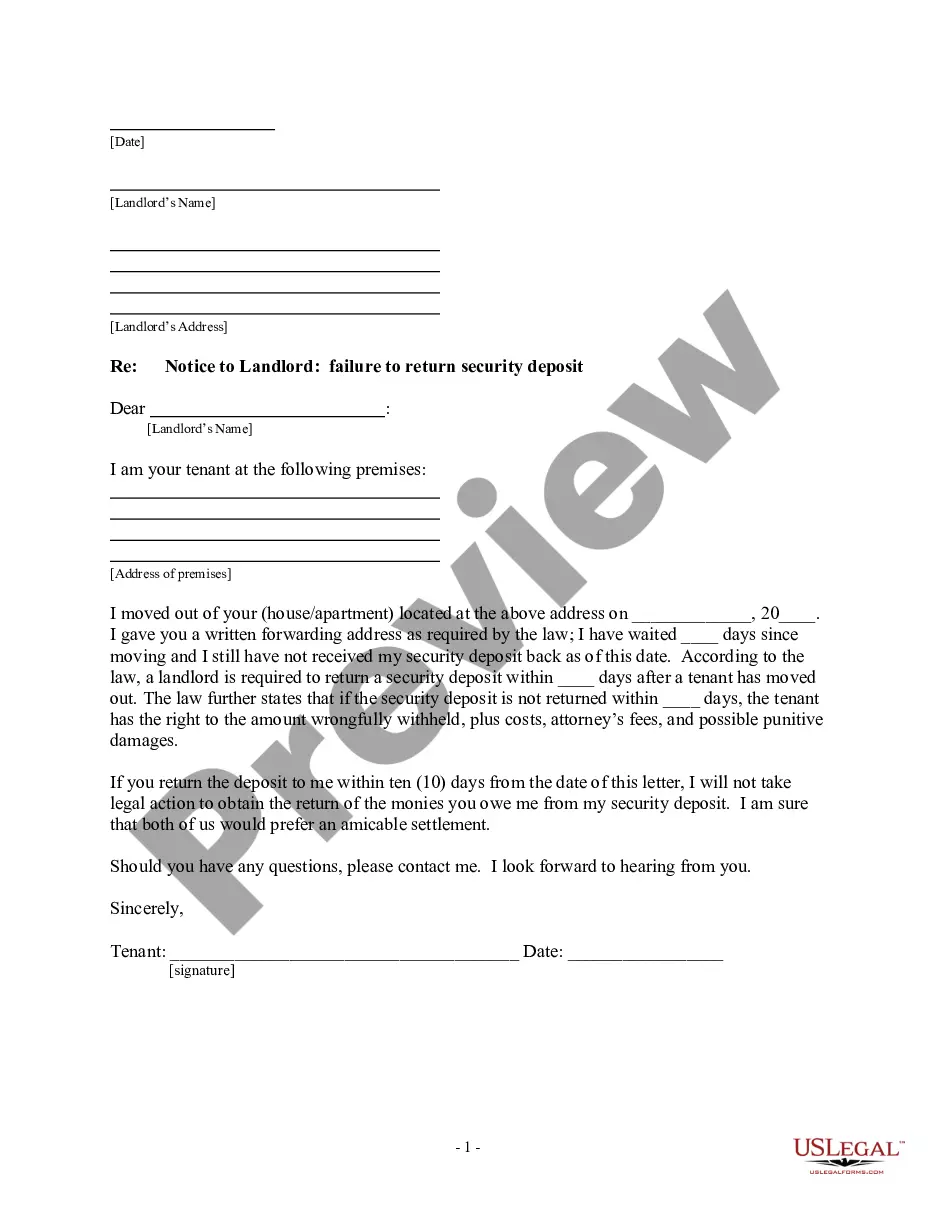
Letter from Tenant to Landlord containing Notice of failure to return security deposit and demand for return
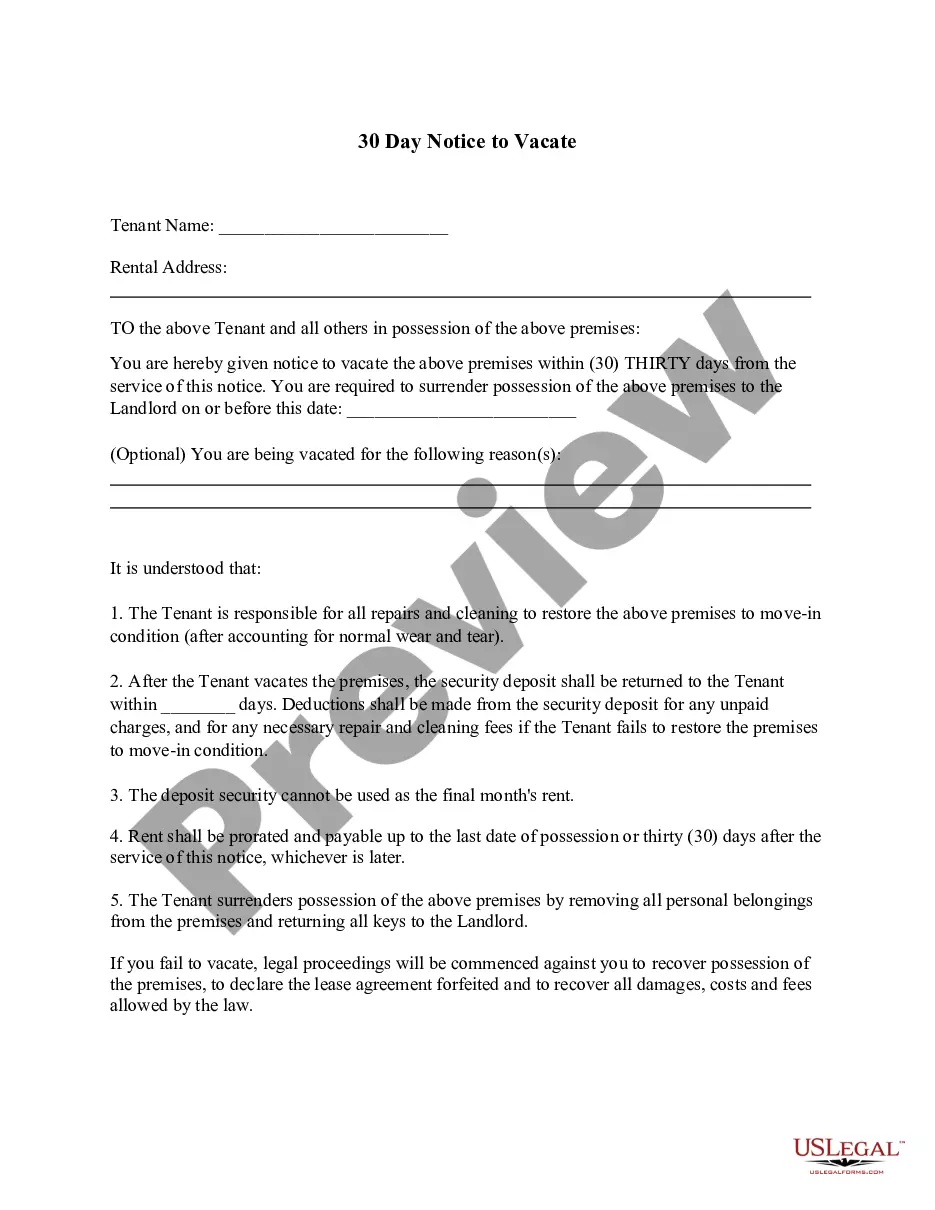
Basic 30 Day Notice to Vacate
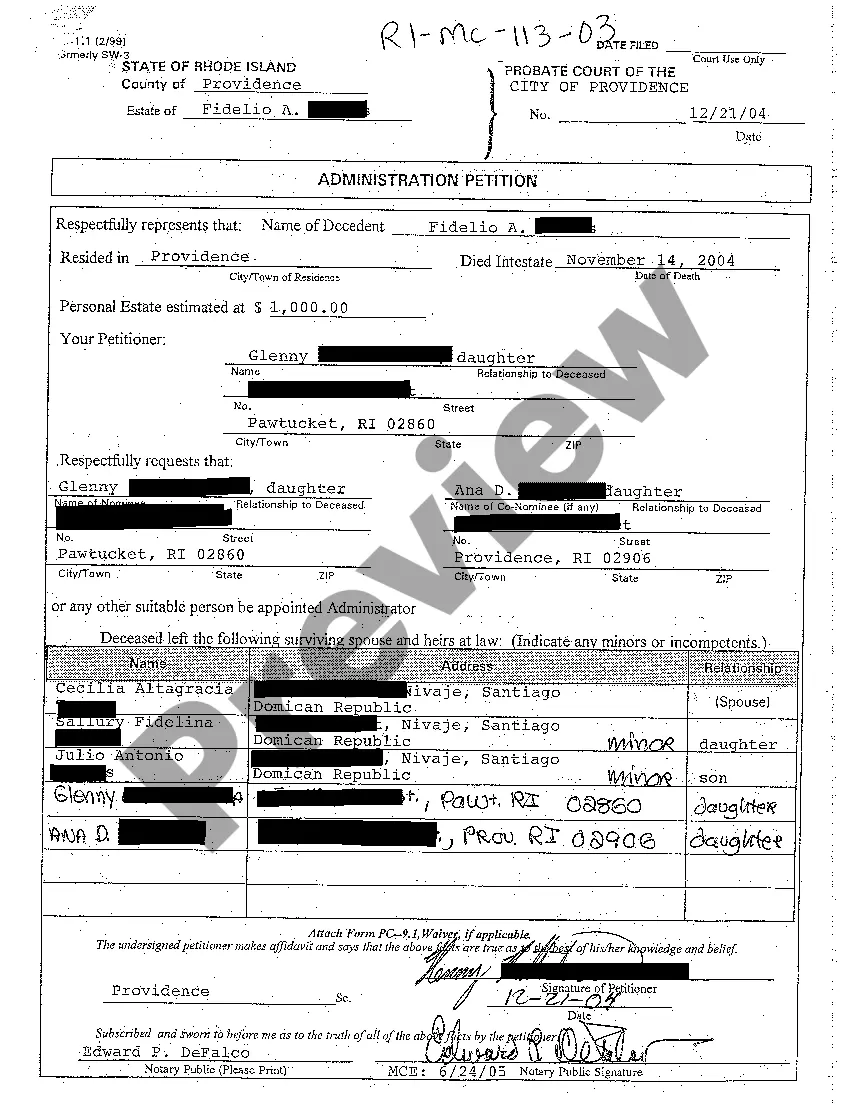
A03 Administration Petition
Contract or Agreement for the Construction of a Residence or Home
Answer to Petition for Custody
Warranty Deed to Separate Property of One Spouse to Both Spouses as Joint Tenants
Letter from Landlord to Tenant as Notice to remove unauthorized pets from premises

Sample Letter for Notice of Judgment - Lien
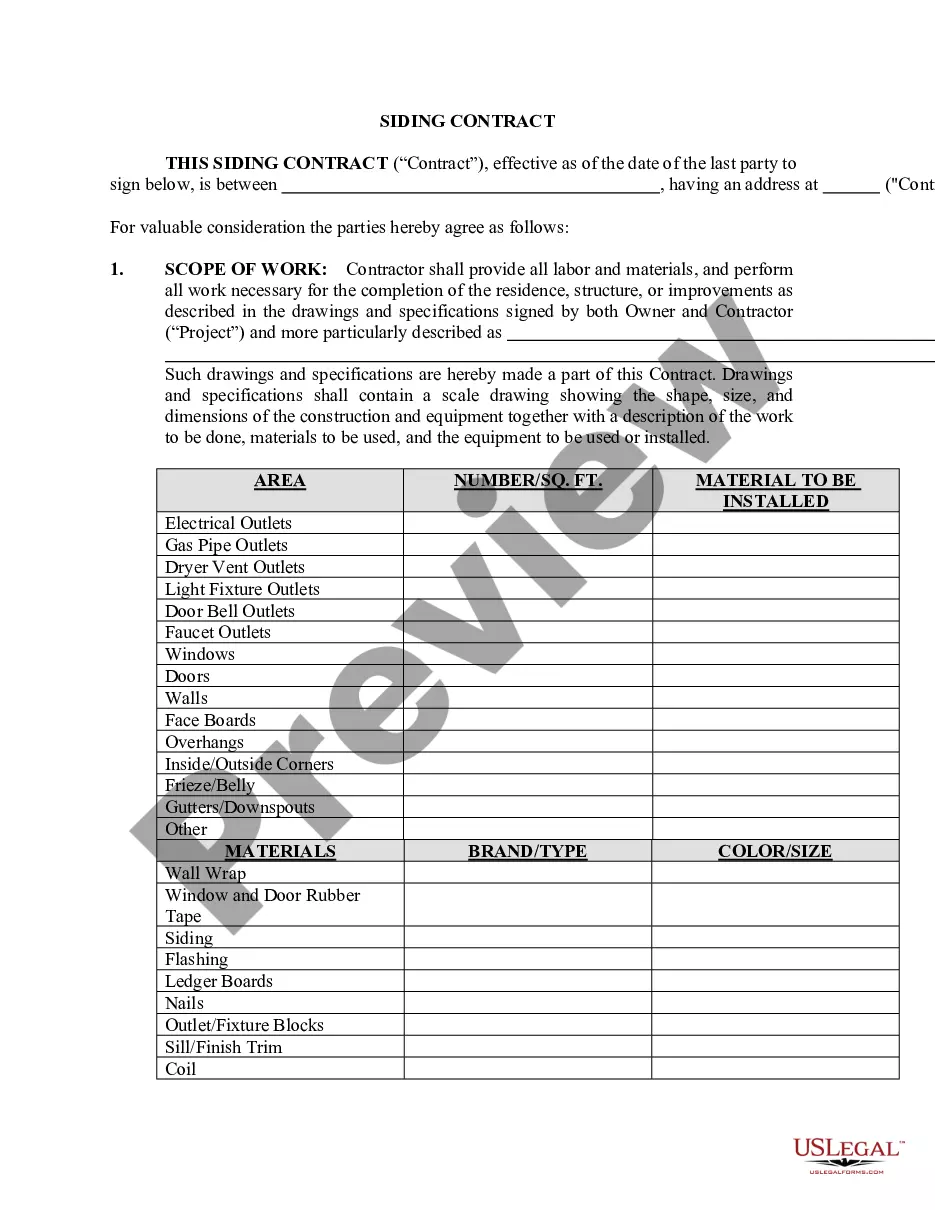
Siding Contract for Contractor
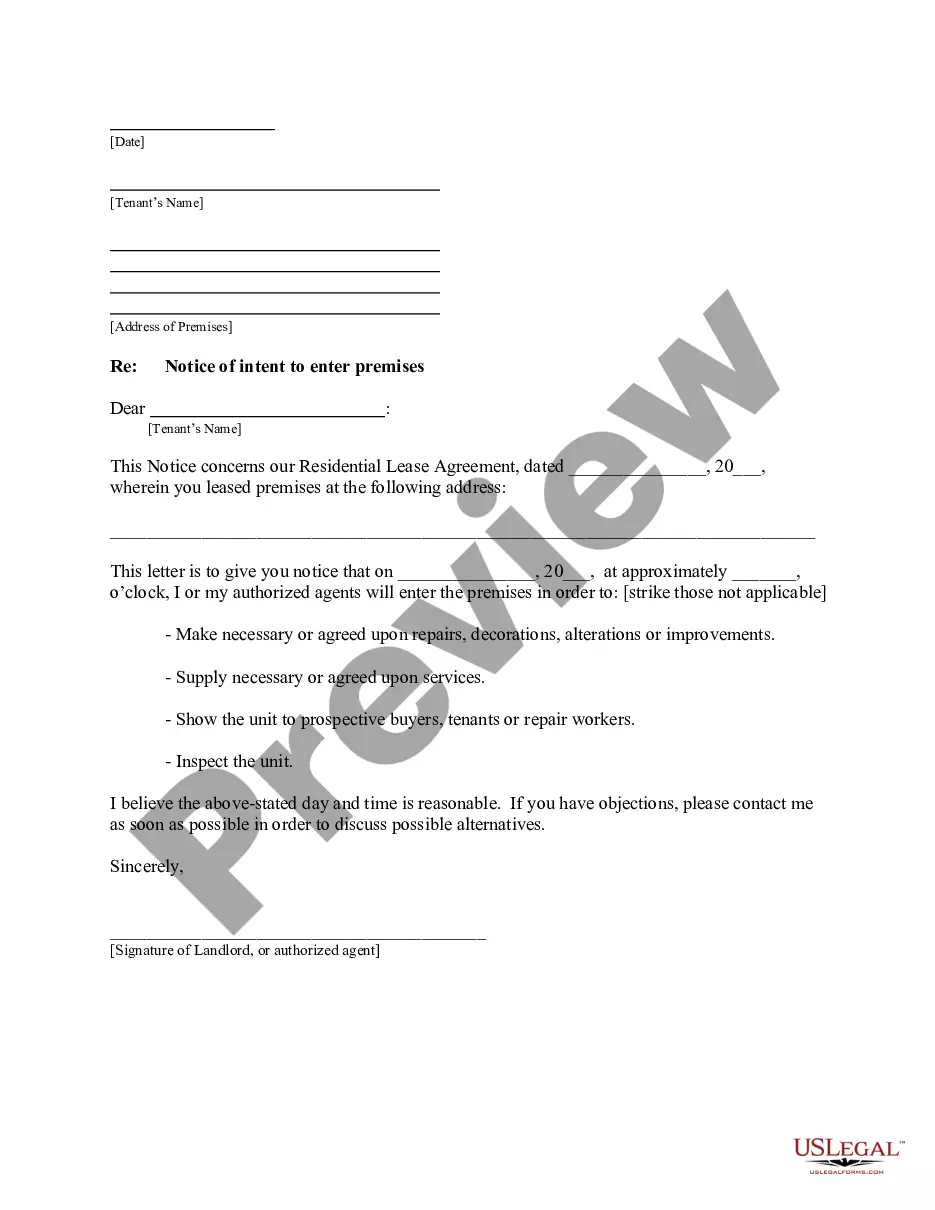
Letter from Landlord to Tenant about time of intent to enter premises
Form popularity
FAQ
The difference between lease and rent is that a lease generally lasts for 12 months while a rental agreement generally lasts for 30 days.That means the landlord can't raise the rent without your written consent or evict you without cause, and you can't stop paying rent or break the lease without consequence.
You can legally move out without penalties. Just include your landlord in every step toward opting out of the lease. Go over the sections pertaining to breaking the lease. Look for an opt-out clause.
Collect each party's information. Include specifics about your property. Consider all of the property's utilities and services. Know the terms of your lease. Set the monthly rent amount and due date. Calculate any additional fees. Determine a payment method. Consider your rights and obligations.
The term is the length of the rental. The document should include the beginning date and whether it's a month-to-month tenancy or a lease.Leases often have a term of one year. The term of the tenancy is usually the primary difference beween a lease and a rental agreement, and the choice is typically the landlord's.
The lease becomes legally binding when all parties have signed: the landlord and all tenants living in the unit who are 18 and older. If you're worried about situations where a lease needs to end early, learn about breaking a lease and grounds for eviction.
A written agreement can act as a roadmap for the landlord-tenant relationship, especially if a dispute arises. Also, real estate (land) leases for more than one year must be in writing. If a lease for over one year is not in writing, it will generally not be enforceable in court.
The standard lease agreement is a legally binding contract between tenant and landlord, which includes specific responsibilities for the parties involved. Subtenants may or may not be included in the agreement. Keep in mind that rental agreements protect both the landlord and the renter.
A lease can be written or verbal, but a verbal lease can be very difficult to enforce.Most leases are fairly standard and cover basic components such as rent amount, duration of lease term, resposiblities of each party and penalties for not following the terms.
The Lease Must be in Writing It does not matter if the lease is handwritten or typed.
Explore more forms
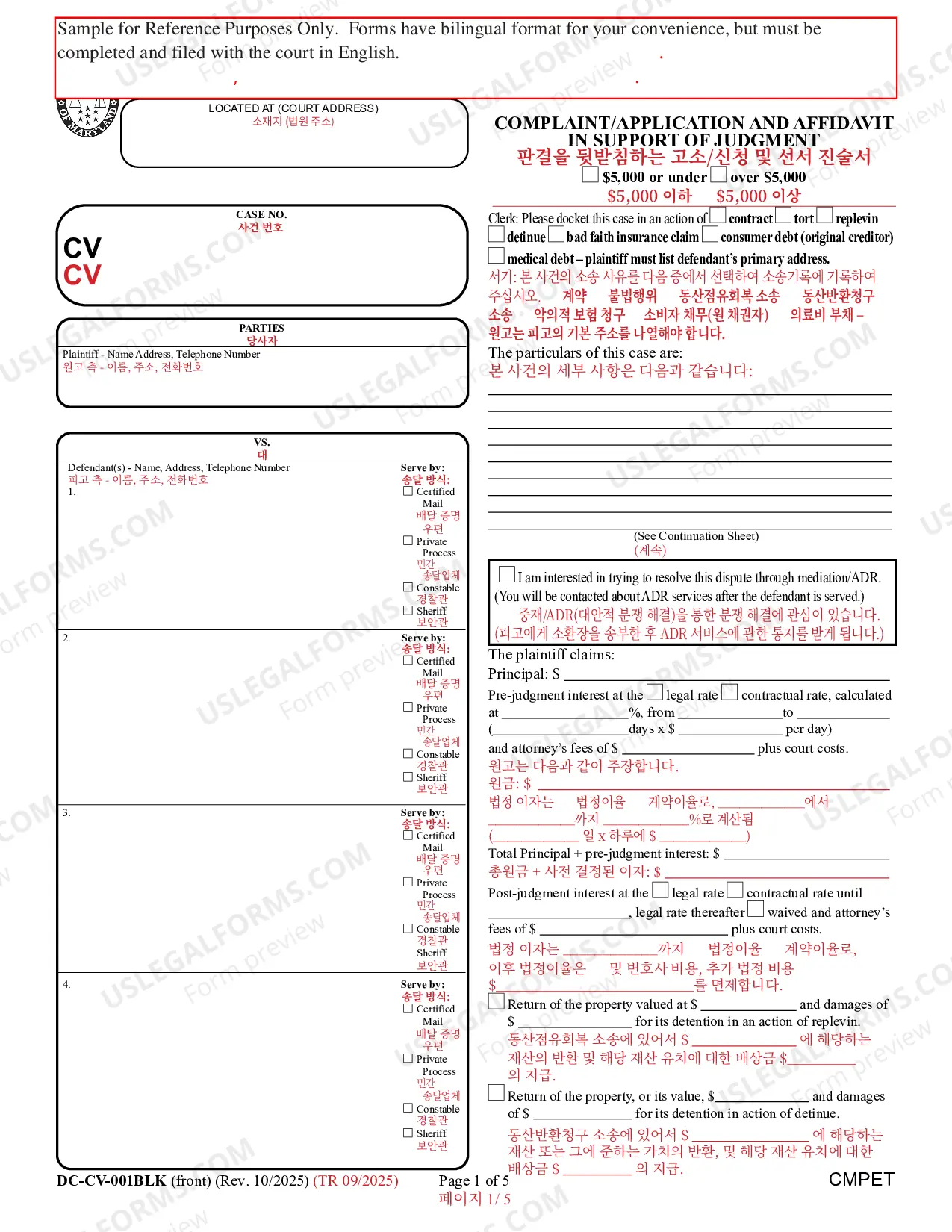
Complaint/Application and Affidavit in Support of Judgment (Bilingual - Korean Format)
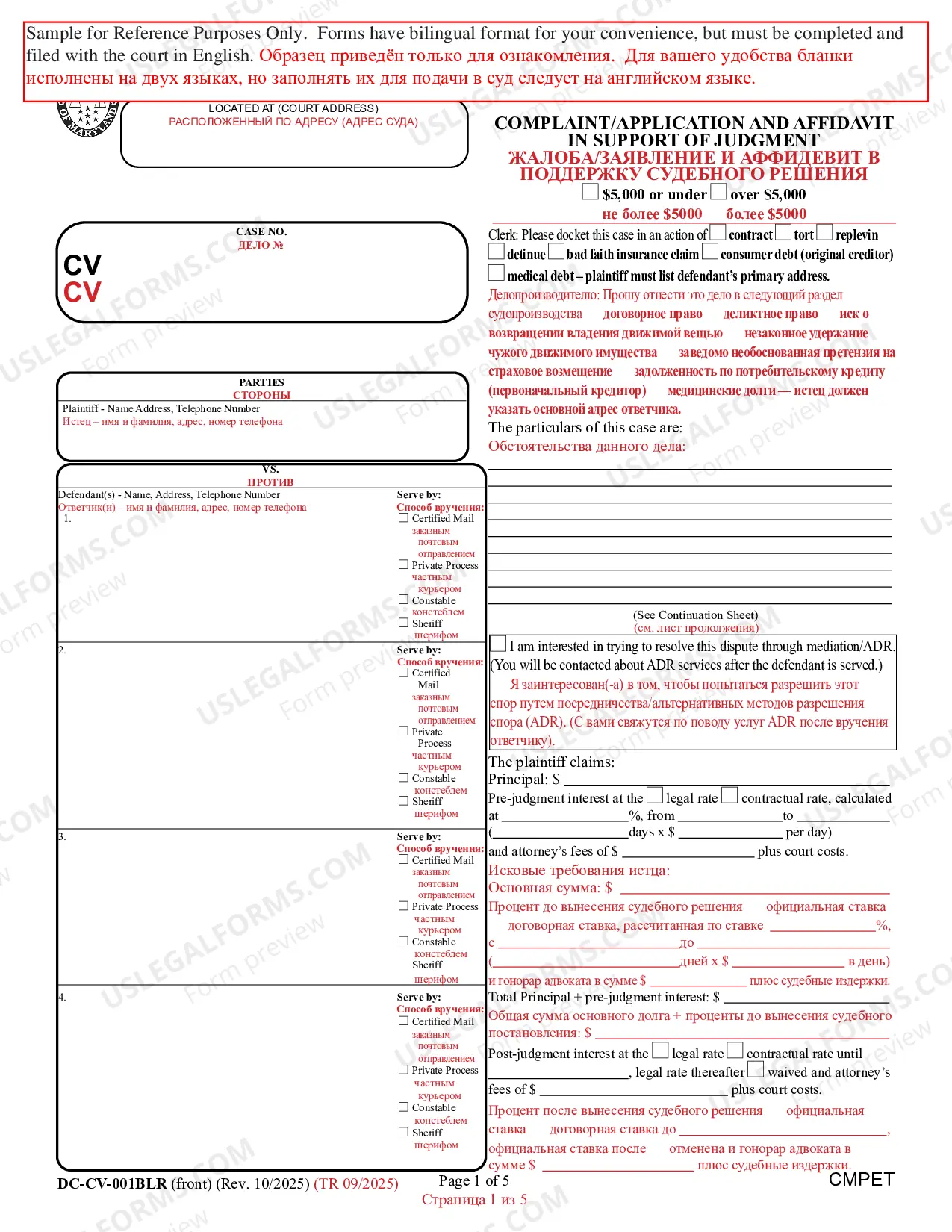
Complaint/Application and Affidavit in Support of Judgment (Bilingual - Russian Format)
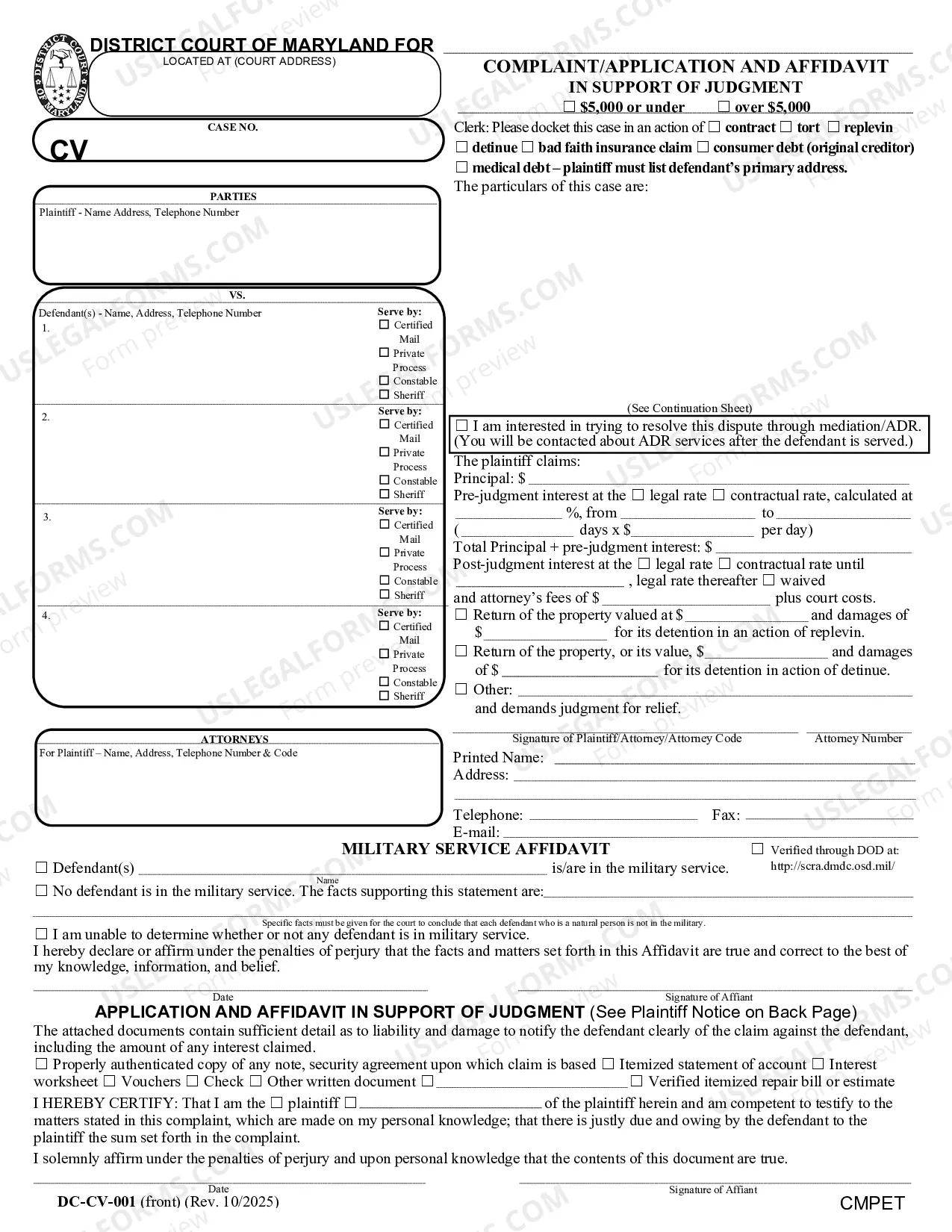
Complaint And Affidavit - Application For Forfeiture of Contraband Money
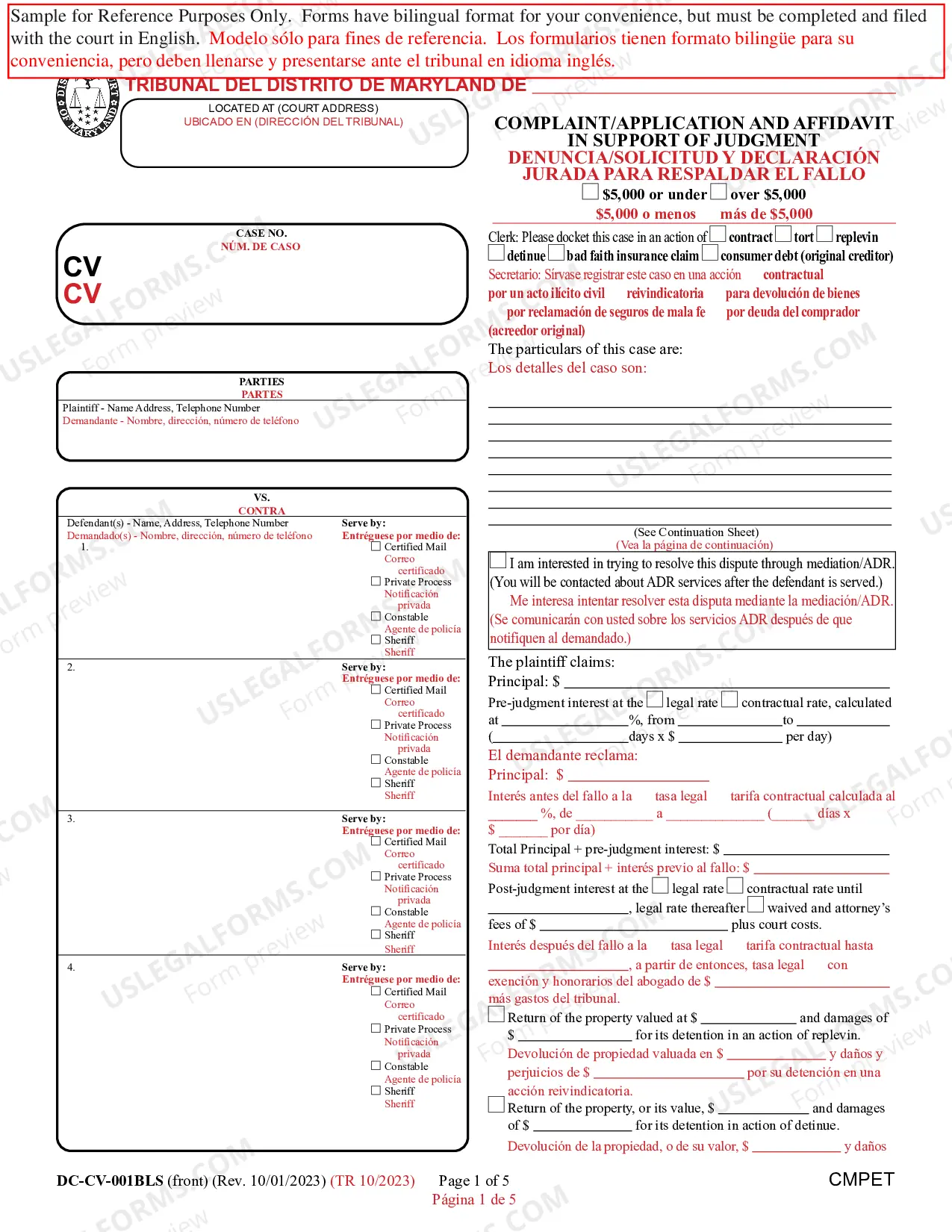
Complaint/Application and Affidavit in Support of Judgment (Bilingual - Spanish Format)
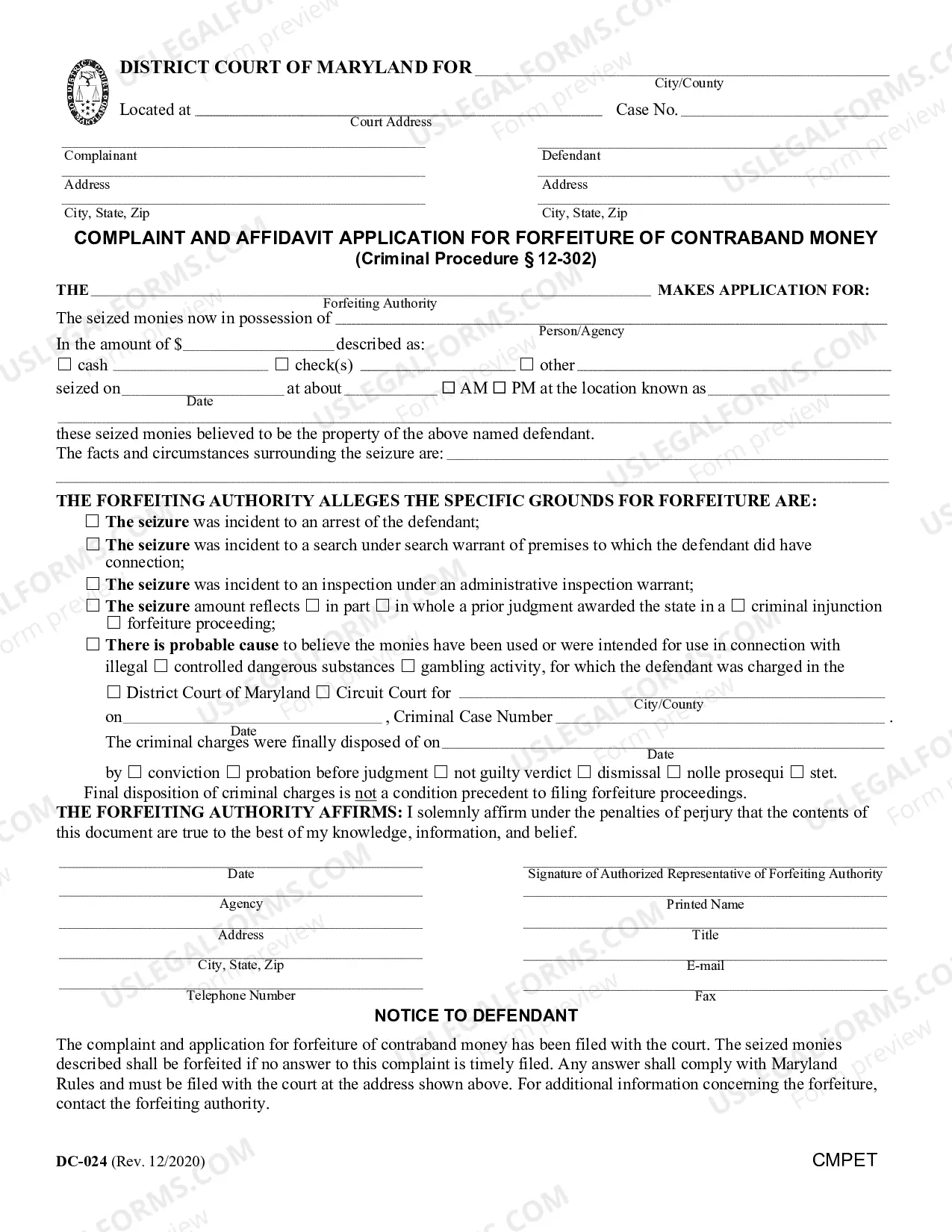
Complaint - Assigned Consumer Debt
Trusted and secure by over 3 million people of the world’s leading companies
Chapter 58.--PERSONAL AND REAL PROPERTY
Article 25.--LANDLORDS AND TENANTS
Tenants at will; terms of lease in certain cases:
Any person in the possession of real property
with the assent of the owner is presumed to be a tenant at will, unless
the contrary is shown except as herein otherwise provided. Where a landlord
is renting farms in large numbers and a total acreage in excess of five
thousand acres, and has tenants in excess of ten or more, and by the lease
requires such tenants to erect or own and maintain substantially all of
the buildings and improvements on the farm, such lease shall contain
just and fair provisions for the free sale and transfer of such buildings
and improvements, or the purchase thereof by the landlord, without requiring
the tenant to remove the same from the land. Ch. 58, Art. 25, Sec.58-2501.
When tenant may remove buildings and improvements:
Where the tenant in possession of farm lands
under lease, with the owner as provided in K.S.A. 58-2501 owns substantially
all the improvements on the land, the tenant may transfer his or her term
and improvements without the consent of the landlord, and any provisions
in the lease prohibiting such transfer or requiring the tenant or the tenant's
assignee to remove such buildings or improvements, that does not require
the landlord or the new tenant to pay the owner thereof the fair value
of the improvements to the land at the time of the expiration of the lease,
shall be void. Ch. 58, Art. 25, Sec.58-2501a.
Tenants from year to year:
When premises are let for one or more years,
and the tenant with the assent of the landlord continues to occupy the
premises after the expiration of the term, such tenant shall be deemed
to be a tenant from year to year. Ch. 58, Art. 25, Sec.58-2502.
Rent payable at intervals:
When rent is reserved payable at intervals of
three months or less, the tenant shall be deemed to hold from one period
to another equal to the interval between the days of payment, unless there
is an express contract to the contrary. Ch. 58, Art. 25, Sec.58-2503.
Termination of tenancy at will; notice:
Thirty days' notice in writing is necessary
to be given by either party before he or she can terminate a tenancy at
will, or from one period to another of three months or less; but where
in any case rent is reserved payable at intervals of less than thirty days,
the length of notice need not be greater than such interval between the
days of payment: Provided, however, That when premises are furnished or
let by an employer to an employee, said tenancy shall cease and determine
ten days after written notice to vacate: Provided further, That not more
than fifteen (15) days' notice in writing by a tenant shall be necessary
to terminate any tenancy as described in this section of persons in the
military service of the United States in which the termination of tenancy
is necessitated by military orders. Ch. 58, Art. 25, Sec.58-2504.
Termination of tenancy from year-to-year; notice:
All tenancies from year to year, other than
farm tenancies from year-to-year, may be terminated by at least thirty
days' notice in writing, given to the tenant prior to the expiration of
the year. Ch. 58, Art. 25, Sec.58-2505.
Termination of farm tenancies; notice:
(a) Except as may be otherwise provided by this section or by a written lease signed by the parties thereto, in cases of tenants occupying and cultivating farms the notice to terminate such a farm tenancy must be given in writing at least 30 days prior to March 1 and must fix the termination of the tenancy to take place on March 1.
(b) When a notice of termination is given pursuant to subsection (a) after a fall seeded grain crop has been planted, as to that part of the farm which is planted to a fall seeded grain crop on cropland which has been prepared in conformance with normal practices in the area, the notice shall be construed as fixing the termination of the tenancy of such portion to take place on the day following the last day of harvesting such crop or crops, or August 1, whichever comes first.
(c) When a notice of termination is given pursuant to subsection (a) after the 30th day preceding March 1 and prior to the planting of a fall seeded grain crop on cropland which has been prepared in conformance with normal practices in the area, in any year in which a fall seeded grain crop has been or will be harvested, the notice shall be construed as fixing the termination of the tenancy of that part of the farm devoted to fall seeded grain crops on the day following the last day of harvesting such crop or crops in the succeeding year or August 1 of such succeeding year, whichever comes first.
(d) Subject to the provisions of subsections (b) and (c), a farm tenant becomes a tenant from year-to-year by occupying the premises after the expiration of the term fixed in a written lease, in which case the notice of termination of tenancy must fix the termination of tenancy to take place on the same day of the same month following the service of the notice as the day and month of termination fixed in the original lease under which the tenant first occupied the premises. Such notice shall be written and given to the tenant at least 30 days prior to such termination date. Ch. 58, Art. 25, Sec.58-2506.
Termination of farm tenancies; landlord's liability for certain substances and services provided by tenant:
(a) When a notice of termination is given by the landlord pursuant to subsection (a) or (d) of K.S.A. 58-2506 and amendments thereto, and the tenant prior to receiving such notice has (1) performed customary tillage practices or has applied or furnished fertilizers, herbicides or pest control substances and (2) has not planted the ground, the landlord shall pay the tenant the fair and reasonable value of the services furnished and the fertilizers, herbicides or pest control substances furnished.
(b) Where a farm tenancy is terminated by the landlord on March 1 pursuant to subsection (a) of K.S.A. 58-2506 and amendments thereto, and the tenant planted and obtained a satisfactory stand of alfalfa the preceding fall, the landlord shall pay the tenant the fair and reasonable value of all services performed in preparing and planting the alfalfa and for all of the tenant's expenditures for seed, fertilizer, herbicide or pest control substances. Ch. 58, Art. 25, Sec.58-2506a.
Termination of lease for three months or longer; notice; effect
of payment of rent:
If a tenant for a period of three months or
longer neglect or refuse to pay rent when due, ten days' notice in writing
to quit shall determine the lease, unless such rent be paid before the
expiration of said ten days. Ch. 58, Art. 25, Sec.58-2507.
Termination of tenancy of less than three months for nonpayment
of rent; notice:
If a tenant for a period of less than three
months shall neglect or refuse to pay rent when due, three days' notice
in writing to quit shall determine the same, unless such rent be paid before
the expiration of said three days. Ch. 58, Art. 25, Sec.58-2508.
Notice to quit not necessary, when:
Where the time for the termination of a tenancy
is specified in the contract, or where a tenant at will commits waste,
or in the case of a tenant by sufferance, and in any case where the relation
of landlord and tenant does not exist, no notice to quit shall be necessary.
Ch. 58, Art. 25, Sec.58-2509.
Service of notice of termination of lease or tenancy:
Notice as required in the preceding sections
may be served on the tenant, or, if the tenant cannot be found, by leaving
a copy thereof at the tenant's usual place of residence, or by delivering
a copy thereof to some person over 12 years of age residing on the premises,
or, if no person is found upon the premises, by posting a copy of the notice
in a conspicuous place thereon, or by registered mail, registered mail
return receipt requested, or certified mail, return receipt requested,
addressed to the tenant at the tenant's usual place of residence. Proof
of service by registered mail may be by the affidavit of the person mailing
such notice or by the return receipt. Proof of service by certified mail
may be by the return receipt. Ch. 58, Art. 25, Sec.58-2510.
Assignment or transfer by tenant, when:
No tenant for a term not exceeding two years,
or at will, or by sufferance, shall assign or transfer his or her term
or interest or any part thereof to another without the written consent
of the landlord or person holding under the landlord. Ch. 58, Art.
25, Sec.58-2511.
Same; re-entry upon violation of 58-2511:
If any tenant shall violate the provisions of
the preceding section, the landlord or person holding under the landlord,
after giving ten days' notice to quit possession, shall have a right to
re-enter the premises and take possession thereof and dispossess the tenant,
subtenant or undertenant. Ch. 58, Art. 25, Sec.58-2512.
Attornment of tenant unnecessary; payment of rent:
A conveyance of real estate or of any interest
therein by a landlord shall be valid without the attornment of the tenant;
but the payment of rent by the tenant to the grantor at any time before
notice of sale given to said tenant shall be good against the grantee.
Ch. 58, Art. 25, Sec.58-2513.
Attornment of tenant to stranger void, when:
The attornment of a tenant to a stranger shall
be void, and shall not affect the possession of his or her landlord unless
it be made with the consent of the landlord, or pursuant to a judgment
at law or the order or decree of a court. Ch. 58, Art. 25, Sec. 58-2514.
Remedies of sublessees:
Sublessees shall have the same remedy upon the
original covenant against the principal landlord as they might have had
against their immediate lessor. Ch. 58, Art. 25, Sec.58-2515.
Remedies of alienees of lessors and lessees:
Alienees of lessors and lessees of land shall
have the same legal remedies in relation to such land as their principal.
Ch. 58, Art. 25, Sec.58-2516.
Rents from lands granted for life:
Rents from lands granted for life or lives may
be recovered as other rents. Ch. 58, Art. 25, Sec.58-2517.
Recovery of rents dependent on life of another:
A person entitled to rents dependent on the
life of another may recover arrears unpaid at the death of that other.
Ch. 58, Art. 25, Sec.58-2518.
Executors and administrators, remedies and liabilities:
Executors and administrators shall have the
same remedies to recover rents, and be subject to the same liabilities
to pay them, as their testators and intestates. Ch. 58, Art. 25,
Sec.58-2519.
Occupant without special contract:
The occupant without special contract, of any
lands, shall be liable for the rent to any person entitled thereto.
Ch. 58, Art. 25, Sec.58-2520.
Repairs and improvements by cotenant:
If a joint tenant, or tenant in common, or tenant
in coparcenary, have by consent management of the estate, and make repairs
and improvements with the knowledge and without objection of his or her
cotenant or coparcener, such cotenant or coparcener shall contribute ratably
thereto. Ch. 58, Art. 25, Sec.58-2521.
Recovery by cotenant of rents and profits:
A joint tenant, or tenant in common, or tenant
in coparcenary, may maintain an action against his or her cotenant or coparcener
or their personal representatives, for receiving more than his or her just
proportion of the rents and profits. Ch. 58, Art. 25, Sec.58-2522.
Action by remainderman or reversioner for waste or trespass:
A person seized of an estate in remainder or
reversion may maintain an action for waste or trespass for injury to the
inheritance, notwithstanding an intervening estate for life or years.
Ch. 58, Art. 25, Sec.58-2523.
Rent as lien on crop:
Any rent due for farming land shall be a lien
on the crop growing or made on the premises. Such lien may be enforced
by action and attachment therein, as hereinafter provided. Ch. 58,
Art. 25, Sec.58-2524.
Same; lessor's remedies when rent payable in share of crop:
When any such rent is payable in a share or
certain proportion of the crop, the lessor shall be deemed the owner of
such share or proportion, and may, if the tenant refuse to deliver the
lessor such share or proportion, enter upon the land and take possession
of the same, or obtain possession thereof by action of replevin.
Ch. 58, Art. 25, Sec.58-2525.
Recovery of rent from purchaser of crop:
The person entitled to the rent may recover
from the purchaser of the crop, or any part thereof, with notice of the
lien the value of the crop purchased, to the extent of the rent due and
damages. Ch. 58, Art. 25, Sec.58-2526.
Attachment for nonpayment of rent; grounds; affidavit and bond:
When any person who shall be liable to pay rent
(whether the same be due or not, if it be due within one year thereafter,
and whether the same be payable in money or other things) intends to remove,
or is removing, or has within thirty days removed his or her property,
or the crops, or any part thereof, from the leased premises, the person
to whom the rent is owing may commence an action in the court having jurisdiction;
and upon making an affidavit stating the amount of rent for which such
person is liable, and one or more of the above facts, and executing an
undertaking as in other cases, an attachment shall issue in the same manner
and with the like effect as is provided by law in other actions.
Ch. 58, Art. 25, Sec.58-2527.
Same; contents of affidavit; proceedings:
In an action to enforce a lien on crops for
rent of farming lands, the affidavit for an attachment shall state that
there is due from the defendant to the plaintiff a certain sum, naming
it, for rent of farming lands, describing the same, and that the plaintiff
claims a lien on the crop made on such land. Upon making and filing such
affidavit and executing an undertaking as prescribed in the preceding section,
an order of attachment shall issue as in other cases, and shall be levied
on such crop, or so much thereof as may be necessary; and all other proceedings
in such attachment shall be the same as in other actions. Ch. 58,
Art. 25, Sec.58-2528.
Tenant may waive exemptions:
A tenant may waive, in writing, the benefit
of the exemption laws of this state for all debts contracted for rents.
Ch. 58, Art. 25, Sec.58-2530.
Leasing of farm lands; provisions in certain contracts enumerated:
Whereas, Much farming land in this state is
owned by persons or corporations for money rent as the sole business of
the owners, the rentals of said lands being evidenced and secured by written
lease contracts obligating the tenants to pay as rent therefor large sums
of money fully equal to the fair and reasonable rental value of the land
without any other or further rental obligation on the tenants' part; and
Whereas, Said lease contracts contain requirements
obligating the tenants in addition to the payment of said agreed rental
to pay to the landlord all taxes or assessments of every kind or nature
levied or assessed upon said leased land, and if not paid promptly when
due the amount thereof to be added to the agreed rent proper, such unpaid
taxes and assessments thenceforth to bear large interest rates until paid,
the whole of said rent, taxes, assessments, and interest to be carried
forward and added to the like amounts payable during the succeeding years
of the tenancy, and extensions thereof; and
Whereas, Said lease contracts contain the further
requirements that all rent inclusive of said taxes, assessments, and interest
shall constitute a lien on all crops growing or made on the leased land
during the tenancy or extension thereof, and likewise on all teams, farming
implements, and machinery owned by the tenant and used by the tenant on
the land during the lease period, that said lease may be filed as a chattel
mortgage, and further that before July first, on the landlord's demand,
the tenant shall execute a chattel mortgage proper, as additional security
for the payment of the rent for the current year; and
Whereas, At the original leasing of said lands
they were without buildings, fences, or other improvements necessary to
farm tillage, the tenant and all succeeding tenants obligating themselves
in said lease contracts to erect or make all buildings, fences, and other
like improvements necessary to the efficient cultivation of the land, the
landlord thereof making no improvements nor obligating himself or herself
to do so, but reserving to himself or herself a lien on all improvements
made by the tenant and only allowing the removal of any such on the termination
of the tenancy and full payment of all rent, taxes, assessments, and interest
as aforesaid, and the performance of all other obligations of the lease;
and
Whereas, Many other burdensome and laborious
requirements on the tenants' part are contained in said lease contracts,
such as pulling up, cleaning out and destroying all burrs, thistles and
other weeds on the land and the public roads bounding the same; mowing
or plowing all lands sown to small grain the preceding season, cultivating,
protecting and maintaining hedge rows, fences, fruit and other trees growing
on the land, by the first of August; and by the first of October cleaning,
plowing, scraping and digging out all ditches and drains; and by the first
of January trimming all hedges and burning the brush thereof; and in default
of the performances named by the time stated pay to the landlord seventy-five
cents per rod for the ditches and drains, twenty-five cents per rod for
the hedges, two dollars per acre for land left in burrs or weeds, and one
dollar per acre for stubble land not mowed or plowed; such sums of stipulated
damage to be added to the rent of the land as though a part thereof; and
Whereas, Many restrictions and requirements
on the tenants' right to cultivate the kinds of crops to be grown on the
lands are dictated to the tenant in said lease contracts which embarrass
him or her in earning the stipulated money rental, for failure to comply
with which a further money payment per acre is charged as rent. It is expressly
provided in said lease contracts that the tenant shall not allow grain
stalks grown on the land to be eaten by the tenants' animals, the landlord
reserving such grain stalks to himself or herself; and as a further burden
on the tenant and as a further security to the landlord the tenants are
made to waive the benefit of the exemption, valuation and appraisement
laws of the state. Ch. 58, Art. 25, Sec.58-2531.
Terms of such contracts variant from approved rental agreements:
The foregoing lease conditions and requirements
are variant from the ordinary and generally used and approved rental agreements
between landlord and tenant in the particulars above mentioned, are harsh,
burdensome, oppressive and extortionate in their terms, and are entered
into by necessitous persons only because of the scarcity of other rental
lands. On account of the pledge of lien by the tenant to the landlord of
the tenant's crops, teams, and all his or her other property the tenant
is deprived of credit with merchants and banks for the purchase of the
comforts and conveniences of ordinary farm life, his or her children deprived
of educational advantages, and himself or herself and family kept impoverished
in condition and estate. Ch. 58, Art. 25, Sec.58-2532.
Such lease contracts against public policy and unenforceable;
tenants to pay fair and reasonable sums:
Lease agreements containing all of the burdensome
requirements heretofore recited are hereby declared to be against the public
policy of the state, illegal and unenforceable, and the tenants subscribing
to the same obligated to pay under said leases as rents for the lands only
fair and reasonable sums with an accord of lien only on the total crops
grown on the leased land and on the total of the livestock raised on share
or lease, and on the total receipts or returns from pasture received by
the tenants including an accord of lien on the tenants' livestock sufficient
to pay pasturage on the tenants' livestock on the landlords' land.
Ch. 58, Art. 25, Sec. 58-2533.
Title of act:
This act shall be known and may be cited as
the "residential landlord and tenant act." Ch. 58, Art. 25, Sec.58-2540.
Arrangements not subject to act:
Unless created to avoid the application of this
act, the following arrangements are not governed by this act:
(a) Residence at an institution, public or private, if incidental to detention or the provision of medical, geriatric, educational, counseling, religious or similar service;
(b) occupancy under a contract of sale of a dwelling unit or the property of which it is a part, if the occupant is the purchaser or a person who succeeds to the purchaser's interest;
(c) occupancy by a member of a fraternal or social organization in the portion of a structure operated for the benefit of the organization;
(d) transient occupancy in a hotel, motel or rooming house;
(e) occupancy by an employee of a landlord whose right to occupancy is conditional upon employment in and about the premises;
(f) occupancy by an owner of a condominium unit or a holder of a proprietary lease in a cooperative; and
(g) occupancy under a rental agreement covering premises used by the occupant primarily for agricultural purposes. Ch. 58, Art. 25, Sec.58-2541.
Jurisdiction of courts; procedure:
The district court shall have jurisdiction over any landlord or
tenant with respect to any conduct in this state governed by this act or
with respect to any claim arising from a transaction subject to this act,
and notwithstanding the provisions of subsection (b) of K.S.A. 61-1603,
and any amendments thereto, such actions may be commenced pursuant to the
code of civil procedure for limited actions. Unless otherwise specifically
provided in this act, the code of civil procedure for limited actions shall
govern any action commenced pursuant to this act. Ch. 58, Art. 25,
Sec.58-2542.
Definitions: As used in this act:
(a) "Action" includes recoupment, counterclaim, setoff, suit in equity and any other proceeding in which rights are determined, including an action for possession.
(b) "Building and housing codes" includes any law, ordinance or governmental regulation concerning fitness for habitation, or the construction, maintenance, operation, occupancy, use or appearance of any premises or dwelling unit.
(c) "Dwelling unit" means a structure or the part of a structure that is used as a home, residence or sleeping place by one person who maintains a household or by two or more persons who maintain a common household; but such term shall not include real property used to accommodate a manufactured home or mobile home, unless such manufactured home or mobile home is rented or leased by the landlord.
(d) "Good faith" means honesty in fact in the conduct of the transaction concerned.
(e) "Landlord" means the owner, lessor or sublessor of the dwelling unit, or the building of which it is a part, and it also means a manager of the premises who fails to disclose as required by K.S.A. 58-2551 and amendments thereto.
(f) "Organization" includes a corporation, government, governmental subdivision or agency, business trust, estate, trust, partnership or association, two or more persons having a joint or common interest, and any other legal or commercial entity.
(g) "Owner" means one or more persons, jointly or severally, in whom is vested:
(1) All or part of the legal title to property; or
(2) all or part of the beneficial ownership and a right to prevent use and enjoyment of the premises; and such term includes a mortgagee in possession.
(h) "Person" includes an individual or organization.
(i) "Premises" means a dwelling unit and the structure of which it is a part and facilities and appurtenances therein and grounds, areas and facilities held out for the use of tenants generally or the use of which is promised to the tenant.
(j) "Rent" means all payments to be made to the landlord under the rental agreement, other than the security deposit.
(k) "Rental agreement" means all agreements, written or oral, and valid rules and regulations adopted under K.S.A. 58-2556 and amendments thereto, embodying the terms and conditions concerning the use and occupancy of a dwelling unit and premise.
(l) "Roomer" means a person occupying a dwelling unit that lacks a major bathroom and kitchen facility, in a structure where one or more major facilities are used in common by occupants of the dwelling unit and other dwelling units. As used herein, a major bathroom facility means a toilet, and either a bath or shower, and a major kitchen facility means a refrigerator, stove and sink.
(m) "Security deposit" means any sum of money specified in a rental agreement, however denominated, to be deposited with a landlord by a tenant as a condition precedent to the occupancy of a dwelling unit, which sum of money, or any part thereof, may be forfeited by the tenant under the terms of the rental agreement upon the occurrence or breach of conditions specified therein.
(n) "Single family residence" means a structure maintained and used as a single dwelling unit. Notwithstanding that a dwelling unit shares one or more walls with another dwelling unit, it is a single family residence if it has direct access to a street or thoroughfare and shares neither heating facilities, hot water equipment, nor any other essential facility or service with any other dwelling unit.
(o) "Tenant" means a person entitled under a rental agreement to occupy a dwelling unit to the exclusion of others. Ch. 58, Art. 25, Sec.58-2543.
Finding of unconscionability; remedies; evidence:
(a) If the court, as a matter of law, finds:
(1) A rental agreement or any provision thereof was unconscionable when made, the court may refuse to enforce the agreement, enforce the remainder of the agreement without the unconscionable provision, or limit the application of any unconscionable provision to avoid an unconscionable result; or
(2) a settlement in which a party waives or agrees to forego a claim or right under this act or under a rental agreement was unconscionable at the time it was made, the court may refuse to enforce the settlement, enforce the remainder of the settlement without the unconscionable provision or limit the application of any unconscionable provision to avoid any unconscionable result.
(b) If unconscionability is put into issue by a party or by the court upon its own motion, the parties shall be afforded a reasonable opportunity to present evidence as to the setting, purpose and effect of the rental agreement or settlement to aid the court in making the determination. Ch. 58, Art. 25, Sec.58-2544.
Rental agreement; terms and conditions in absence thereof:
(a) The landlord and tenant may include in a rental agreement, terms and conditions not prohibited by this act or other rule of law, including rent, term of the agreement and other provisions governing the rights and obligations of the parties.
(b) In absence of agreement, the tenant shall pay as rent the fair rental value for the use and occupancy of the dwelling unit.
(c) Rent shall be payable without demand or notice at the time and place agreed upon by the parties. Unless otherwise agreed, rent is payable at the dwelling unit, and periodic rent is payable at the beginning of any term of one (1) month or less and otherwise in equal monthly installments at the beginning of each month. Unless otherwise agreed, rent shall be uniformly apportionable from day-to-day.
(d) Unless the rental agreement fixes a definite term, the tenancy shall be week-to-week, in the case of a roomer who pays weekly rent, and in all other cases month-to-month. Ch. 58, Art. 25, Sec.58-2545.
Same; agreement not signed and delivered given effect by certain actions; limitation on term:
(a) If the landlord does not sign and deliver a written rental agreement which has been signed and delivered to such landlord by the tenant, the knowing acceptance of rent without reservation by the landlord gives the rental agreement the same effect as if it had been signed and delivered by the landlord.
(b) If the tenant does not sign and deliver a written rental agreement which has been signed and delivered to such tenant by the landlord, the knowing acceptance of possession and payment of rent without reservation gives the rental agreement the same effect as if it had been signed and delivered by the tenant.
(c) If a rental agreement given effect by the operation of this section provides for a term longer than one year, it is effective only for one year. Ch. 58, Art. 25, Sec.58-2546.
Same; prohibited terms and conditions; damages:
(a) No rental agreement may provide that the tenant or landlord:
(1) Agrees to waive or to forego rights or remedies under this act;
(2) authorizes any person to confess judgment on a claim arising out of the rental agreement;
(3) agrees to pay either party's attorneys' fees; or
(4) agrees to the exculpation or limitation of any liability of either party arising under law or to indemnify either party for that liability or the costs connected therewith, except that a rental agreement may provide that a tenant agrees to limit the landlord's liability for fire, theft or breakage with respect to common areas of the dwelling unit.
(b) A provision prohibited by subsection (a) included in a rental agreement is unenforceable. If a landlord deliberately uses a rental agreement containing provisions known by such landlord to be prohibited, the tenant may recover actual damages sustained by such tenant. Ch. 58, Art. 25, Sec.58-2547.
Inventory of premises by landlord and tenant, when; copies:
Within five (5) days of the initial date of
occupancy or upon delivery of possession, the landlord, or such landlord's
designated representative, and the tenant shall jointly inventory the premises.
A written record detailing the condition of the premises and any furnishings
or appliances provided shall be completed. Duplicate copies of the record
shall be signed by the landlord and the tenant as an indication the inventory
was completed. The tenant shall be given a copy of the inventory.
Ch. 58, Art. 25, Sec.58-2548.
Receipt of rent subject to certain obligations:
A rental agreement, assignment, conveyance,
trust deed or security instrument may not permit the receipt of rent free
of the obligation to comply with subsection (a) of K.S.A. 58-2553.
Ch. 58, Art. 25, Sec.58-2549.
Security deposits; amounts; retention; return; damages for noncompliance:
(a) A landlord may not demand or receive a security deposit for an unfurnished dwelling unit in an amount or value in excess of one month's periodic rent. If the rental agreement provides for the tenant to use furniture owned by the landlord, the landlord may demand and receive a security deposit not to exceed 1 1/2 months' rent, and if the rental agreement permits the tenant to keep or maintain pets in the dwelling unit, the landlord may demand and receive an additional security deposit not to exceed 1/2 of one month's rent. A municipal housing authority created under the provisions of K.S.A. 17-2337 et seq., and amendments thereto, which is wholly or partially subsidized by aid from the federal government, pursuant to a rental agreement in which rent is determined solely by the personal income of the tenant, may demand and receive a security deposit in accordance with a schedule established by the housing authority, which is based on the bedroom unit size of the dwelling unit. Any such municipal housing authority which establishes such a schedule shall provide a deferred payment plan whereby the tenant may pay the deposit in reasonable increments over a period of time.
(b) Upon termination of the tenancy, any security deposit held by the landlord may be applied to the payment of accrued rent and the amount of damages which the landlord has suffered by reason of the tenant's noncompliance with K.S.A. 58-2555, and amendments thereto, and the rental agreement, all as itemized by the landlord in a written notice delivered to the tenant. If the landlord proposes to retain any portion of the security deposit for expenses, damages or other legally allowable charges under the provisions of the rental agreement, other than rent, the landlord shall return the balance of the security deposit to the tenant within 14 days after the determination of the amount of such expenses, damages or other charges, but in no event to exceed 30 days after termination of the tenancy, delivery of possession and demand by the tenant. If the tenant does not make such demand within 30 days after termination of the tenancy, the landlord shall mail that portion of the security deposit due the tenant to the tenant's last known address.
(c) If the landlord fails to comply with subsection (b) of this section, the tenant may recover that portion of the security deposit due together with damages in an amount equal to 1 1/2 the amount wrongfully withheld.
(d) Except as otherwise provided by the rental agreement, a tenant shall not apply or deduct any portion of the security deposit from the last month's rent or use or apply such tenant's security deposit at any time in lieu of payment of rent. If a tenant fails to comply with this subsection, the security deposit shall be forfeited and the landlord may recover the rent due as if the deposit had not been applied or deducted from the rent due.
(e) Nothing in this section shall preclude the landlord or tenant from recovering other damages to which such landlord or tenant may be entitled under this act.
(f) The holder of the landlord's interest in the premises at the time of the termination of the tenancy shall be bound by this section. Ch. 58, Art. 25, Sec.58-2550.
Disclosures required of landlord or person authorized to enter rental agreement; person failing to comply becomes landlord's agent for certain purposes:
(a) The landlord or any person authorized to enter into a rental agreement on the landlord's behalf shall disclose to the tenant in writing, at or before the commencement of the tenancy, the name and address of:
(1) The person authorized to manage the premises; and
(2) an owner of the premises or a person authorized to act for and on behalf of the owner for the purpose of service of process and for the purpose of receiving and receipting for notices and demands.
(b) The information required to be furnished by this section shall be kept current and this section extends to and is enforceable against any successor landlord, owner or manager.
(c) A person who fails to comply with subsection (a) becomes an agent of each person who is a landlord for the purpose of:
(1) Service of process and receiving and receipting for notices and demands; and
(2) performing the obligations of the landlord under this act and under the rental agreement and expending or making available for such purpose all rent collected from the premises. Ch. 58, Art. 25, Sec.58-2551.
Delivery of possession of premises; action for possession; damages:
At the commencement of the term the landlord
shall deliver possession of the premises to the tenant in compliance with
the rental agreement and K.S.A.58-2553. The landlord may bring an action
for possession against any person wrongfully in possession and may recover
the damages provided in subsection (c) of K.S.A. 58-2570. Ch. 58,
Art. 25, Sec.58-2552.
Duties of landlord; agreement that tenant perform landlord's duties; limitations:
(a) Except when prevented by an act of God, the failure of public utility services or other conditions beyond the landlord's control, the landlord shall:
(1) Comply with the requirements of applicable building and housing codes materially affecting health and safety. If the duty imposed by this paragraph is greater than any duty imposed by any other paragraph of this subsection, the landlord's duty shall be determined in accordance with the provisions of this paragraph;
(2) exercise reasonable care in the maintenance of the common areas;
(3) maintain in good and safe working order and condition all electrical, plumbing, sanitary, heating, ventilating and air-conditioning appliances including elevators, supplied or required to be supplied by such landlord;
(4) except where provided by a governmental entity, provide and maintain on the grounds, for the common use by all tenants, appropriate receptacles and conveniences for the removal of ashes, garbage, rubbish and other waste incidental to the occupancy of the dwelling unit and arrange for their removal; and
(5) supply running water and reasonable amounts of hot water at all times and reasonable heat, unless the building that includes the dwelling units is not required by law to be equipped for that purpose, or the dwelling unit is so constructed that heat or hot water is generated by an installation within the exclusive control of the tenant and supplied by a direct public utility connection. Nothing in this section shall be construed as abrogating, limiting or otherwise affecting the obligation of a tenant to pay for any utility service in accordance with the provisions of the rental agreement. The landlord shall not interfere with or refuse to allow access or service to a tenant by a communication or cable television service duly franchised by a municipality.
(b) The landlord and tenants of a dwelling unit or units which provide a home, residence or sleeping place for not to exceed four households having common areas may agree in writing that the tenant is to perform the landlord's duties specified in paragraphs (4) and (5) of subsection (a) of this section and also specified repairs, maintenance tasks, alterations or remodeling, but only if the transaction is entered into in good faith and not for the purpose of evading the obligations of the landlord.
(c) The landlord and tenant of any dwelling unit, other than a single family residence, may agree that the tenant is to perform specified repairs, maintenance tasks, alterations or remodeling only if:
(1) The agreement of the parties is entered into in good faith, and not to evade the obligations of the landlord, and is set forth in a separate written agreement signed by the parties and supported by adequate consideration;
(2) the work is not necessary to cure noncompliance with subsection (a)(1) of this section; and
(3) the agreement does not diminish or affect the obligation of the landlord to other tenants in the premises.
(d) The landlord may not treat performance of the separate agreement described in subsection (c) of this section as a condition to any obligation or the performance of any rental agreement. Ch. 58, Art. 25, Sec.58-2553.
Conveyance by landlord or termination by manager; notice; no liability for subsequent events:
(a) Unless otherwise agreed, a landlord, who conveys premises that include a dwelling unit subject to a rental agreement in a good faith sale to a bona fide purchaser, is relieved of liability under the rental agreement and this act as to events occurring subsequent to written notice to the tenant of the conveyance. However, such landlord remains liable to the tenant for any portion of a security deposit to which the tenant is entitled under K.S.A. 58-2550.
(b) Unless otherwise agreed, a manager of premises that include a dwelling unit is relieved of liability under the rental agreement and this act as to events occurring after written notice to the tenant of the termination of such manager's management. Ch. 58,
Duties of tenant:
The tenant shall:
(a) Comply with all obligations primarily imposed upon tenants by applicable provisions of building and housing codes materially affecting health and safety;
(b) keep that part of the premises that such tenant occupies and uses as clean and safe as the condition of the premises permit;
(c) remove from such tenant's dwelling unit all ashes, rubbish, garbage and other waste in a clean and safe manner;
(d) keep all plumbing fixtures in the dwelling unit or used by the tenant as clean as their condition permits;
(e) use in a reasonable manner all electrical, plumbing, sanitary, heating, ventilating, air-conditioning and other facilities and appliances, including elevators in the premises;
(f) be responsible for any destruction, defacement, damage, impairment or removal of any part of the premises caused by an act or omission of the tenant or by any person or animal or pet on the premises at any time with the express or implied permission or consent of the tenant;
(g) not engage in conduct or allow any person or animal or pet, on the premises with the express or implied permission or consent of the tenant, to engage in conduct that will disturb the quiet and peaceful enjoyment of the premises by other tenants. Ch. 58, Art. 25, Sec.58-2555.
Rules and regulations of landlord; when enforceable:
A landlord, from time to time, may adopt rules
or regulations, however described, concerning the tenant's use and occupancy
of the premises. Any such rule or regulation is enforceable against the
tenant only if:
(a) Its purpose is to promote the convenience, safety, peace or welfare of the tenants in the premises, preserve the landlord's property from abusive use or make a fair distribution of services and facilities held out for the tenants generally;
(b) it is reasonably related to the purpose for which it is adopted;
(c) it applies to all tenants in the premises equally;
(d) it is sufficiently explicit in its prohibition, direction or limitation of the tenant's conduct to fairly inform the tenant of what such tenant must or must not do to comply;
(e) it is not for the purpose of evading the obligations of the landlord; and
(f) the tenant has notice of it at the time such tenant enters into the rental agreement.
After the tenant enters into the rental agreement, if a rule or regulation which effects a substantial modification of the rental agreement is adopted, such rule or regulation is not enforceable against the tenant unless such tenant consents to it in writing. Ch. 58, Art. 25, Sec.58-2556.
Landlord's right to enter; limitations:
(a) The landlord shall have the right to enter the dwelling unit at reasonable hours, after reasonable notice to the tenant, in order to inspect the premises, make necessary or agreed repairs, decorations, alterations or improvements, supply necessary or agreed services, or exhibit the dwelling unit to prospective or actual purchasers, mortgagees, tenants, workmen or contractors.
(b) The landlord may enter the dwelling unit without consent of the tenant in case of an extreme hazard involving the potential loss of life or severe property damage.
(c) The landlord shall not abuse the right of access or use it to harass the tenant. Ch. 58, Art. 25, Sec.58-2557.
Use of premises; extended absence of tenant:
Unless otherwise agreed, the tenant shall occupy
such tenant's dwelling unit only as a dwelling unit. The rental agreement
may require that the tenant notify the landlord of any anticipated extended
absence from the premises in excess of seven days no later than the first
day of the extended absence. Ch. 58, Art. 25, Sec.58-2558.
Material noncompliance by landlord; notice; termination of rental agreement; limitations; remedies; security deposit: <[>(a) Except as otherwise provided in this act, if there is a material noncompliance by the landlord with the rental agreement or a noncompliance with K.S.A. 58-2553 materially affecting health and safety, the tenant may deliver a written notice to the landlord specifying the acts and omissions constituting the breach and that the rental agreement will terminate upon a periodic rent-paying date not less than thirty (30) days after receipt of the notice. The rental agreement shall terminate as provided in the notice, subject to the following:
(1) If the breach is remediable by repairs or the payment of damages or otherwise, and the landlord adequately initiates a good faith effort to remedy the breach within fourteen (14) days after receipt of the notice, the rental agreement shall not terminate. However, in the event that the same or a similar breach occurs after the fourteen-day period provided herein, the tenant may deliver a written notice to the landlord specifically describing the breach and stating that the rental agreement shall terminate upon a periodic rent-paying date not less than thirty (30) days after the receipt of such notice by the landlord. The rental agreement then shall terminate as provided in such notice.
(2) The tenant may not terminate for a condition caused by an act or omission of, or which is or can be properly attributable or applicable to, the tenant or any person or animal or pet on the premises at any time with the tenant's express or implied permission or consent.
(b) Except as otherwise provided in this act, the tenant may recover damages and obtain injunctive relief for any noncompliance by the landlord with the rental agreement or K.S.A. 58-2553. The remedy provided in this subsection shall be in addition to any right of the tenant arising under subsection (a) of this section.
(c) If the rental agreement is terminated, the landlord shall return that portion of the security deposit recoverable by the tenant under K.S.A. 58-2550.
(d) The provisions of this section shall not limit a landlord's or tenant's right to terminate the rental agreement pursuant to K.S.A. 58-2570, and amendments thereto. Ch. 58, Art. 25, Sec.58-2559.
Failure by landlord to deliver possession; remedies:
If the landlord fails to deliver possession
of the dwelling unit to the tenant as provided in K.S.A. 58-2552, rent
abates until possession is delivered and the tenant:
(a) Upon at least five days' written notice to the landlord, may terminate the rental agreement and upon termination the landlord shall return all of the security deposit; or
(b) may demand performance of the rental agreement by the landlord and, if the tenant elects, maintain an action for possession of the dwelling unit against the landlord, or any person wrongfully in possession, and recover the damages sustained by such tenant.
If a person's failure to deliver possession is willful and not in good faith, an aggrieved party may recover from such person an amount not more than one and one-half (1 1/2) months' periodic rent or one and one-half (1 1/2) times the actual damages sustained by such party, whichever is greater. Ch. 58, Art. 25, Sec.58-2560.
Action for possession for nonpayment of rent; counterclaim, waiver; accrued rent, payment into court; disposition; when judgment for tenant:
(a) In an action for possession based upon nonpayment of the rent, or in an action for rent where the tenant is in possession, the tenant shall counterclaim for any amount which such tenant may recover under the rental agreement or this act or such counterclaim shall be deemed to have been waived. In that event, the court from time to time may order the tenant to pay into court all or part of the rent accrued and thereafter accruing, and shall determine the amount due to each party. The party to whom a net amount is owed shall be paid first from the money paid into court, and the balance shall be paid by the other party. If no rent remains due after application of this section, judgment may be entered for the tenant in the action for possession.
(b) In an action for rent where the tenant is not in possession, the tenant may counterclaim as provided in subsection (a), but the tenant shall not be required to pay any rent into court. Ch. 58, Art. 25, Sec.58-2561.
Damage or destruction by fire or casualty; termination of rental agreement; notice; vacation of part of dwelling; reduction of rent; security deposit:
(a) If the dwelling unit or premises are damaged or destroyed by fire or casualty to an extent that the use and habitability of the dwelling unit is substantially impaired, the tenant:
(1) May vacate the premises immediately and shall notify the landlord in writing within five (5) days thereafter of such tenant's intention to terminate the rental agreement, in which case the rental agreement terminates as of the date of vacating; or
(2) if continued occupancy is lawful, may vacate any part of the dwelling unit rendered unusable by the fire or casualty, in which case the tenant's liability for rent is reduced in proportion to the diminution in the fair rental value of the dwelling unit.
(b) If the rental agreement is terminated pursuant to this section, the landlord shall return that portion of the security deposit recoverable by the tenant under K.S.A. 58-2550, and accounting for rent in the event of either termination of the rental agreement or apportionment of rent shall occur as of the date of vacating. Ch. 58, Art. 25, Sec.58-2562.
Unlawful removal or exclusion of tenant; diminished services;
damages; security deposit:
If the landlord unlawfully removes or excludes
the tenant from the premises or willfully diminishes services to the tenant
by interrupting or causing the interruption of electric, gas, water or
other essential service to the tenant, the tenant may recover possession
or terminate the rental agreement and, in either case, recover an amount
not more than one and one-half (1 1/2) months' periodic rent or the damages
sustained by the tenant, whichever is greater. If the rental agreement
is terminated, the landlord shall return that portion of the security deposit
recoverable by the tenant under K.S.A. 58-2550. Ch. 58, Art. 25,
Sec.58-2563.
Material noncompliance by tenant; notice; termination of rental agreement; limitations; nonpayment of rent; remedies:
(a) Except as otherwise provided in the residential landlord and tenant act, if there is a material noncompliance by the tenant with the rental agreement or a noncompliance with K.S.A. 58-2555 and amendments thereto materially affecting health and safety, the landlord may deliver a written notice to the tenant specifying the acts and omissions constituting the breach and that the rental agreement will terminate upon a date not less than 30 days after receipt of the notice, if the breach is not remedied in 14 days. The rental agreement shall terminate as provided in the notice regardless of the periodic rent-paying date, except that if the breach is remediable by repairs or the payment of damages or otherwise, and the tenant adequately initiates a good faith effort to remedy the breach prior to the date specified in the notice, the rental agreement will not terminate. However, in the event that such breach or a similar breach occurs after the 14-day period provided in this subsection, the landlord may deliver a written notice to the tenant that the rental agreement will terminate upon a date not less than 30 days after receipt of the notice without providing the opportunity to remedy the breach. The rental agreement then shall terminate as provided in such notice regardless of the periodic rent-paying date.
(b) The landlord may terminate the rental agreement if rent is unpaid when due and the tenant fails to pay rent within three days, after written notice by the landlord of nonpayment and such landlord's intention to terminate the rental agreement if the rent is not paid within such three-day period. The three-day notice period provided for in this subsection shall be computed as three consecutive 24-hour periods. When such notice is served on the tenant or to some person over 12 years of age residing on the premises, or by posting a copy of the notice in a conspicuous place thereon, the three-day period shall commence at the time of delivery or posting. When such notice is delivered by mailing, an additional two days from the date of mailing should be allowed for the tenant to pay such tenant's rent and thereby avoid having the rental agreement terminated.
(c) Except as otherwise provided in the residential landlord and tenant act, the landlord may recover damages and obtain injunctive relief for any noncompliance by the tenant with the rental agreement or K.S.A. 58-2555 and amendments thereto.
(d) The provisions of this section shall not limit a landlord's or tenant's right to terminate the rental agreement pursuant to K.S.A. 58-2570, and amendments thereto. Ch. 58, Art. 25, Sec.58-2564.
Extended absence of tenant; damages; entry by landlord; abandonment by tenant, when; reasonable effort to rent required; termination of rental agreement, when; personal property of tenant; disposition, procedure; proceeds; rights of person receiving property:
(a) If the rental agreement requires the tenant to give notice to the landlord of an anticipated extended absence in excess of seven days required in K.S.A. 58-2558, and amendments thereto, and the tenant willfully fails to do so, the landlord may recover actual damages from the tenant.
(b) During any absence of the tenant in excess of 30 days, the landlord may enter the dwelling unit at times reasonably necessary. If, after the tenant is 10 days in default for nonpayment of rent and has removed a substantial portion of such tenant's belongings from the dwelling unit, the landlord may assume that the tenant has abandoned the dwelling unit, unless the tenant has notified the landlord to the contrary.
(c) If the tenant abandons the dwelling unit, the landlord shall make reasonable efforts to rent it at a fair rental. If the landlord rents the dwelling unit for a term beginning prior to the expiration of the rental agreement, it is deemed to be terminated as of the date the new tenancy begins. The rental agreement is deemed to be terminated by the landlord as of the date the landlord has notice of the abandonment, if the landlord fails to use reasonable efforts to rent the dwelling unit at a fair rental or if the landlord accepts the abandonment as a surrender. If the tenancy is from month-to-month, or week-to-week, the term of the rental agreement for this purpose shall be deemed to be a month or a week, as the case may be.
(d) If the tenant abandons or surrenders possession of the dwelling unit and leaves household goods, furnishings, fixtures or any other personal property in or at the dwelling unit or if the tenant is removed from the dwelling unit as a result of a forcible detainer action, pursuant to K.S.A. 61-2301, et seq., and amendment thereto, and fails to remove any household goods, furnishings, fixtures or any other personal property in or at the dwelling unit after possession of the dwelling unit is returned to the landlord, the landlord may take possession of the property, store it at tenant's expense and sell or otherwise dispose of the same upon the expiration of 30 days after the landlord takes possession of the property, if at least 15 days prior to the sale or other disposition of such property the landlord shall publish once in a newspaper of general circulation in the county in which such dwelling unit is located a notice of the landlord's intention to sell or dispose of such property. Within seven days after publication, a copy of the published notice shall be mailed by the landlord to the tenant at the tenant's last known address. Such notice shall state the name of the tenant, a brief description of the property and the approximate date on which the landlord intends to sell or otherwise dispose of such property. If the foregoing requirements are met, the landlord may sell or otherwise dispose of the property without liability to the tenant or to any other person who has or claims to have an interest in such property, except as to any secured creditor who gives notice of creditor's interest in such property to the landlord prior to the sale or disposition thereof, if the landlord has no knowledge or notice that any person, other than the tenant, has or claims to have an interest in such property. During such 30 [30-day] period after the landlord takes possession of the property, and at any time prior to sale or other disposition thereof, the tenant may redeem the property upon payment to the landlord of the reasonable expenses incurred by the landlord of taking, holding and preparing the property for sale and of any amount due from the tenant to the landlord for rent or otherwise.
(e) Any proceeds from the sale or other disposition of the property as provided in subsection (d) shall be applied by the landlord in the following order:
(1) To the reasonable expenses of taking, holding, preparing for sale or disposition, giving notice and selling or disposing thereof;
(2) to the satisfaction of any amount due from the tenant to the landlord for rent or otherwise; and,
(3) the balance, if any, may be retained by the landlord, without liability to the tenant or to any other person, other than a secured creditor who gave notice of creditors interest as provided in subsection (d), for any profit made as a result of a sale or other disposition of such property.
(f) Any person who purchases or otherwise receives the property pursuant to a sale or other disposition of the property as provided under subsection (d) of this section, without knowledge that such sale or disposition is in violation of the ownership rights or security interest of a third party in the property, takes title to the property free and clear of any right, title, claim or interest of the tenant or such third party in the property. Ch. 58, Art. 25, Sec.58-2565.
Acceptance of late rent; effect:
Acceptance of late payment of rent from the
tenant without reservation by the landlord, or acceptance of performance
by the tenant, other than for payment of rent, that varies from the terms
of the rental agreement, constitutes a waiver of the landlord's right to
terminate the rental agreement for that breach, unless otherwise agreed
after the breach has occurred. Ch. 58, Art. 25, Sec.58-2566.
Lien or security interest in tenant's personal property unenforceable; distraint abolished, exception:
(a) Except as otherwise provided in this act, a lien or security interest on behalf of the landlord in the tenant's household goods, furnishings, fixtures or other personal property is not enforceable unless perfected prior to the effective date of this act.
(b) Except as otherwise provided in K.S.A. 58-2565, distraint for rent is abolished. Ch. 58, Art. 25, Sec.58-2567.
Landlord's remedies upon termination of rental agreement:
Upon termination of the rental agreement, the
landlord may have a claim and file an action for possession or for rent
or both.
Chapter 58.--PERSONAL AND REAL PROPERTY
Article 25.--LANDLORDS AND TENANTS
Tenants at will; terms of lease in certain cases:
Any person in the possession of real property
with the assent of the owner is presumed to be a tenant at will, unless
the contrary is shown except as herein otherwise provided. Where a landlord
is renting farms in large numbers and a total acreage in excess of five
thousand acres, and has tenants in excess of ten or more, and by the lease
requires such tenants to erect or own and maintain substantially all of
the buildings and improvements on the farm, such lease shall contain
just and fair provisions for the free sale and transfer of such buildings
and improvements, or the purchase thereof by the landlord, without requiring
the tenant to remove the same from the land. Ch. 58, Art. 25, Sec.58-2501.
When tenant may remove buildings and improvements:
Where the tenant in possession of farm lands
under lease, with the owner as provided in K.S.A. 58-2501 owns substantially
all the improvements on the land, the tenant may transfer his or her term
and improvements without the consent of the landlord, and any provisions
in the lease prohibiting such transfer or requiring the tenant or the tenant's
assignee to remove such buildings or improvements, that does not require
the landlord or the new tenant to pay the owner thereof the fair value
of the improvements to the land at the time of the expiration of the lease,
shall be void. Ch. 58, Art. 25, Sec.58-2501a.
Tenants from year to year:
When premises are let for one or more years,
and the tenant with the assent of the landlord continues to occupy the
premises after the expiration of the term, such tenant shall be deemed
to be a tenant from year to year. Ch. 58, Art. 25, Sec.58-2502.
Rent payable at intervals:
When rent is reserved payable at intervals of
three months or less, the tenant shall be deemed to hold from one period
to another equal to the interval between the days of payment, unless there
is an express contract to the contrary. Ch. 58, Art. 25, Sec.58-2503.
Termination of tenancy at will; notice:
Thirty days' notice in writing is necessary
to be given by either party before he or she can terminate a tenancy at
will, or from one period to another of three months or less; but where
in any case rent is reserved payable at intervals of less than thirty days,
the length of notice need not be greater than such interval between the
days of payment: Provided, however, That when premises are furnished or
let by an employer to an employee, said tenancy shall cease and determine
ten days after written notice to vacate: Provided further, That not more
than fifteen (15) days' notice in writing by a tenant shall be necessary
to terminate any tenancy as described in this section of persons in the
military service of the United States in which the termination of tenancy
is necessitated by military orders. Ch. 58, Art. 25, Sec.58-2504.
Termination of tenancy from year-to-year; notice:
All tenancies from year to year, other than
farm tenancies from year-to-year, may be terminated by at least thirty
days' notice in writing, given to the tenant prior to the expiration of
the year. Ch. 58, Art. 25, Sec.58-2505.
Termination of farm tenancies; notice:
(a) Except as may be otherwise provided by this section or by a written lease signed by the parties thereto, in cases of tenants occupying and cultivating farms the notice to terminate such a farm tenancy must be given in writing at least 30 days prior to March 1 and must fix the termination of the tenancy to take place on March 1.
(b) When a notice of termination is given pursuant to subsection (a) after a fall seeded grain crop has been planted, as to that part of the farm which is planted to a fall seeded grain crop on cropland which has been prepared in conformance with normal practices in the area, the notice shall be construed as fixing the termination of the tenancy of such portion to take place on the day following the last day of harvesting such crop or crops, or August 1, whichever comes first.
(c) When a notice of termination is given pursuant to subsection (a) after the 30th day preceding March 1 and prior to the planting of a fall seeded grain crop on cropland which has been prepared in conformance with normal practices in the area, in any year in which a fall seeded grain crop has been or will be harvested, the notice shall be construed as fixing the termination of the tenancy of that part of the farm devoted to fall seeded grain crops on the day following the last day of harvesting such crop or crops in the succeeding year or August 1 of such succeeding year, whichever comes first.
(d) Subject to the provisions of subsections (b) and (c), a farm tenant becomes a tenant from year-to-year by occupying the premises after the expiration of the term fixed in a written lease, in which case the notice of termination of tenancy must fix the termination of tenancy to take place on the same day of the same month following the service of the notice as the day and month of termination fixed in the original lease under which the tenant first occupied the premises. Such notice shall be written and given to the tenant at least 30 days prior to such termination date. Ch. 58, Art. 25, Sec.58-2506.
Termination of farm tenancies; landlord's liability for certain substances and services provided by tenant:
(a) When a notice of termination is given by the landlord pursuant to subsection (a) or (d) of K.S.A. 58-2506 and amendments thereto, and the tenant prior to receiving such notice has (1) performed customary tillage practices or has applied or furnished fertilizers, herbicides or pest control substances and (2) has not planted the ground, the landlord shall pay the tenant the fair and reasonable value of the services furnished and the fertilizers, herbicides or pest control substances furnished.
(b) Where a farm tenancy is terminated by the landlord on March 1 pursuant to subsection (a) of K.S.A. 58-2506 and amendments thereto, and the tenant planted and obtained a satisfactory stand of alfalfa the preceding fall, the landlord shall pay the tenant the fair and reasonable value of all services performed in preparing and planting the alfalfa and for all of the tenant's expenditures for seed, fertilizer, herbicide or pest control substances. Ch. 58, Art. 25, Sec.58-2506a.
Termination of lease for three months or longer; notice; effect
of payment of rent:
If a tenant for a period of three months or
longer neglect or refuse to pay rent when due, ten days' notice in writing
to quit shall determine the lease, unless such rent be paid before the
expiration of said ten days. Ch. 58, Art. 25, Sec.58-2507.
Termination of tenancy of less than three months for nonpayment
of rent; notice:
If a tenant for a period of less than three
months shall neglect or refuse to pay rent when due, three days' notice
in writing to quit shall determine the same, unless such rent be paid before
the expiration of said three days. Ch. 58, Art. 25, Sec.58-2508.
Notice to quit not necessary, when:
Where the time for the termination of a tenancy
is specified in the contract, or where a tenant at will commits waste,
or in the case of a tenant by sufferance, and in any case where the relation
of landlord and tenant does not exist, no notice to quit shall be necessary.
Ch. 58, Art. 25, Sec.58-2509.
Service of notice of termination of lease or tenancy:
Notice as required in the preceding sections
may be served on the tenant, or, if the tenant cannot be found, by leaving
a copy thereof at the tenant's usual place of residence, or by delivering
a copy thereof to some person over 12 years of age residing on the premises,
or, if no person is found upon the premises, by posting a copy of the notice
in a conspicuous place thereon, or by registered mail, registered mail
return receipt requested, or certified mail, return receipt requested,
addressed to the tenant at the tenant's usual place of residence. Proof
of service by registered mail may be by the affidavit of the person mailing
such notice or by the return receipt. Proof of service by certified mail
may be by the return receipt. Ch. 58, Art. 25, Sec.58-2510.
Assignment or transfer by tenant, when:
No tenant for a term not exceeding two years,
or at will, or by sufferance, shall assign or transfer his or her term
or interest or any part thereof to another without the written consent
of the landlord or person holding under the landlord. Ch. 58, Art.
25, Sec.58-2511.
Same; re-entry upon violation of 58-2511:
If any tenant shall violate the provisions of
the preceding section, the landlord or person holding under the landlord,
after giving ten days' notice to quit possession, shall have a right to
re-enter the premises and take possession thereof and dispossess the tenant,
subtenant or undertenant. Ch. 58, Art. 25, Sec.58-2512.
Attornment of tenant unnecessary; payment of rent:
A conveyance of real estate or of any interest
therein by a landlord shall be valid without the attornment of the tenant;
but the payment of rent by the tenant to the grantor at any time before
notice of sale given to said tenant shall be good against the grantee.
Ch. 58, Art. 25, Sec.58-2513.
Attornment of tenant to stranger void, when:
The attornment of a tenant to a stranger shall
be void, and shall not affect the possession of his or her landlord unless
it be made with the consent of the landlord, or pursuant to a judgment
at law or the order or decree of a court. Ch. 58, Art. 25, Sec. 58-2514.
Remedies of sublessees:
Sublessees shall have the same remedy upon the
original covenant against the principal landlord as they might have had
against their immediate lessor. Ch. 58, Art. 25, Sec.58-2515.
Remedies of alienees of lessors and lessees:
Alienees of lessors and lessees of land shall
have the same legal remedies in relation to such land as their principal.
Ch. 58, Art. 25, Sec.58-2516.
Rents from lands granted for life:
Rents from lands granted for life or lives may
be recovered as other rents. Ch. 58, Art. 25, Sec.58-2517.
Recovery of rents dependent on life of another:
A person entitled to rents dependent on the
life of another may recover arrears unpaid at the death of that other.
Ch. 58, Art. 25, Sec.58-2518.
Executors and administrators, remedies and liabilities:
Executors and administrators shall have the
same remedies to recover rents, and be subject to the same liabilities
to pay them, as their testators and intestates. Ch. 58, Art. 25,
Sec.58-2519.
Occupant without special contract:
The occupant without special contract, of any
lands, shall be liable for the rent to any person entitled thereto.
Ch. 58, Art. 25, Sec.58-2520.
Repairs and improvements by cotenant:
If a joint tenant, or tenant in common, or tenant
in coparcenary, have by consent management of the estate, and make repairs
and improvements with the knowledge and without objection of his or her
cotenant or coparcener, such cotenant or coparcener shall contribute ratably
thereto. Ch. 58, Art. 25, Sec.58-2521.
Recovery by cotenant of rents and profits:
A joint tenant, or tenant in common, or tenant
in coparcenary, may maintain an action against his or her cotenant or coparcener
or their personal representatives, for receiving more than his or her just
proportion of the rents and profits. Ch. 58, Art. 25, Sec.58-2522.
Action by remainderman or reversioner for waste or trespass:
A person seized of an estate in remainder or
reversion may maintain an action for waste or trespass for injury to the
inheritance, notwithstanding an intervening estate for life or years.
Ch. 58, Art. 25, Sec.58-2523.
Rent as lien on crop:
Any rent due for farming land shall be a lien
on the crop growing or made on the premises. Such lien may be enforced
by action and attachment therein, as hereinafter provided. Ch. 58,
Art. 25, Sec.58-2524.
Same; lessor's remedies when rent payable in share of crop:
When any such rent is payable in a share or
certain proportion of the crop, the lessor shall be deemed the owner of
such share or proportion, and may, if the tenant refuse to deliver the
lessor such share or proportion, enter upon the land and take possession
of the same, or obtain possession thereof by action of replevin.
Ch. 58, Art. 25, Sec.58-2525.
Recovery of rent from purchaser of crop:
The person entitled to the rent may recover
from the purchaser of the crop, or any part thereof, with notice of the
lien the value of the crop purchased, to the extent of the rent due and
damages. Ch. 58, Art. 25, Sec.58-2526.
Attachment for nonpayment of rent; grounds; affidavit and bond:
When any person who shall be liable to pay rent
(whether the same be due or not, if it be due within one year thereafter,
and whether the same be payable in money or other things) intends to remove,
or is removing, or has within thirty days removed his or her property,
or the crops, or any part thereof, from the leased premises, the person
to whom the rent is owing may commence an action in the court having jurisdiction;
and upon making an affidavit stating the amount of rent for which such
person is liable, and one or more of the above facts, and executing an
undertaking as in other cases, an attachment shall issue in the same manner
and with the like effect as is provided by law in other actions.
Ch. 58, Art. 25, Sec.58-2527.
Same; contents of affidavit; proceedings:
In an action to enforce a lien on crops for
rent of farming lands, the affidavit for an attachment shall state that
there is due from the defendant to the plaintiff a certain sum, naming
it, for rent of farming lands, describing the same, and that the plaintiff
claims a lien on the crop made on such land. Upon making and filing such
affidavit and executing an undertaking as prescribed in the preceding section,
an order of attachment shall issue as in other cases, and shall be levied
on such crop, or so much thereof as may be necessary; and all other proceedings
in such attachment shall be the same as in other actions. Ch. 58,
Art. 25, Sec.58-2528.
Tenant may waive exemptions:
A tenant may waive, in writing, the benefit
of the exemption laws of this state for all debts contracted for rents.
Ch. 58, Art. 25, Sec.58-2530.
Leasing of farm lands; provisions in certain contracts enumerated:
Whereas, Much farming land in this state is
owned by persons or corporations for money rent as the sole business of
the owners, the rentals of said lands being evidenced and secured by written
lease contracts obligating the tenants to pay as rent therefor large sums
of money fully equal to the fair and reasonable rental value of the land
without any other or further rental obligation on the tenants' part; and
Whereas, Said lease contracts contain requirements
obligating the tenants in addition to the payment of said agreed rental
to pay to the landlord all taxes or assessments of every kind or nature
levied or assessed upon said leased land, and if not paid promptly when
due the amount thereof to be added to the agreed rent proper, such unpaid
taxes and assessments thenceforth to bear large interest rates until paid,
the whole of said rent, taxes, assessments, and interest to be carried
forward and added to the like amounts payable during the succeeding years
of the tenancy, and extensions thereof; and
Whereas, Said lease contracts contain the further
requirements that all rent inclusive of said taxes, assessments, and interest
shall constitute a lien on all crops growing or made on the leased land
during the tenancy or extension thereof, and likewise on all teams, farming
implements, and machinery owned by the tenant and used by the tenant on
the land during the lease period, that said lease may be filed as a chattel
mortgage, and further that before July first, on the landlord's demand,
the tenant shall execute a chattel mortgage proper, as additional security
for the payment of the rent for the current year; and
Whereas, At the original leasing of said lands
they were without buildings, fences, or other improvements necessary to
farm tillage, the tenant and all succeeding tenants obligating themselves
in said lease contracts to erect or make all buildings, fences, and other
like improvements necessary to the efficient cultivation of the land, the
landlord thereof making no improvements nor obligating himself or herself
to do so, but reserving to himself or herself a lien on all improvements
made by the tenant and only allowing the removal of any such on the termination
of the tenancy and full payment of all rent, taxes, assessments, and interest
as aforesaid, and the performance of all other obligations of the lease;
and
Whereas, Many other burdensome and laborious
requirements on the tenants' part are contained in said lease contracts,
such as pulling up, cleaning out and destroying all burrs, thistles and
other weeds on the land and the public roads bounding the same; mowing
or plowing all lands sown to small grain the preceding season, cultivating,
protecting and maintaining hedge rows, fences, fruit and other trees growing
on the land, by the first of August; and by the first of October cleaning,
plowing, scraping and digging out all ditches and drains; and by the first
of January trimming all hedges and burning the brush thereof; and in default
of the performances named by the time stated pay to the landlord seventy-five
cents per rod for the ditches and drains, twenty-five cents per rod for
the hedges, two dollars per acre for land left in burrs or weeds, and one
dollar per acre for stubble land not mowed or plowed; such sums of stipulated
damage to be added to the rent of the land as though a part thereof; and
Whereas, Many restrictions and requirements
on the tenants' right to cultivate the kinds of crops to be grown on the
lands are dictated to the tenant in said lease contracts which embarrass
him or her in earning the stipulated money rental, for failure to comply
with which a further money payment per acre is charged as rent. It is expressly
provided in said lease contracts that the tenant shall not allow grain
stalks grown on the land to be eaten by the tenants' animals, the landlord
reserving such grain stalks to himself or herself; and as a further burden
on the tenant and as a further security to the landlord the tenants are
made to waive the benefit of the exemption, valuation and appraisement
laws of the state. Ch. 58, Art. 25, Sec.58-2531.
Terms of such contracts variant from approved rental agreements:
The foregoing lease conditions and requirements
are variant from the ordinary and generally used and approved rental agreements
between landlord and tenant in the particulars above mentioned, are harsh,
burdensome, oppressive and extortionate in their terms, and are entered
into by necessitous persons only because of the scarcity of other rental
lands. On account of the pledge of lien by the tenant to the landlord of
the tenant's crops, teams, and all his or her other property the tenant
is deprived of credit with merchants and banks for the purchase of the
comforts and conveniences of ordinary farm life, his or her children deprived
of educational advantages, and himself or herself and family kept impoverished
in condition and estate. Ch. 58, Art. 25, Sec.58-2532.
Such lease contracts against public policy and unenforceable;
tenants to pay fair and reasonable sums:
Lease agreements containing all of the burdensome
requirements heretofore recited are hereby declared to be against the public
policy of the state, illegal and unenforceable, and the tenants subscribing
to the same obligated to pay under said leases as rents for the lands only
fair and reasonable sums with an accord of lien only on the total crops
grown on the leased land and on the total of the livestock raised on share
or lease, and on the total receipts or returns from pasture received by
the tenants including an accord of lien on the tenants' livestock sufficient
to pay pasturage on the tenants' livestock on the landlords' land.
Ch. 58, Art. 25, Sec. 58-2533.
Title of act:
This act shall be known and may be cited as
the "residential landlord and tenant act." Ch. 58, Art. 25, Sec.58-2540.
Arrangements not subject to act:
Unless created to avoid the application of this
act, the following arrangements are not governed by this act:
(a) Residence at an institution, public or private, if incidental to detention or the provision of medical, geriatric, educational, counseling, religious or similar service;
(b) occupancy under a contract of sale of a dwelling unit or the property of which it is a part, if the occupant is the purchaser or a person who succeeds to the purchaser's interest;
(c) occupancy by a member of a fraternal or social organization in the portion of a structure operated for the benefit of the organization;
(d) transient occupancy in a hotel, motel or rooming house;
(e) occupancy by an employee of a landlord whose right to occupancy is conditional upon employment in and about the premises;
(f) occupancy by an owner of a condominium unit or a holder of a proprietary lease in a cooperative; and
(g) occupancy under a rental agreement covering premises used by the occupant primarily for agricultural purposes. Ch. 58, Art. 25, Sec.58-2541.
Jurisdiction of courts; procedure:
The district court shall have jurisdiction over any landlord or
tenant with respect to any conduct in this state governed by this act or
with respect to any claim arising from a transaction subject to this act,
and notwithstanding the provisions of subsection (b) of K.S.A. 61-1603,
and any amendments thereto, such actions may be commenced pursuant to the
code of civil procedure for limited actions. Unless otherwise specifically
provided in this act, the code of civil procedure for limited actions shall
govern any action commenced pursuant to this act. Ch. 58, Art. 25,
Sec.58-2542.
Definitions: As used in this act:
(a) "Action" includes recoupment, counterclaim, setoff, suit in equity and any other proceeding in which rights are determined, including an action for possession.
(b) "Building and housing codes" includes any law, ordinance or governmental regulation concerning fitness for habitation, or the construction, maintenance, operation, occupancy, use or appearance of any premises or dwelling unit.
(c) "Dwelling unit" means a structure or the part of a structure that is used as a home, residence or sleeping place by one person who maintains a household or by two or more persons who maintain a common household; but such term shall not include real property used to accommodate a manufactured home or mobile home, unless such manufactured home or mobile home is rented or leased by the landlord.
(d) "Good faith" means honesty in fact in the conduct of the transaction concerned.
(e) "Landlord" means the owner, lessor or sublessor of the dwelling unit, or the building of which it is a part, and it also means a manager of the premises who fails to disclose as required by K.S.A. 58-2551 and amendments thereto.
(f) "Organization" includes a corporation, government, governmental subdivision or agency, business trust, estate, trust, partnership or association, two or more persons having a joint or common interest, and any other legal or commercial entity.
(g) "Owner" means one or more persons, jointly or severally, in whom is vested:
(1) All or part of the legal title to property; or
(2) all or part of the beneficial ownership and a right to prevent use and enjoyment of the premises; and such term includes a mortgagee in possession.
(h) "Person" includes an individual or organization.
(i) "Premises" means a dwelling unit and the structure of which it is a part and facilities and appurtenances therein and grounds, areas and facilities held out for the use of tenants generally or the use of which is promised to the tenant.
(j) "Rent" means all payments to be made to the landlord under the rental agreement, other than the security deposit.
(k) "Rental agreement" means all agreements, written or oral, and valid rules and regulations adopted under K.S.A. 58-2556 and amendments thereto, embodying the terms and conditions concerning the use and occupancy of a dwelling unit and premise.
(l) "Roomer" means a person occupying a dwelling unit that lacks a major bathroom and kitchen facility, in a structure where one or more major facilities are used in common by occupants of the dwelling unit and other dwelling units. As used herein, a major bathroom facility means a toilet, and either a bath or shower, and a major kitchen facility means a refrigerator, stove and sink.
(m) "Security deposit" means any sum of money specified in a rental agreement, however denominated, to be deposited with a landlord by a tenant as a condition precedent to the occupancy of a dwelling unit, which sum of money, or any part thereof, may be forfeited by the tenant under the terms of the rental agreement upon the occurrence or breach of conditions specified therein.
(n) "Single family residence" means a structure maintained and used as a single dwelling unit. Notwithstanding that a dwelling unit shares one or more walls with another dwelling unit, it is a single family residence if it has direct access to a street or thoroughfare and shares neither heating facilities, hot water equipment, nor any other essential facility or service with any other dwelling unit.
(o) "Tenant" means a person entitled under a rental agreement to occupy a dwelling unit to the exclusion of others. Ch. 58, Art. 25, Sec.58-2543.
Finding of unconscionability; remedies; evidence:
(a) If the court, as a matter of law, finds:
(1) A rental agreement or any provision thereof was unconscionable when made, the court may refuse to enforce the agreement, enforce the remainder of the agreement without the unconscionable provision, or limit the application of any unconscionable provision to avoid an unconscionable result; or
(2) a settlement in which a party waives or agrees to forego a claim or right under this act or under a rental agreement was unconscionable at the time it was made, the court may refuse to enforce the settlement, enforce the remainder of the settlement without the unconscionable provision or limit the application of any unconscionable provision to avoid any unconscionable result.
(b) If unconscionability is put into issue by a party or by the court upon its own motion, the parties shall be afforded a reasonable opportunity to present evidence as to the setting, purpose and effect of the rental agreement or settlement to aid the court in making the determination. Ch. 58, Art. 25, Sec.58-2544.
Rental agreement; terms and conditions in absence thereof:
(a) The landlord and tenant may include in a rental agreement, terms and conditions not prohibited by this act or other rule of law, including rent, term of the agreement and other provisions governing the rights and obligations of the parties.
(b) In absence of agreement, the tenant shall pay as rent the fair rental value for the use and occupancy of the dwelling unit.
(c) Rent shall be payable without demand or notice at the time and place agreed upon by the parties. Unless otherwise agreed, rent is payable at the dwelling unit, and periodic rent is payable at the beginning of any term of one (1) month or less and otherwise in equal monthly installments at the beginning of each month. Unless otherwise agreed, rent shall be uniformly apportionable from day-to-day.
(d) Unless the rental agreement fixes a definite term, the tenancy shall be week-to-week, in the case of a roomer who pays weekly rent, and in all other cases month-to-month. Ch. 58, Art. 25, Sec.58-2545.
Same; agreement not signed and delivered given effect by certain actions; limitation on term:
(a) If the landlord does not sign and deliver a written rental agreement which has been signed and delivered to such landlord by the tenant, the knowing acceptance of rent without reservation by the landlord gives the rental agreement the same effect as if it had been signed and delivered by the landlord.
(b) If the tenant does not sign and deliver a written rental agreement which has been signed and delivered to such tenant by the landlord, the knowing acceptance of possession and payment of rent without reservation gives the rental agreement the same effect as if it had been signed and delivered by the tenant.
(c) If a rental agreement given effect by the operation of this section provides for a term longer than one year, it is effective only for one year. Ch. 58, Art. 25, Sec.58-2546.
Same; prohibited terms and conditions; damages:
(a) No rental agreement may provide that the tenant or landlord:
(1) Agrees to waive or to forego rights or remedies under this act;
(2) authorizes any person to confess judgment on a claim arising out of the rental agreement;
(3) agrees to pay either party's attorneys' fees; or
(4) agrees to the exculpation or limitation of any liability of either party arising under law or to indemnify either party for that liability or the costs connected therewith, except that a rental agreement may provide that a tenant agrees to limit the landlord's liability for fire, theft or breakage with respect to common areas of the dwelling unit.
(b) A provision prohibited by subsection (a) included in a rental agreement is unenforceable. If a landlord deliberately uses a rental agreement containing provisions known by such landlord to be prohibited, the tenant may recover actual damages sustained by such tenant. Ch. 58, Art. 25, Sec.58-2547.
Inventory of premises by landlord and tenant, when; copies:
Within five (5) days of the initial date of
occupancy or upon delivery of possession, the landlord, or such landlord's
designated representative, and the tenant shall jointly inventory the premises.
A written record detailing the condition of the premises and any furnishings
or appliances provided shall be completed. Duplicate copies of the record
shall be signed by the landlord and the tenant as an indication the inventory
was completed. The tenant shall be given a copy of the inventory.
Ch. 58, Art. 25, Sec.58-2548.
Receipt of rent subject to certain obligations:
A rental agreement, assignment, conveyance,
trust deed or security instrument may not permit the receipt of rent free
of the obligation to comply with subsection (a) of K.S.A. 58-2553.
Ch. 58, Art. 25, Sec.58-2549.
Security deposits; amounts; retention; return; damages for noncompliance:
(a) A landlord may not demand or receive a security deposit for an unfurnished dwelling unit in an amount or value in excess of one month's periodic rent. If the rental agreement provides for the tenant to use furniture owned by the landlord, the landlord may demand and receive a security deposit not to exceed 1 1/2 months' rent, and if the rental agreement permits the tenant to keep or maintain pets in the dwelling unit, the landlord may demand and receive an additional security deposit not to exceed 1/2 of one month's rent. A municipal housing authority created under the provisions of K.S.A. 17-2337 et seq., and amendments thereto, which is wholly or partially subsidized by aid from the federal government, pursuant to a rental agreement in which rent is determined solely by the personal income of the tenant, may demand and receive a security deposit in accordance with a schedule established by the housing authority, which is based on the bedroom unit size of the dwelling unit. Any such municipal housing authority which establishes such a schedule shall provide a deferred payment plan whereby the tenant may pay the deposit in reasonable increments over a period of time.
(b) Upon termination of the tenancy, any security deposit held by the landlord may be applied to the payment of accrued rent and the amount of damages which the landlord has suffered by reason of the tenant's noncompliance with K.S.A. 58-2555, and amendments thereto, and the rental agreement, all as itemized by the landlord in a written notice delivered to the tenant. If the landlord proposes to retain any portion of the security deposit for expenses, damages or other legally allowable charges under the provisions of the rental agreement, other than rent, the landlord shall return the balance of the security deposit to the tenant within 14 days after the determination of the amount of such expenses, damages or other charges, but in no event to exceed 30 days after termination of the tenancy, delivery of possession and demand by the tenant. If the tenant does not make such demand within 30 days after termination of the tenancy, the landlord shall mail that portion of the security deposit due the tenant to the tenant's last known address.
(c) If the landlord fails to comply with subsection (b) of this section, the tenant may recover that portion of the security deposit due together with damages in an amount equal to 1 1/2 the amount wrongfully withheld.
(d) Except as otherwise provided by the rental agreement, a tenant shall not apply or deduct any portion of the security deposit from the last month's rent or use or apply such tenant's security deposit at any time in lieu of payment of rent. If a tenant fails to comply with this subsection, the security deposit shall be forfeited and the landlord may recover the rent due as if the deposit had not been applied or deducted from the rent due.
(e) Nothing in this section shall preclude the landlord or tenant from recovering other damages to which such landlord or tenant may be entitled under this act.
(f) The holder of the landlord's interest in the premises at the time of the termination of the tenancy shall be bound by this section. Ch. 58, Art. 25, Sec.58-2550.
Disclosures required of landlord or person authorized to enter rental agreement; person failing to comply becomes landlord's agent for certain purposes:
(a) The landlord or any person authorized to enter into a rental agreement on the landlord's behalf shall disclose to the tenant in writing, at or before the commencement of the tenancy, the name and address of:
(1) The person authorized to manage the premises; and
(2) an owner of the premises or a person authorized to act for and on behalf of the owner for the purpose of service of process and for the purpose of receiving and receipting for notices and demands.
(b) The information required to be furnished by this section shall be kept current and this section extends to and is enforceable against any successor landlord, owner or manager.
(c) A person who fails to comply with subsection (a) becomes an agent of each person who is a landlord for the purpose of:
(1) Service of process and receiving and receipting for notices and demands; and
(2) performing the obligations of the landlord under this act and under the rental agreement and expending or making available for such purpose all rent collected from the premises. Ch. 58, Art. 25, Sec.58-2551.
Delivery of possession of premises; action for possession; damages:
At the commencement of the term the landlord
shall deliver possession of the premises to the tenant in compliance with
the rental agreement and K.S.A.58-2553. The landlord may bring an action
for possession against any person wrongfully in possession and may recover
the damages provided in subsection (c) of K.S.A. 58-2570. Ch. 58,
Art. 25, Sec.58-2552.
Duties of landlord; agreement that tenant perform landlord's duties; limitations:
(a) Except when prevented by an act of God, the failure of public utility services or other conditions beyond the landlord's control, the landlord shall:
(1) Comply with the requirements of applicable building and housing codes materially affecting health and safety. If the duty imposed by this paragraph is greater than any duty imposed by any other paragraph of this subsection, the landlord's duty shall be determined in accordance with the provisions of this paragraph;
(2) exercise reasonable care in the maintenance of the common areas;
(3) maintain in good and safe working order and condition all electrical, plumbing, sanitary, heating, ventilating and air-conditioning appliances including elevators, supplied or required to be supplied by such landlord;
(4) except where provided by a governmental entity, provide and maintain on the grounds, for the common use by all tenants, appropriate receptacles and conveniences for the removal of ashes, garbage, rubbish and other waste incidental to the occupancy of the dwelling unit and arrange for their removal; and
(5) supply running water and reasonable amounts of hot water at all times and reasonable heat, unless the building that includes the dwelling units is not required by law to be equipped for that purpose, or the dwelling unit is so constructed that heat or hot water is generated by an installation within the exclusive control of the tenant and supplied by a direct public utility connection. Nothing in this section shall be construed as abrogating, limiting or otherwise affecting the obligation of a tenant to pay for any utility service in accordance with the provisions of the rental agreement. The landlord shall not interfere with or refuse to allow access or service to a tenant by a communication or cable television service duly franchised by a municipality.
(b) The landlord and tenants of a dwelling unit or units which provide a home, residence or sleeping place for not to exceed four households having common areas may agree in writing that the tenant is to perform the landlord's duties specified in paragraphs (4) and (5) of subsection (a) of this section and also specified repairs, maintenance tasks, alterations or remodeling, but only if the transaction is entered into in good faith and not for the purpose of evading the obligations of the landlord.
(c) The landlord and tenant of any dwelling unit, other than a single family residence, may agree that the tenant is to perform specified repairs, maintenance tasks, alterations or remodeling only if:
(1) The agreement of the parties is entered into in good faith, and not to evade the obligations of the landlord, and is set forth in a separate written agreement signed by the parties and supported by adequate consideration;
(2) the work is not necessary to cure noncompliance with subsection (a)(1) of this section; and
(3) the agreement does not diminish or affect the obligation of the landlord to other tenants in the premises.
(d) The landlord may not treat performance of the separate agreement described in subsection (c) of this section as a condition to any obligation or the performance of any rental agreement. Ch. 58, Art. 25, Sec.58-2553.
Conveyance by landlord or termination by manager; notice; no liability for subsequent events:
(a) Unless otherwise agreed, a landlord, who conveys premises that include a dwelling unit subject to a rental agreement in a good faith sale to a bona fide purchaser, is relieved of liability under the rental agreement and this act as to events occurring subsequent to written notice to the tenant of the conveyance. However, such landlord remains liable to the tenant for any portion of a security deposit to which the tenant is entitled under K.S.A. 58-2550.
(b) Unless otherwise agreed, a manager of premises that include a dwelling unit is relieved of liability under the rental agreement and this act as to events occurring after written notice to the tenant of the termination of such manager's management. Ch. 58,
Duties of tenant:
The tenant shall:
(a) Comply with all obligations primarily imposed upon tenants by applicable provisions of building and housing codes materially affecting health and safety;
(b) keep that part of the premises that such tenant occupies and uses as clean and safe as the condition of the premises permit;
(c) remove from such tenant's dwelling unit all ashes, rubbish, garbage and other waste in a clean and safe manner;
(d) keep all plumbing fixtures in the dwelling unit or used by the tenant as clean as their condition permits;
(e) use in a reasonable manner all electrical, plumbing, sanitary, heating, ventilating, air-conditioning and other facilities and appliances, including elevators in the premises;
(f) be responsible for any destruction, defacement, damage, impairment or removal of any part of the premises caused by an act or omission of the tenant or by any person or animal or pet on the premises at any time with the express or implied permission or consent of the tenant;
(g) not engage in conduct or allow any person or animal or pet, on the premises with the express or implied permission or consent of the tenant, to engage in conduct that will disturb the quiet and peaceful enjoyment of the premises by other tenants. Ch. 58, Art. 25, Sec.58-2555.
Rules and regulations of landlord; when enforceable:
A landlord, from time to time, may adopt rules
or regulations, however described, concerning the tenant's use and occupancy
of the premises. Any such rule or regulation is enforceable against the
tenant only if:
(a) Its purpose is to promote the convenience, safety, peace or welfare of the tenants in the premises, preserve the landlord's property from abusive use or make a fair distribution of services and facilities held out for the tenants generally;
(b) it is reasonably related to the purpose for which it is adopted;
(c) it applies to all tenants in the premises equally;
(d) it is sufficiently explicit in its prohibition, direction or limitation of the tenant's conduct to fairly inform the tenant of what such tenant must or must not do to comply;
(e) it is not for the purpose of evading the obligations of the landlord; and
(f) the tenant has notice of it at the time such tenant enters into the rental agreement.
After the tenant enters into the rental agreement, if a rule or regulation which effects a substantial modification of the rental agreement is adopted, such rule or regulation is not enforceable against the tenant unless such tenant consents to it in writing. Ch. 58, Art. 25, Sec.58-2556.
Landlord's right to enter; limitations:
(a) The landlord shall have the right to enter the dwelling unit at reasonable hours, after reasonable notice to the tenant, in order to inspect the premises, make necessary or agreed repairs, decorations, alterations or improvements, supply necessary or agreed services, or exhibit the dwelling unit to prospective or actual purchasers, mortgagees, tenants, workmen or contractors.
(b) The landlord may enter the dwelling unit without consent of the tenant in case of an extreme hazard involving the potential loss of life or severe property damage.
(c) The landlord shall not abuse the right of access or use it to harass the tenant. Ch. 58, Art. 25, Sec.58-2557.
Use of premises; extended absence of tenant:
Unless otherwise agreed, the tenant shall occupy
such tenant's dwelling unit only as a dwelling unit. The rental agreement
may require that the tenant notify the landlord of any anticipated extended
absence from the premises in excess of seven days no later than the first
day of the extended absence. Ch. 58, Art. 25, Sec.58-2558.
Material noncompliance by landlord; notice; termination of rental agreement; limitations; remedies; security deposit: <[>(a) Except as otherwise provided in this act, if there is a material noncompliance by the landlord with the rental agreement or a noncompliance with K.S.A. 58-2553 materially affecting health and safety, the tenant may deliver a written notice to the landlord specifying the acts and omissions constituting the breach and that the rental agreement will terminate upon a periodic rent-paying date not less than thirty (30) days after receipt of the notice. The rental agreement shall terminate as provided in the notice, subject to the following:
(1) If the breach is remediable by repairs or the payment of damages or otherwise, and the landlord adequately initiates a good faith effort to remedy the breach within fourteen (14) days after receipt of the notice, the rental agreement shall not terminate. However, in the event that the same or a similar breach occurs after the fourteen-day period provided herein, the tenant may deliver a written notice to the landlord specifically describing the breach and stating that the rental agreement shall terminate upon a periodic rent-paying date not less than thirty (30) days after the receipt of such notice by the landlord. The rental agreement then shall terminate as provided in such notice.
(2) The tenant may not terminate for a condition caused by an act or omission of, or which is or can be properly attributable or applicable to, the tenant or any person or animal or pet on the premises at any time with the tenant's express or implied permission or consent.
(b) Except as otherwise provided in this act, the tenant may recover damages and obtain injunctive relief for any noncompliance by the landlord with the rental agreement or K.S.A. 58-2553. The remedy provided in this subsection shall be in addition to any right of the tenant arising under subsection (a) of this section.
(c) If the rental agreement is terminated, the landlord shall return that portion of the security deposit recoverable by the tenant under K.S.A. 58-2550.
(d) The provisions of this section shall not limit a landlord's or tenant's right to terminate the rental agreement pursuant to K.S.A. 58-2570, and amendments thereto. Ch. 58, Art. 25, Sec.58-2559.
Failure by landlord to deliver possession; remedies:
If the landlord fails to deliver possession
of the dwelling unit to the tenant as provided in K.S.A. 58-2552, rent
abates until possession is delivered and the tenant:
(a) Upon at least five days' written notice to the landlord, may terminate the rental agreement and upon termination the landlord shall return all of the security deposit; or
(b) may demand performance of the rental agreement by the landlord and, if the tenant elects, maintain an action for possession of the dwelling unit against the landlord, or any person wrongfully in possession, and recover the damages sustained by such tenant.
If a person's failure to deliver possession is willful and not in good faith, an aggrieved party may recover from such person an amount not more than one and one-half (1 1/2) months' periodic rent or one and one-half (1 1/2) times the actual damages sustained by such party, whichever is greater. Ch. 58, Art. 25, Sec.58-2560.
Action for possession for nonpayment of rent; counterclaim, waiver; accrued rent, payment into court; disposition; when judgment for tenant:
(a) In an action for possession based upon nonpayment of the rent, or in an action for rent where the tenant is in possession, the tenant shall counterclaim for any amount which such tenant may recover under the rental agreement or this act or such counterclaim shall be deemed to have been waived. In that event, the court from time to time may order the tenant to pay into court all or part of the rent accrued and thereafter accruing, and shall determine the amount due to each party. The party to whom a net amount is owed shall be paid first from the money paid into court, and the balance shall be paid by the other party. If no rent remains due after application of this section, judgment may be entered for the tenant in the action for possession.
(b) In an action for rent where the tenant is not in possession, the tenant may counterclaim as provided in subsection (a), but the tenant shall not be required to pay any rent into court. Ch. 58, Art. 25, Sec.58-2561.
Damage or destruction by fire or casualty; termination of rental agreement; notice; vacation of part of dwelling; reduction of rent; security deposit:
(a) If the dwelling unit or premises are damaged or destroyed by fire or casualty to an extent that the use and habitability of the dwelling unit is substantially impaired, the tenant:
(1) May vacate the premises immediately and shall notify the landlord in writing within five (5) days thereafter of such tenant's intention to terminate the rental agreement, in which case the rental agreement terminates as of the date of vacating; or
(2) if continued occupancy is lawful, may vacate any part of the dwelling unit rendered unusable by the fire or casualty, in which case the tenant's liability for rent is reduced in proportion to the diminution in the fair rental value of the dwelling unit.
(b) If the rental agreement is terminated pursuant to this section, the landlord shall return that portion of the security deposit recoverable by the tenant under K.S.A. 58-2550, and accounting for rent in the event of either termination of the rental agreement or apportionment of rent shall occur as of the date of vacating. Ch. 58, Art. 25, Sec.58-2562.
Unlawful removal or exclusion of tenant; diminished services;
damages; security deposit:
If the landlord unlawfully removes or excludes
the tenant from the premises or willfully diminishes services to the tenant
by interrupting or causing the interruption of electric, gas, water or
other essential service to the tenant, the tenant may recover possession
or terminate the rental agreement and, in either case, recover an amount
not more than one and one-half (1 1/2) months' periodic rent or the damages
sustained by the tenant, whichever is greater. If the rental agreement
is terminated, the landlord shall return that portion of the security deposit
recoverable by the tenant under K.S.A. 58-2550. Ch. 58, Art. 25,
Sec.58-2563.
Material noncompliance by tenant; notice; termination of rental agreement; limitations; nonpayment of rent; remedies:
(a) Except as otherwise provided in the residential landlord and tenant act, if there is a material noncompliance by the tenant with the rental agreement or a noncompliance with K.S.A. 58-2555 and amendments thereto materially affecting health and safety, the landlord may deliver a written notice to the tenant specifying the acts and omissions constituting the breach and that the rental agreement will terminate upon a date not less than 30 days after receipt of the notice, if the breach is not remedied in 14 days. The rental agreement shall terminate as provided in the notice regardless of the periodic rent-paying date, except that if the breach is remediable by repairs or the payment of damages or otherwise, and the tenant adequately initiates a good faith effort to remedy the breach prior to the date specified in the notice, the rental agreement will not terminate. However, in the event that such breach or a similar breach occurs after the 14-day period provided in this subsection, the landlord may deliver a written notice to the tenant that the rental agreement will terminate upon a date not less than 30 days after receipt of the notice without providing the opportunity to remedy the breach. The rental agreement then shall terminate as provided in such notice regardless of the periodic rent-paying date.
(b) The landlord may terminate the rental agreement if rent is unpaid when due and the tenant fails to pay rent within three days, after written notice by the landlord of nonpayment and such landlord's intention to terminate the rental agreement if the rent is not paid within such three-day period. The three-day notice period provided for in this subsection shall be computed as three consecutive 24-hour periods. When such notice is served on the tenant or to some person over 12 years of age residing on the premises, or by posting a copy of the notice in a conspicuous place thereon, the three-day period shall commence at the time of delivery or posting. When such notice is delivered by mailing, an additional two days from the date of mailing should be allowed for the tenant to pay such tenant's rent and thereby avoid having the rental agreement terminated.
(c) Except as otherwise provided in the residential landlord and tenant act, the landlord may recover damages and obtain injunctive relief for any noncompliance by the tenant with the rental agreement or K.S.A. 58-2555 and amendments thereto.
(d) The provisions of this section shall not limit a landlord's or tenant's right to terminate the rental agreement pursuant to K.S.A. 58-2570, and amendments thereto. Ch. 58, Art. 25, Sec.58-2564.
Extended absence of tenant; damages; entry by landlord; abandonment by tenant, when; reasonable effort to rent required; termination of rental agreement, when; personal property of tenant; disposition, procedure; proceeds; rights of person receiving property:
(a) If the rental agreement requires the tenant to give notice to the landlord of an anticipated extended absence in excess of seven days required in K.S.A. 58-2558, and amendments thereto, and the tenant willfully fails to do so, the landlord may recover actual damages from the tenant.
(b) During any absence of the tenant in excess of 30 days, the landlord may enter the dwelling unit at times reasonably necessary. If, after the tenant is 10 days in default for nonpayment of rent and has removed a substantial portion of such tenant's belongings from the dwelling unit, the landlord may assume that the tenant has abandoned the dwelling unit, unless the tenant has notified the landlord to the contrary.
(c) If the tenant abandons the dwelling unit, the landlord shall make reasonable efforts to rent it at a fair rental. If the landlord rents the dwelling unit for a term beginning prior to the expiration of the rental agreement, it is deemed to be terminated as of the date the new tenancy begins. The rental agreement is deemed to be terminated by the landlord as of the date the landlord has notice of the abandonment, if the landlord fails to use reasonable efforts to rent the dwelling unit at a fair rental or if the landlord accepts the abandonment as a surrender. If the tenancy is from month-to-month, or week-to-week, the term of the rental agreement for this purpose shall be deemed to be a month or a week, as the case may be.
(d) If the tenant abandons or surrenders possession of the dwelling unit and leaves household goods, furnishings, fixtures or any other personal property in or at the dwelling unit or if the tenant is removed from the dwelling unit as a result of a forcible detainer action, pursuant to K.S.A. 61-2301, et seq., and amendment thereto, and fails to remove any household goods, furnishings, fixtures or any other personal property in or at the dwelling unit after possession of the dwelling unit is returned to the landlord, the landlord may take possession of the property, store it at tenant's expense and sell or otherwise dispose of the same upon the expiration of 30 days after the landlord takes possession of the property, if at least 15 days prior to the sale or other disposition of such property the landlord shall publish once in a newspaper of general circulation in the county in which such dwelling unit is located a notice of the landlord's intention to sell or dispose of such property. Within seven days after publication, a copy of the published notice shall be mailed by the landlord to the tenant at the tenant's last known address. Such notice shall state the name of the tenant, a brief description of the property and the approximate date on which the landlord intends to sell or otherwise dispose of such property. If the foregoing requirements are met, the landlord may sell or otherwise dispose of the property without liability to the tenant or to any other person who has or claims to have an interest in such property, except as to any secured creditor who gives notice of creditor's interest in such property to the landlord prior to the sale or disposition thereof, if the landlord has no knowledge or notice that any person, other than the tenant, has or claims to have an interest in such property. During such 30 [30-day] period after the landlord takes possession of the property, and at any time prior to sale or other disposition thereof, the tenant may redeem the property upon payment to the landlord of the reasonable expenses incurred by the landlord of taking, holding and preparing the property for sale and of any amount due from the tenant to the landlord for rent or otherwise.
(e) Any proceeds from the sale or other disposition of the property as provided in subsection (d) shall be applied by the landlord in the following order:
(1) To the reasonable expenses of taking, holding, preparing for sale or disposition, giving notice and selling or disposing thereof;
(2) to the satisfaction of any amount due from the tenant to the landlord for rent or otherwise; and,
(3) the balance, if any, may be retained by the landlord, without liability to the tenant or to any other person, other than a secured creditor who gave notice of creditors interest as provided in subsection (d), for any profit made as a result of a sale or other disposition of such property.
(f) Any person who purchases or otherwise receives the property pursuant to a sale or other disposition of the property as provided under subsection (d) of this section, without knowledge that such sale or disposition is in violation of the ownership rights or security interest of a third party in the property, takes title to the property free and clear of any right, title, claim or interest of the tenant or such third party in the property. Ch. 58, Art. 25, Sec.58-2565.
Acceptance of late rent; effect:
Acceptance of late payment of rent from the
tenant without reservation by the landlord, or acceptance of performance
by the tenant, other than for payment of rent, that varies from the terms
of the rental agreement, constitutes a waiver of the landlord's right to
terminate the rental agreement for that breach, unless otherwise agreed
after the breach has occurred. Ch. 58, Art. 25, Sec.58-2566.
Lien or security interest in tenant's personal property unenforceable; distraint abolished, exception:
(a) Except as otherwise provided in this act, a lien or security interest on behalf of the landlord in the tenant's household goods, furnishings, fixtures or other personal property is not enforceable unless perfected prior to the effective date of this act.
(b) Except as otherwise provided in K.S.A. 58-2565, distraint for rent is abolished. Ch. 58, Art. 25, Sec.58-2567.
Landlord's remedies upon termination of rental agreement:
Upon termination of the rental agreement, the
landlord may have a claim and file an action for possession or for rent
or both.