Kansas Buyer's Request for Accounting from Seller under Contract for Deed
What is this form?
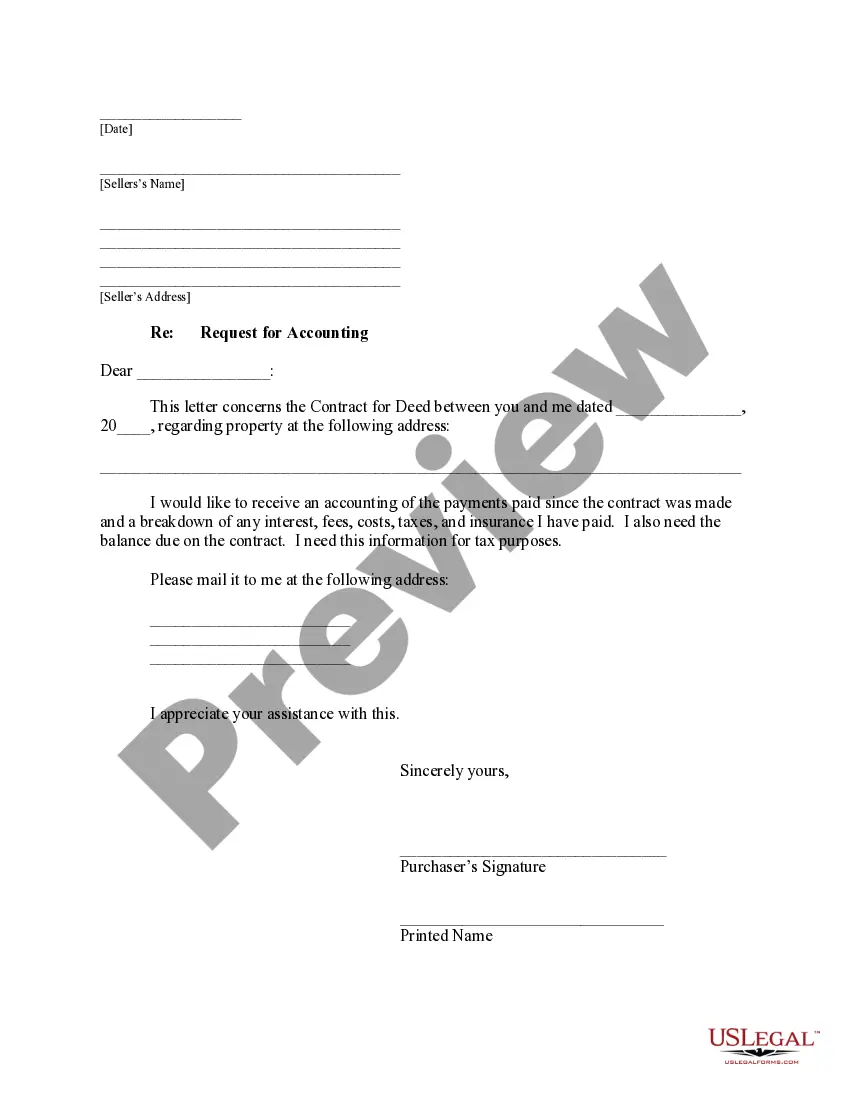
The Buyer's Request for Accounting from Seller under Contract for Deed is a formal document used by purchasers to request a detailed accounting statement from the seller. This request outlines payments made under the contract and breaks down any interest, fees, costs, taxes, and insurance related to the agreement. It serves as a key tool for buyers to understand their financial obligations and ensure accurate record-keeping for tax purposes.
Main sections of this form
- Request for detailed accounting of payments made since the contract date.
- Breakdown of interest, fees, costs, taxes, and insurance paid by the purchaser.
- Request for the remaining balance due on the contract.
- Purchaser's signature and printed name.
- Space to provide mailing address for the accounting statement.
When to use this form
This form is essential when a buyer seeks clarification about their payments under a Contract for Deed. You should use it if you need to verify how much you have paid, understand the allocation of your payments, or determine the remaining balance. It is particularly useful for keeping accurate records for potential tax reporting or future financial planning.
Who this form is for
- Individuals who have entered into a Contract for Deed.
- Buyers wanting to clarify their payment history with the seller.
- Purchasers needing detailed records for tax purposes.
- Anyone unsure about the balance remaining on their agreement.
Steps to complete this form
- Identify yourself as the purchaser by filling in your printed name.
- Provide the seller's details if required, including their name and address.
- Clearly state your request for an accounting of payments made under the contract.
- List any specific information you require, such as a breakdown of fees and the balance due.
- Sign the document and include the date of your request.
- Mail the completed form to the seller's provided address.
Notarization guidance
This form does not typically require notarization unless specified by local law. Ensure to check local regulations to confirm if any notarization is necessary for your specific situation.
Get your form ready online
Our built-in tools help you complete, sign, share, and store your documents in one place.
Make edits, fill in missing information, and update formatting in US Legal Forms—just like you would in MS Word.
Download a copy, print it, send it by email, or mail it via USPS—whatever works best for your next step.
Sign and collect signatures with our SignNow integration. Send to multiple recipients, set reminders, and more. Go Premium to unlock E-Sign.
If this form requires notarization, complete it online through a secure video call—no need to meet a notary in person or wait for an appointment.
We protect your documents and personal data by following strict security and privacy standards.

Make edits, fill in missing information, and update formatting in US Legal Forms—just like you would in MS Word.

Download a copy, print it, send it by email, or mail it via USPS—whatever works best for your next step.

Sign and collect signatures with our SignNow integration. Send to multiple recipients, set reminders, and more. Go Premium to unlock E-Sign.

If this form requires notarization, complete it online through a secure video call—no need to meet a notary in person or wait for an appointment.

We protect your documents and personal data by following strict security and privacy standards.
Mistakes to watch out for
- Failing to include a clear request for all required details.
- Neglecting to provide an accurate mailing address for correspondence.
- Not signing the form, making it unofficial.
- Overlooking any specific requirements dictated by local law.
Benefits of completing this form online
- Convenience of downloading and completing the form at your own pace.
- Editability allows you to personalize the request to fit your situation.
- Reliability, as the form is crafted by licensed attorneys to ensure legal compliance.
Main things to remember
- The Buyer's Request for Accounting is crucial for maintaining financial clarity in contracts for deed.
- Utilizing this form helps document payments and outstanding balances, important for tax purposes.
- Keep your communication clear and complete to avoid common mistakes during the request process.
Looking for another form?


Form popularity
FAQ
If you want out of a real estate contract and don't have any contingencies available, you can breach the contract.The seller could also decide to sue you for breach of contract. Some real estate contracts have a liquidated damages clause that states the maximum the seller can keep if the buyers breach the contract.
The buyer must record the contract for deed with the county recorder where the land is located within four months after the contract is signed. Contracts for deed must provide the legal name of the buyer and the buyer's address.
But unlike buyers, sellers can't back out and forfeit their earnest deposit money (usually 1-3 percent of the offer price). If you decide to cancel a deal when the home is already under contract, you can be either legally forced to close anyway or sued for financial damages.
A disadvantage to the seller is that a contract for deed is frequently characterized by a low down payment and the purchase price is paid in installments instead of one lump sum.The legal fees and time frame for this process will be more extensive than a standard Power of Sale foreclosure.
Contact the other party and ask whether they are willing to negotiate the cancellation of the contract. Offer the other party an incentive to cancel the contract for deed.
The buyer should record the contract for deed with the county recorder where the land is located and does so normally within four months after the contract is signed, though the time may vary depending on state law.
While a buyer can legally back out of a home contract, there can be consequences for doing so. For example, you can lose your earnest money, which could amount to thousands of dollars or more. That is unless your reason for pulling out of the deal is stipulated in your contract.
Act fastthe sooner you back out, the more options you have. If you are having cold feet about buying a home, don't waste too much time before you speak up. See if your contract gives you an out. Be prepared to pay for backing out. Be nice to the sellerand they may return the favor.