Indiana Last Will and Testament for Divorced person not Remarried with Adult Children
What is this form?
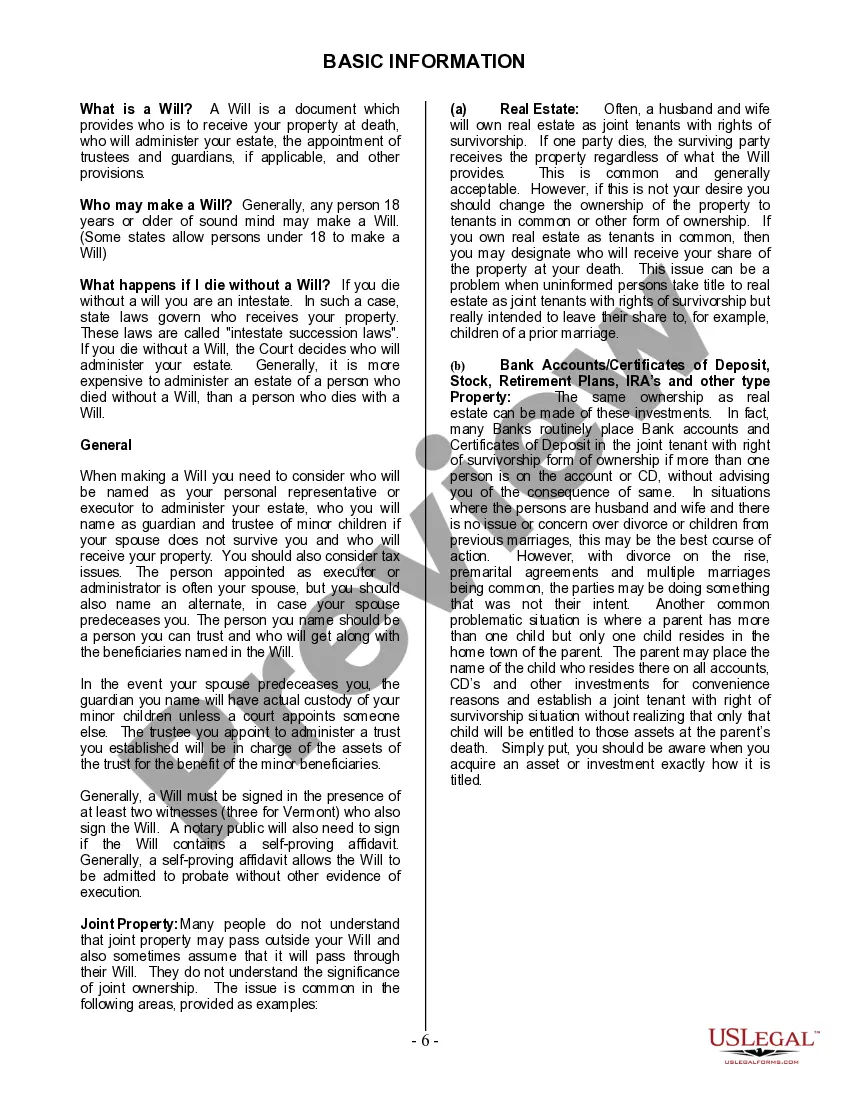
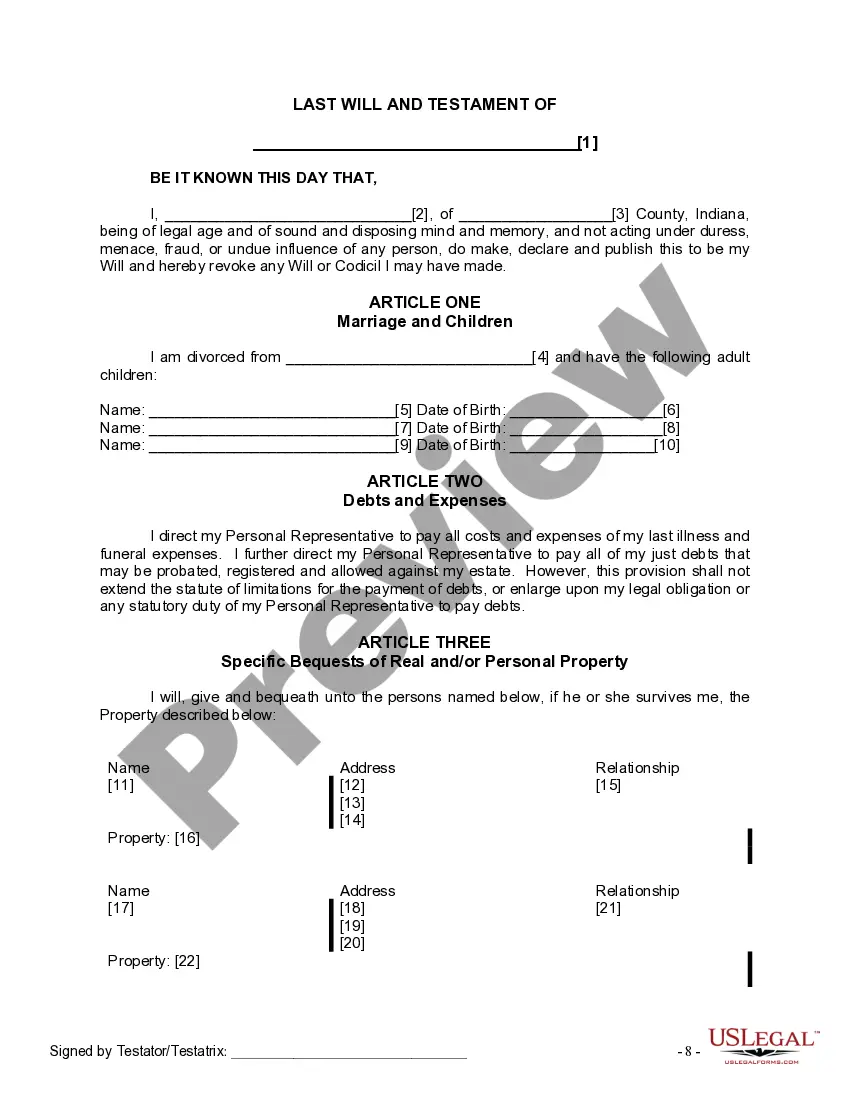
This Last Will and Testament is specifically designed for a divorced person who has not remarried and has adult children. The form outlines who should inherit your property, appoints a personal representative to manage your estate, and includes clear directions for the distribution of your assets. It is essential for ensuring that your wishes are honored after your passing, particularly given your unique family situation that may involve prior relationships or children from those relationships.
Key parts of this document
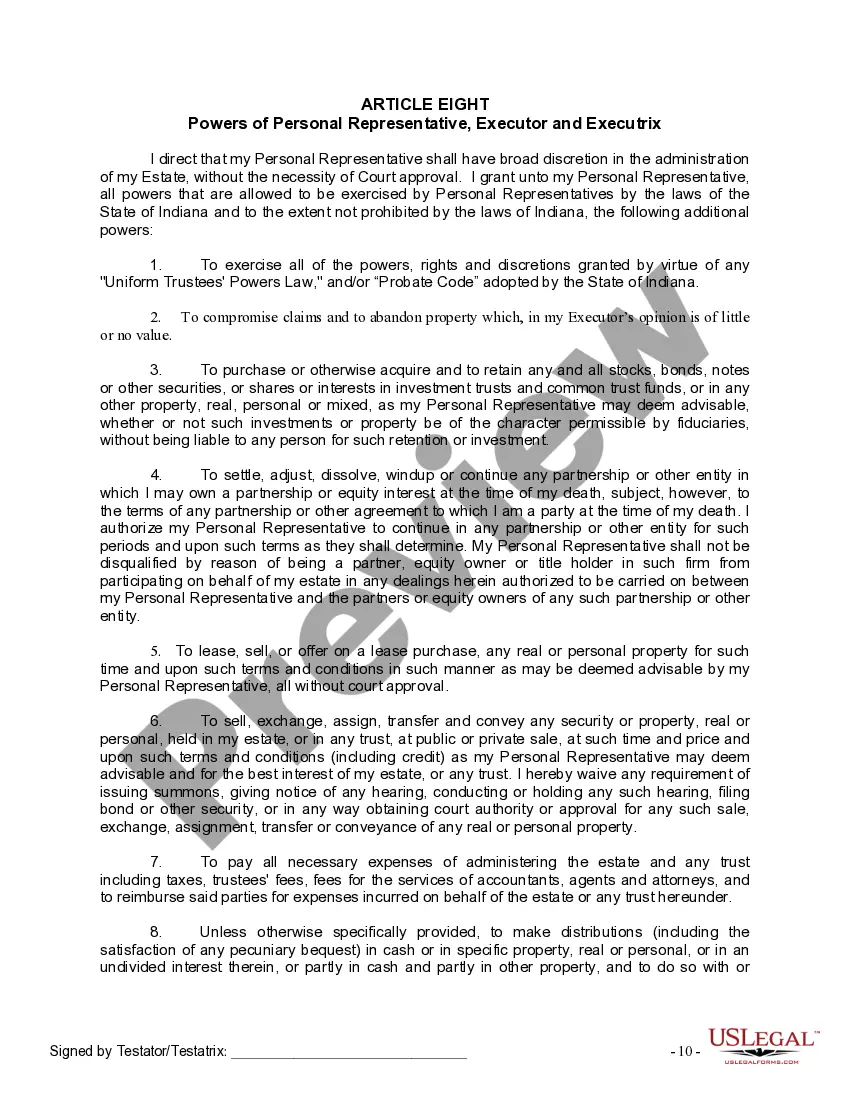
- Appointment of a personal representative to manage the estate.
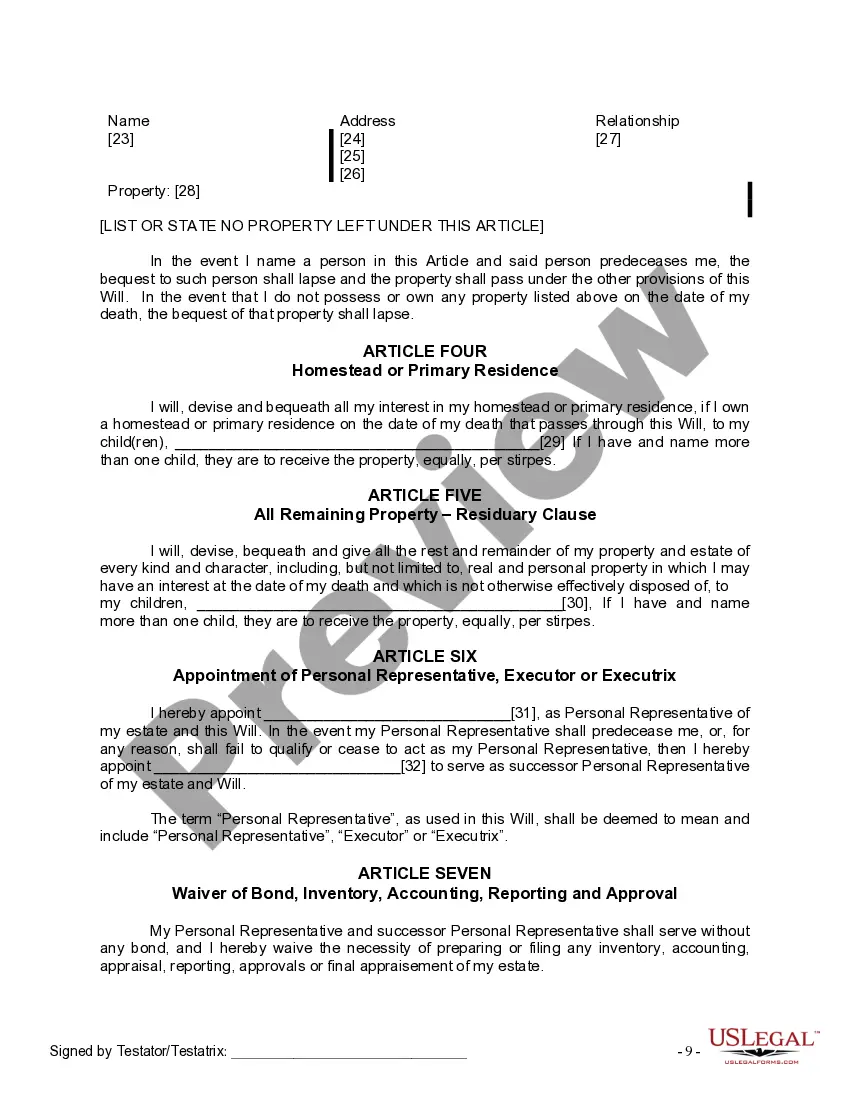
- Designation of heirs, specifically your adult children and any specific bequests.
- Provisions for homestead or primary residence distribution.
- Instructions for addressing debts and expenses related to your estate.
- clauses for waiving a bond by your personal representative.
- Signature requirements including witnesses and notarization details.








Common use cases
This Last Will and Testament should be used when a divorced individual wants to clearly define how their estate will be distributed after they pass away. It is particularly relevant for individuals who have adult children and wish to ensure their wishes for asset distribution are respected, as well as when dealing with any specific property or financial assets that they wish to bequeath to designated individuals.
Who needs this form
- Divorced individuals who have not remarried.
- Parents with adult children who wish to detail asset distribution.
- Anyone looking to clarify their estate plan post-divorce.
- Individuals wanting to appoint a personal representative for their estate.
How to complete this form
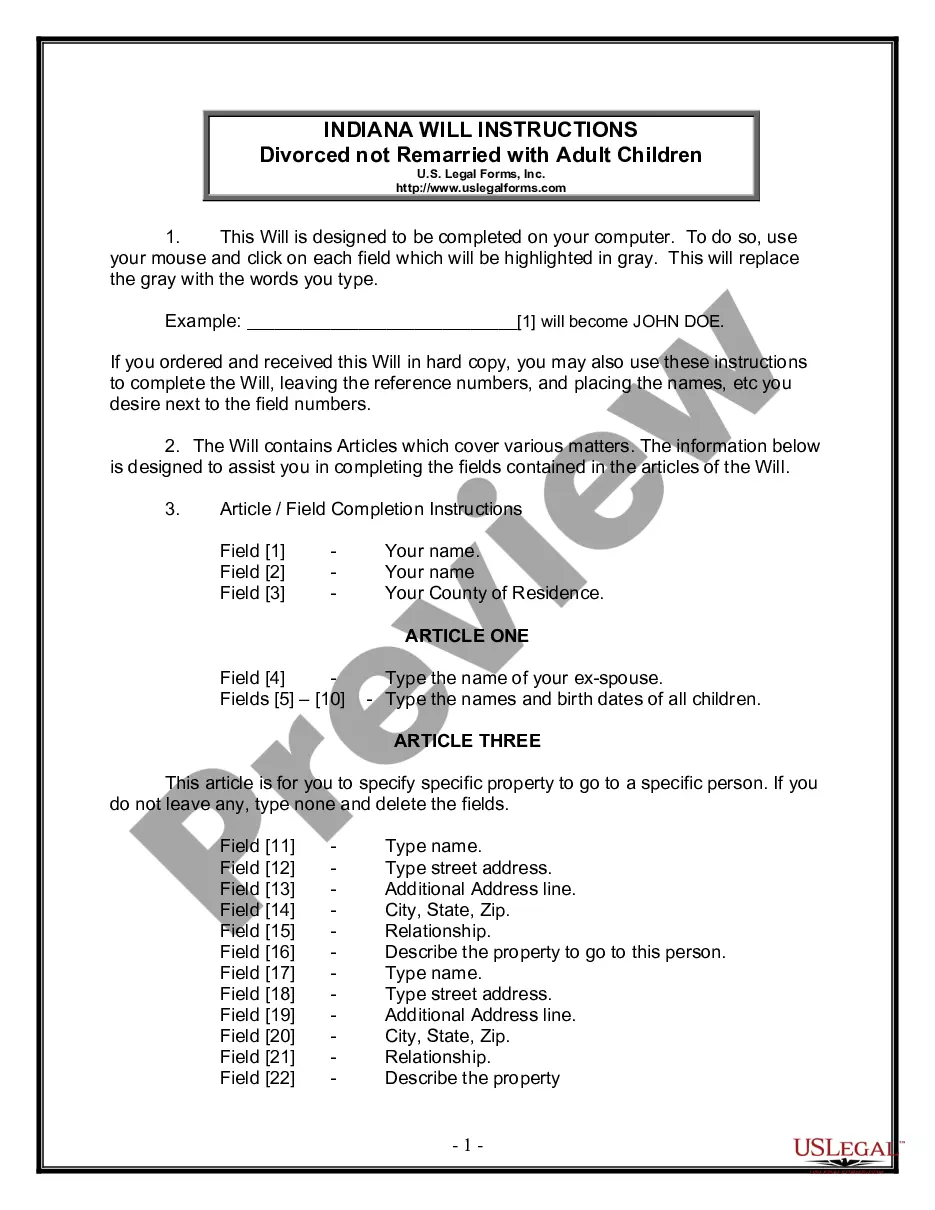
- Enter your full name and county of residence at the beginning of the document.
- Provide the name of your ex-spouse and the names and birth dates of your adult children.
- Specify any specific property or items you wish to bequeath to individuals by filling in the respective fields.
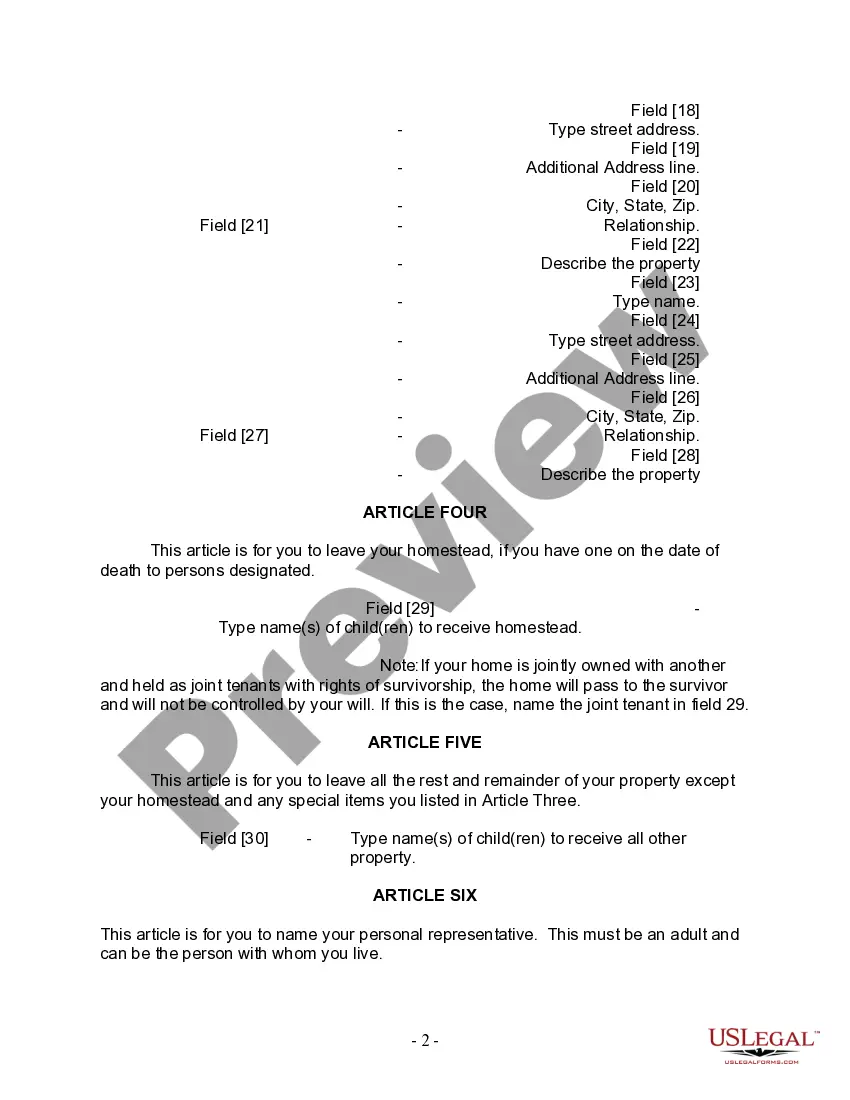
- Designate who will receive your homestead or primary residence, if applicable.
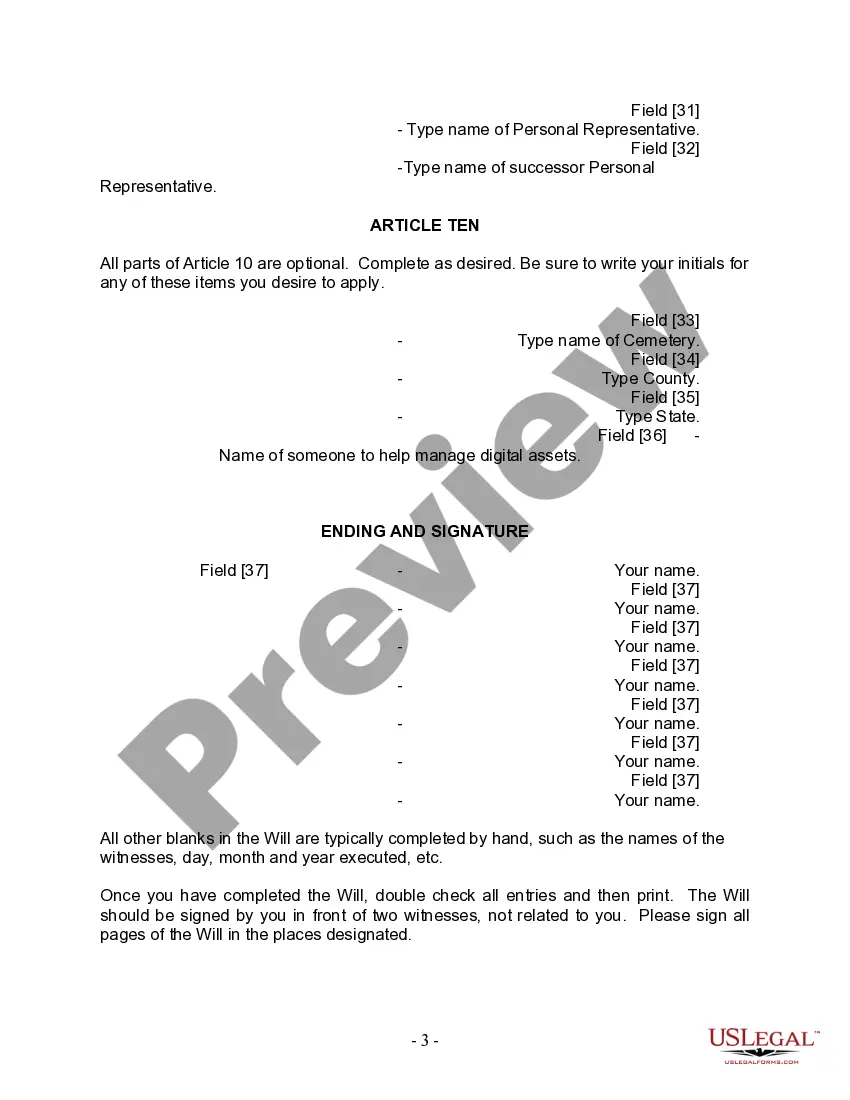
- Appoint a personal representative to manage your estate and include a successor representative.
- Ensure the document is signed in the presence of two witnesses and, if applicable, notarized.
Does this form need to be notarized?
Notarization is required for this form to take effect. Our online notarization service, powered by Notarize, lets you verify and sign documents remotely through an encrypted video session, available 24/7.
Get your form ready online
Our built-in tools help you complete, sign, share, and store your documents in one place.
Make edits, fill in missing information, and update formatting in US Legal Forms—just like you would in MS Word.
Download a copy, print it, send it by email, or mail it via USPS—whatever works best for your next step.
Sign and collect signatures with our SignNow integration. Send to multiple recipients, set reminders, and more. Go Premium to unlock E-Sign.
If this form requires notarization, complete it online through a secure video call—no need to meet a notary in person or wait for an appointment.
We protect your documents and personal data by following strict security and privacy standards.

Make edits, fill in missing information, and update formatting in US Legal Forms—just like you would in MS Word.

Download a copy, print it, send it by email, or mail it via USPS—whatever works best for your next step.

Sign and collect signatures with our SignNow integration. Send to multiple recipients, set reminders, and more. Go Premium to unlock E-Sign.

If this form requires notarization, complete it online through a secure video call—no need to meet a notary in person or wait for an appointment.

We protect your documents and personal data by following strict security and privacy standards.
Mistakes to watch out for
- Not signing in the presence of the required witnesses.
- Failing to specify who receives your property in case of a predeceasing beneficiary.
- Overlooking the inclusion of a self-proving affidavit where applicable.
- Failing to update the will after life changes such as a divorce or children reaching adulthood.
Benefits of using this form online
- Easy to complete on your computer with guided fields.
- Immediate access, allowing you to print or save your completed Will.
- Time-efficient compared to traditional lawyer consultations.
- Secure storage options for your completed legal documents.
Looking for another form?


Form popularity
FAQ
Small estate administration is a simplified court procedure that is an alternative to the longer probate process. It is available when the person who dies did not own that much in assets. There is often a limit to the value of the property, such as $25,000 or $100,000.
It's very common for a lawyer to charge a flat fee to write a will and other basic estate planning documents. The low end for a simple lawyer-drafted will is around $300. A price of closer to $1,000 is more common, and it's not unusual to find a $1,200 price tag. Lawyers like flat fees for several reasons.
Drafting the will yourself is less costly and may put you out about $150 or less. Depending on your situation, expect to pay anywhere between $300 and $1,000 to hire a lawyer for your will. While do-it-yourself will kits may save you time and money, writing your will with a lawyer ensures it will be error-free.
While the probate process isn't necessary for every estate in Indiana, a sizable portion of them will be forced to go before the court. However, there are certain assets of a decedent that will skip past this process, as they already have heirs or beneficiaries chosen. These include: Life insurance.
In Indiana, you can make a living trust to avoid probate for virtually any asset you ownreal estate, bank accounts, vehicles, and so on. You need to create a trust document (it's similar to a will), naming someone to take over as trustee after your death (called a successor trustee).
A will written by a lawyer can cost between about $400 and $3,000 depending on its complexity, a will written by a Public Trustee may be free in certain circumstances, and a will kit can be bought for about $30.
Indiana does not permit holographic (handwritten) wills.
Before you can be formally recognized as the estate's executor, you have to be appointed by an Indiana probate court. To accomplish that feat, you must bring the original copy of the deceased's Last Will and Testament to the appropriate court which will be the court in the county where the deceased lived.
Small Estate Threshold The Indiana small estate procedures are available when the gross probate estate, less liens and encumbrances, does not exceed $50,000. The estate calculation includes all property owned by the decedent, including real estate.