Indiana Relative Caretaker Legal Documents Package
Understanding this form package
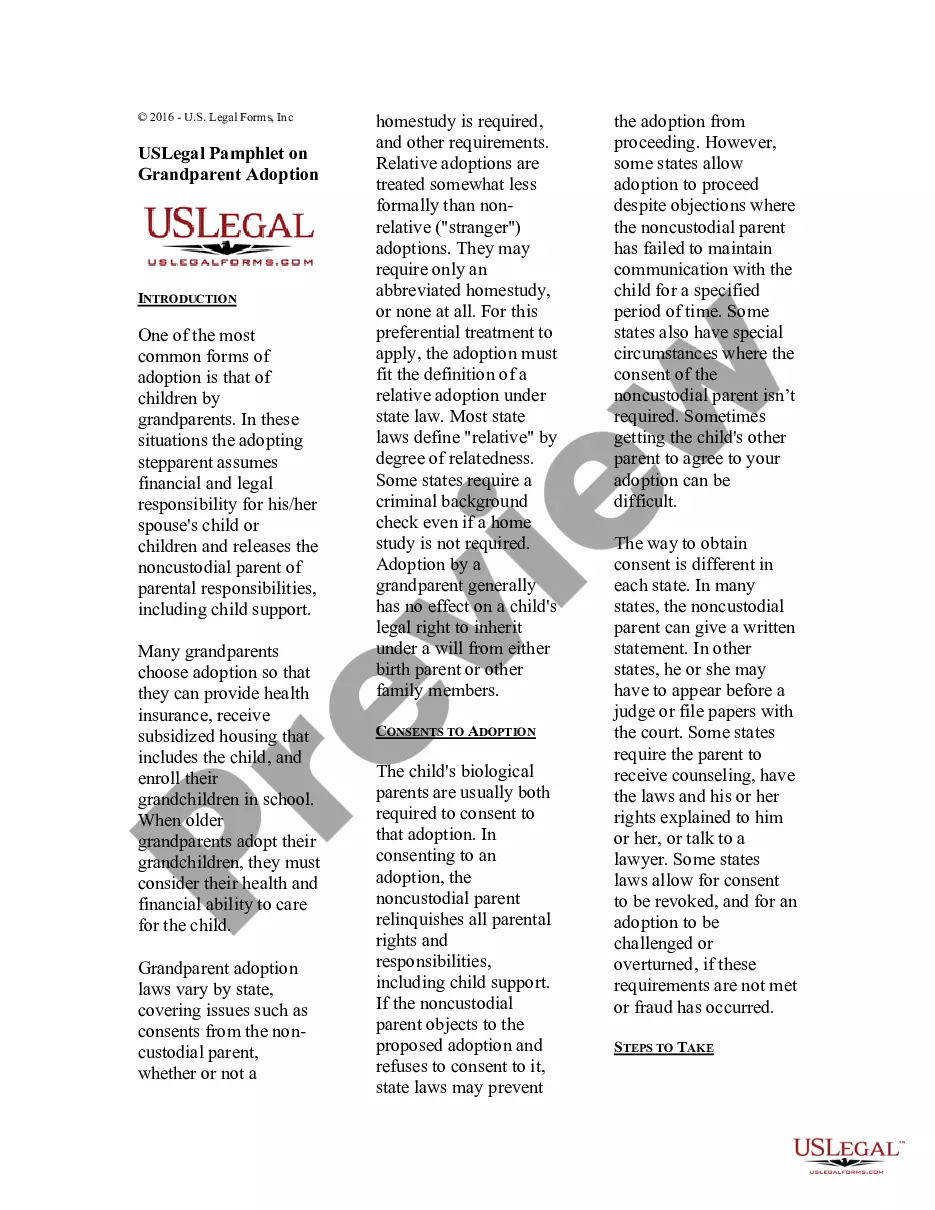
The Indiana Relative Caretaker Legal Documents Package provides essential legal forms and information for relatives seeking to care for a child, including resources on state laws, rights, and responsibilities. This package is designed to streamline the legal process for relatives stepping in as caregivers, making it easier to navigate complex family law issues compared to purchasing individual documents separately. By offering a comprehensive set of guides and forms, this package offers more than 50 percent savings compared to buying each item individually.
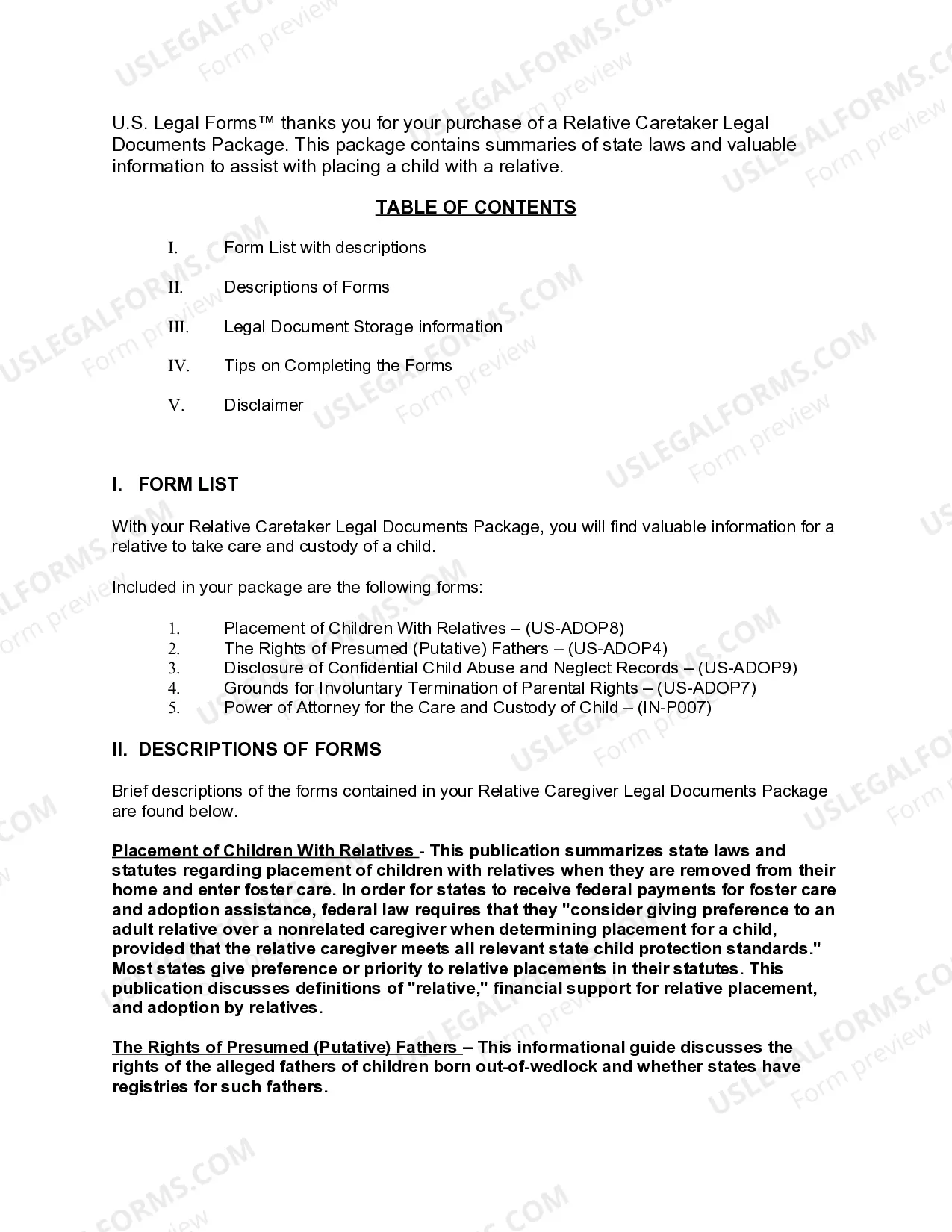
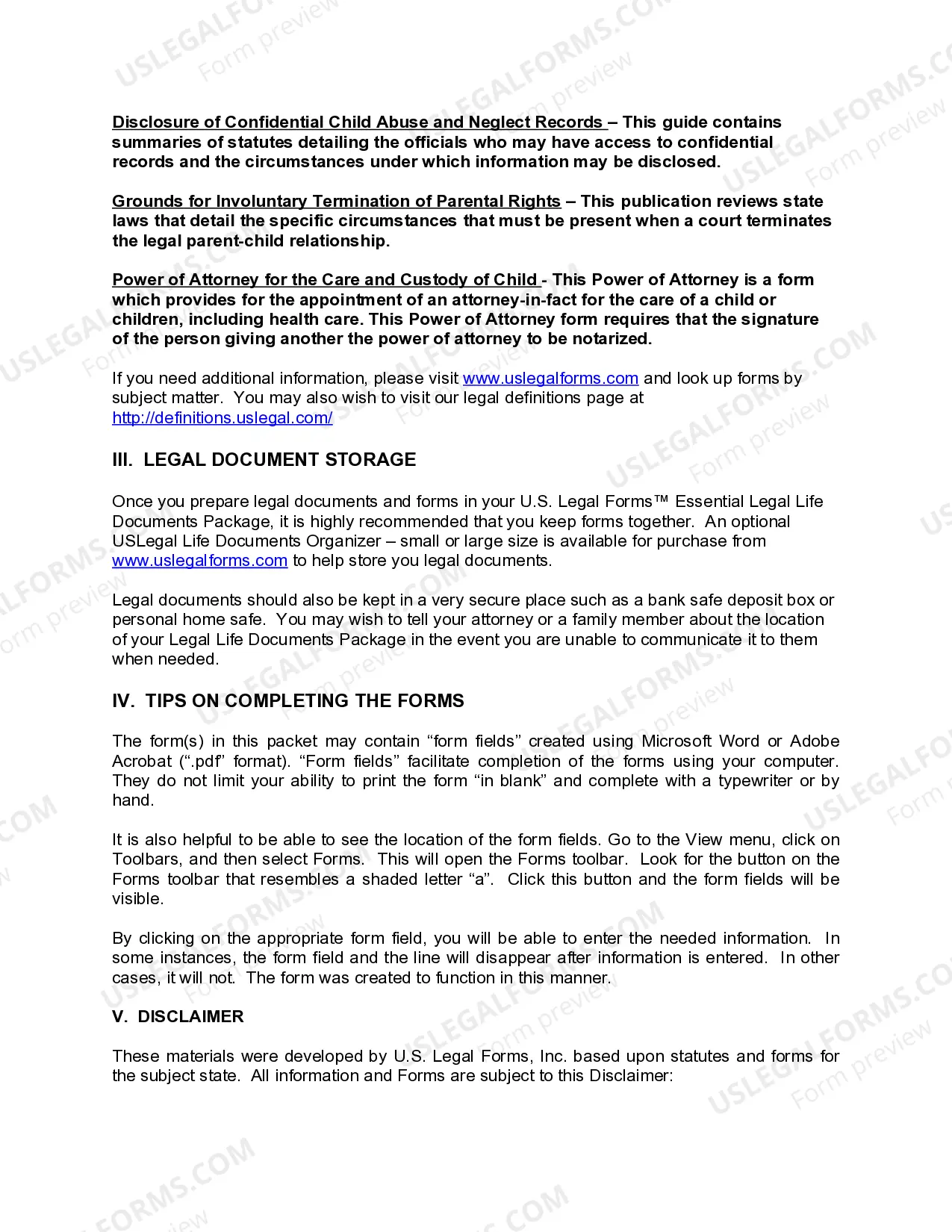
Forms included in this package



When to use this document
This package is useful in various situations, including:
- When a child is removed from their home and needs to be placed with a relative.
- If you are a relative seeking to secure legal rights to care for a child.
- When you need to understand the rights of putative fathers in cases involving children born out-of-wedlock.
- If you require access to confidential child abuse and neglect records.
- In circumstances where parental rights may need to be terminated for legal reasons.
- When you need to establish Power of Attorney for the care and custody of a child.
Who this form package is for
- Relatives looking to take custody of a child.
- Grandparents, aunts, uncles, or other family members seeking legal recognition as caregivers.
- Putative fathers wanting to assert their rights.
- Legal guardians requiring access to necessary documentation for child welfare.
- Anyone involved in family law situations involving the placement of children.
How to prepare this document
- Review all included forms and guides to understand your rights and responsibilities.
- Identify the correct forms based on your specific circumstances and needs.
- Complete the necessary information in each form, including dates, signatures, and relevant details.
- If required, have the Power of Attorney form notarized to ensure it is legally binding.
- Keep copies of completed forms in a secure location for future reference.
Do documents in this package require notarization?
Notarization is required for one or more forms in this package. US Legal Forms provides secure online notarization powered by Notarize, allowing you to complete the process through a verified video call.
Get your form ready online
Our built-in tools help you complete, sign, share, and store your documents in one place.
Make edits, fill in missing information, and update formatting in US Legal Forms—just like you would in MS Word.
Download a copy, print it, send it by email, or mail it via USPS—whatever works best for your next step.
Sign and collect signatures with our SignNow integration. Send to multiple recipients, set reminders, and more. Go Premium to unlock E-Sign.
If this form requires notarization, complete it online through a secure video call—no need to meet a notary in person or wait for an appointment.
We protect your documents and personal data by following strict security and privacy standards.

Make edits, fill in missing information, and update formatting in US Legal Forms—just like you would in MS Word.

Download a copy, print it, send it by email, or mail it via USPS—whatever works best for your next step.

Sign and collect signatures with our SignNow integration. Send to multiple recipients, set reminders, and more. Go Premium to unlock E-Sign.

If this form requires notarization, complete it online through a secure video call—no need to meet a notary in person or wait for an appointment.

We protect your documents and personal data by following strict security and privacy standards.
Common mistakes
- Failing to complete all necessary fields in the forms.
- Not understanding the legal definitions of terms like "relative" or "putative father."
- Neglecting to notarize documents when required.
- Not keeping a secure copy of the completed forms.
- Misunderstanding the criteria for involuntary termination of parental rights.
Advantages of online completion
- Convenient access to legal documents from the comfort of your home.
- Editable forms that make it easy to personalize your information.
- Drafted by licensed attorneys, ensuring reliability and legal compliance.
- Comprehensive resources that educate you on your rights and obligations.
Looking for another form?


Form popularity
FAQ
Placement refers to the placing of a child in the. home of an individual other than a parent or guardian or in a facility other than a youth services center.
21 years of age or older, In good health. Able to demonstrate an ability and interest in caring for children. Able to provide a safe living environment for a child.
Kinship care arrangements fall roughly into three categories: (1) informal kinship care, (2) voluntary kinship care, and (3) formal kinship care. Informal kinship care refers to arrangements made by parents and other family members without any involvement from either the child welfare agency or the juvenile court.
Family and Friends Care or Kinship Care is an arrangement whereby a child who cannot be cared for by their parent(s) or other person with Parental Responsibility, goes to live with a relative, friend or other connected person.
What is Kinship Care? Kinship care refers to the care of children by relatives or, in some jurisdictions such as California, non-relative extended family members (NREFMs often referred to as fictive kin).Informal kinship care commonly refers to relatives raising children who are not in the foster care system.
The process of adoption begins with an initial conversation with a Kinship Center adoption professional. Prospective adoptive parents may call (831) 455-4740. Someone will speak to you then or return your call promptly. Or you may complete and submit the Adoption Interest Form and someone will call you.
Kinship care refers to the care of children by relatives or, in some jurisdictions, close family friends (often referred to as fictive kin). Relatives are the preferred resource for children who must be removed from their birth parents because it maintains the children's connections with their families.
Unlike fostering, kinship is a type of out-of-home care where the child or young person is with a caregiver with whom they have had a previous relationship.informal, when the caregiver is providing home care as a private arrangement with the family, unrecognised by both the court and jurisdiction.
For relative placements, before a child can be placed in. the home of a relative, the child-placing agency must do. an assessment to determine that the relative is fit and. willing to provide a suitable placement for the child, able to ensure the child's safety, and able to meet the.