Illinois Contractor's Verified Statement of Labor and Materials and amount due - Mechanic Liens - Individual
About this form
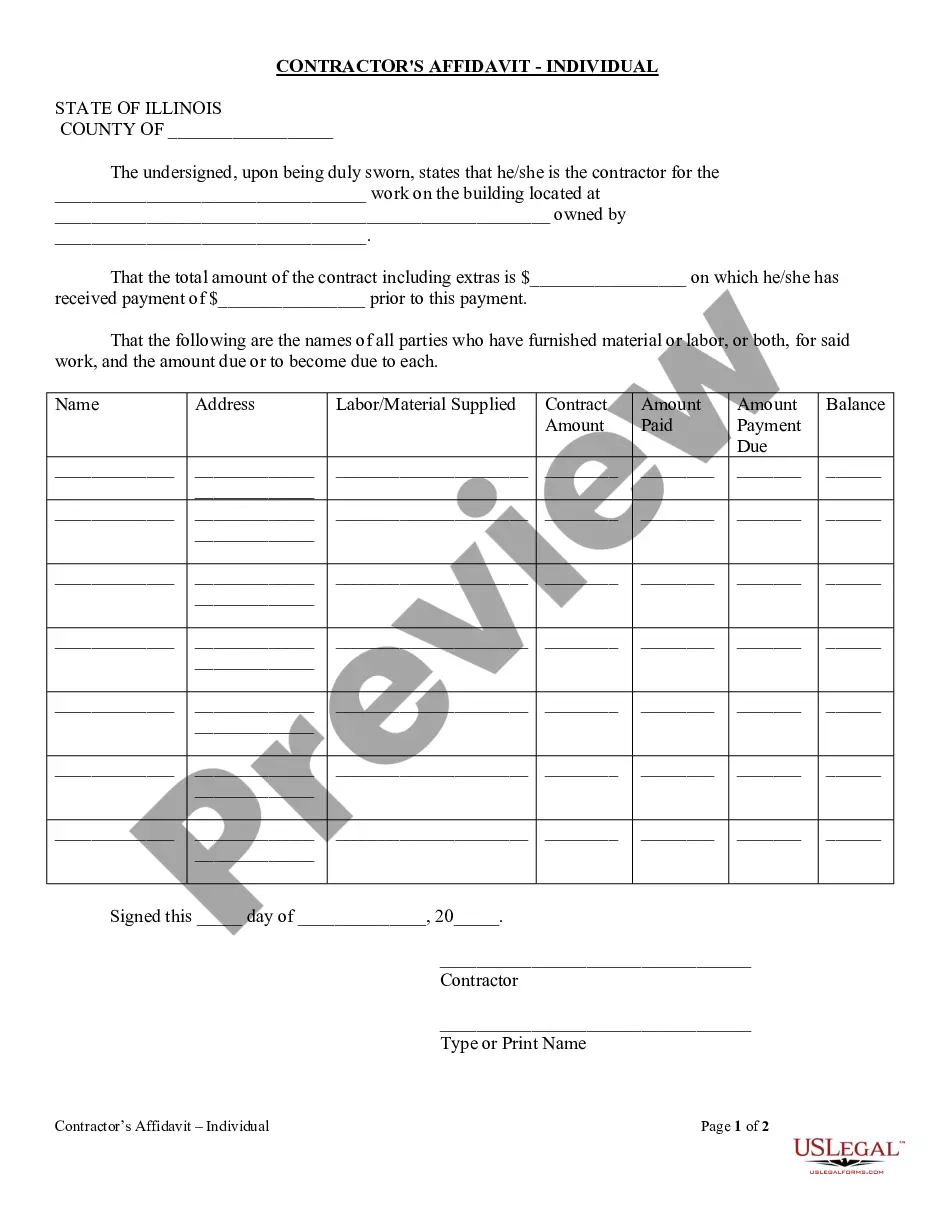
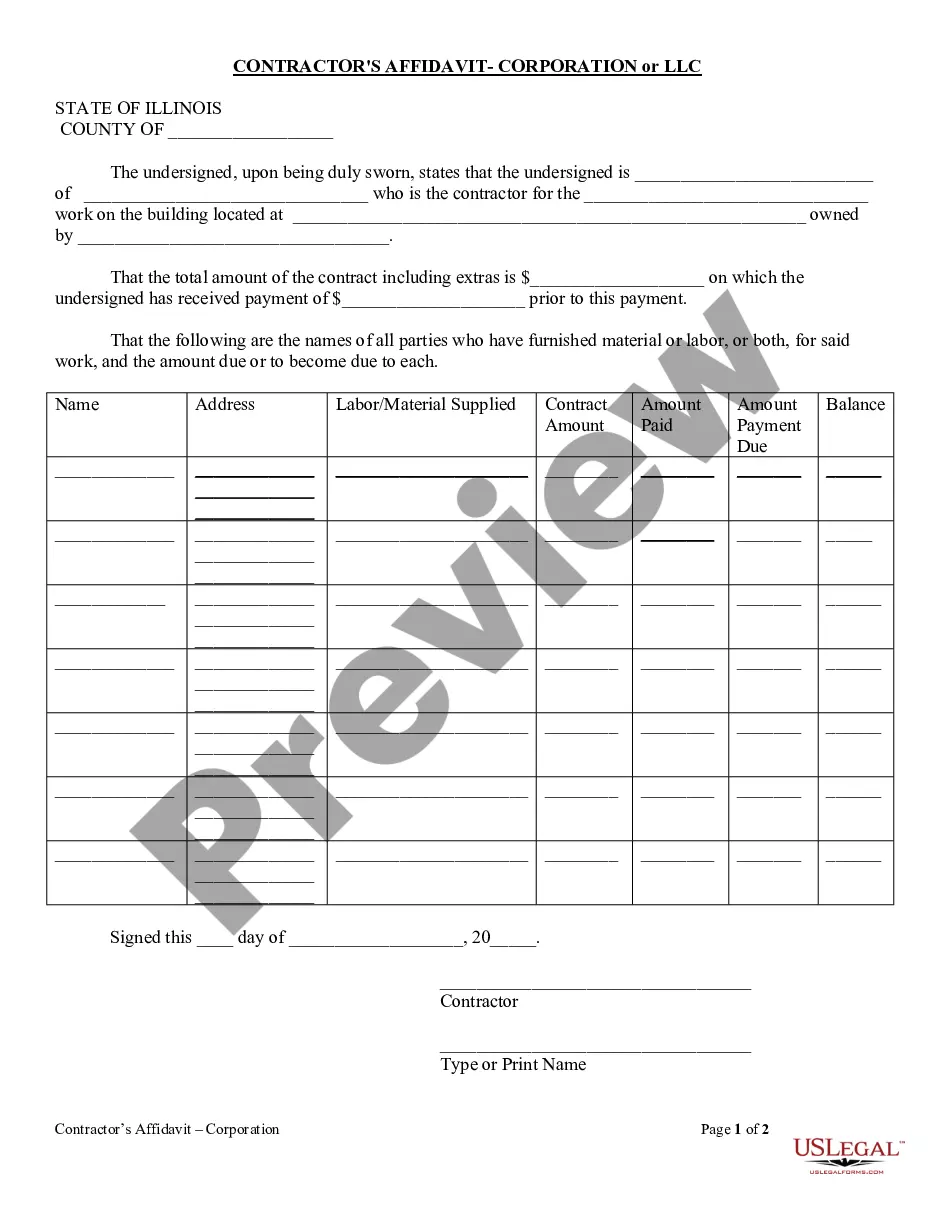
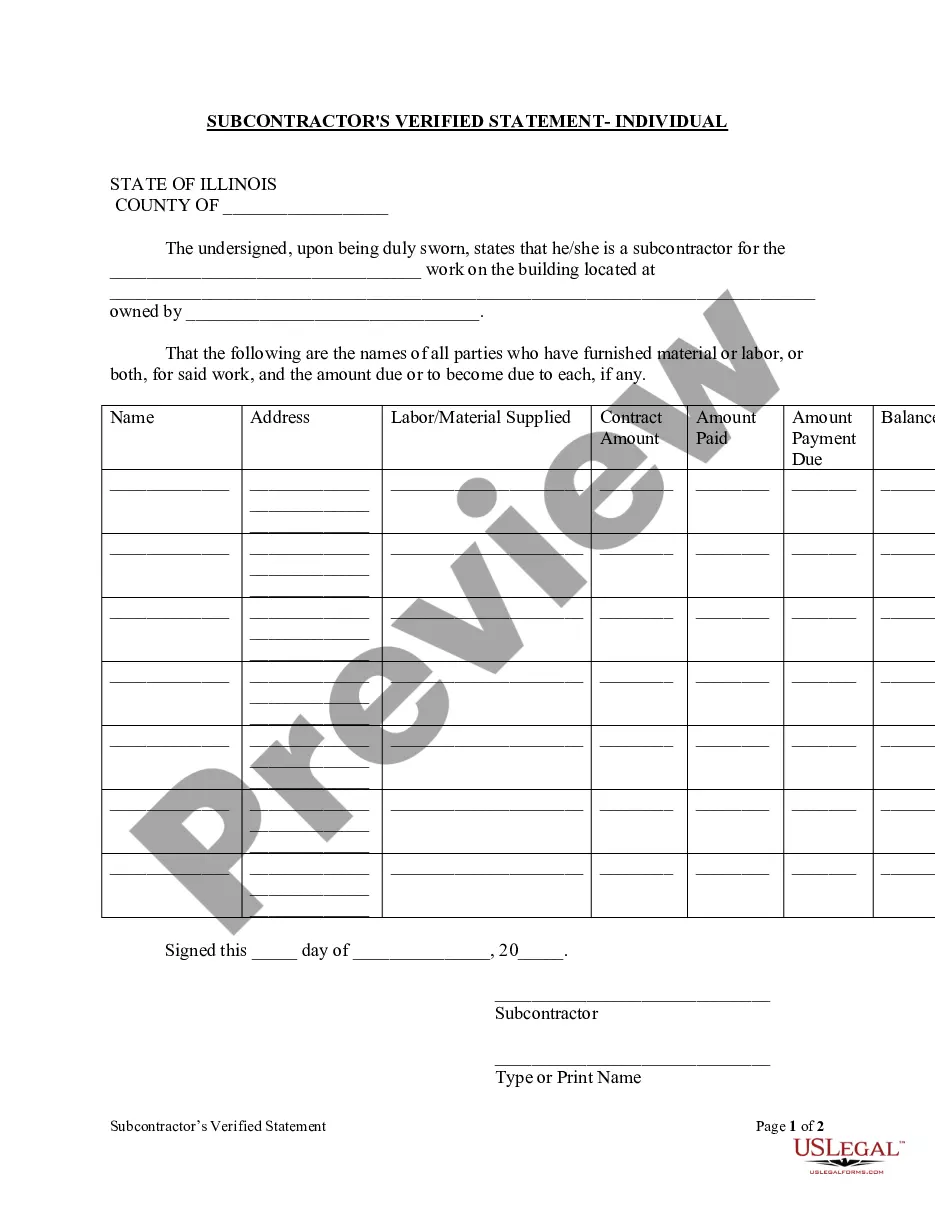
The Contractor's Verified Statement of Labor and Materials and Amount Due is a legal document required by Illinois law, specifically pursuant to 770 ILCS 60/5. This form enables individual contractors to provide property owners a detailed notice of all parties that furnished labor or materials for a construction project, along with the amounts owed. This notification serves to protect the contractor's right to payment and differs from similar forms by focusing specifically on the statement of labor and materials provided by individual contractors rather than corporations or other entities.
Key components of this form
- Contractor's name and contact information.
- Property owner's name and contact details.
- Description of the work performed.
- Contract amount including any extras.
- List of all parties who provided labor or materials, including their addresses and the payment amounts due.
- Signature of the contractor and date of signing.
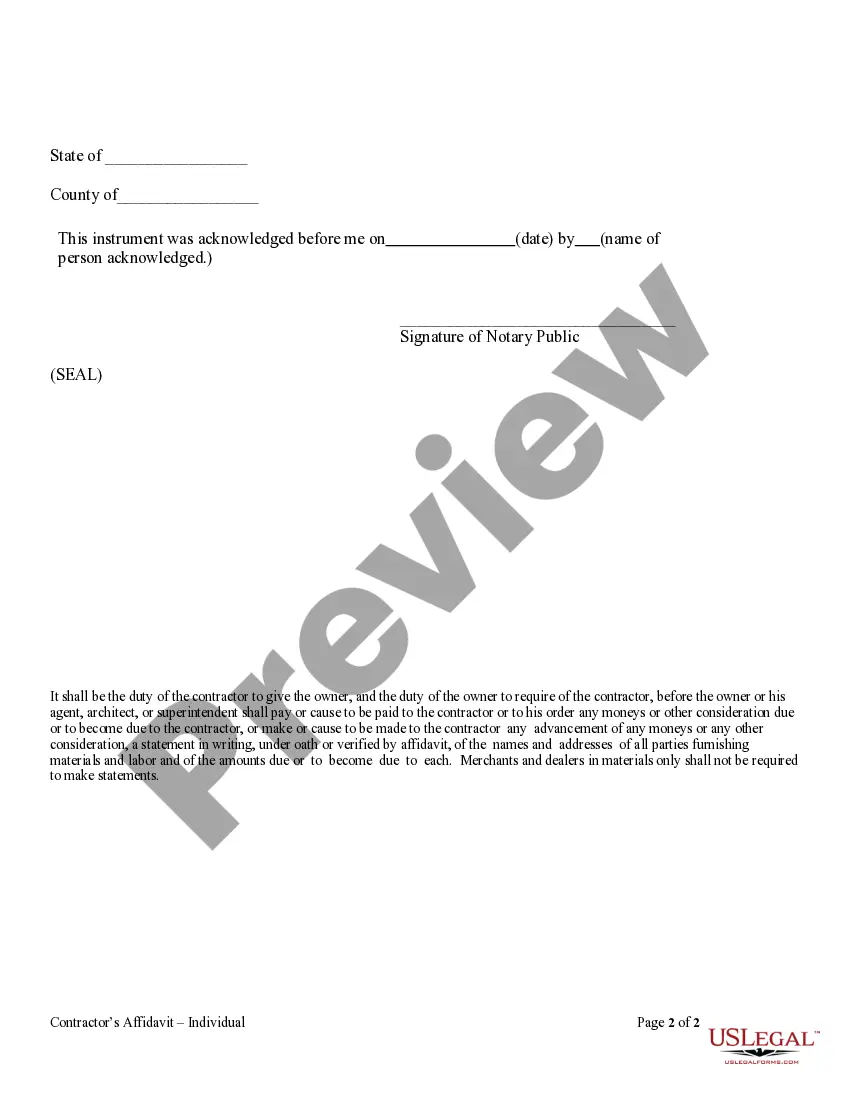
- Notary verification section to affirm the statement is true and correct.
When to use this form
This form should be used when an individual contractor has completed work on a property and needs to inform the property owner of all laborers and suppliers involved. It is particularly crucial when seeking payment for work done, ensuring that the owner is aware of who needs to be paid to avoid any future disputes regarding outstanding balances.
Who should use this form
- Individual contractors who have provided labor or materials for a construction project.
- Subcontractors who need to detail their work contributions for payment purposes.
- Property owners who require a record of payments made to contractors and their suppliers.
Completing this form step by step
- Identify and enter the contractor's full name and address.
- Provide the property owner's name and the address of the property where the work was performed.
- Fill in the work description and total contract amount, including any extras.
- List all parties who supplied labor or materials, including their addresses and payment details.
- Sign and date the form in the appropriate section to affirm its accuracy.
- Have the form notarized to validate the statement, if required.
Does this form need to be notarized?
This form must be notarized to be legally valid. US Legal Forms provides secure online notarization powered by Notarize, allowing you to complete the process through a verified video call.
Get your form ready online
Our built-in tools help you complete, sign, share, and store your documents in one place.
Make edits, fill in missing information, and update formatting in US Legal Forms—just like you would in MS Word.
Download a copy, print it, send it by email, or mail it via USPS—whatever works best for your next step.
Sign and collect signatures with our SignNow integration. Send to multiple recipients, set reminders, and more. Go Premium to unlock E-Sign.
If this form requires notarization, complete it online through a secure video call—no need to meet a notary in person or wait for an appointment.
We protect your documents and personal data by following strict security and privacy standards.

Make edits, fill in missing information, and update formatting in US Legal Forms—just like you would in MS Word.

Download a copy, print it, send it by email, or mail it via USPS—whatever works best for your next step.

Sign and collect signatures with our SignNow integration. Send to multiple recipients, set reminders, and more. Go Premium to unlock E-Sign.

If this form requires notarization, complete it online through a secure video call—no need to meet a notary in person or wait for an appointment.

We protect your documents and personal data by following strict security and privacy standards.
Common mistakes
- Not including all parties involved in providing labor or materials.
- Failing to specify the complete contract amount or payment due.
- Omitting necessary signatures or dates.
- Not having the form notarized when required.
Benefits of using this form online
- Quick access to a legally compliant form tailored to your needs.
- Editable format allows for easy customization to fit specific circumstances.
- Immediate download ensures you can fill out and submit documents without delay.
Looking for another form?
Form popularity
FAQ
What Is a Mechanics' (Construction) Lien? When a contractor files a mechanics' (construction) lien on your home, the lien makes your home into what's called security for an outstanding debt, which the contractor claims is due and unpaid for services or materials.
A construction lien is a claim made against a property by a contractor or subcontractor who has not been paid for work done on that property. Construction liens are designed to protect professionals from the risk of not being paid for services rendered.
A mechanic's lien is a guarantee of payment to builders, contractors, and construction firms that build or repair structures. Mechanic's liens also extend to suppliers of materials and subcontractors and cover building repairs as well.
Mechanic's liens are legal documents that essentially reserve the rights of the filer to seek unpaid compensation. They are usually filed by contractors, subcontractors, or suppliers that never received payment for work that they performed or materials that they provided on the property.
A construction mechanics lien is claimed against real estate property, and the lien must be filed in the appropriate office in order to be valid.Additionally, construction liens have strict timing and notice requirements.
Mechanic's lien: A mechanic's lien is a lien placed on your property for nonpayment for work you had done on the property.A lis pendens isn't a lien but instead is a notice of a potential future lien. It's recorded in the public records to give notice to future buyers of the real estate.
Negotiate with the contractor who placed the lien (the "lienor" to remove it. Obtain a lien bond to discharge the lien, or. File a lawsuit to vacate the lien.
In order to enforce a lien, the contractor, subcontractor or supplier must file a lawsuit. The deadline to file a lawsuit is two years from the last date work was performed or materials were supplied. A recorded lien is valid for these two years, but a failure to sue within that time frame voids the lien.
The people who can file mechanic's liens are identified by state law. A subcontractor or supplier to a subcontractor may not be able to file a lien. Also, unlicensed contractors are often barred from filing a mechanic's lien.