Iowa Quitclaim Deed by Two Individuals to LLC
Overview of this form
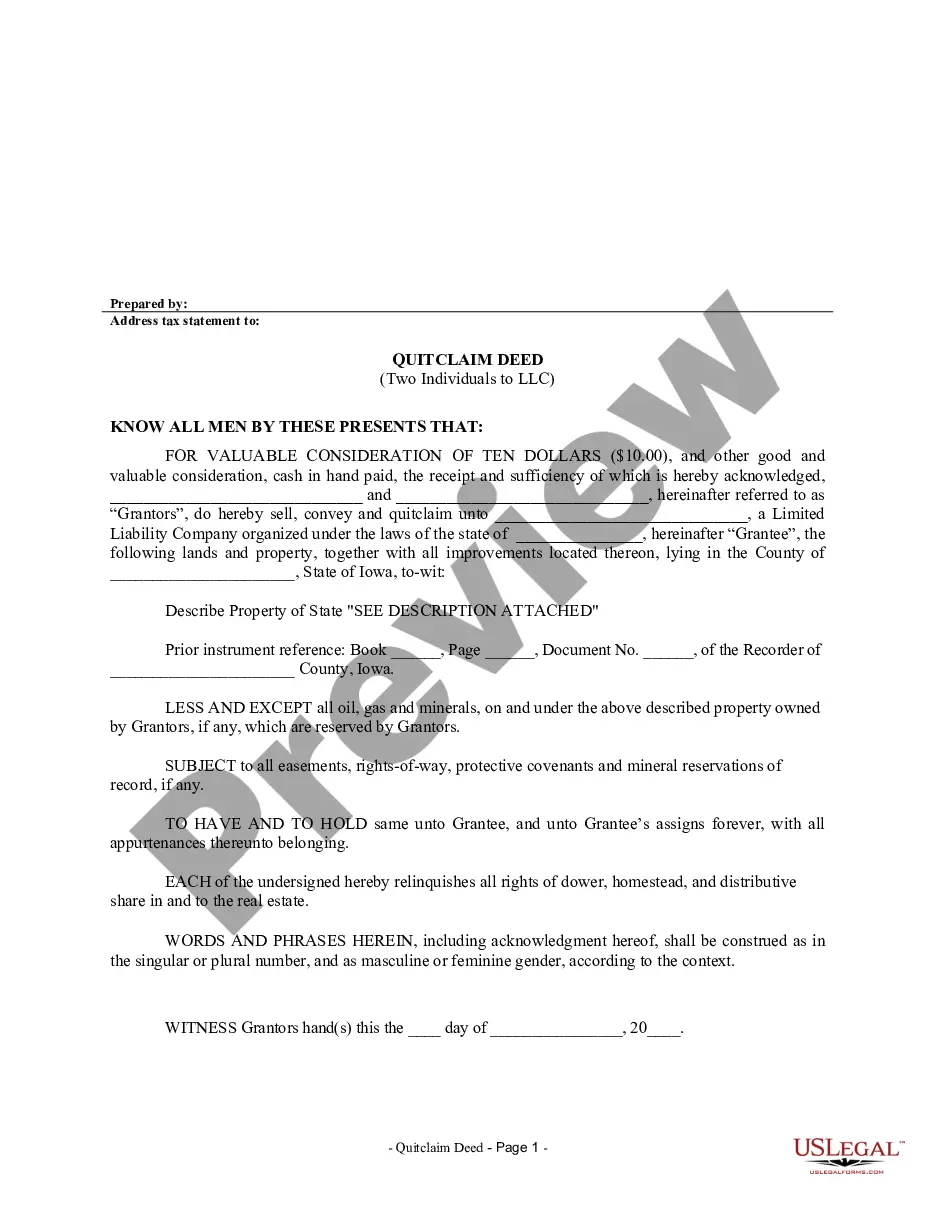
The Quitclaim Deed by Two Individuals to LLC is a legal document that allows two individuals (the Grantors) to transfer their interest in a property to a limited liability company (the Grantee). This form specifically conveys the property while reserving rights to any oil, gas, or minerals beneath it. Unlike warranty deeds, this quitclaim deed does not guarantee that the Grantors have clear title to the property, making it a simpler option for transferring ownership in certain situations.
Key components of this form
- Identification of Grantors and Grantee
- Statement of consideration for the deed
- Description of the property being conveyed
- Reservation of oil, gas, and mineral rights
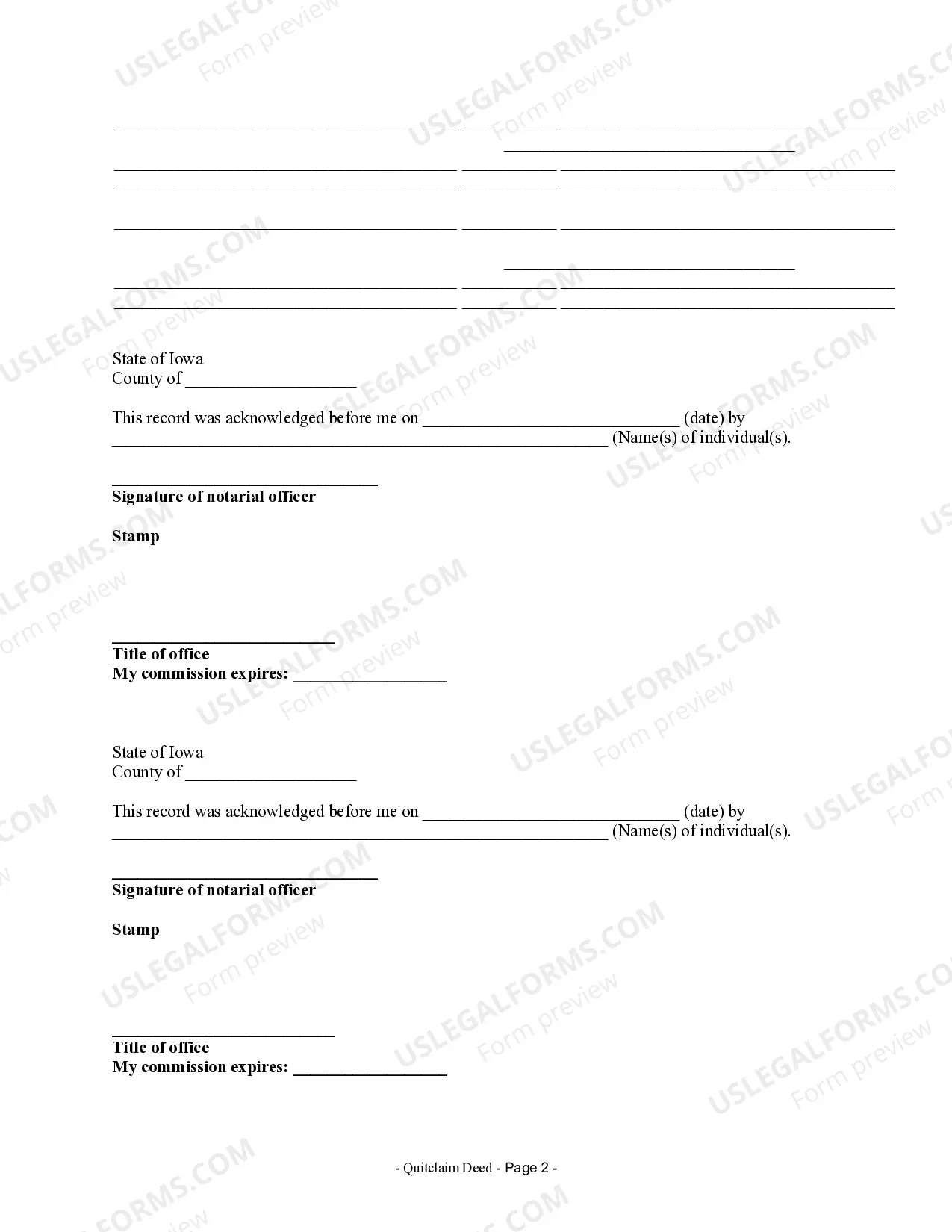
- Signature and acknowledgment by the Grantors
- Notary acknowledgment to validate the document





When to use this form
This form is typically used when two individuals want to transfer their property rights to a limited liability company, especially when they want to simplify the transfer process without ensuring title. Common scenarios include transferring property for business purposes, such as putting real estate into an LLC for liability protection or tax benefits.
Intended users of this form
This form is suitable for:
- Individuals who jointly own property and wish to transfer ownership to an LLC.
- Members of an LLC who are seeking to consolidate property under the company's name.
- Property owners looking for a straightforward method to relinquish their property rights without warranties.
How to prepare this document
- Identify the Grantors by entering their full names.
- Enter the name of the LLC as the Grantee.
- Clearly describe the property being transferred.
- Fill in the date and signatures of the Grantors.
- Complete the required notary acknowledgment section.
Notarization requirements for this form
This form must be notarized to be legally valid. US Legal Forms provides secure online notarization powered by Notarize, allowing you to complete the process through a verified video call.
Get your form ready online
Our built-in tools help you complete, sign, share, and store your documents in one place.
Make edits, fill in missing information, and update formatting in US Legal Forms—just like you would in MS Word.
Download a copy, print it, send it by email, or mail it via USPS—whatever works best for your next step.
Sign and collect signatures with our SignNow integration. Send to multiple recipients, set reminders, and more. Go Premium to unlock E-Sign.
If this form requires notarization, complete it online through a secure video call—no need to meet a notary in person or wait for an appointment.
We protect your documents and personal data by following strict security and privacy standards.

Make edits, fill in missing information, and update formatting in US Legal Forms—just like you would in MS Word.

Download a copy, print it, send it by email, or mail it via USPS—whatever works best for your next step.

Sign and collect signatures with our SignNow integration. Send to multiple recipients, set reminders, and more. Go Premium to unlock E-Sign.

If this form requires notarization, complete it online through a secure video call—no need to meet a notary in person or wait for an appointment.

We protect your documents and personal data by following strict security and privacy standards.
Typical mistakes to avoid
- Failing to provide a complete and accurate property description.
- Not including the reservation of oil, gas, and mineral rights when applicable.
- Omitting signatures or dates, making the form invalid.
- Not having the form notarized when required by state law.
Why complete this form online
- Easy download and printing from the comfort of your home.
- Editable fields allow you to tailor the form to your specific needs.
- Access to forms drafted by licensed attorneys for legal reliability.
- Convenient and quick to complete, saving you time on legal tasks.
Looking for another form?


Form popularity
FAQ
Transferring the deed of your house to an LLC involves using an Iowa Quitclaim Deed by Two Individuals to LLC. Start by completing the quitclaim deed with accurate information about both the property and the LLC. After signing it before a notary, you will need to file the document at your county recorder's office to complete the transfer legally.
Yes, you can quit claim your property to your LLC using an Iowa Quitclaim Deed by Two Individuals to LLC. This process allows you to transfer ownership without the need for a sales transaction. Just ensure that you follow the correct procedures, including signing in front of a notary and recording the deed with your county.
To quitclaim a deed to your LLC, obtain an Iowa Quitclaim Deed by Two Individuals to LLC form. Fill it in with your specifics and property details, then sign the document in the presence of a notary. After notarization, you must record the deed with the county recorder's office, making the transfer official and legally binding.
To transfer property from an individual to an LLC, you'll need to complete an Iowa Quitclaim Deed by Two Individuals to LLC. First, fill out the quitclaim deed form with the necessary property details and owner information. Next, ensure that the deed is signed in front of a notary public. Finally, file the completed deed with your local county recorder's office to finalize the transfer.
A quitclaim deed can be deemed invalid for several reasons, such as improper execution, lack of notarization, or if essential information is missing. If the transferor does not have the authority to transfer the property, this could also invalidate the deed. When dealing with an Iowa Quitclaim Deed by Two Individuals to LLC, be aware of these factors to ensure the deed meets all legal requirements.
To transfer personal property to an LLC, you generally create a quitclaim deed that states the current owner's intention to transfer ownership to the LLC. This document should clearly outline the property being transferred and include relevant details about the LLC. Using an Iowa Quitclaim Deed by Two Individuals to LLC can make this process straightforward, ensuring all legal aspects are covered for an effective transfer.
In Missouri, a quitclaim deed requires the property owner's signature, the identification of the property involved, and a clear statement that the ownership is being transferred. The document also must be notarized to be valid. When executing an Iowa Quitclaim Deed by Two Individuals to LLC, make sure to follow Missouri's specific guidelines to ensure an effective and legal transfer.
A quitclaim deed can become void under certain circumstances, such as if the signing was coerced or if it was improperly executed without the required signatures. Additionally, if the grantor did not have the legal right to transfer the property, the quitclaim deed may not hold up. Understanding these limitations is essential when creating an Iowa Quitclaim Deed by Two Individuals to LLC to avoid potential disputes.
Typically, both parties do not need to be present when signing a quitclaim deed. However, it's important to ensure that the document is signed in front of a notary to validate the transaction. This process is important when completing an Iowa Quitclaim Deed by Two Individuals to LLC, as it adds a layer of security and recognition to the property transfer.
In Minnesota, a quitclaim deed transfers ownership of property without guaranteeing clear title. It's a simple way for owners to pass on property rights, commonly used among family members or when transferring property to an entity, like an LLC. When two individuals execute an Iowa Quitclaim Deed by Two Individuals to LLC, they assert their ownership, but it does not verify if any debts or claims are attached to the property.