Iowa Quitclaim Deed from Individual to Two Individuals in Joint Tenancy

Understanding this form
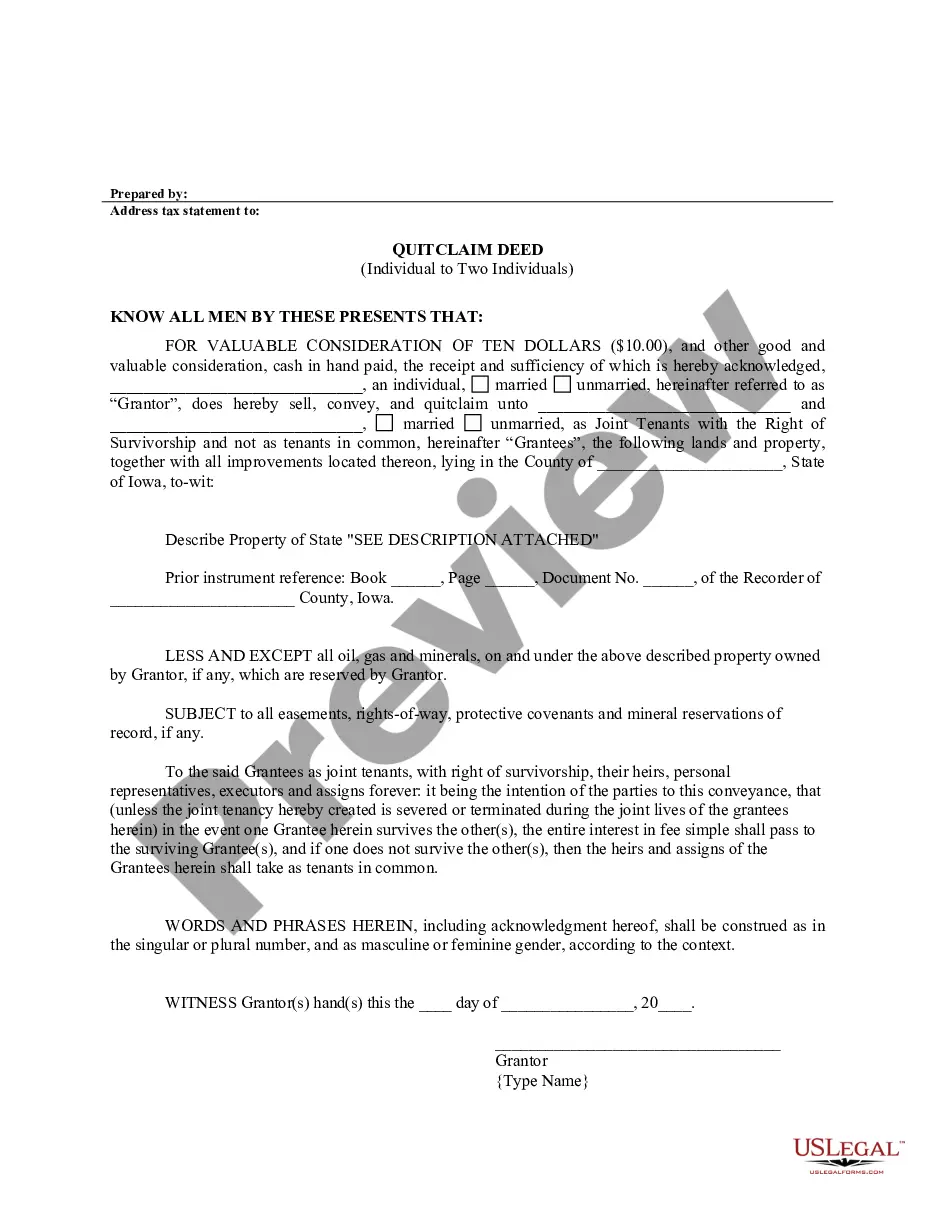
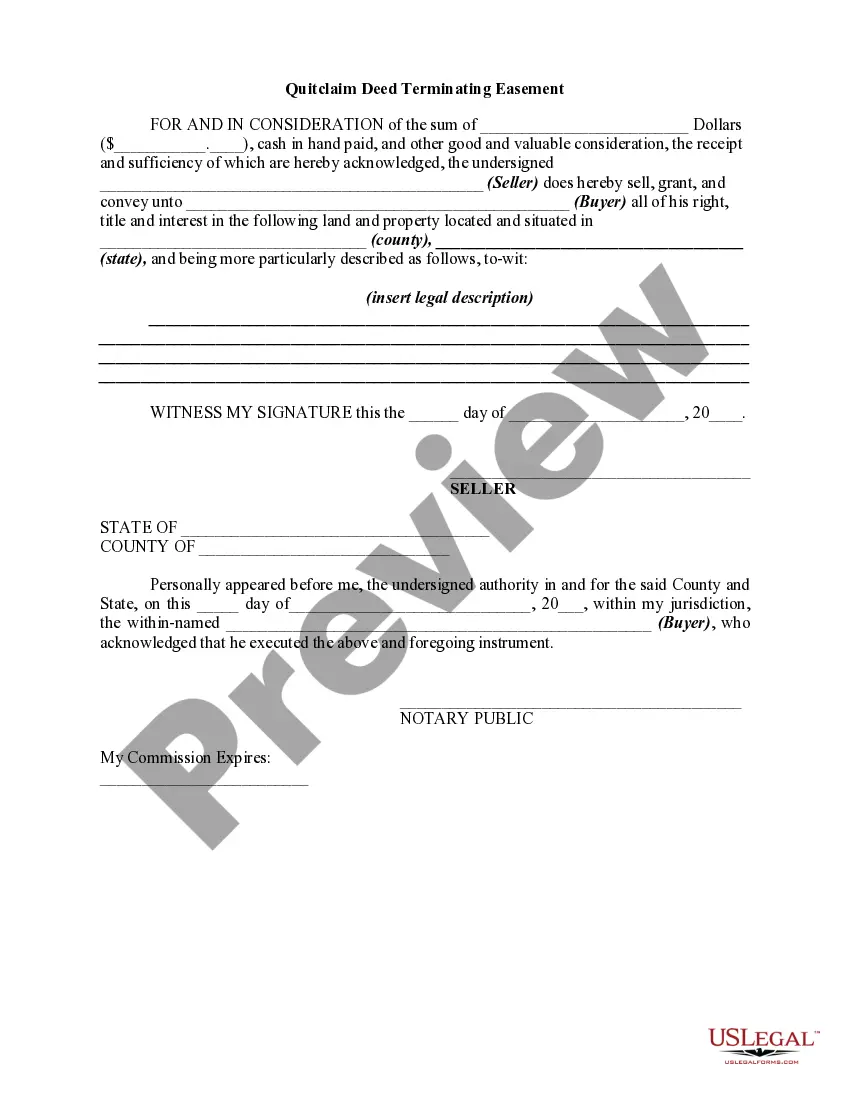
The Quitclaim Deed from Individual to Two Individuals in Joint Tenancy is a legal document that allows an individual (the Grantor) to transfer their ownership interest in a property to two other individuals (the Grantees) who will hold the property as joint tenants. This means that upon the death of one Grantee, their share automatically passes to the surviving Grantee, without going through probate. This form is distinct from other types of deeds, like warranty deeds, as it does not guarantee that the Grantor holds clear title to the property.
Form components explained
- Identification of the Grantor and Grantees with their marital status.
- Description of the property being conveyed.
- Statement of the transfer as a quitclaim, indicating that the Grantor is relinquishing any interest.
- Specification of the joint tenancy arrangement and intent for survivorship.
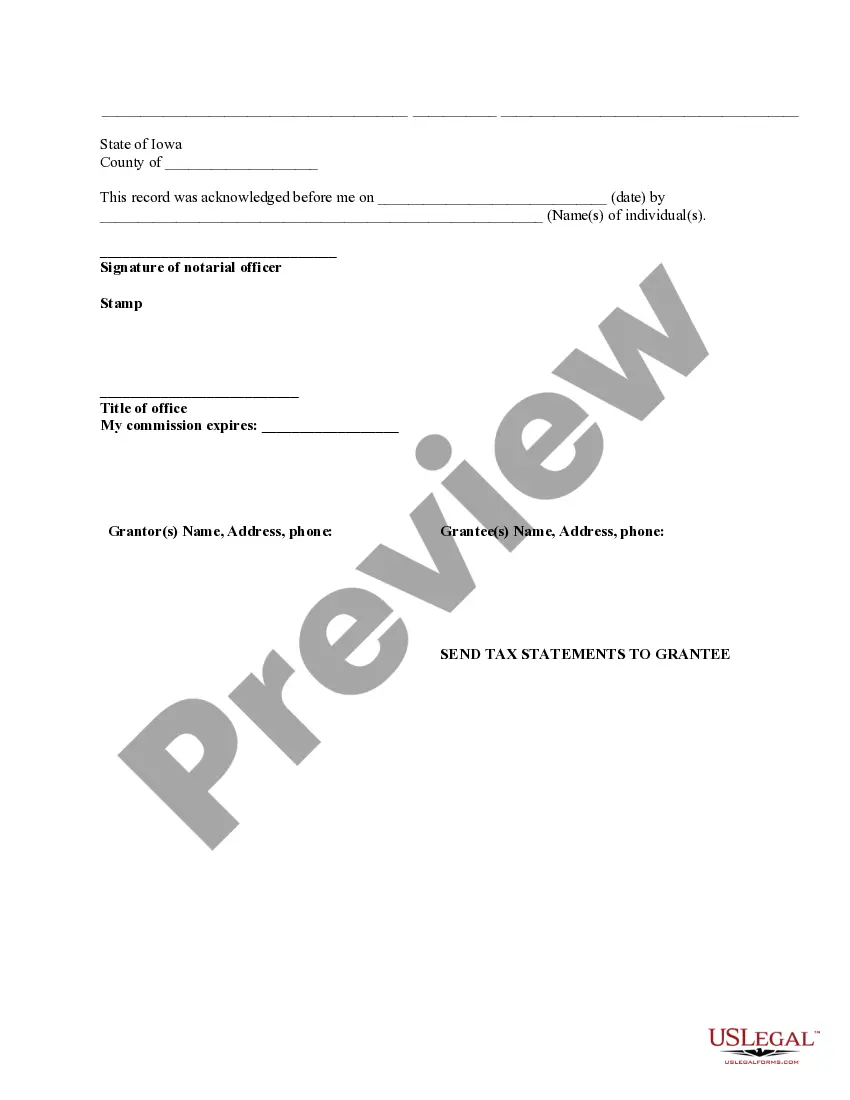
- Notary acknowledgment to verify the authenticity of the signatures.



Common use cases
This form is useful in various situations, such as:- When an individual wants to transfer property to two other individuals without the need for formal assurance of title.- To consolidate family property among multiple heirs.- When facilitating estate planning strategies that involve joint ownership.- In real estate transactions where the transfer is straightforward and quick.
Who needs this form
- Individuals transferring property ownership to family members or co-owners.
- Married or unmarried partners seeking joint ownership of a property.
- Anyone looking for a simple means to pass property ownership without warranties.
Steps to complete this form
- Identify the parties involved: the Grantor and the two Grantees.
- Provide a legal description of the property being transferred.
- Indicate the marital status of the Grantor and Grantees.
- Include the date of the transfer and the Grantor's signature.
- Have the document notarized to ensure its legal validity.
Is notarization required?
To make this form legally binding, it must be notarized. Our online notarization service, powered by Notarize, lets you verify and sign documents remotely through an encrypted video session.
Get your form ready online
Our built-in tools help you complete, sign, share, and store your documents in one place.
Make edits, fill in missing information, and update formatting in US Legal Forms—just like you would in MS Word.
Download a copy, print it, send it by email, or mail it via USPS—whatever works best for your next step.
Sign and collect signatures with our SignNow integration. Send to multiple recipients, set reminders, and more. Go Premium to unlock E-Sign.
If this form requires notarization, complete it online through a secure video call—no need to meet a notary in person or wait for an appointment.
We protect your documents and personal data by following strict security and privacy standards.

Make edits, fill in missing information, and update formatting in US Legal Forms—just like you would in MS Word.

Download a copy, print it, send it by email, or mail it via USPS—whatever works best for your next step.

Sign and collect signatures with our SignNow integration. Send to multiple recipients, set reminders, and more. Go Premium to unlock E-Sign.

If this form requires notarization, complete it online through a secure video call—no need to meet a notary in person or wait for an appointment.

We protect your documents and personal data by following strict security and privacy standards.
Mistakes to watch out for
- Failing to include the legal description of the property accurately.
- Not specifying whether the Grantor and Grantees are married or unmarried.
- Neglecting to have the document notarized, if required.
- Using the form without verifying compliance with state-specific requirements.
Benefits of using this form online
- Convenience of completing the form from home at your own pace.
- Editable templates allow for easy customization to fit specific needs.
- Access to forms that are drafted by licensed attorneys for reliability.
- Immediate download for quick execution.
Looking for another form?

Form popularity
FAQ
In the case of an Iowa Quitclaim Deed from Individual to Two Individuals in Joint Tenancy, it is not mandatory for both parties to be present at the same time. One party can sign the deed while the other party can sign it later, as long as it is executed properly according to Iowa law. However, having both parties present can simplify the process, ensuring that both understand and agree to the terms of the transfer. For an easy and effective way to complete your quit claim deed, consider using US Legal Forms, where you can find the necessary documents and guidance.
Yes, you can create a quitclaim deed yourself; however, it's essential to understand the process. A quitclaim deed allows you to transfer ownership of property, such as an Iowa Quitclaim Deed from Individual to Two Individuals in Joint Tenancy. While DIY options are available, using a platform like US Legal Forms can provide you with clear guidelines and professionally drafted templates. This ensures that your deed meets all legal requirements and protects your interests.
To add a joint owner to a deed, start by drafting an Iowa Quitclaim Deed from Individual to Two Individuals in Joint Tenancy. Fill in the full names of the new joint owners and the property description. After completing the deed, you and the joint owner must sign it in front of a notary. Don’t forget to file the signed document with the appropriate county office to make it official.
Yes, you can add someone to your deed without refinancing your mortgage. You simply need to complete the Iowa Quitclaim Deed from Individual to Two Individuals in Joint Tenancy to add the desired person as a joint owner. This deed transfer does not affect your current mortgage terms, but you should inform your lender about the change to ensure transparency. Always make sure to follow the local filing requirements.
Adding someone to a deed can come with risks, such as losing control over the property if disagreements arise. With an Iowa Quitclaim Deed from Individual to Two Individuals in Joint Tenancy, both parties have equal right to the property, which might complicate future sale decisions. Additionally, there may be tax implications or issues regarding liability if the co-owner faces legal or financial troubles. Consider these factors carefully.
While it is not mandatory to hire a lawyer to add someone to a deed, consulting one can simplify the process. An attorney can help ensure that you correctly complete the Iowa Quitclaim Deed from Individual to Two Individuals in Joint Tenancy. They can also assist with any legal concerns you may have about property rights or local regulations. Choosing to seek legal advice can give you peace of mind.
Filling out a quitclaim deed to add your spouse involves clearly indicating both parties' names and the property description on the Iowa Quitclaim Deed from Individual to Two Individuals in Joint Tenancy. Make sure to list the current owner and your spouse as the joint tenants. After completing the form, sign it in the presence of a notary. You can then file it to formalize the addition legally.
To add individuals to a house deed, you'll typically need to complete an Iowa Quitclaim Deed from Individual to Two Individuals in Joint Tenancy. First, obtain the correct deed form, which can be found on various legal document platforms. Fill in the required information, including the names of the new owners and the property details. Finally, sign the document in front of a notary public and file it with your local county recorder.
A quitclaim deed in Iowa transfers the grantor's interest in a property to the grantee without any warranties on the title's validity. When you execute an Iowa Quitclaim Deed from Individual to Two Individuals in Joint Tenancy, you quickly and efficiently transfer ownership. This process is straightforward, but it is crucial to record the deed with the county to protect your rights as an owner. Platforms like UsLegalForms can assist you in drafting and filing the necessary paperwork.
Joint tenancy in Iowa means that two or more individuals hold equal shares of a property, and when one owner passes away, their interest automatically transfers to the remaining co-owners. This setup provides survivorship rights, making it a popular choice for couples and partners. To establish joint tenancy, you can use an Iowa Quitclaim Deed from Individual to Two Individuals in Joint Tenancy, ensuring that you explicitly state this arrangement in the deed. Knowing the specifics helps in managing property ownership efficiently.