Wyoming Last Will and Testament Package

About this form package
The Wyoming Last Will and Testament Package provides essential legal documents designed to help you create a comprehensive last will. This package simplifies the estate planning process by including a Last Will and Testament tailored to your needs, along with additional forms, giving you the tools to protect your assets and ensure your wishes are honored after your passing. Unlike other form packages, this one offers a completed sample of the Will for your review, further enhancing your understanding and confidence in preparing your documents.
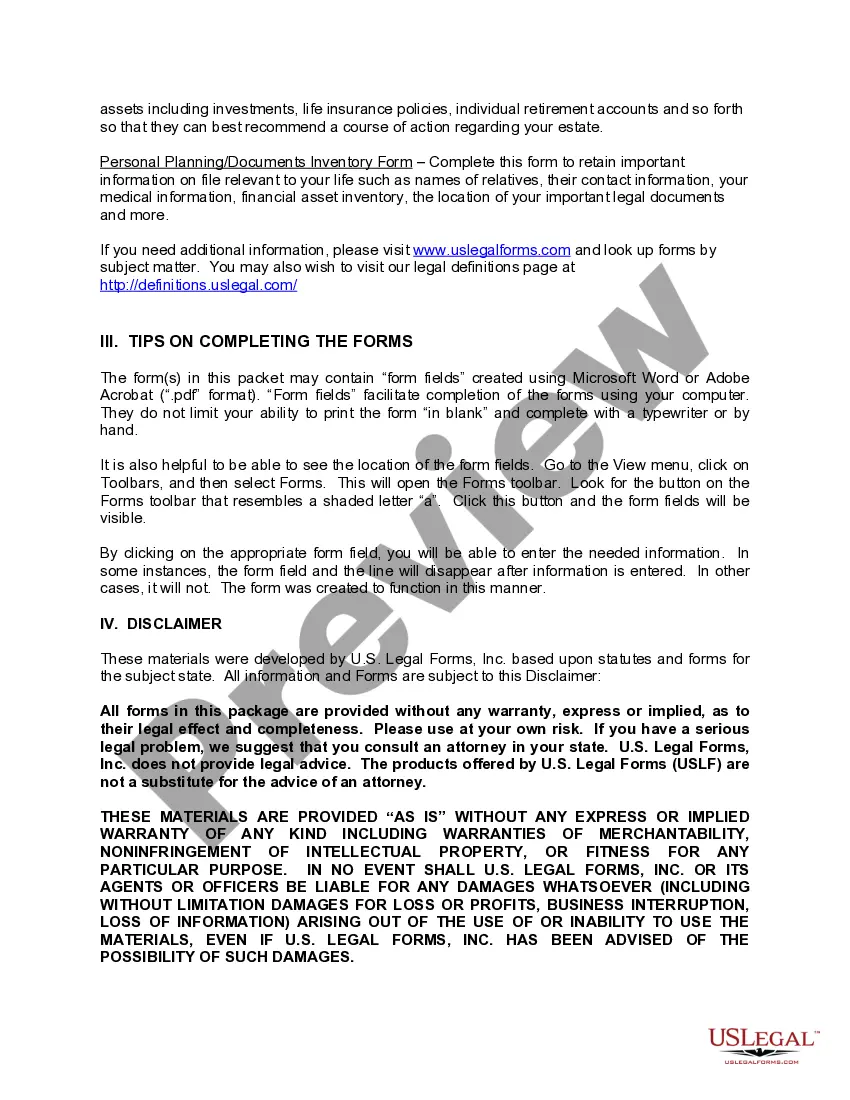
Forms you’ll find in this package


Situations where these forms applies
You should use the Wyoming Last Will and Testament Package in the following situations:
- If you are planning your estate and want to ensure your assets are distributed according to your wishes.
- When you need to designate guardianship for minor children or dependents.
- If you have recently experienced a major life change, such as marriage, divorce, or the birth of a child.
- To prepare for unforeseen circumstances that may affect your health or financial affairs.
Who should use this form package
- Individuals residing in Wyoming who seek to draft a legally binding Last Will and Testament.
- Parents or guardians looking to establish legal guardianship for their children in the event of their passing.
- Anyone wanting to ensure their healthcare and financial wishes are clearly documented.
- Individuals experiencing significant life changes that necessitate updates to their estate plans.
How to complete these forms
- Review the forms included in your package to understand the requirements.
- Select the appropriate version of the Last Will and Testament based on your circumstances (married, single, with or without children).
- Complete the Estate Planning Questionnaire to provide necessary details about your assets and beneficiaries.
- Fill out the Personal Planning Information and Document Inventory Worksheets to organize critical information for your loved ones.
- Refer to the completed sample Will while drafting your own for guidance on structure and language.
Do forms in this package need to be notarized?
Notarization is generally not required for forms in this package. However, specific circumstances or local laws may require it. You can complete notarization remotely through US Legal Forms, powered by Notarize, with 24/7 availability.
Get your form ready online
Our built-in tools help you complete, sign, share, and store your documents in one place.
Make edits, fill in missing information, and update formatting in US Legal Forms—just like you would in MS Word.
Download a copy, print it, send it by email, or mail it via USPS—whatever works best for your next step.
Sign and collect signatures with our SignNow integration. Send to multiple recipients, set reminders, and more. Go Premium to unlock E-Sign.
If this form requires notarization, complete it online through a secure video call—no need to meet a notary in person or wait for an appointment.
We protect your documents and personal data by following strict security and privacy standards.

Make edits, fill in missing information, and update formatting in US Legal Forms—just like you would in MS Word.

Download a copy, print it, send it by email, or mail it via USPS—whatever works best for your next step.

Sign and collect signatures with our SignNow integration. Send to multiple recipients, set reminders, and more. Go Premium to unlock E-Sign.

If this form requires notarization, complete it online through a secure video call—no need to meet a notary in person or wait for an appointment.

We protect your documents and personal data by following strict security and privacy standards.
Avoid these common issues
- Failing to update the Will after significant life events, such as marriage or divorce.
- Not clearly specifying guardianship for minor children.
- Overlooking the need for witnesses to sign the Will in accordance with state requirements.
- Neglecting to keep the original Will in a safe place accessible to executors.
Benefits of using this package online
- Convenient access: Download the forms instantly at your convenience.
- Editability: Modify forms easily to fit your specific needs without needing a lawyer for initial drafts.
- Guidance: Provides a user-friendly interface with clear instructions, making the process straightforward.
- Reliability: Forms are drafted by licensed attorneys, ensuring they meet legal standards.
Looking for another form?
Form popularity
FAQ
Contrary to popular belief, you do not need to have an attorney draft a will for you. Anyone can write this document on their own, and as long as it meets all of the legal requirements of the state, courts will recognize one you wrote yourself.
A person's last will and testament outlines what to do with possessions, whether the deceased will leave them to another person, a group or donate them to charity, and what happens to other things that they are responsible for, such as custody of dependents and management of accounts and financial interests.
No, in Wyoming, you do not need to notarize your will to make it legal. However, Wyoming allows you to make your will "self-proving" and you'll need to go to a notary if you want to do that. A self-proving will speeds up probate because the court can accept the will without contacting the witnesses who signed it.
In order for a will to be valid, it must be: made by a person who is 18 years old or over and. made voluntarily and without pressure from any other person and.signed by the two witnesses, in the presence of the person making the will, after it has been signed.
Wyoming recognizes holographic (handwritten) wills so long as the document is entirely in the handwriting of the testator and signed by the hand of the testator himself. A Wyoming holographic will does not need to be witnessed.
In Wyoming, you can make a living trust to avoid probate for virtually any asset you own -- real estate, bank accounts, vehicles, and so on. You need to create a trust document (it's similar to a will), naming someone to take over as trustee after your death (called a successor trustee).
A will doesn't have to be notarized to be valid. But in most states, you'll want to add a self-proving affidavit to your will, which must be signed by your witnesses and notarized.If you sign your will in a lawyer's office, the lawyer will provide a notary public.
Bank accounts. Brokerage or investment accounts. Retirement accounts and pension plans. A life insurance policy.