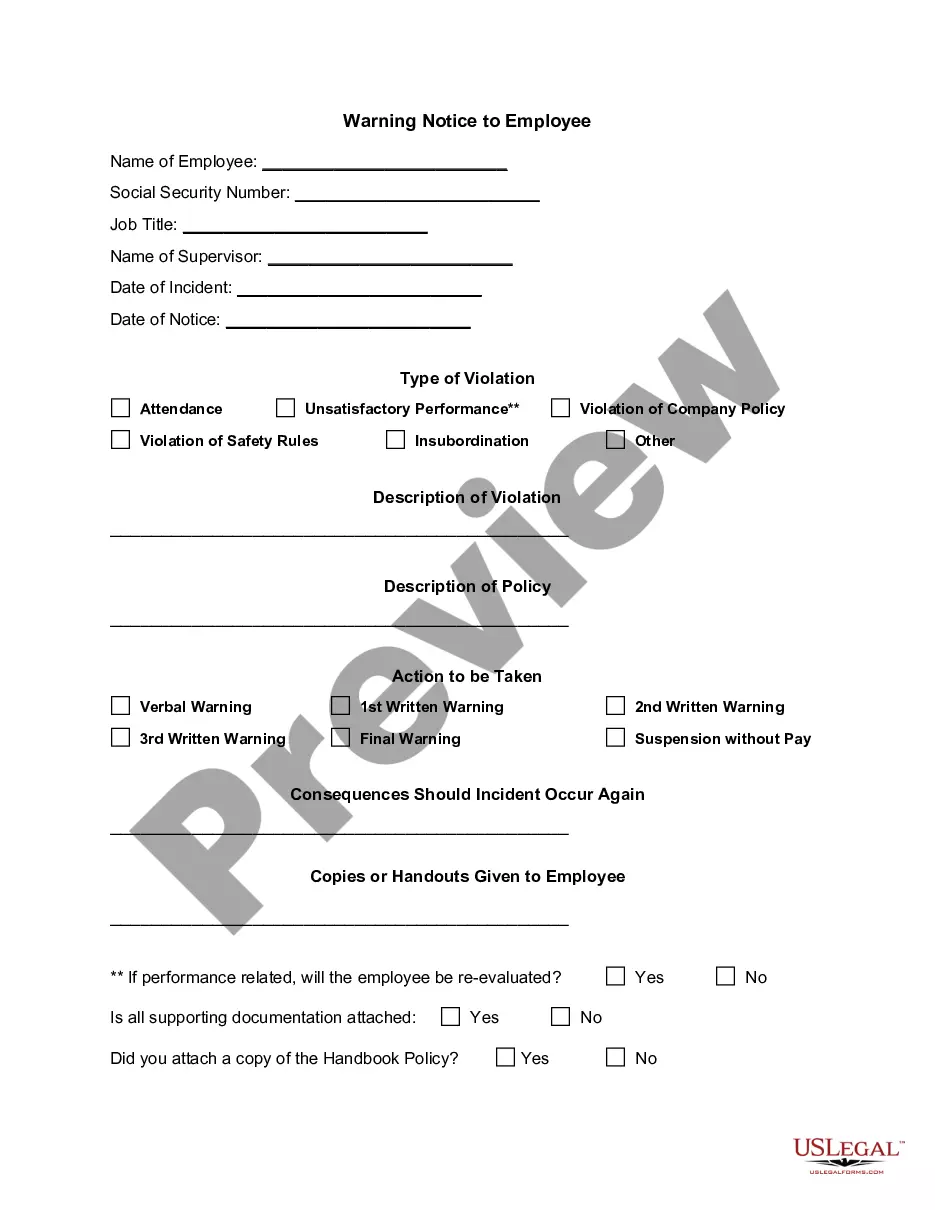
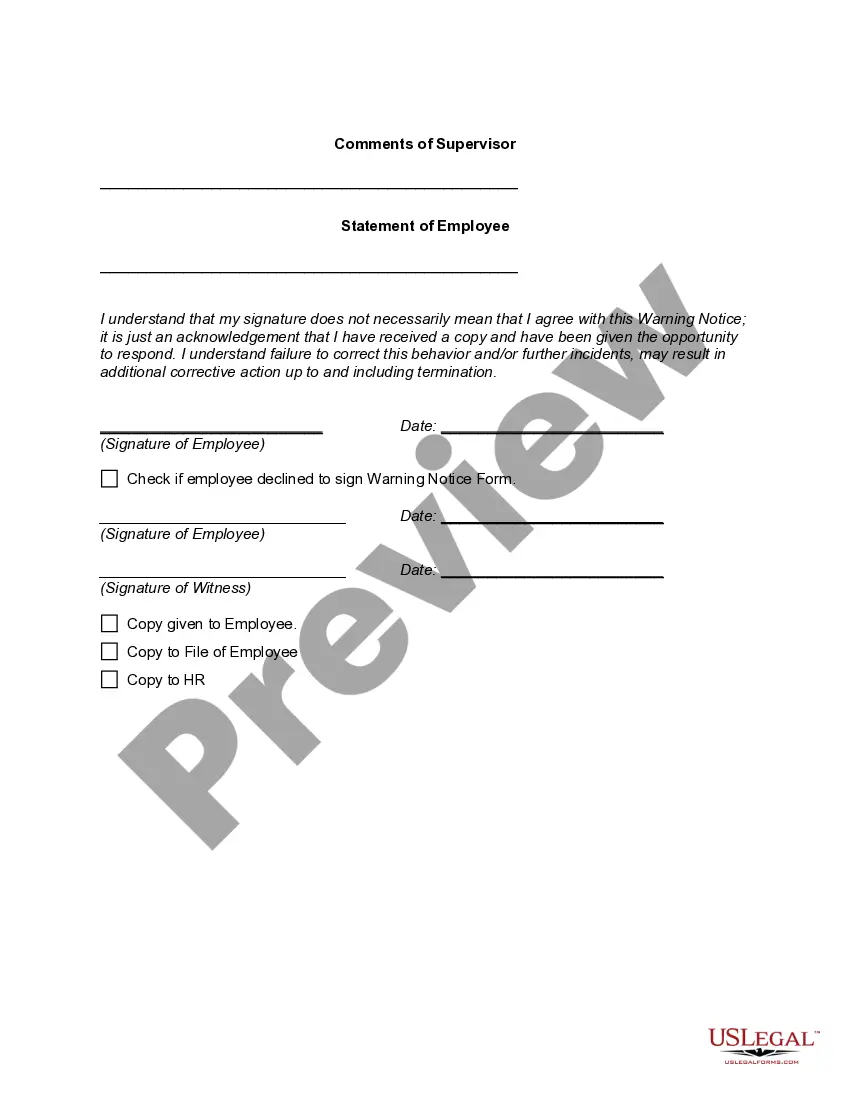
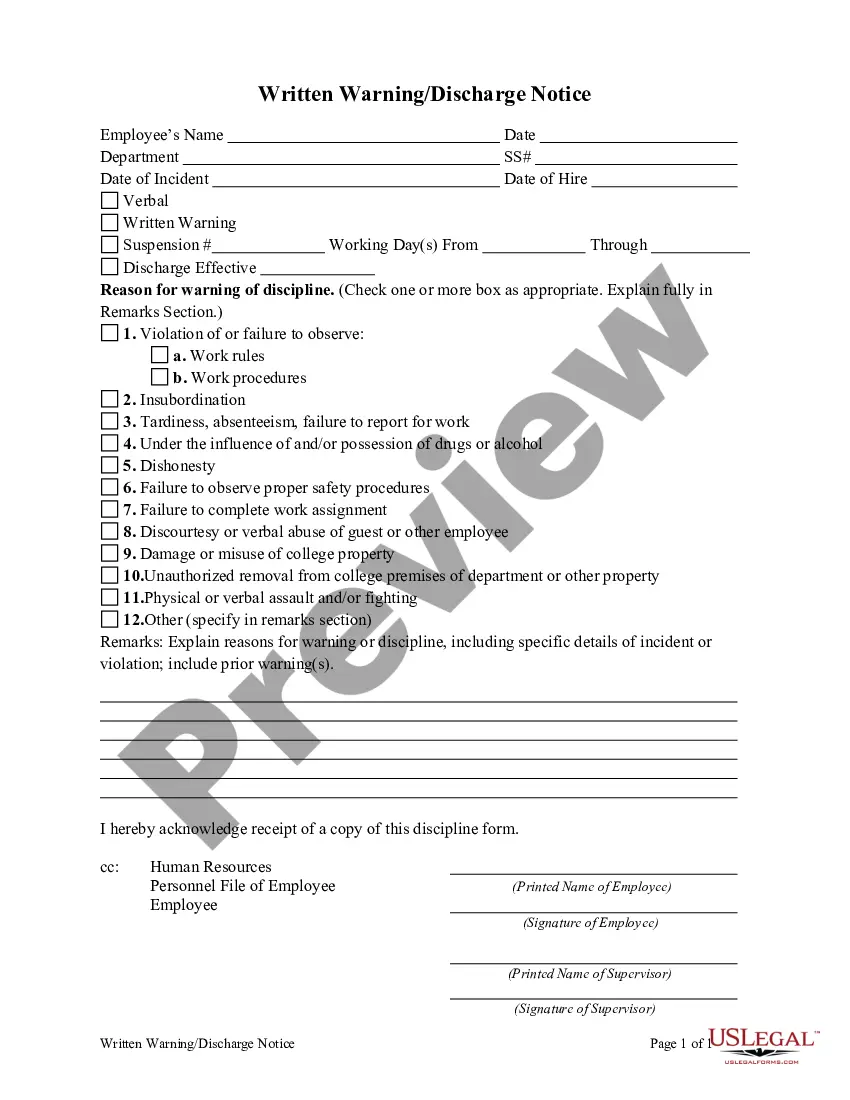
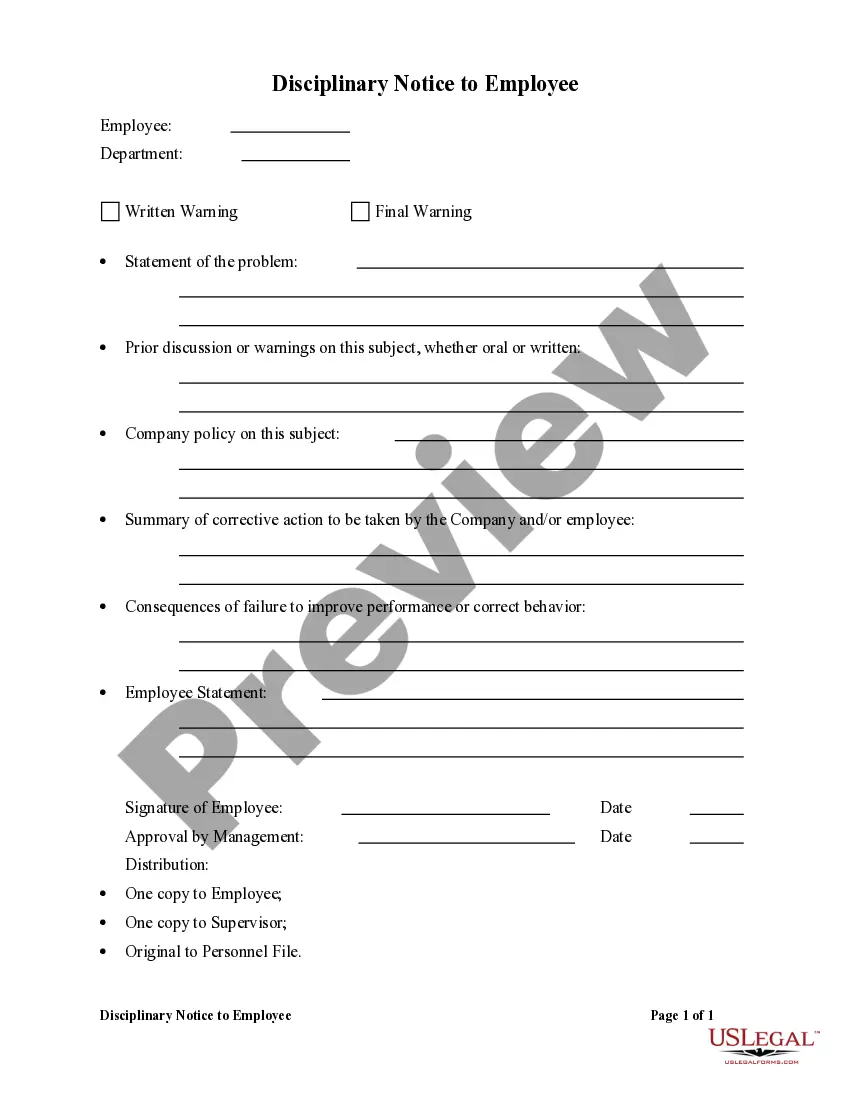
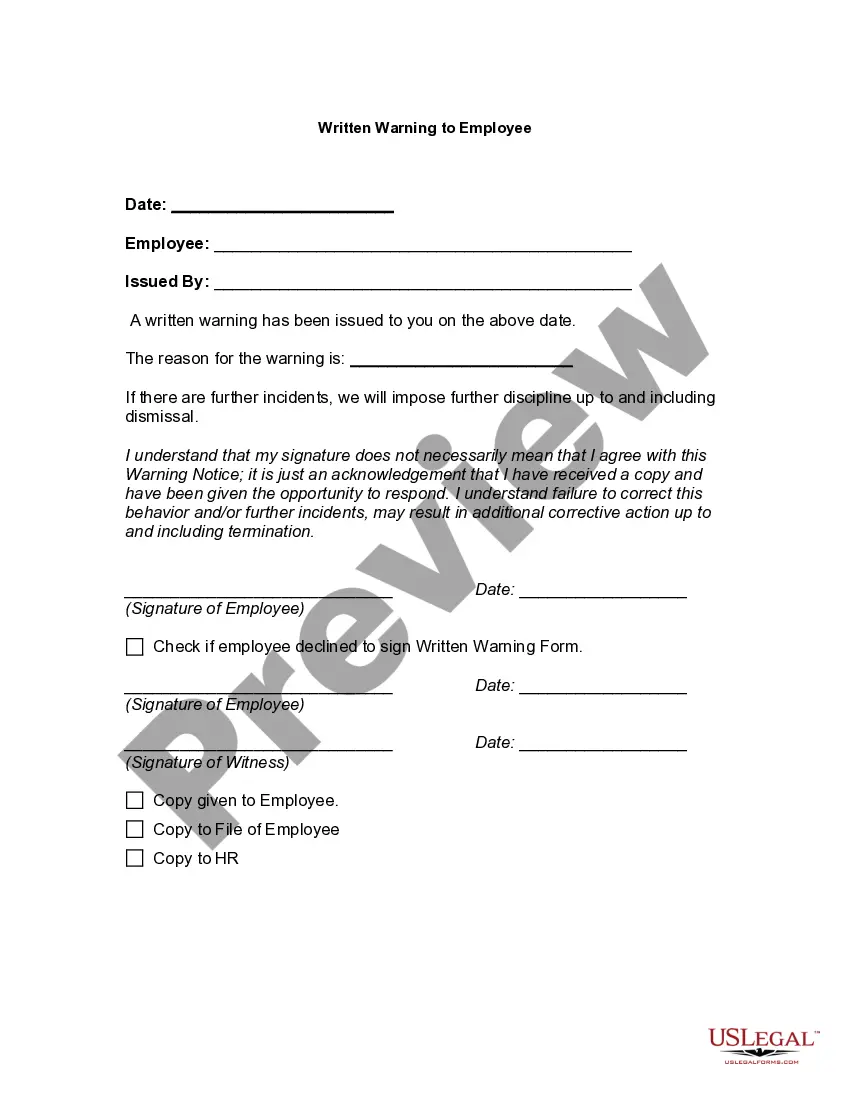
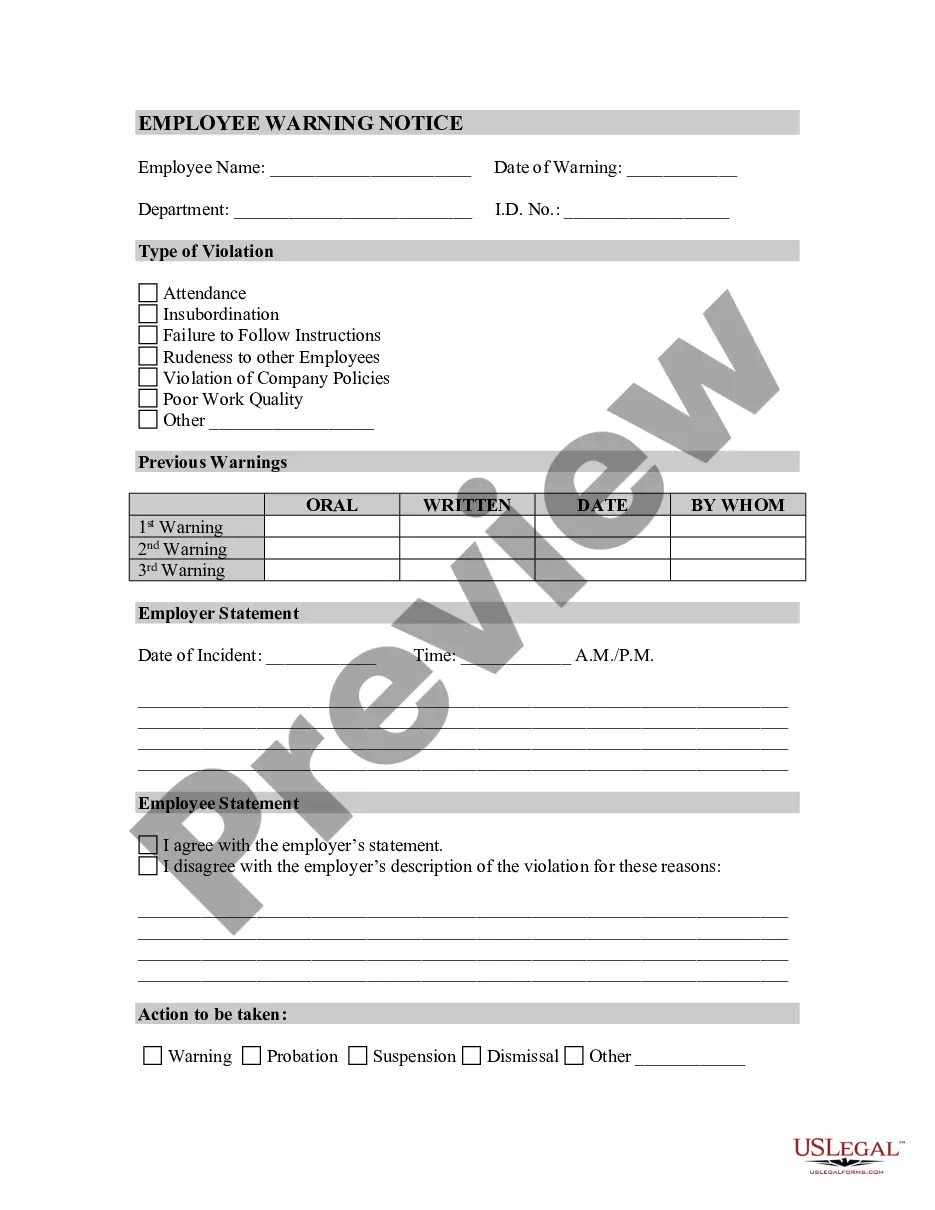
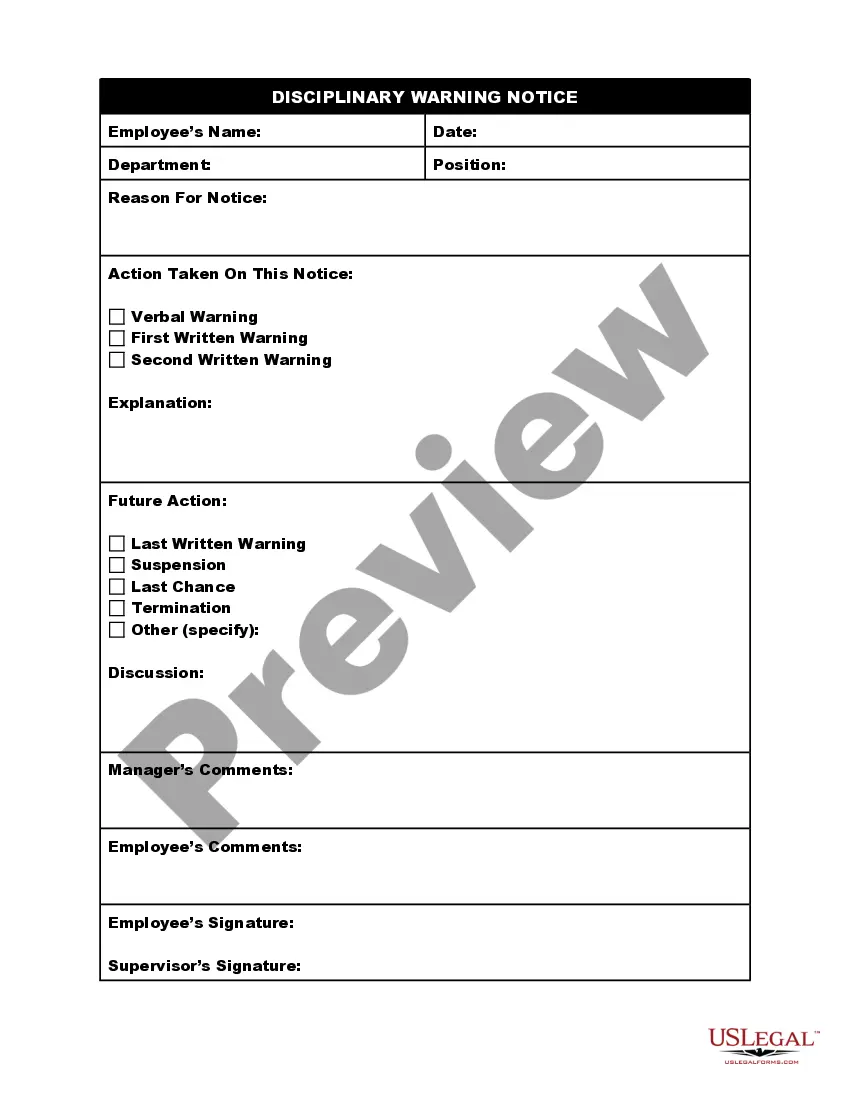
West Virginia Warning Notice to Employee
Description
Get your form ready online
Our built-in tools help you complete, sign, share, and store your documents in one place.
Make edits, fill in missing information, and update formatting in US Legal Forms—just like you would in MS Word.
Download a copy, print it, send it by email, or mail it via USPS—whatever works best for your next step.
Sign and collect signatures with our SignNow integration. Send to multiple recipients, set reminders, and more. Go Premium to unlock E-Sign.
If this form requires notarization, complete it online through a secure video call—no need to meet a notary in person or wait for an appointment.
We protect your documents and personal data by following strict security and privacy standards.

Make edits, fill in missing information, and update formatting in US Legal Forms—just like you would in MS Word.

Download a copy, print it, send it by email, or mail it via USPS—whatever works best for your next step.

Sign and collect signatures with our SignNow integration. Send to multiple recipients, set reminders, and more. Go Premium to unlock E-Sign.

If this form requires notarization, complete it online through a secure video call—no need to meet a notary in person or wait for an appointment.

We protect your documents and personal data by following strict security and privacy standards.
Looking for another form?

How to fill out Warning Notice To Employee?
It is feasible to allocate time online looking for the approved document template that conforms to the federal and state requirements you require.
US Legal Forms offers numerous legal forms that have been assessed by experts.
You can effortlessly download or print the West Virginia Warning Notice to Employee from my service.
Refer to the form description to ensure you have chosen the correct form. If available, utilize the Preview option to examine the document template as well.
- If you already possess a US Legal Forms account, you can Log In and click on the Download option.
- Subsequently, you can fill out, modify, print, or sign the West Virginia Warning Notice to Employee.
- Each legal document template you acquire is yours permanently.
- To obtain another copy of any purchased form, visit the My documents tab and click the relevant option.
- If you are using the US Legal Forms site for the first time, follow the simple instructions below.
- First, verify that you have selected the correct document template for the region/city you choose.
Form popularity
FAQ
Typically, you might give an employee one verbal warning and two written warnings before dismissal. Verbal warnings will often be removed from an employee's disciplinary record after six months and written warnings after 12 months (if there are no further disciplinary offences).
An informal verbal warning is often all you need to improve an employee's conduct or performance. You would normally issue this type of warning before giving someone a written verbal warning. You will need to give at least one employee a verbal warning at work at some point in your time as a boss.
Typically, an employer will give you three warnings before they fire you. But, again, the employer may fire you after one warning or without any warning at all.
The answer lies in the company's disciplinary policy and code. It is recommended that you make provision for a comprehensive final written warning and include a provision in your disciplinary policy that stipulates that any employee who is issued with more than two valid final written warnings may be dismissed.
Employers might want to include the following elements in a written warning:the date of the warning;the name of the employee;the name and position of the person issuing the discipline;the level/type of discipline (e.g., written warning or written warning with three-day suspension);More items...?
How do you write a warning letter to an employee?Identify the problem.Meet with the employee and clarify the issue.Create your warning letter and include all the performance issues you've considered.Give the employee the warning notice and make sure you receive a signature to confirm receipt.
Include: the reason for the warning and the potential problem, how someone should act, and what happens if they don't act. If you don't know the reason for a warning, don't make one up just say that something's gone wrong and offer a solution for what they can do. Avoid repeating content from the title.
In cases of serious misconduct or poor performance, the employer does not have to give a first written warning and can instead go straight to a final written warning. For example, where the employee's actions have, or could, cause serious harm to the business.
Here are some steps you can take to issue a verbal warning easily and appropriately:Take the employee into a private room.State the issue clearly.Discuss the changes they should make.Provide a timeframe for correction.State consequences.Provide support for change.
Typically, you give one verbal warning and two written warnings (one initial and one final) before dismissing them. However, in cases of severe or gross misconduct, you may dismiss the employee without prior warning.