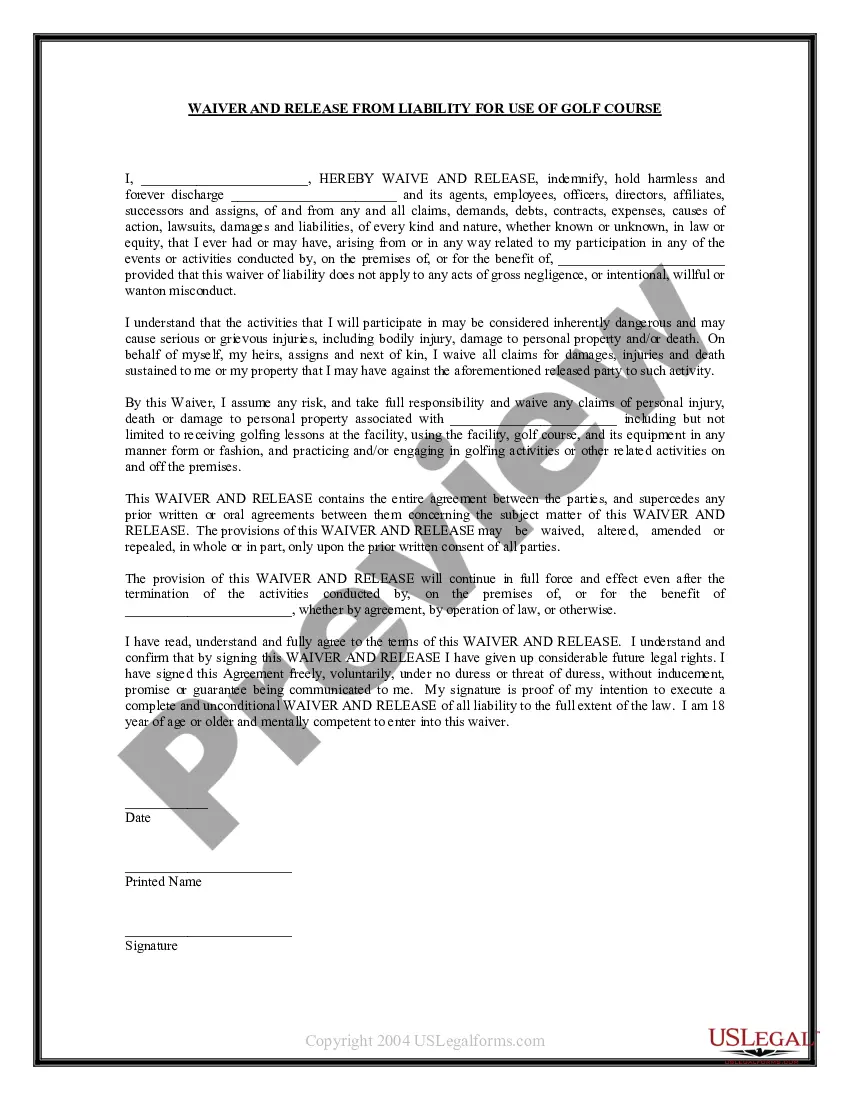
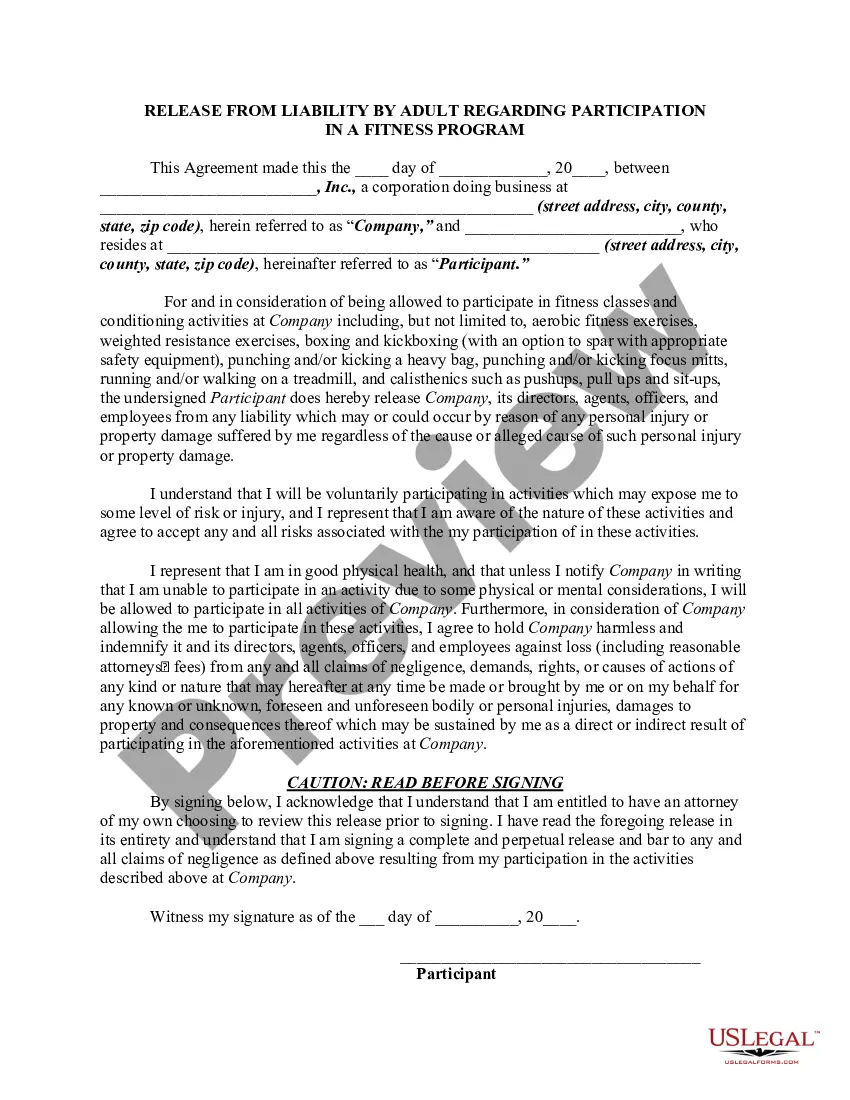
This form allows an adult to release a golf course from liability for injuries which may be incurred while on the premises, taking part in activities, etc.
Wisconsin Waiver and Release From Liability For Adult for Golf Course
Category:
State:
Multi-State
Control #:
US-WAV-07A
Format:
Word;
Rich Text
Instant download
Description
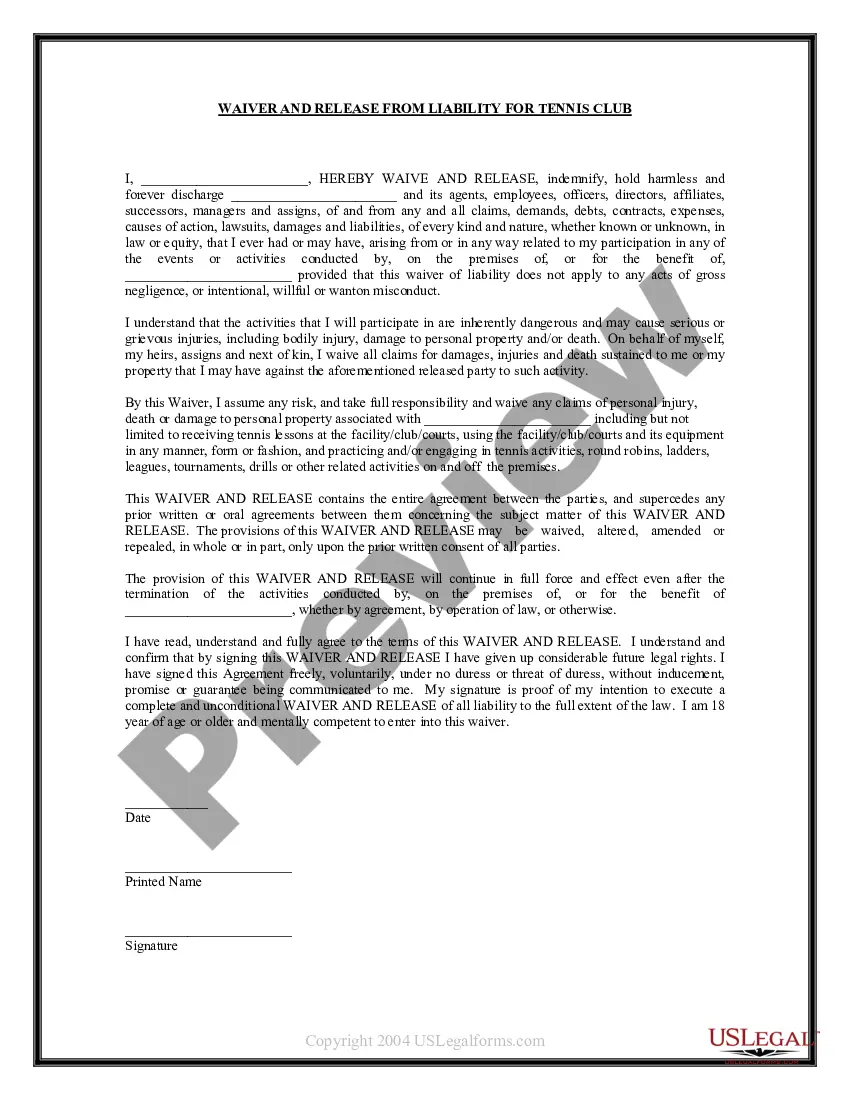
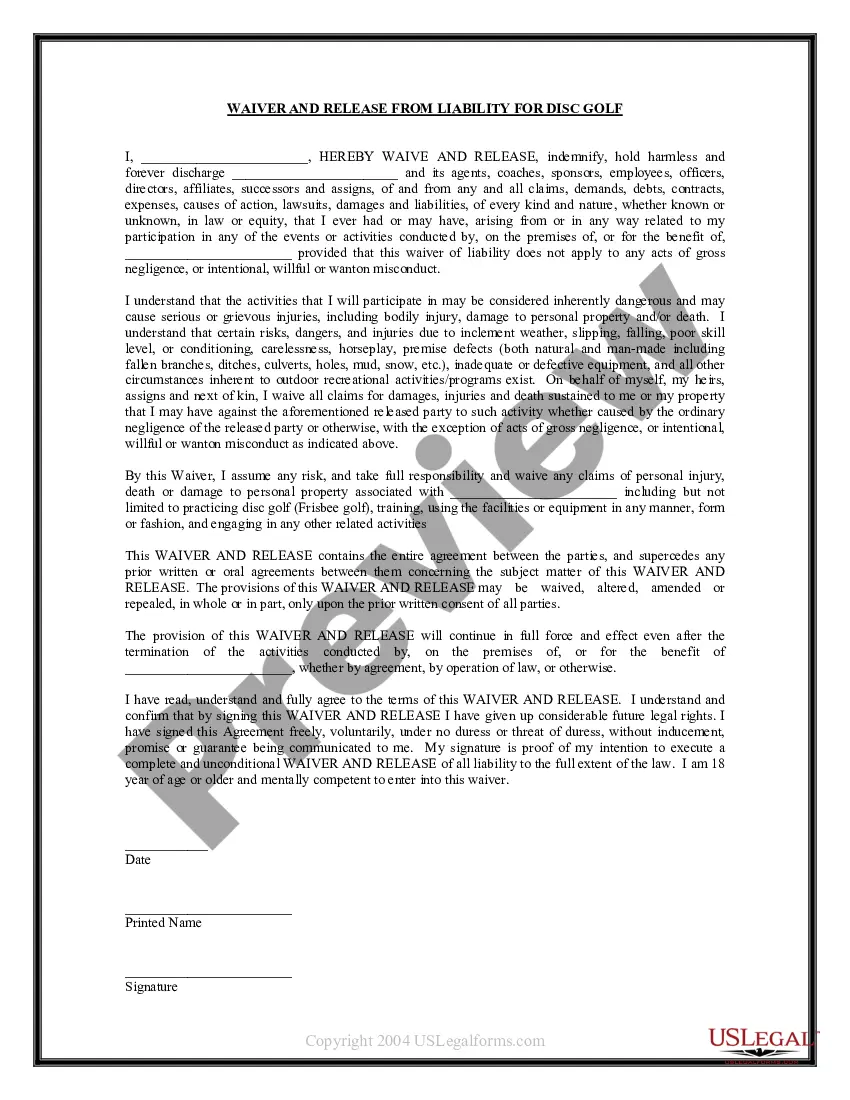


How to fill out Waiver And Release From Liability For Adult For Golf Course?
Are you in the location where you will require documentation for either business or specific purposes nearly every daytime.
There are numerous legitimate document templates available online, but locating versions you can rely on is not simple.
US Legal Forms offers thousands of form templates, including the Wisconsin Waiver and Release From Liability For Adult for Golf Course, which are crafted to meet state and federal regulations.
When you find the appropriate document, click Buy now.
Select the pricing plan you want, complete the necessary information to create your account, and purchase the order with your PayPal or credit card.
- If you are already acquainted with the US Legal Forms website and possess an account, just Log In.
- Then, you can obtain the Wisconsin Waiver and Release From Liability For Adult for Golf Course template.
- If you do not have an account and wish to start using US Legal Forms, follow these steps.
- Acquire the form you need and ensure it is for your correct town/area.
- Use the Review button to evaluate the document.
- Check the outline to confirm that you have selected the correct form.
- If the document is not what you are looking for, use the Search section to find the form that meets your needs and requirements.
Form popularity
FAQ
To write a release of liability waiver, start by identifying the parties involved and the specific activity, such as golfing. Include a detailed description of the risks associated with the activity, and state that participants are waiving their right to sue. Using a platform like uslegalforms can provide you with templates tailored for a Wisconsin Waiver and Release From Liability For Adult for Golf Course, which can simplify the process and ensure compliance with legal standards.
Yes, liability waivers are generally enforceable in Wisconsin, provided they meet specific legal criteria. Participants must understand the risks they are assuming, and the waiver must be written in clear language. A Wisconsin Waiver and Release From Liability For Adult for Golf Course should not be overly broad or vague to ensure its enforceability in court.
To create an effective waiver of liability, it must clearly identify the parties involved, outline the risks associated with the activity, and include an explicit statement of release. Specifically for a Wisconsin Waiver and Release From Liability For Adult for Golf Course, the language must be unambiguous and understandable to all participants. Ensuring these elements are present can help reinforce the waiver's legality.
Yes, you can write your own liability waiver, but it is essential to ensure that it meets the legal standards in Wisconsin. A Wisconsin Waiver and Release From Liability For Adult for Golf Course should clearly outline the risks involved and explicitly state that participants are waiving their rights to sue. While templates are available, consider consulting a legal professional to ensure your waiver is valid and enforceable.
In Wisconsin, an enforceable release of liability must meet certain criteria to be valid. It should clearly state the intent to relinquish rights and must be specific about the activities covered, such as those outlined in the Wisconsin Waiver and Release From Liability For Adult for Golf Course. Additionally, the language should be clear and understandable, ensuring that participants are fully informed of their rights and the risks involved. Using a reliable platform like uslegalforms can help you create a compliant waiver that meets these standards.
A liability waiver is a legal document designed to protect organizations and businesses from claims related to injuries or damages. When you sign a Wisconsin Waiver and Release From Liability For Adult for Golf Course, you agree not to hold the golf course responsible for any accidents that may occur during your visit. This helps ensure that both the facility and participants understand the risks involved in the activity. Ultimately, this document promotes a safer environment for everyone involved.
Generally, a liability waiver document is a legally binding agreement that relinquishes the right of one party to pursue legal remedy for injuries accrued on the property, regardless of fault involved.
As tempting as it may be, you should never write your own liability waiver. Unless you're a fully qualified lawyer with experience in this area, it's likely that you'll omit critical language that puts your business at risk for lawsuits.
Despite the oft-repeated mantra that exculpatory contracts are not invalid per se, the Wisconsin appellate courts have not enforced an exculpatory contract in many years.
A release and waiver agreement is an enforceable promise not to pursue legal action in exchange for compensation. The releasee gives money or some other form of compensation to the releasor, who then agrees not to press charges, sue, or take any other legal action against the releasee.