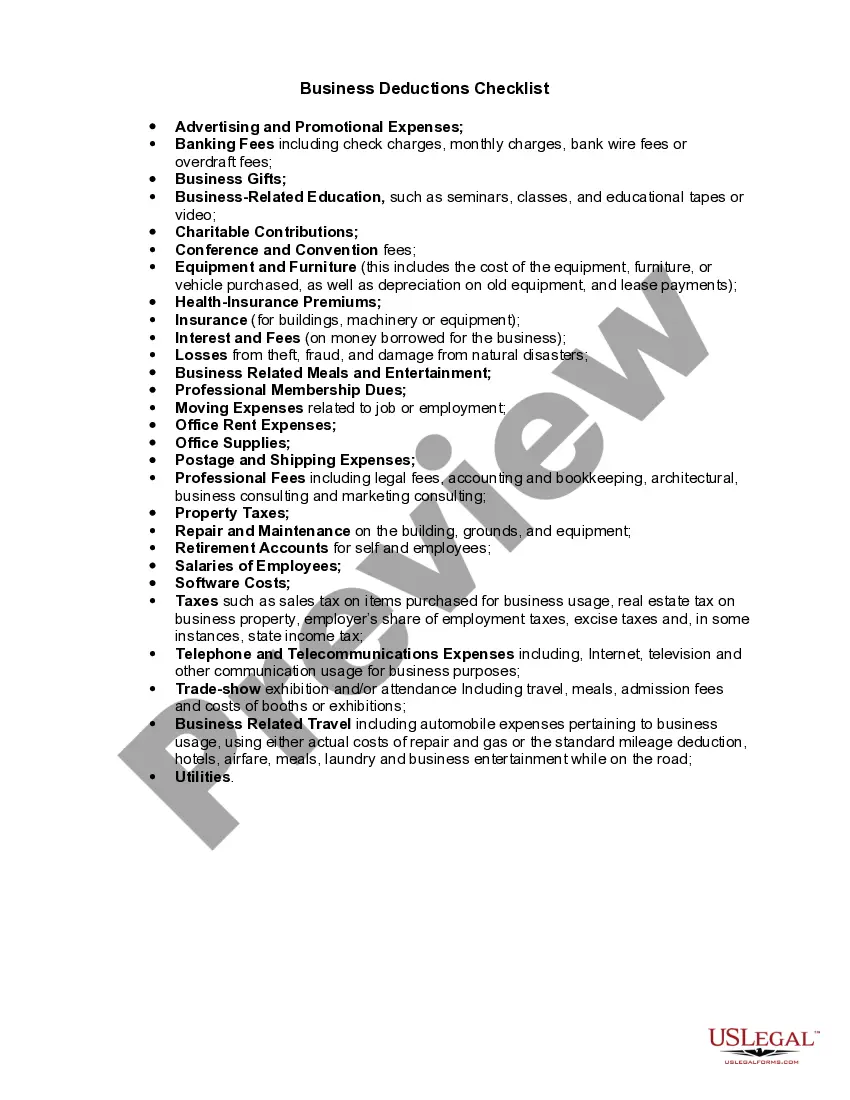
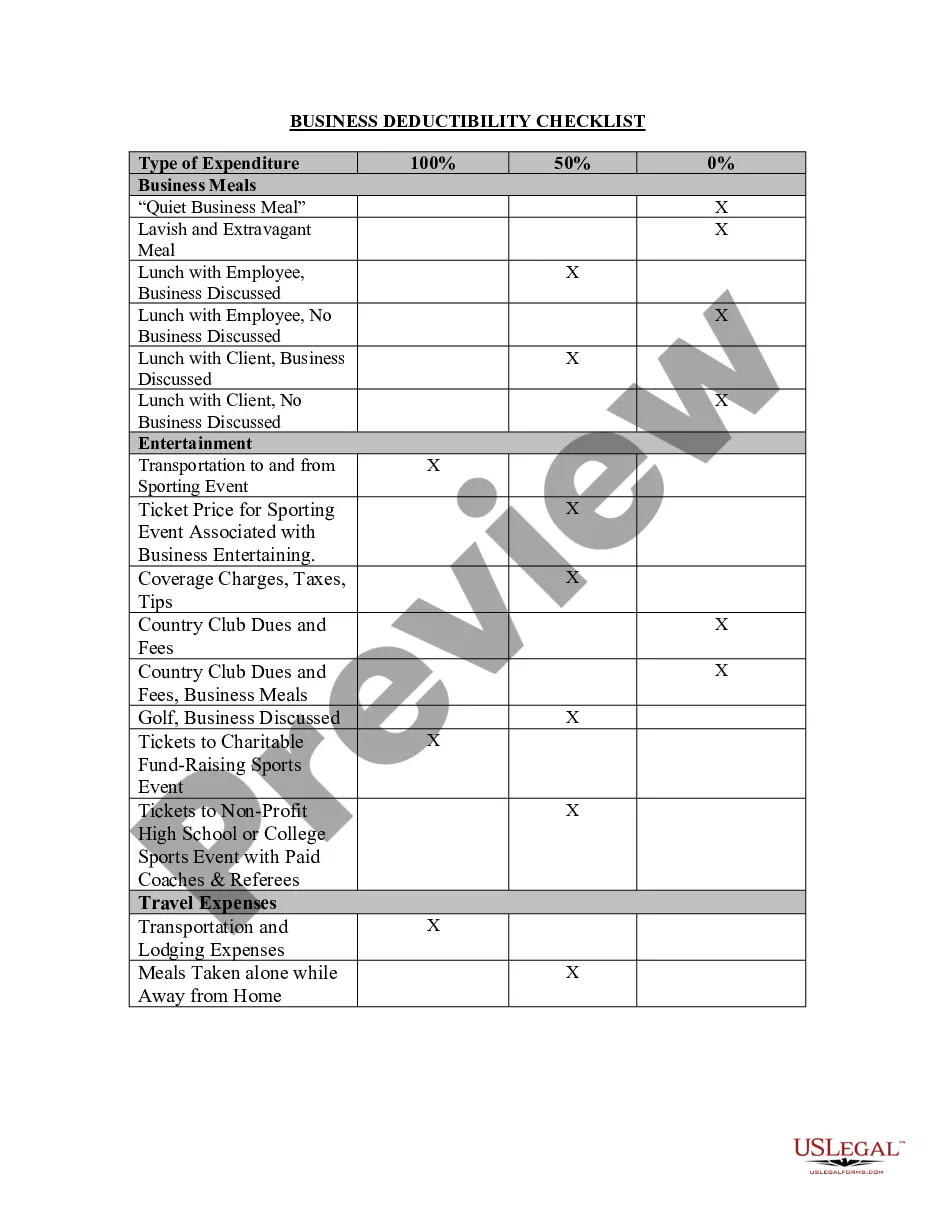
Wisconsin Business Deductions Checklist
Description
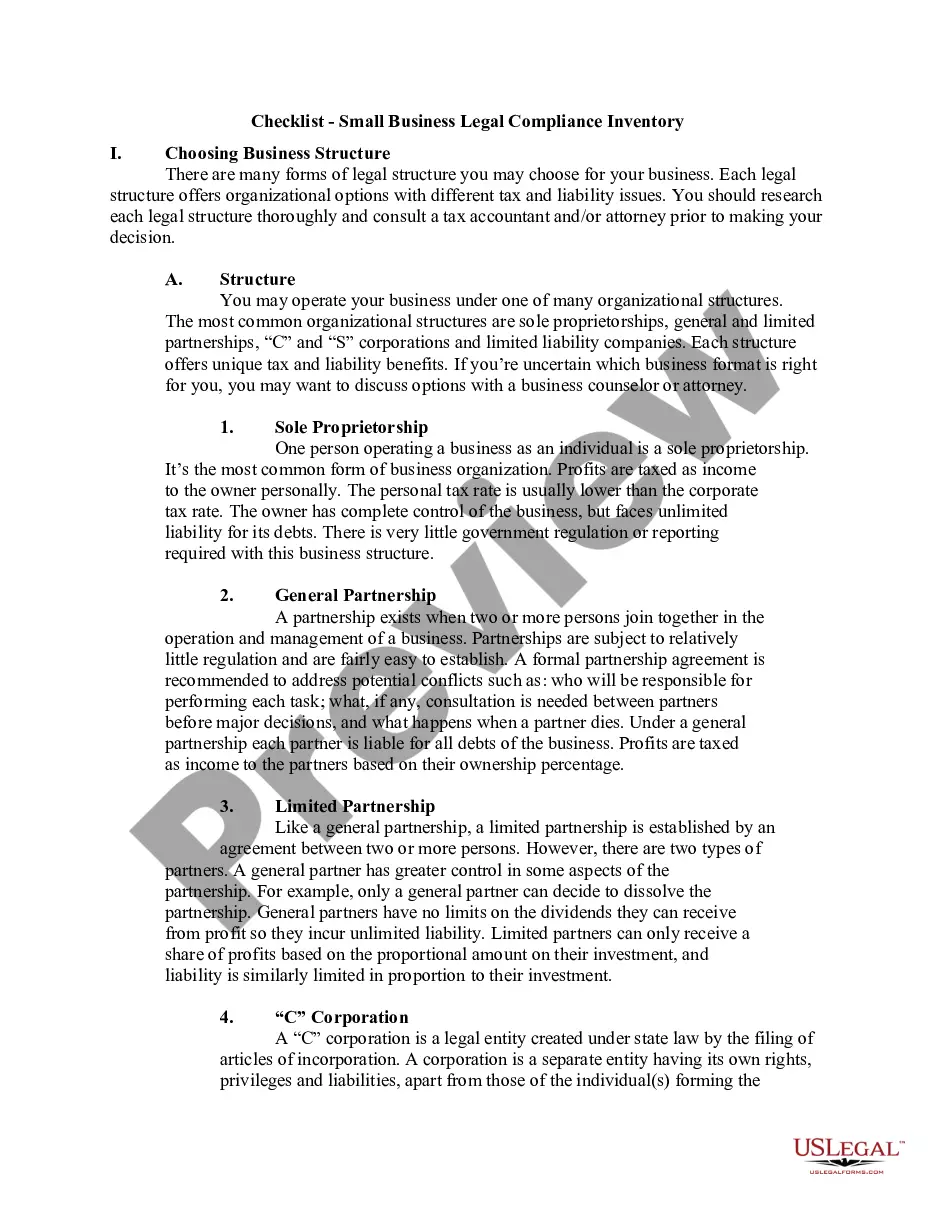
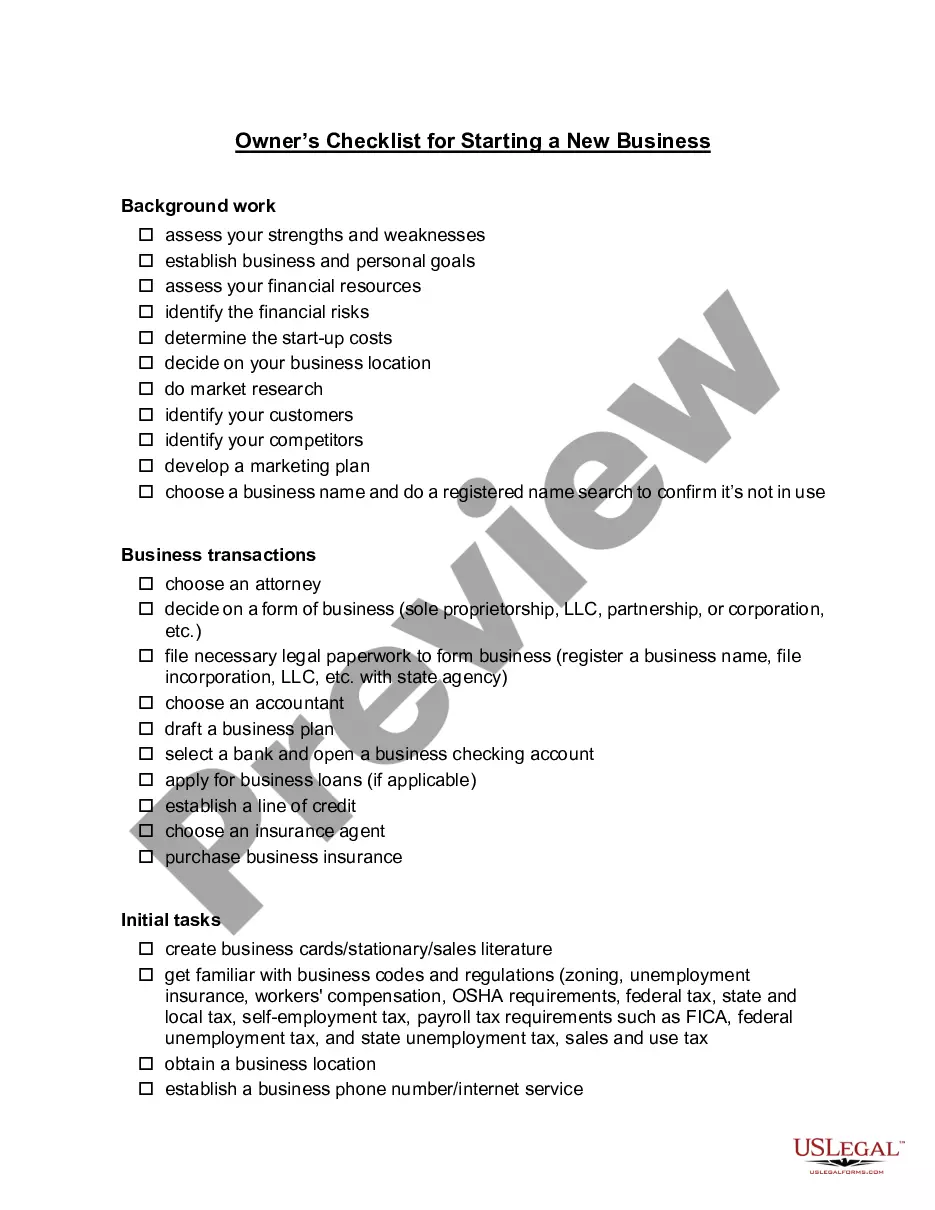
Get your form ready online
Our built-in tools help you complete, sign, share, and store your documents in one place.
Make edits, fill in missing information, and update formatting in US Legal Forms—just like you would in MS Word.
Download a copy, print it, send it by email, or mail it via USPS—whatever works best for your next step.
Sign and collect signatures with our SignNow integration. Send to multiple recipients, set reminders, and more. Go Premium to unlock E-Sign.
If this form requires notarization, complete it online through a secure video call—no need to meet a notary in person or wait for an appointment.
We protect your documents and personal data by following strict security and privacy standards.

Make edits, fill in missing information, and update formatting in US Legal Forms—just like you would in MS Word.

Download a copy, print it, send it by email, or mail it via USPS—whatever works best for your next step.

Sign and collect signatures with our SignNow integration. Send to multiple recipients, set reminders, and more. Go Premium to unlock E-Sign.

If this form requires notarization, complete it online through a secure video call—no need to meet a notary in person or wait for an appointment.

We protect your documents and personal data by following strict security and privacy standards.
Looking for another form?






How to fill out Business Deductions Checklist?
You might allocate time online looking for the legal document format that fulfills the state and federal requirements you need.
US Legal Forms offers thousands of legal documents that are reviewed by experts.
You can obtain or create the Wisconsin Business Deductions Checklist through my assistance.
If available, use the Review option to examine the document format as well.
- If you possess a US Legal Forms account, you can sign in and then select the Obtain option.
- After that, you can fill out, edit, create, or sign the Wisconsin Business Deductions Checklist.
- Every legal document format you acquire is yours indefinitely.
- To obtain another copy of any purchased document, navigate to the My documents section and select the corresponding option.
- If you are using the US Legal Forms website for the first time, follow the simple instructions outlined below.
- First, ensure that you have chosen the correct document format for your preferred state/city.
- Check the form outline to confirm you have picked the right form.
Form popularity
FAQ
Seniors over 65 typically receive a higher standard deduction than those who are younger. This amount can change yearly, so it’s important to keep your information current. Including this aspect in your Wisconsin Business Deductions Checklist allows you to take full advantage of your entitlements.
Deciding whether to itemize or take the standard deduction depends on your individual financial situation. If your deductible expenses exceed the standard deduction, itemizing may be beneficial. Utilize your Wisconsin Business Deductions Checklist to keep detailed records, which will help inform your decision.
Standard deduction amounts can vary based on filing status and change each tax year. It’s vital to stay updated to ensure you maximize your deductions. Referencing your Wisconsin Business Deductions Checklist can be a great way to ascertain these amounts for your specific situation.
Generally, items that are considered necessary and ordinary for your business may be fully deductible. Examples include supplies, equipment, and certain business meals. Understanding what qualifies can enhance your Wisconsin Business Deductions Checklist, making tax time easier for you.
The standard deduction varies based on the tax year and filing status. For the current year, it’s essential to check the IRS guidelines or update your Wisconsin Business Deductions Checklist to reflect these amounts. This will help you determine the most tax-efficient way to manage your dependents' deductions.
Yes, you can write off your cell phone bill as a business expense if you use your phone for work purposes. The key is to keep track of your business usage. You may need to separate your personal and business use, and this can help you complete your Wisconsin Business Deductions Checklist effectively.
To deduct business expenses, you must ensure the expenses are substantiated by appropriate documentation and directly tied to your business operations. Addressing the requirements on your Wisconsin Business Deductions Checklist is important for staying IRS-compliant. It’s wise to keep records like receipts and invoices to support your deductions. By understanding these requirements, you can better prepare for tax season and maximize your potential savings.
To claim business expenses, you must demonstrate that the expenses are both ordinary and necessary for your trade or business. Additionally, your Wisconsin Business Deductions Checklist should include proving that these expenses relate directly to your income-generating activities. Keeping accurate records is vital, as inconsistent documentation may jeopardize your claims. By adhering to these requirements, you can confidently file your deductions.
The five standard deduction amounts vary based on filing status, including single, married filing jointly, married filing separately, head of household, and qualifying widow. As part of your Wisconsin Business Deductions Checklist, familiarize yourself with these amounts, as they can affect your overall tax strategy. It's crucial to stay updated on these values each tax year since they adjust for inflation. By knowing these deductions, you can maximize your tax benefits.
Yes, you need proof to write off business expenses. For an effective Wisconsin Business Deductions Checklist, it is essential to keep thorough records of all transactions. This includes receipts, contracts, and bank statements that clarify the nature and purpose of the expenses. Without proper documentation, you may face challenges should the IRS request verification.