Wisconsin Assignment of Lien - Corporation
What this document covers
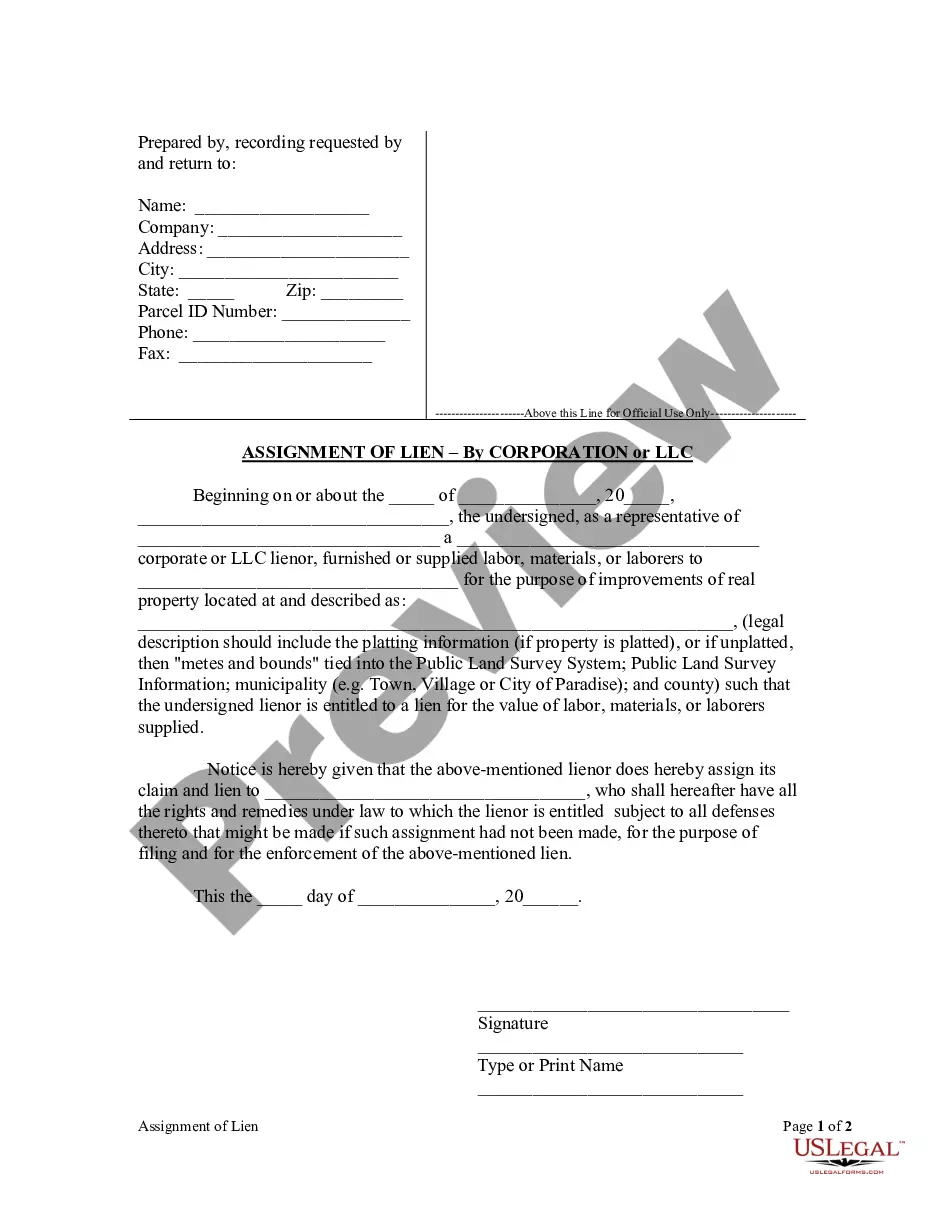
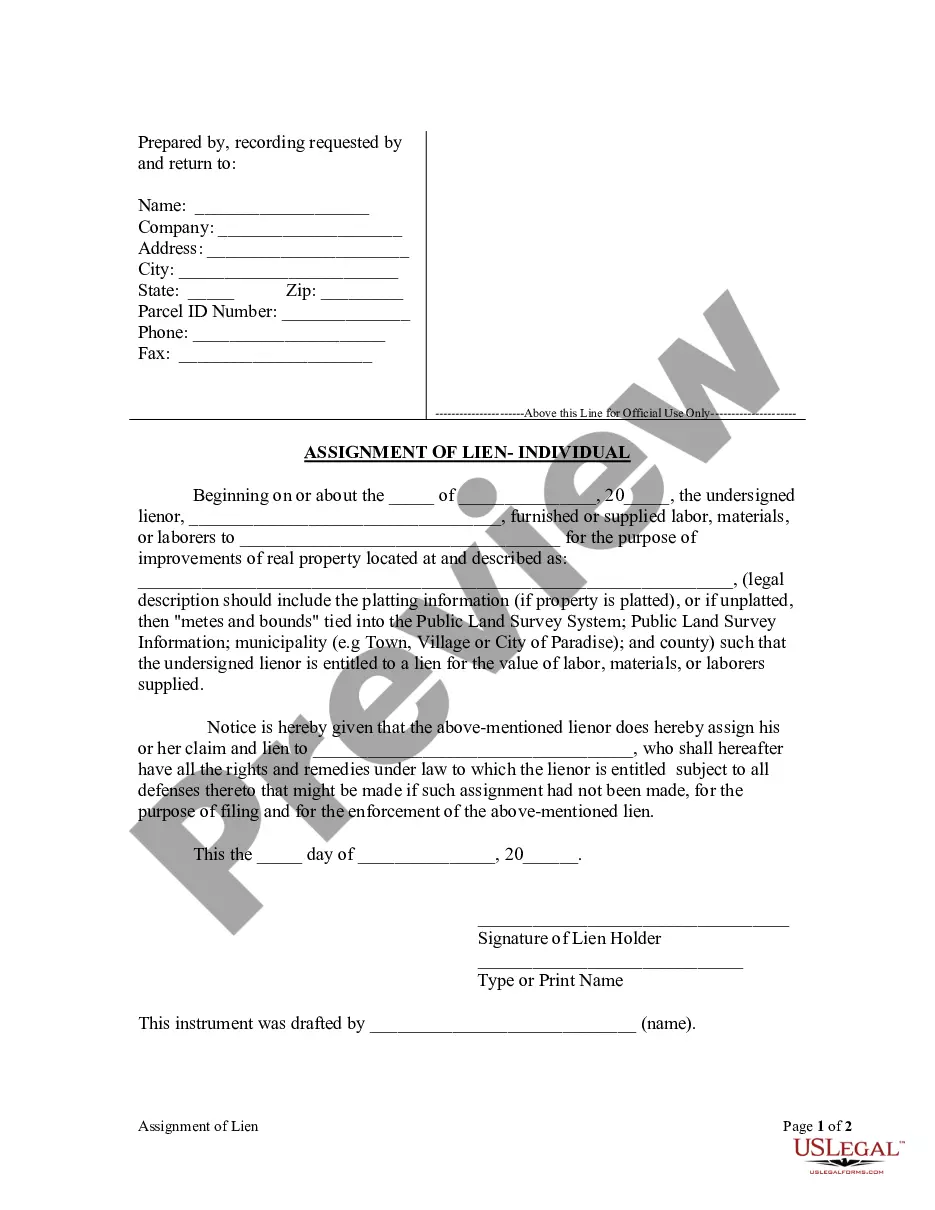
The Assignment of Lien - Corporation is a legal document used by a corporate lienor to notify that they are transferring their lien rights to another party. This form is specifically designed for corporate entities that have supplied labor, materials, or services for improvements on real property. It distinguishes itself from similar forms by addressing the specific needs and legal requirements of corporate lienors in these situations.
Key components of this form
- Identification of the lienor and the party receiving the lien rights.
- Description of the property where the improvements occurred.
- Legal details surrounding the labor, materials, or services provided.
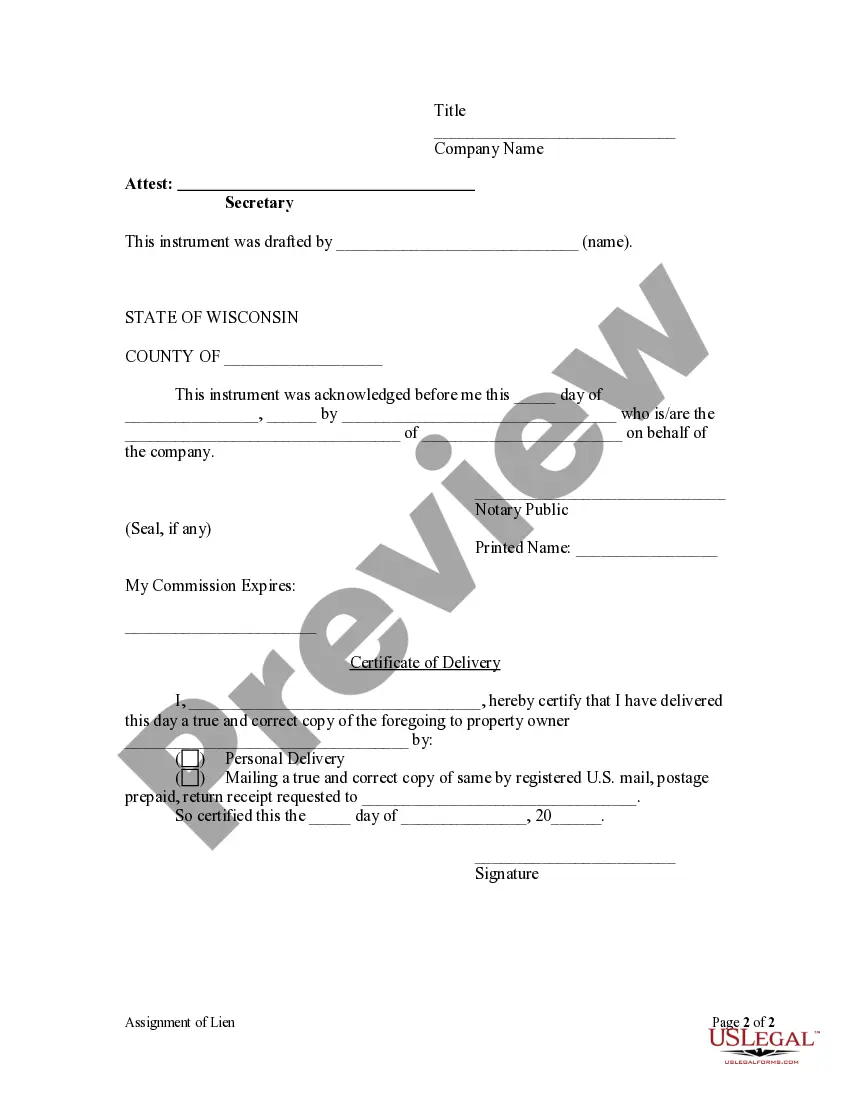
- Space for signatures from authorized representatives of the corporate lienor.
- Notary acknowledgment section for added legal compliance.
When to use this form
This form is necessary when a corporate entity that has supplied labor or materials for property improvements wants to assign its lien rights to another individual or entity. It is particularly useful in construction or renovation scenarios where multiple parties may have contributed to the project and need to ensure their claims are formally recognized and enforceable.
Who this form is for
- Corporate lienors who have provided services, labor, or materials for property improvements.
- Corporations looking to transfer their lien rights to another party for handling claims.
- Any legal representatives of a corporation managing lien assignments.
Steps to complete this form
- Identify the parties involved, including the lienor and the assignee.
- Provide a detailed description of the property linked to the lien.
- Enter the dates relevant to the assignment and signing.
- Ensure all required signatures from authorized representatives are included.
- Complete the notary acknowledgment section for verification purposes.
Notarization guidance
This form must be notarized to be legally valid. US Legal Forms provides secure online notarization powered by Notarize, allowing you to complete the process through a verified video call.
Get your form ready online
Our built-in tools help you complete, sign, share, and store your documents in one place.
Make edits, fill in missing information, and update formatting in US Legal Forms—just like you would in MS Word.
Download a copy, print it, send it by email, or mail it via USPS—whatever works best for your next step.
Sign and collect signatures with our SignNow integration. Send to multiple recipients, set reminders, and more. Go Premium to unlock E-Sign.
If this form requires notarization, complete it online through a secure video call—no need to meet a notary in person or wait for an appointment.
We protect your documents and personal data by following strict security and privacy standards.

Make edits, fill in missing information, and update formatting in US Legal Forms—just like you would in MS Word.

Download a copy, print it, send it by email, or mail it via USPS—whatever works best for your next step.

Sign and collect signatures with our SignNow integration. Send to multiple recipients, set reminders, and more. Go Premium to unlock E-Sign.

If this form requires notarization, complete it online through a secure video call—no need to meet a notary in person or wait for an appointment.

We protect your documents and personal data by following strict security and privacy standards.
Common mistakes
- Failing to include a complete legal description of the property.
- Not obtaining the necessary signatures from corporate officials.
- Omitting the notary acknowledgment, which can invalidate the document.
- Not delivering a copy of the assignment to the property owner.
Why complete this form online
- Convenient access to templates drafted by licensed attorneys.
- Easy customization and download options for immediate use.
- Secure and reliable documentation process with straightforward instructions.
Looking for another form?
Form popularity
FAQ
A claimant must file an original and 2 signed, copies of a Wisconsin "Claim for Lien" form with the clerk of circuit court in the county where the property is located, at least thirty (30) days after service of the notice of intent to file claim for lien, but within, and no later than, 6 months from the date that the
Put your full name, as shown on your original deed, and your current address. Fill in the grantee section of the deed. The grantee is the recipient, so enter your full name and the name of your spouse, followed by your addresses. Put "as husband and wife" after your names.
Option 1: Access the Wisconsin Department of Financial Institutions' online services. Scroll down to the bottom and select Click here to start filing. Then, fill in the required fields and submit. Option 2: Download and mail in the Articles of Organization to Wisconsin's Department of Financial Institutions.
The name of the LLC. The names of the members and managers of the LLC. The address of the LLC's principal place of business.
A mortgage creates a lien on your property that gives the lender the right to foreclose and sell the home to satisfy the debt. A deed of trust (sometimes called a trust deed) is also a document that gives the lender the right to sell the property to satisfy the debt should you fail to pay back the loan.
In Wisconsin, a potential lien claimant must file a mechanics lien within 6 months after the last day on which labor and/or materials were furnished to the project, but at least 30 days after the filing of a Notice of Intention to File a Claim of Lien.
While it's unlikely that just anyone can put a lien on your home or land, it's not unheard of for a court decision or a settlement to result in a lien being placed against a property.
If you have unpaid debt of any kind, this can lead the creditors that you owe money to place a lien on your assets.In other cases, liens may be placed on property by a court order as a result of legal action.