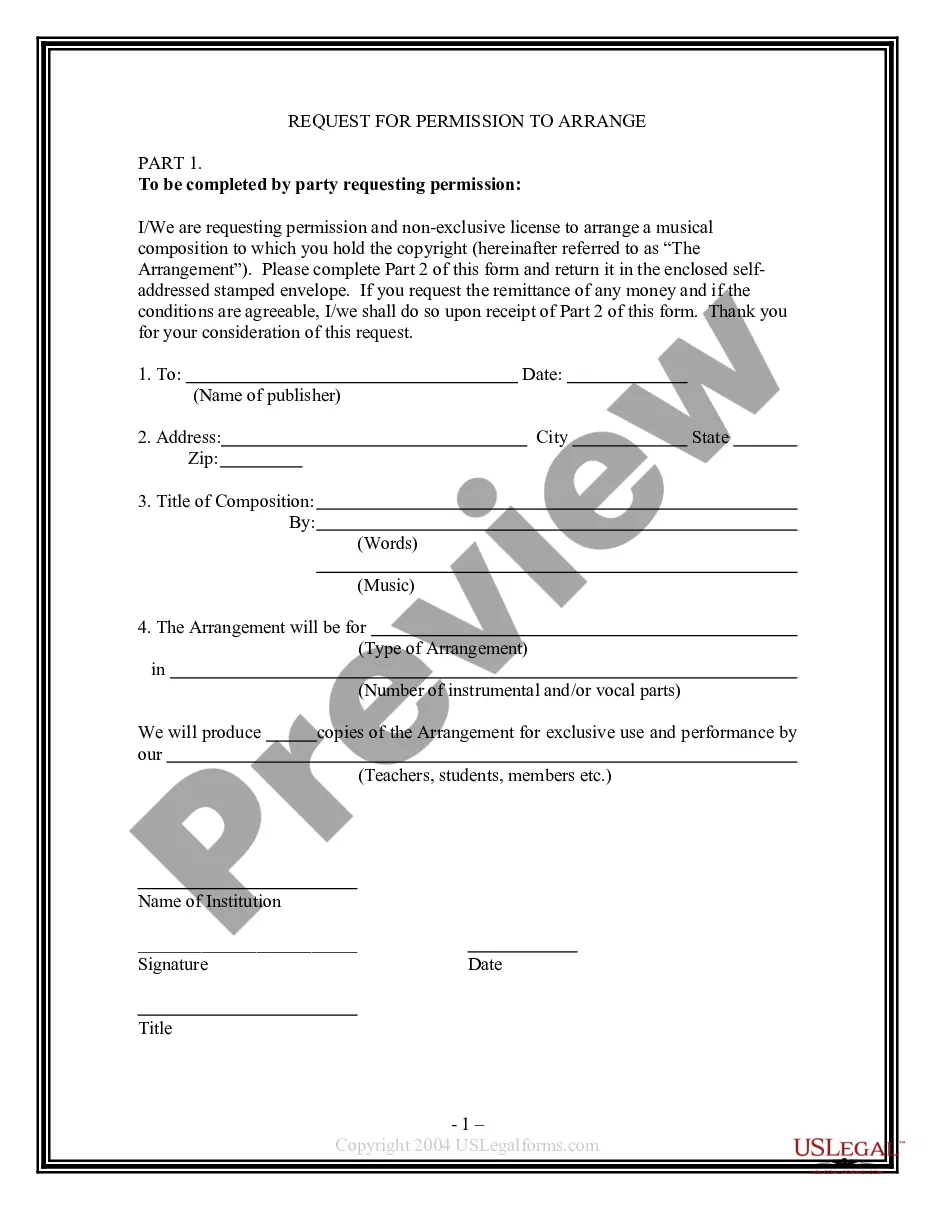
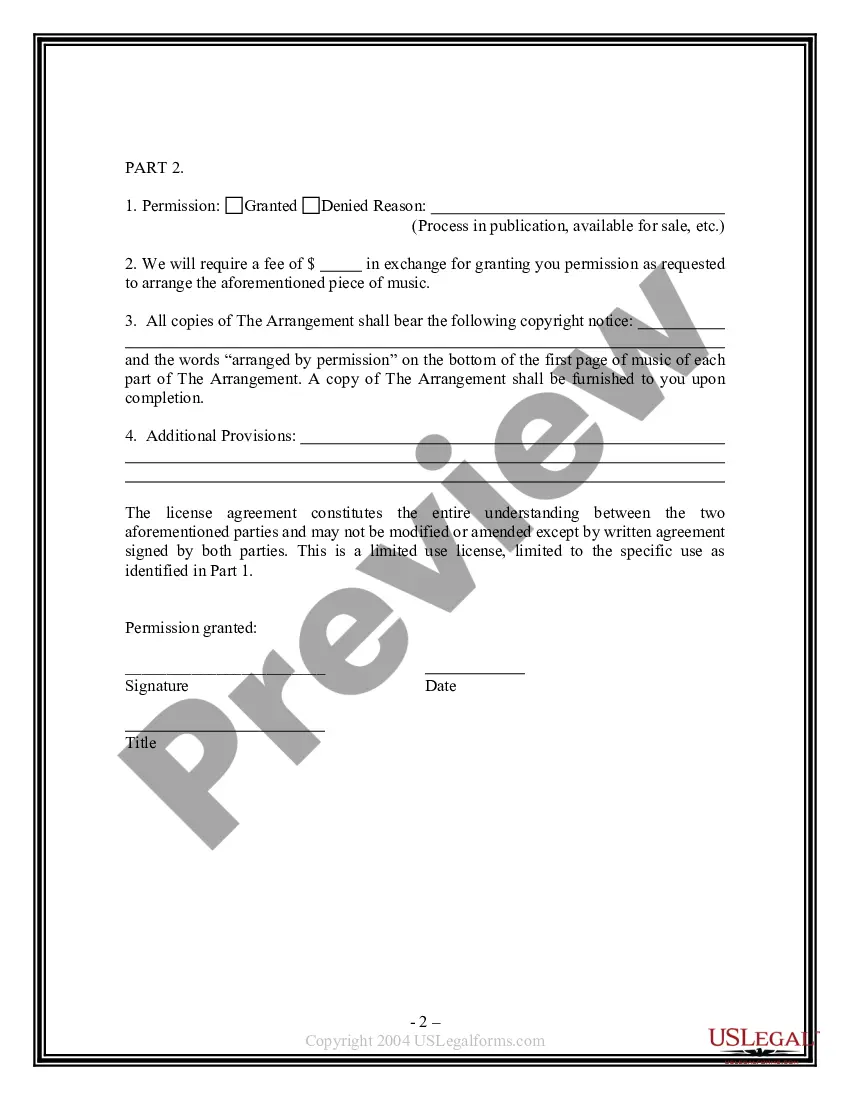
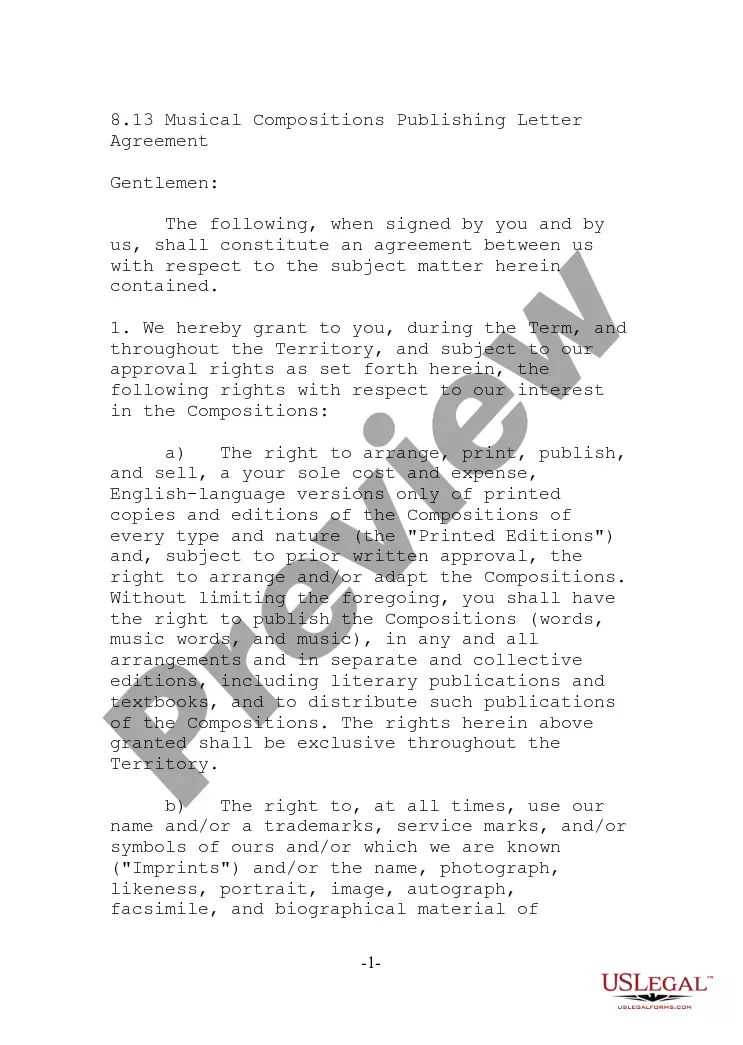
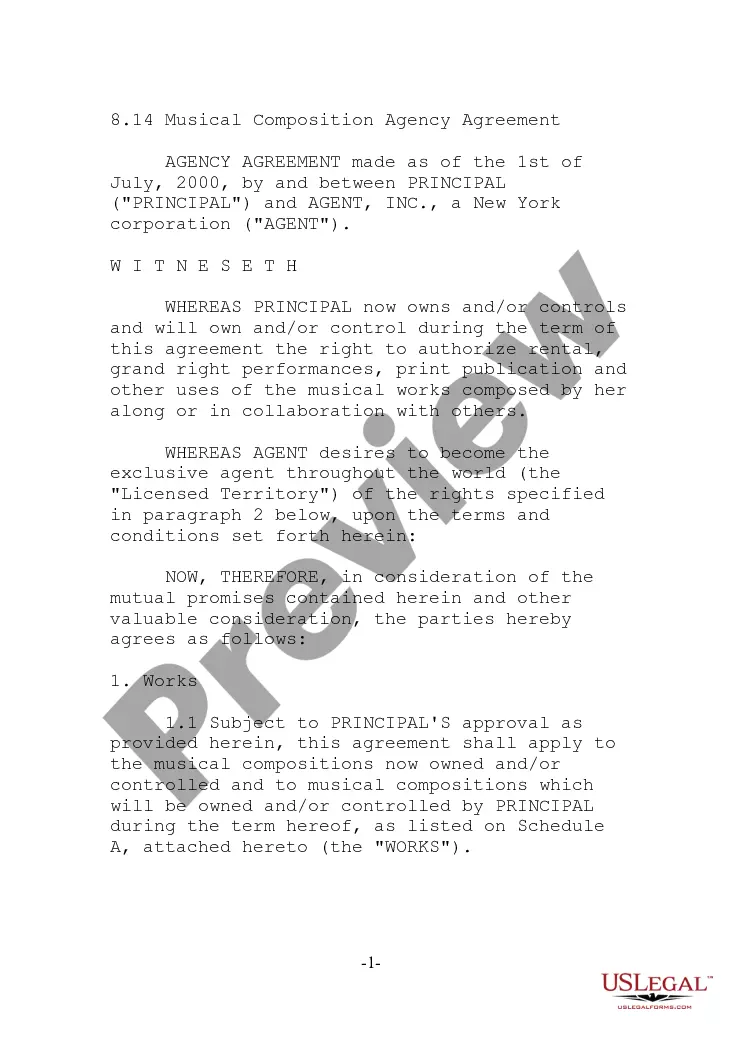
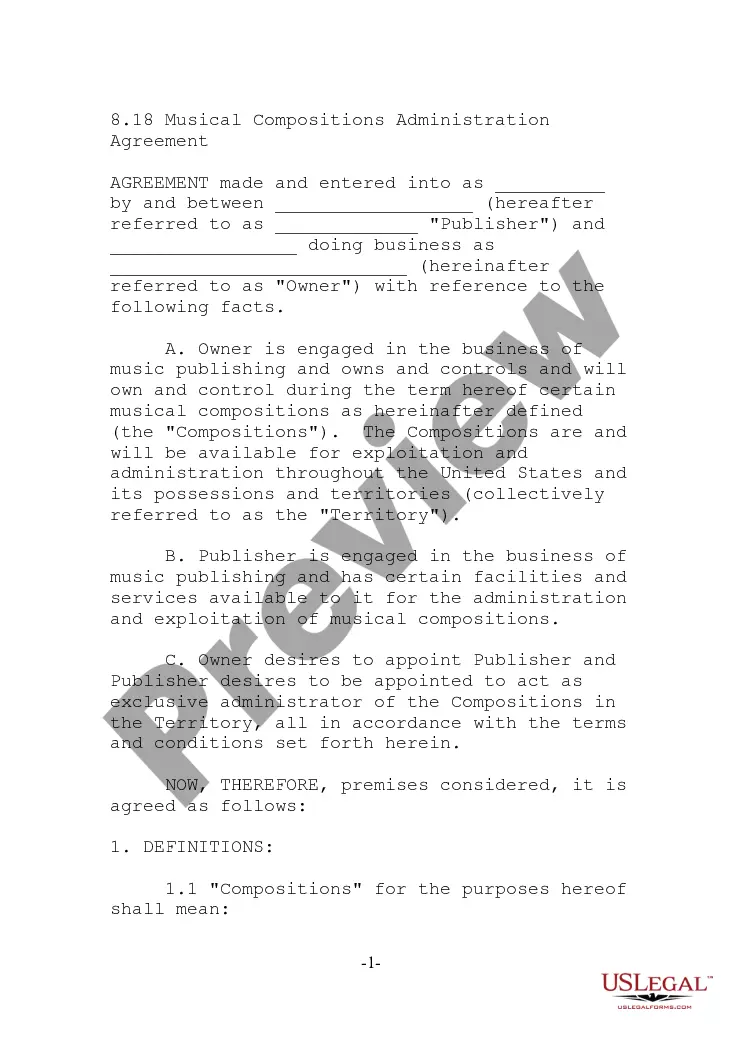
This is a form requesting permission to arrange a piece of music from a publisher. The first part of the form is to be completed by the party requesting permission, and the second part is to be filled out by the publisher or party granting permission.
Washington Request For Permission To Arrange a Musical Composition
State:
Multi-State
Control #:
US-PRM-11
Format:
Word;
Rich Text
Instant download
Description
Free preview
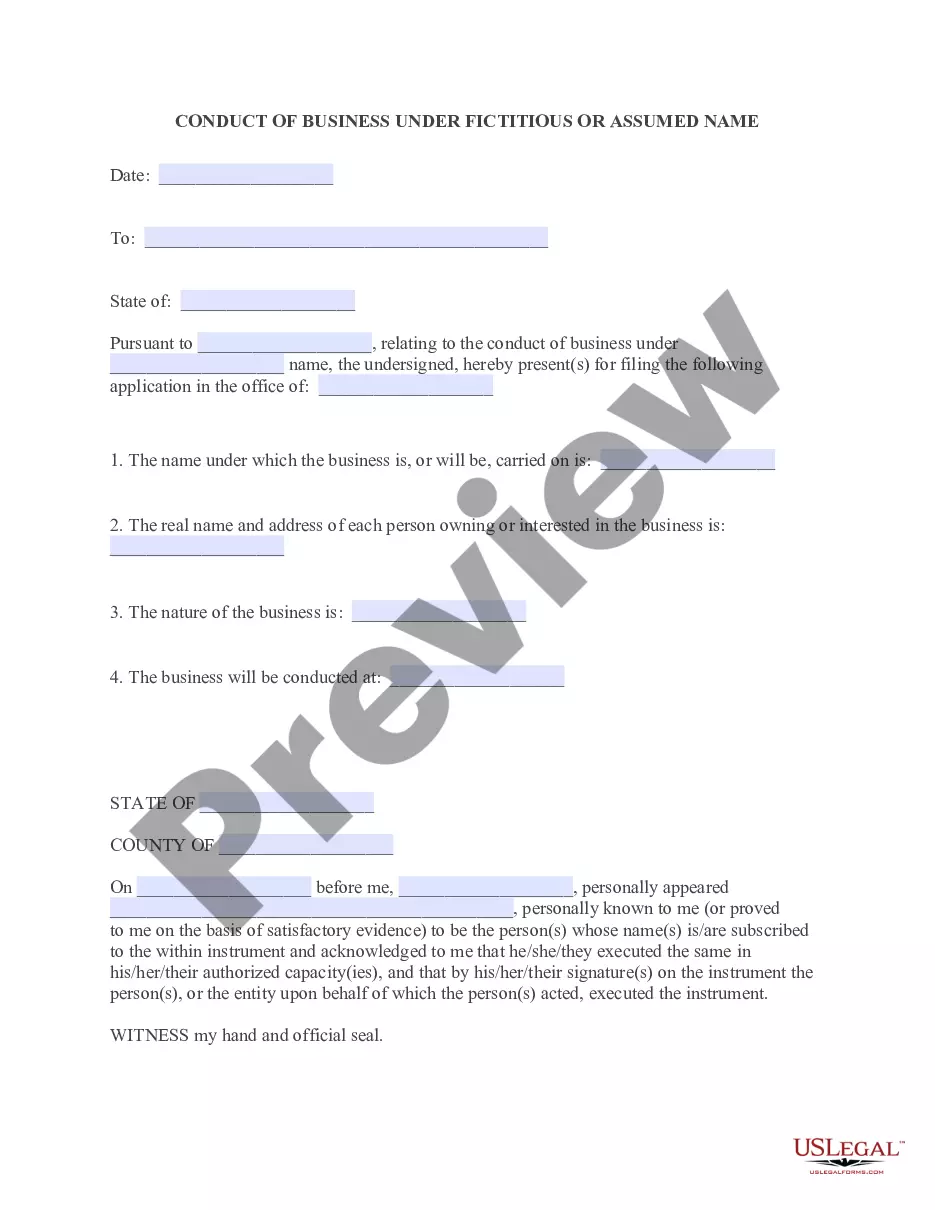

How to fill out Request For Permission To Arrange A Musical Composition?
If you need to finalize, obtain, or print valid document templates, utilize US Legal Forms, the largest assortment of legal forms available online.
Take advantage of the site’s user-friendly and efficient search to find the documents you require.
A wide range of templates for business and personal purposes are categorized by types and jurisdictions, or keywords. Use US Legal Forms to acquire the Washington Request For Permission To Arrange a Musical Composition in just a few clicks.
Every legal document template you purchase is yours permanently. You have access to every form you downloaded with your account. Go to the My documents section and select a form to print or download again.
Compete and acquire, and print the Washington Request For Permission To Arrange a Musical Composition with US Legal Forms. There are millions of professional and state-specific forms you can utilize for your business or personal needs.
- If you are already a US Legal Forms user, Log In to your account and click the Download button to obtain the Washington Request For Permission To Arrange a Musical Composition.
- You can also access forms you previously downloaded in the My documents section of your account.
- If you are using US Legal Forms for the first time, follow the steps below.
- Step 1. Ensure you have selected the form for the correct city/state.
- Step 2. Use the Preview option to review the form’s content. Don’t forget to read the description.
- Step 3. If you are unhappy with the form, use the Search bar at the top of the page to find other versions of the legal form template.
- Step 4. Once you have found the form you need, click the Buy now button. Choose the payment plan you prefer and enter your details to register for an account.
- Step 5. Process the payment. You can use your credit card or PayPal account to complete the transaction.
- Step 6. Select the format of the legal form and download it to your device.
- Step 7. Complete, modify, and print or sign the Washington Request For Permission To Arrange a Musical Composition.
Form popularity
FAQ
To buy the rights to arrange a song, begin by identifying the copyright owner or publisher associated with that song. You will need to negotiate the terms and submit a Washington Request For Permission To Arrange a Musical Composition, which formalizes your request. Platforms like uslegalforms can assist you in navigating this process, ensuring you obtain the appropriate permissions to legally arrange the music you love.
Getting permission to arrange a piece of music involves a few key steps. First, locate the copyright owner or publisher of the music. Afterward, you can submit a Washington Request For Permission To Arrange a Musical Composition, detailing your arrangement plans. This request not only clarifies your intentions but also helps you gain the rights you need to create your unique version.
To request permission to use music, start by identifying the copyright holder of the composition. You can often find this information through a music rights organization or the publisher. Once you have the details, you will need to submit a formal Washington Request For Permission To Arrange a Musical Composition, outlining your intended use and the specific music involved. This process ensures that you respect copyright laws and obtain the necessary rights.
To ask for permission to use music, you need to draft a formal request that includes your intent and how you plan to use the piece. This should be submitted as a Washington Request For Permission To Arrange a Musical Composition to the copyright holder. Be sure to communicate the specifics of your project, such as the format and distribution of your work. Platforms like US Legal Forms can assist you in creating a professional request that meets legal standards.
Obtaining rights to perform a musical involves contacting the rights holder, typically the publisher or the authors of the work. You will need to submit a Washington Request For Permission To Arrange a Musical Composition if your performance includes unique arrangements. Make sure to specify the production details and any anticipated audience size. US Legal Forms provides resources that can help you navigate this process efficiently.
To get permission to arrange music, you must submit a Washington Request For Permission To Arrange a Musical Composition to the copyright owner. This request should clearly outline your intentions, including details about the arrangement and its intended use. It is essential to provide any necessary information that demonstrates your respect for the original work. Utilizing platforms like US Legal Forms can streamline this process, offering templates and guidance.
General Requirements for CopyrightThe arrangement must be an original work. It must be fixed in a tangible medium of expression, such as on sheet music or a digital recording. It must be a musical work, including any accompanying words. It must not be an idea or concept.
Arrangements made by someone other than the composer are LEGAL when: the song being arranged is in public domain; OR. the arranger has the explicit permission of any one of the song's composers/publishers to make the arrangement; OR.
Getting The Proper License For Your Commissioned Arrangement Permission Fees range from $50 to several hundred dollars, depending on variables such as the nature of intended performance, who the licensee is (educational is cheaper), our arranging fee, and other factors.
Requesting Permission Determine the copyright owner (usually the publisher) using the Harry Fox Agency's Songfile or ASCAP's ACE Title Search. Contact the copyright owner and ask for permission. Get permission in writing. Show a copyright notice on the arrangementon all copies and all parts.More items...