Washington Small Estate Affidavit
Understanding this form
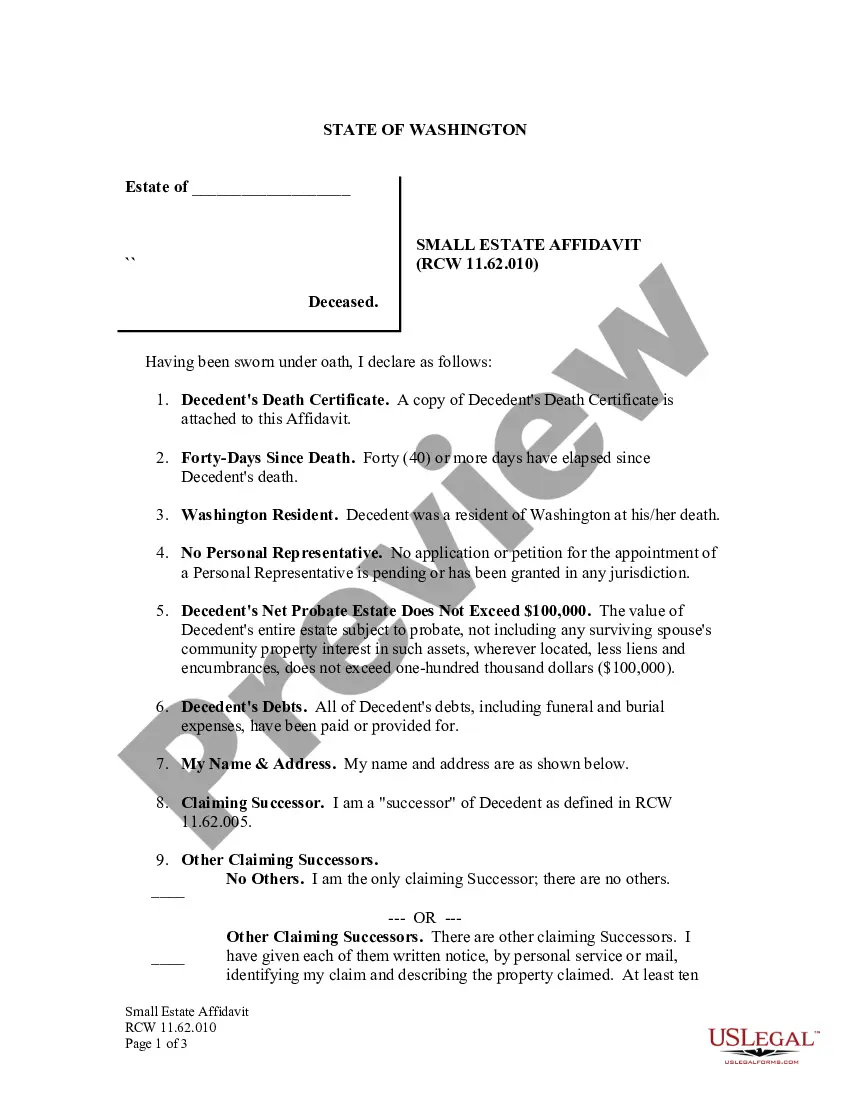
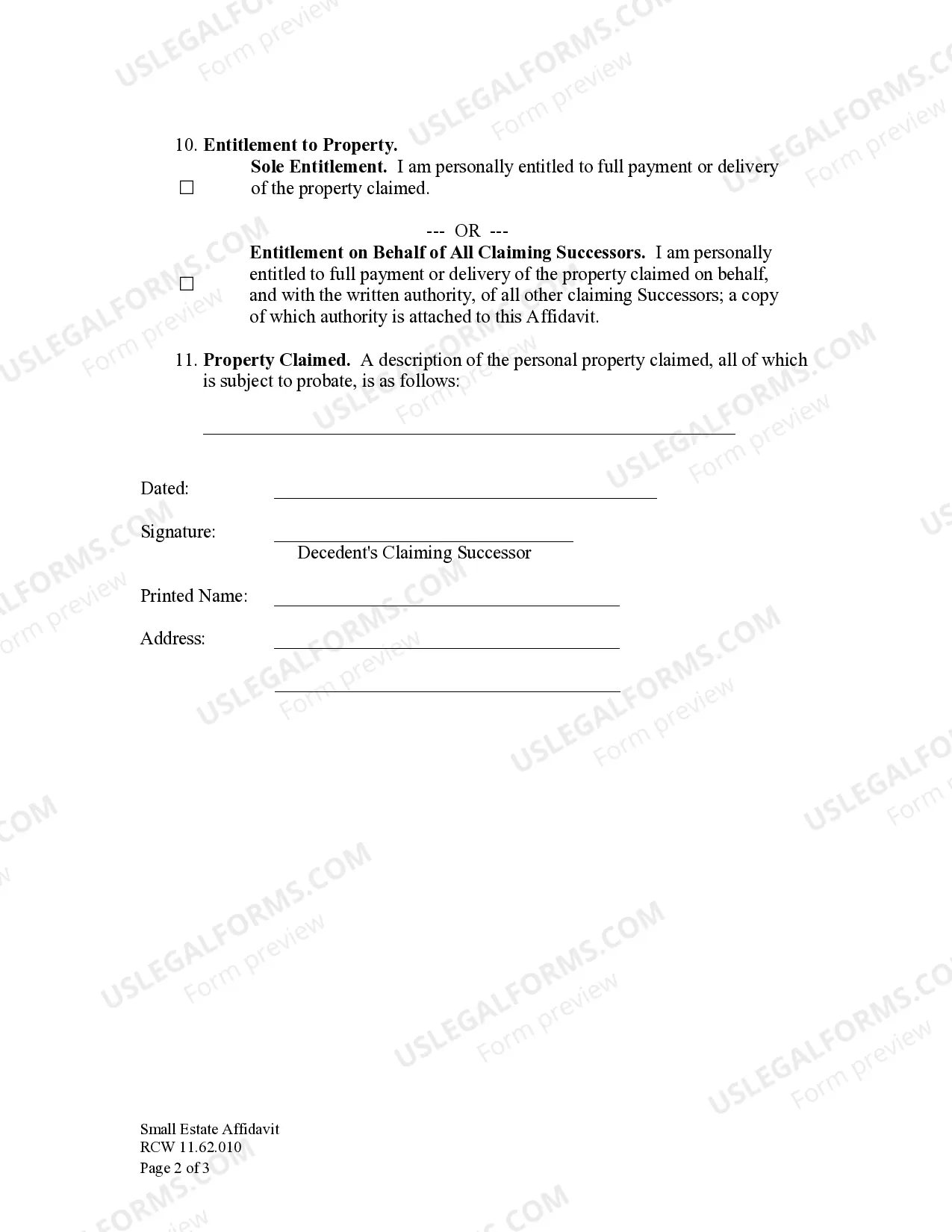
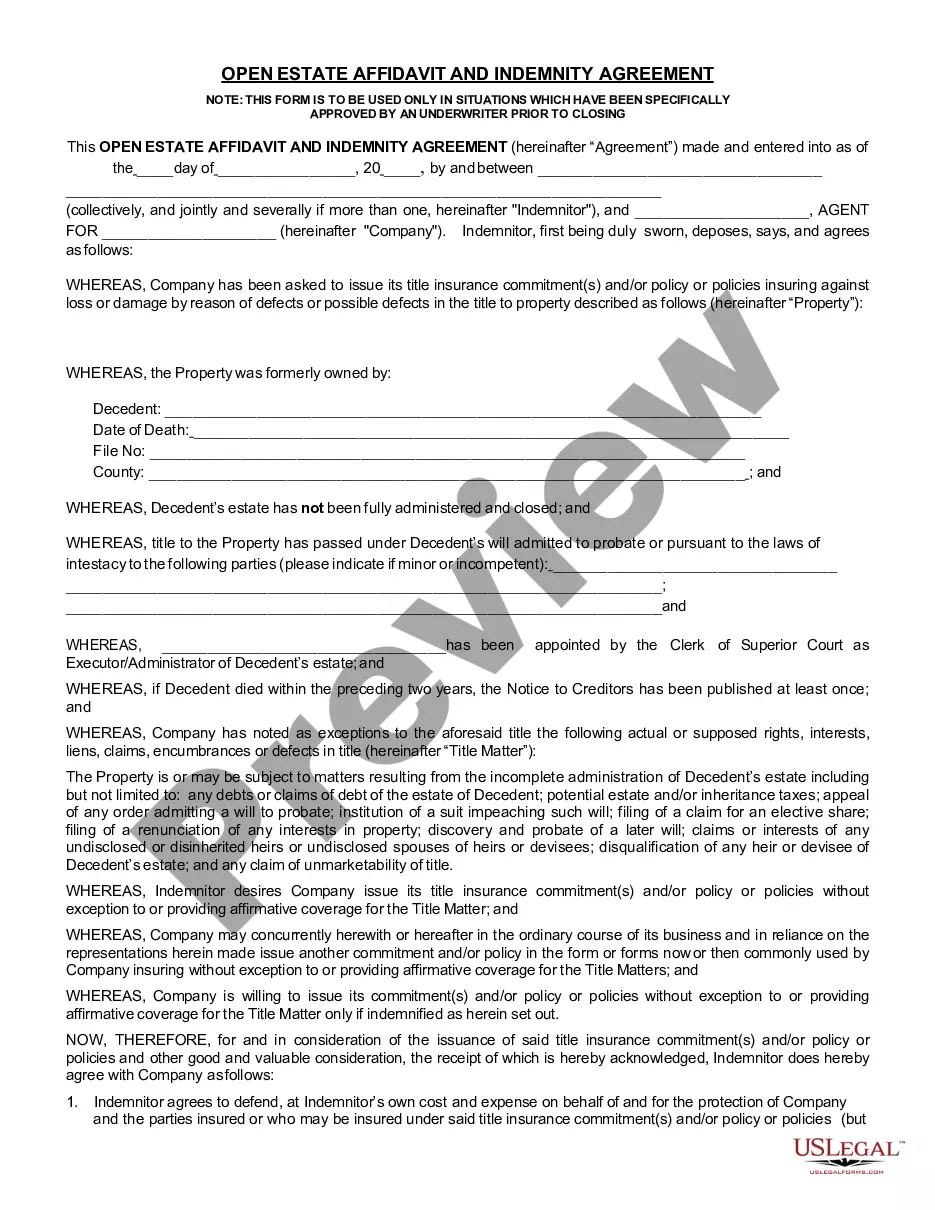
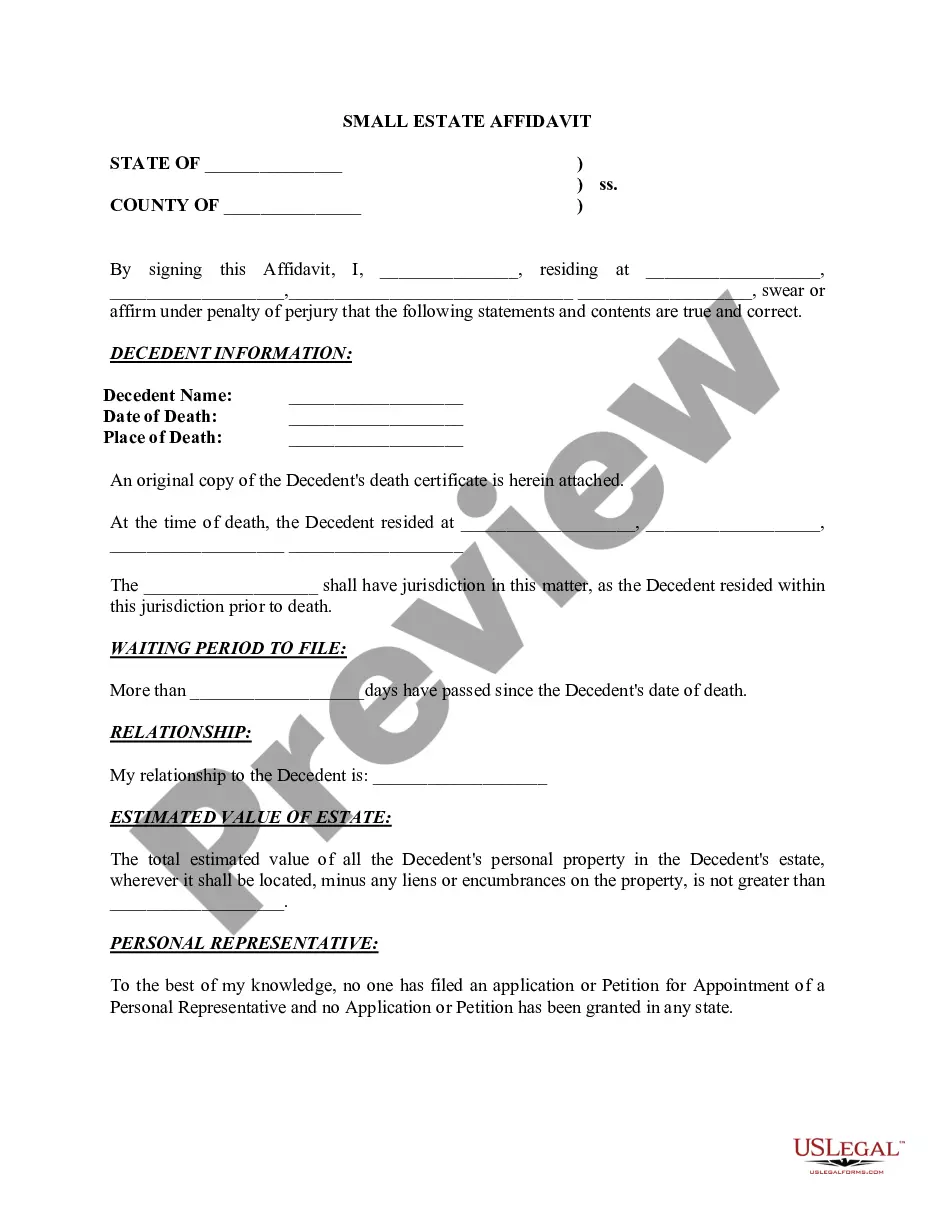
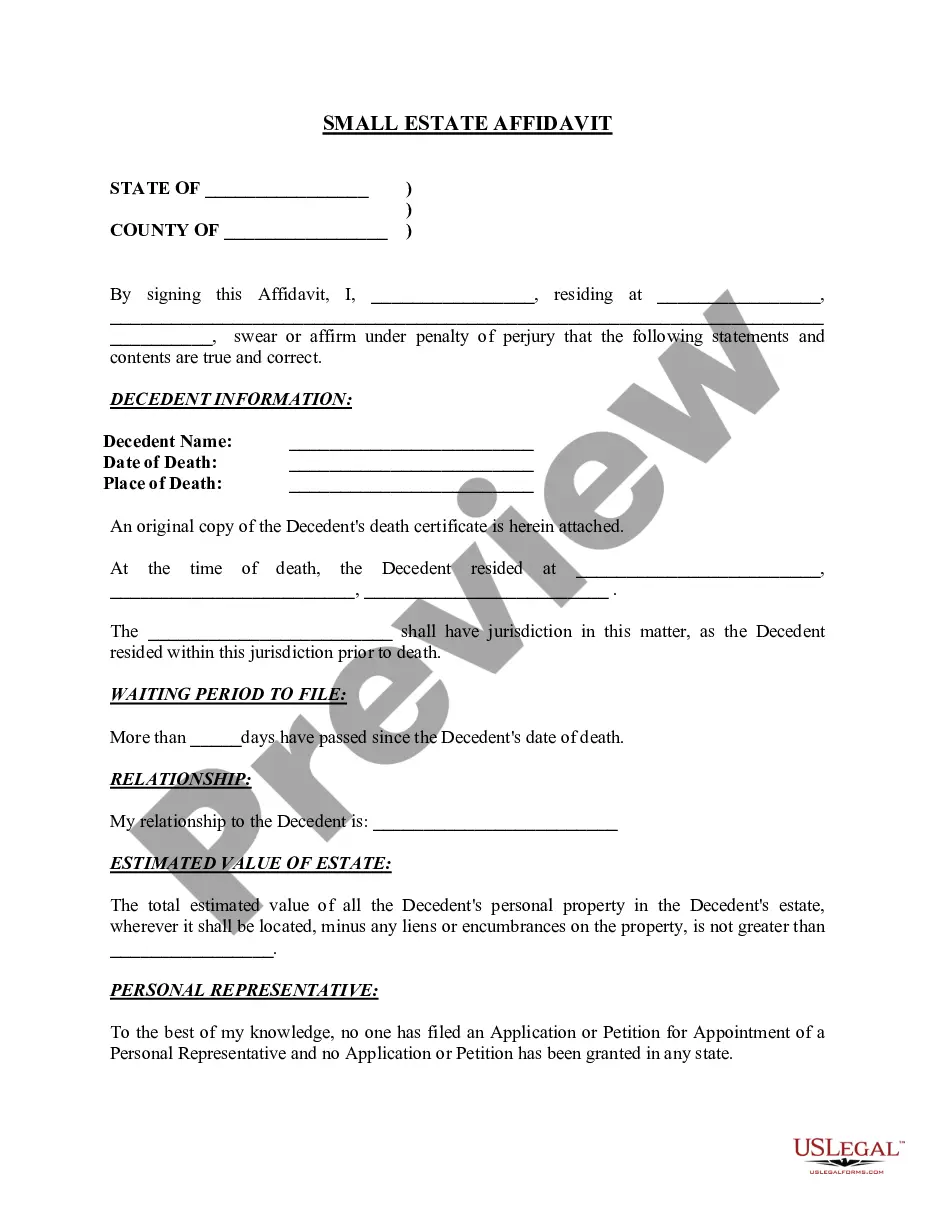
The Small Estate Affidavit is a legal document that allows an interested party to collect debts owed to a deceased person when their estate is valued at not more than $100,000. This form is specifically designed for use in Washington state and simplifies the process of claiming assets without going through formal probate. By using this affidavit, eligible successors can access the decedent's personal property in a more efficient and less costly manner compared to other probate processes.
Key parts of this document
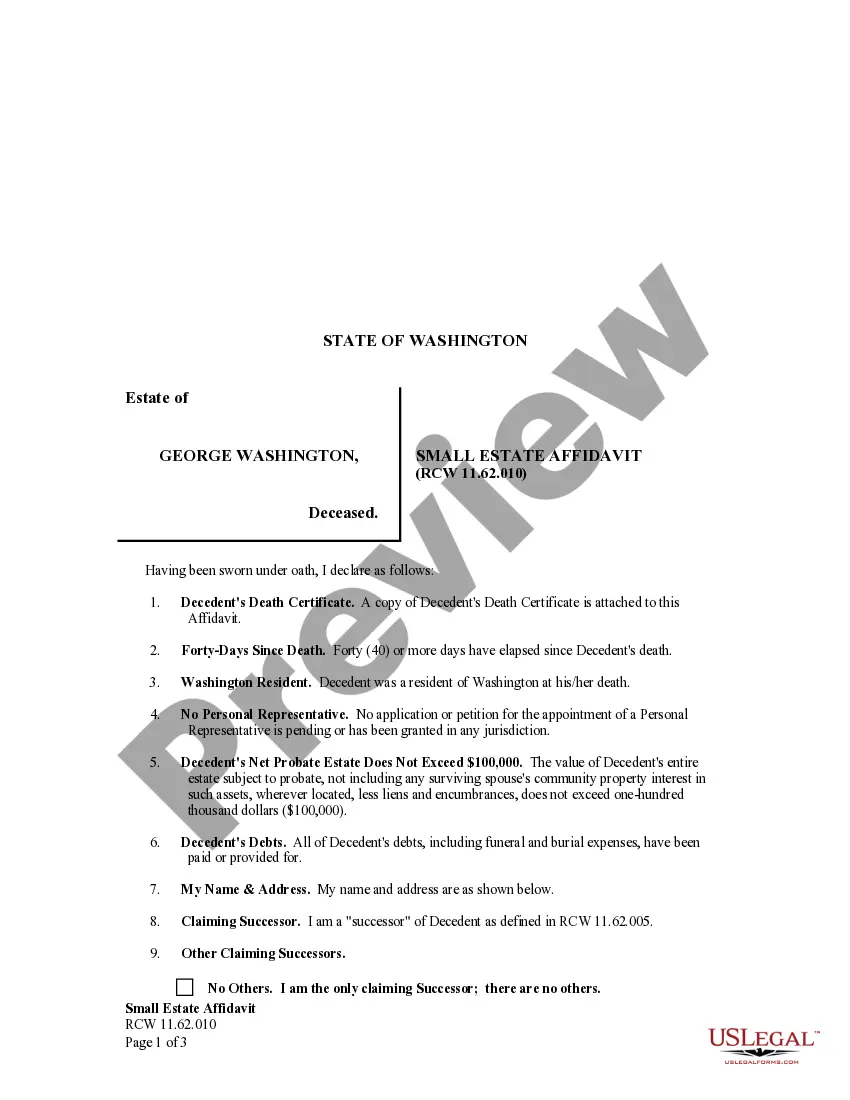
- Decedent's death certificate: Proof of the decedent's passing.
- Confirmation of death: A declaration that at least forty days have passed since the decedent's death.
- Declaration of residency: A statement confirming the decedent was a resident of Washington.
- No personal representative: Assurance that no petition for a personal representative has been filed.
- Overview of the estate: A statement indicating that the estate's total value does not exceed $100,000.
- Debts satisfaction: Confirmation that all debts, including funeral expenses, have been taken care of.
- Claiming successor details: Information about who is claiming the assets and their entitlement to them.
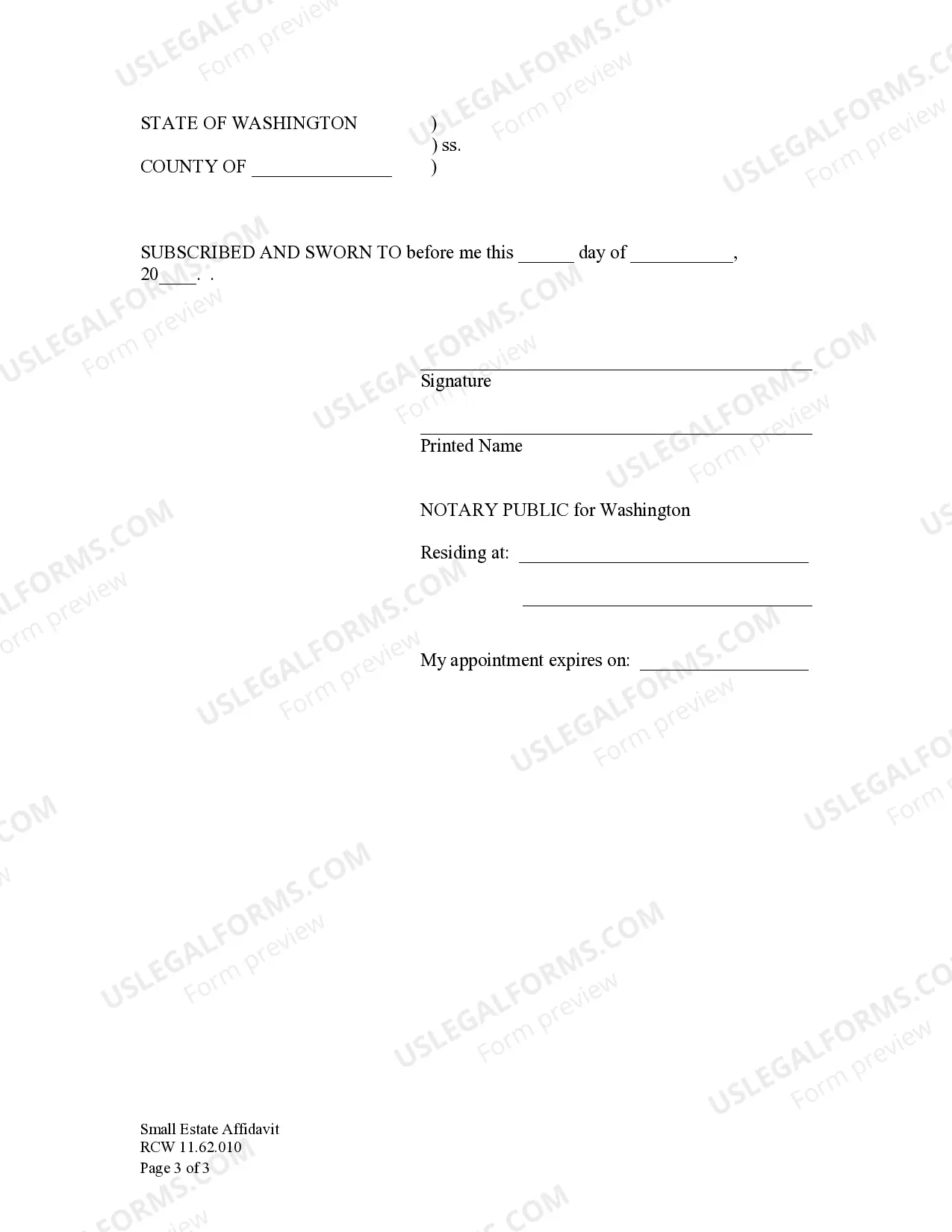
- Notary public section: Space for notarization to validate the affidavit.
When to use this document
This form is typically used when a person passes away, and their estate is small, not exceeding the $100,000 threshold. If you need to settle debts or claim assets after the death of a loved one without undergoing formal probate, this Small Estate Affidavit can be an expedient solution. It is especially useful when multiple successors are involved and can serve to clarify claims on personal property.
Who should use this form
- Individuals who are successors of the decedent as defined under Washington law.
- Family members, such as children or spouses, seeking to claim personal property from the decedent's estate.
- Any responsible party who believes they are entitled to debts owed to the decedent.
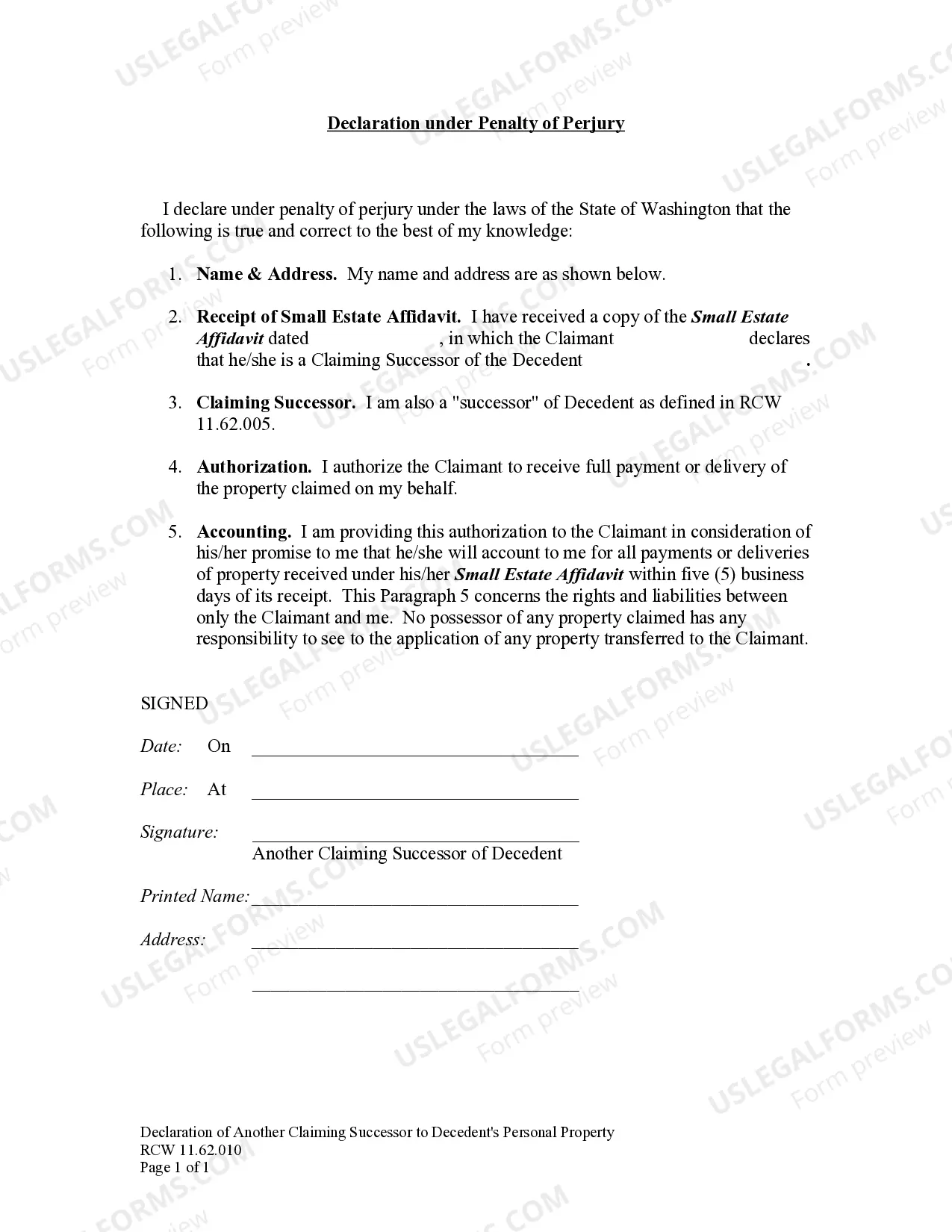
- Persons acting on behalf of multiple successors with their written authority.
Instructions for completing this form
- Obtain a copy of the decedent's death certificate and attach it to the affidavit.
- Indicate that forty days have passed since the decedent's death.
- Confirm the decedent's residency in Washington at the time of death.
- State the total value of the decedent's estate and confirm that it does not exceed $100,000.
- Fill in your details as the claiming successor and note if other successors are involved.
- Sign the affidavit in front of a notary public to validate it.
Does this form need to be notarized?
Yes, this form must be notarized to be legally valid. This requirement ensures that the statements made in the affidavit are verified by a notary public, providing an additional layer of authenticity and compliance. US Legal Forms offers integrated online notarization options, allowing you to notarize your document securely and conveniently at your convenience.
Get your form ready online
Our built-in tools help you complete, sign, share, and store your documents in one place.
Make edits, fill in missing information, and update formatting in US Legal Forms—just like you would in MS Word.
Download a copy, print it, send it by email, or mail it via USPS—whatever works best for your next step.
Sign and collect signatures with our SignNow integration. Send to multiple recipients, set reminders, and more. Go Premium to unlock E-Sign.
If this form requires notarization, complete it online through a secure video call—no need to meet a notary in person or wait for an appointment.
We protect your documents and personal data by following strict security and privacy standards.

Make edits, fill in missing information, and update formatting in US Legal Forms—just like you would in MS Word.

Download a copy, print it, send it by email, or mail it via USPS—whatever works best for your next step.

Sign and collect signatures with our SignNow integration. Send to multiple recipients, set reminders, and more. Go Premium to unlock E-Sign.

If this form requires notarization, complete it online through a secure video call—no need to meet a notary in person or wait for an appointment.

We protect your documents and personal data by following strict security and privacy standards.
Avoid these common issues
- Failing to provide the death certificate with the affidavit.
- Overlooking the requirement that forty days must have passed since the death.
- Not confirming the total value of the estate accurately.
- Neglecting to notify other claiming successors if applicable.
- Skipping the notarization step, which is crucial for the document's validity.
Advantages of online completion
- Convenient access to legal forms that can be downloaded immediately.
- Editability allows you to customize the form to your specific needs.
- Reliable templates drafted by licensed attorneys ensure compliance with Washington law.
- Eliminates the need for lengthy probate processes, saving time and resources.
Looking for another form?
Form popularity
FAQ
One of the most effective ways to avoid probate is to establish a living trust. Property is transferred to the trust, and these assets are overseen by a trustee who is charged with managing the trust for the benefit of the designated beneficiaries.
Property that is jointly owned with a survivorship right will avoid probate. If one owner dies, title passes automatically to the remaining owner. There are three types of joint ownership with survivorship rights: Joint tenancy with rights of survivorship.
Washington State law DOES NOT REQUIRE Probate. Probate is discretionary. Practically speaking only a small percent of deaths in Washington result in a Probate being filed.
Is Probate Required by Washington Law? Probate: Washington law does NOT require a probate proceeding to be filed following death, regardless of whether the Decedent died with or without a Will (ie, testate or intestate, respectively).
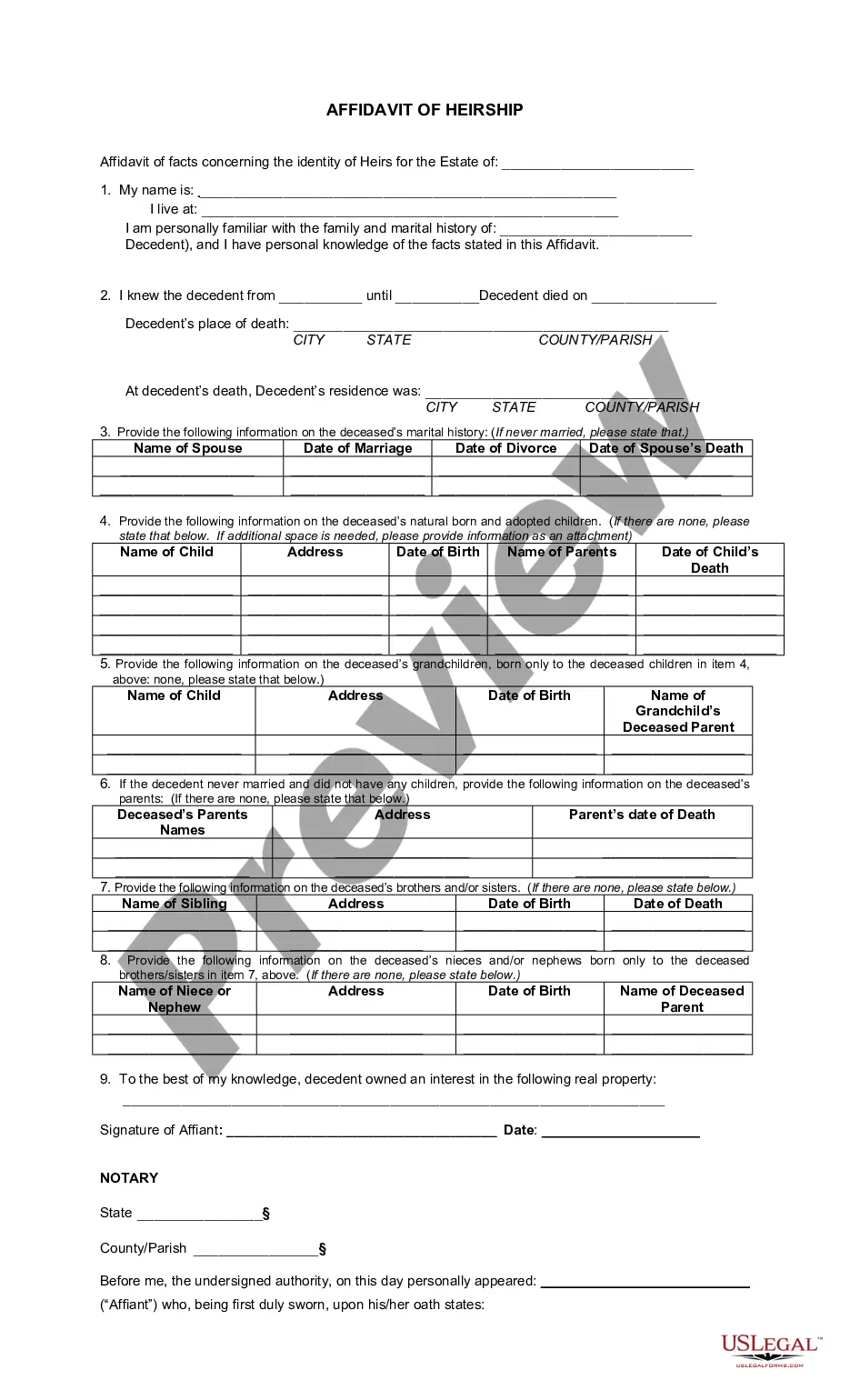
The Affidavit Lack of Probate (or ?No Probate?) is a factual confirmation which supports that the rightful heirs are entitled to their interest in the property after the passing of the Decedent. It is recognized in many Washington Counties as a way to clear the Decedent's name off title as an alternative to a probate.
Washington State does NOT always require a probate proceeding. Estates with less than $100,000 in assets can often avoid probate provided there are no liens on the property or unpaid debts.
?Successors? include all persons who are entitled to claim property ing to the decedent's will or by virtue of all the laws of intestate succession. Send a copy of this affidavit to the Department of Social and Health Services, Office of Financial Recovery, PO Box 9501, Olympia, WA 98507-9501.
First, you must wait at least 40 days after your loved one has died before submitting the affidavit. Second, you are required to mail a copy of the affidavit, along with the decedent's social security number, to DSHS's Office of Financial Recovery, whose address is currently: P.O. Box 9501, Olympia, WA 98507-9501.