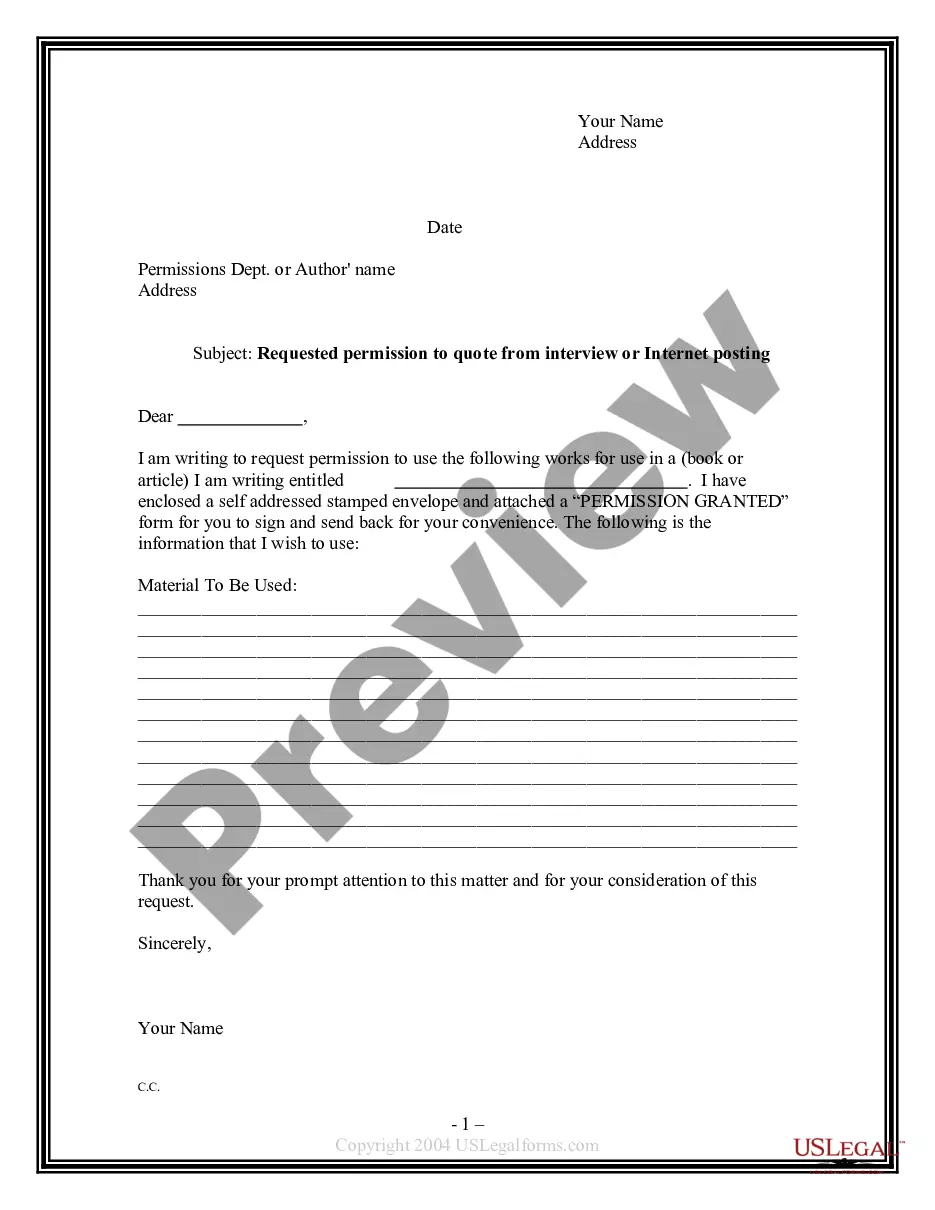
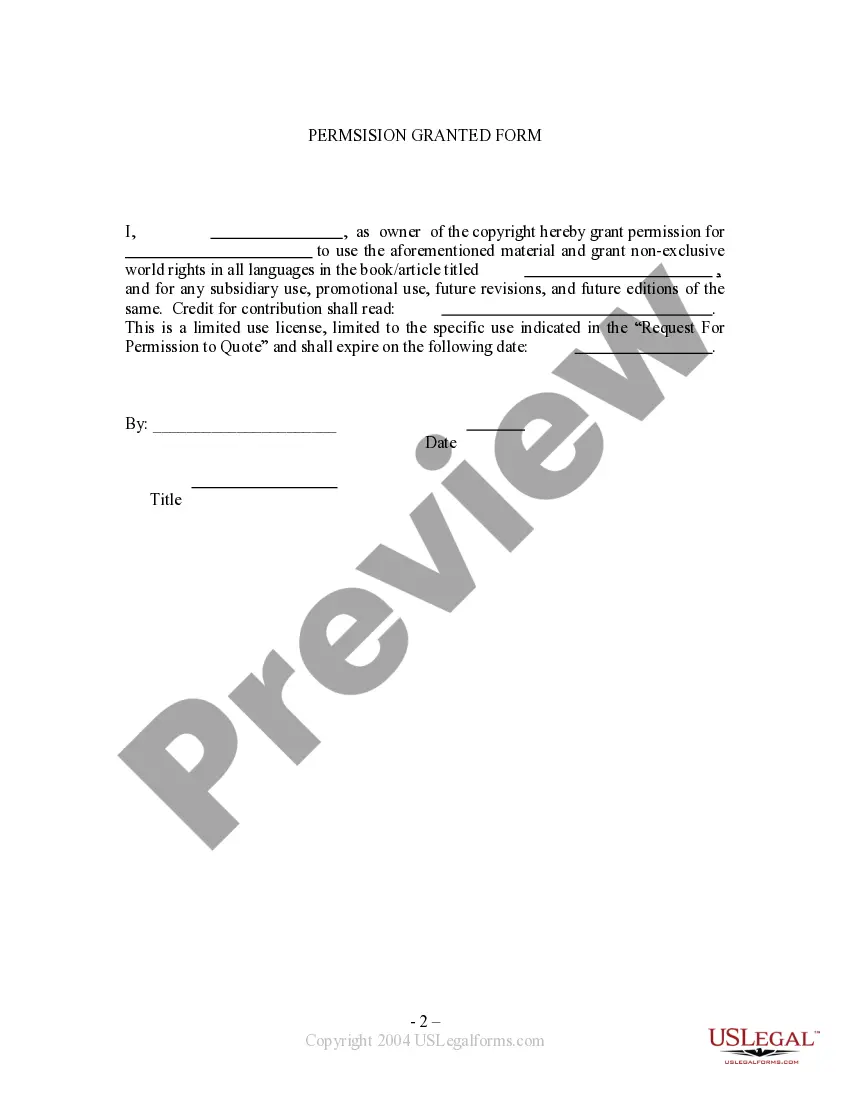
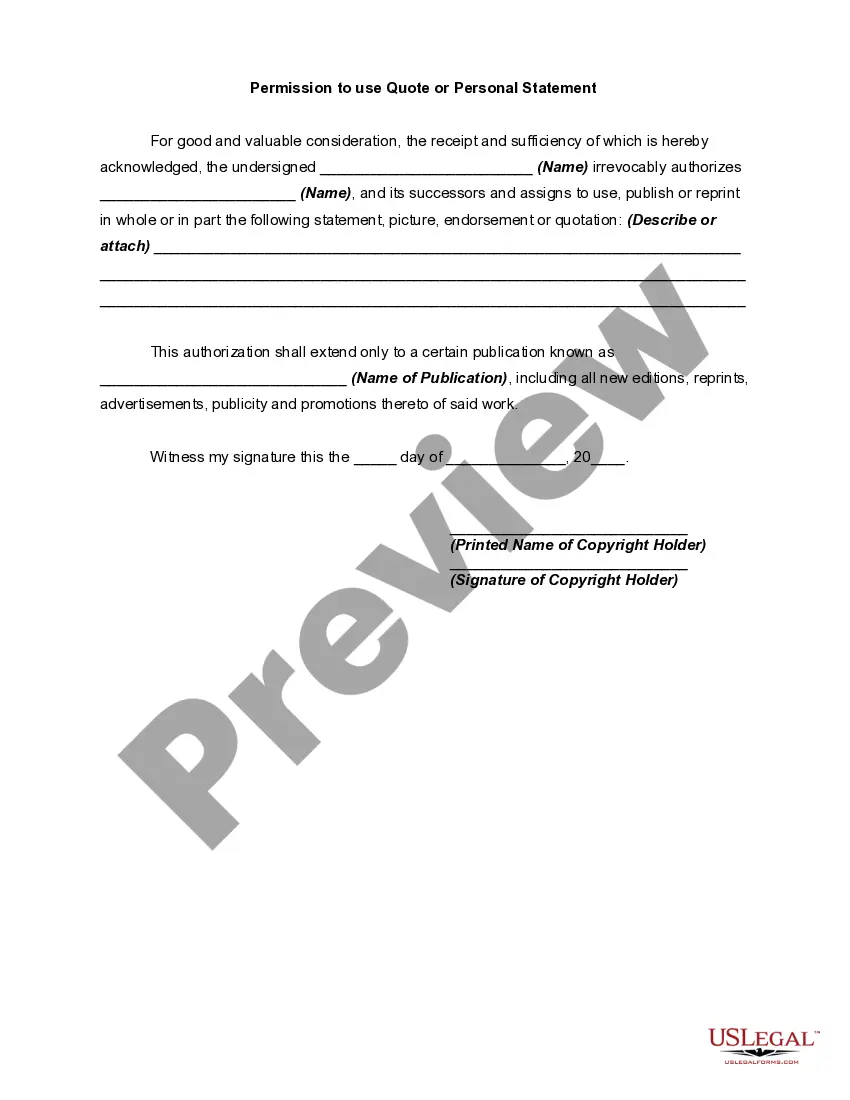
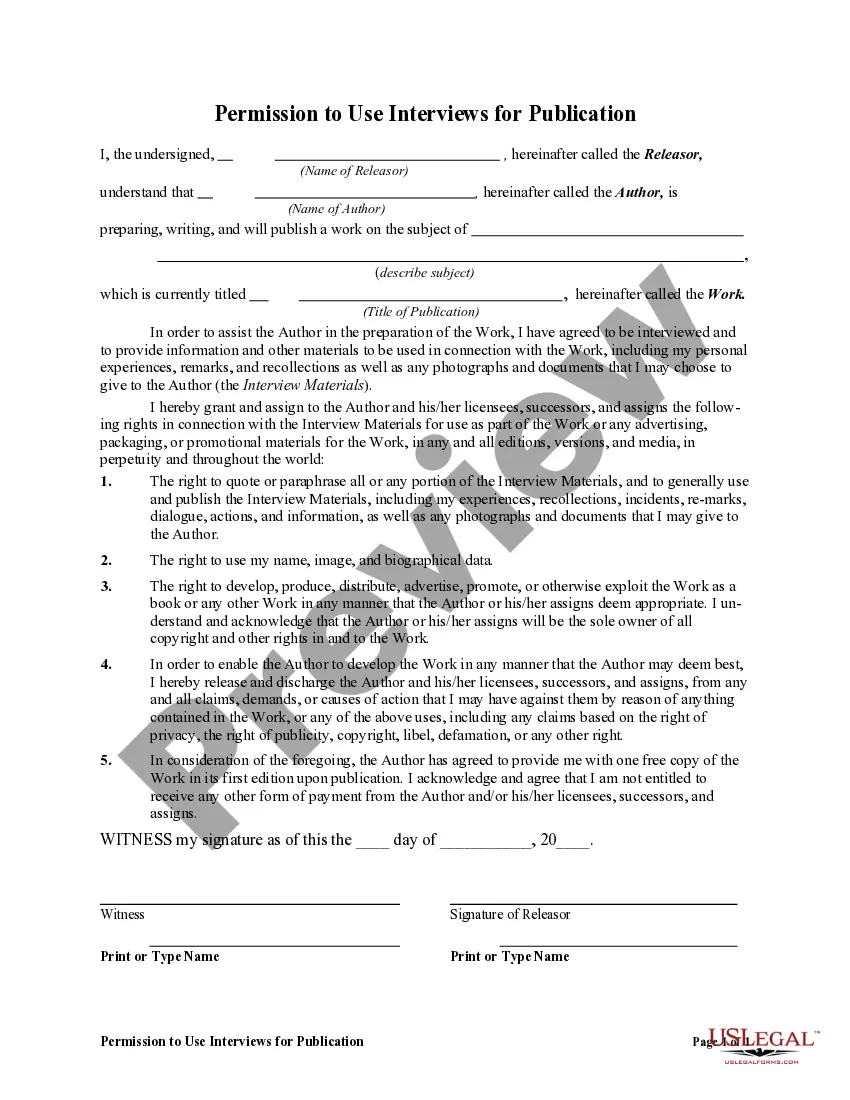
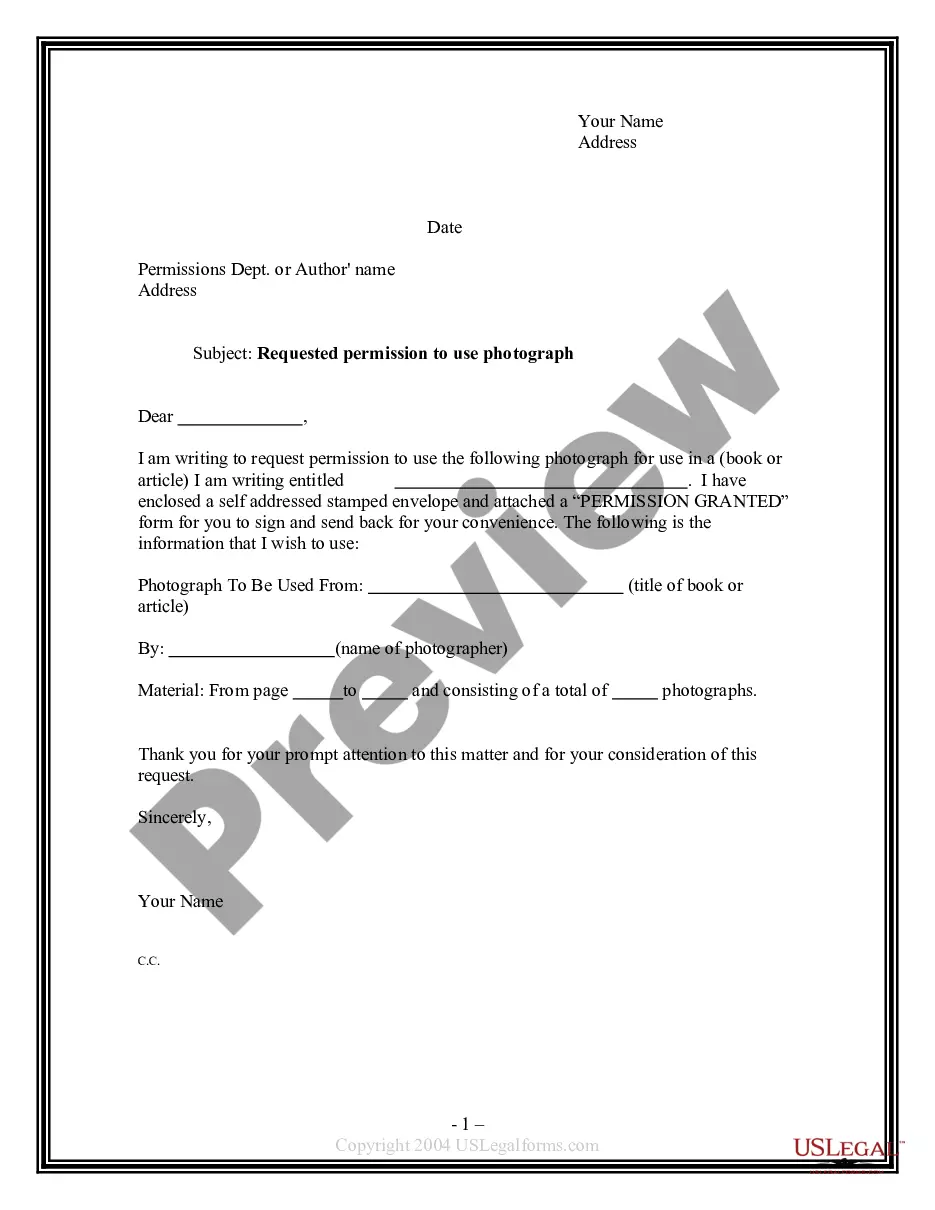
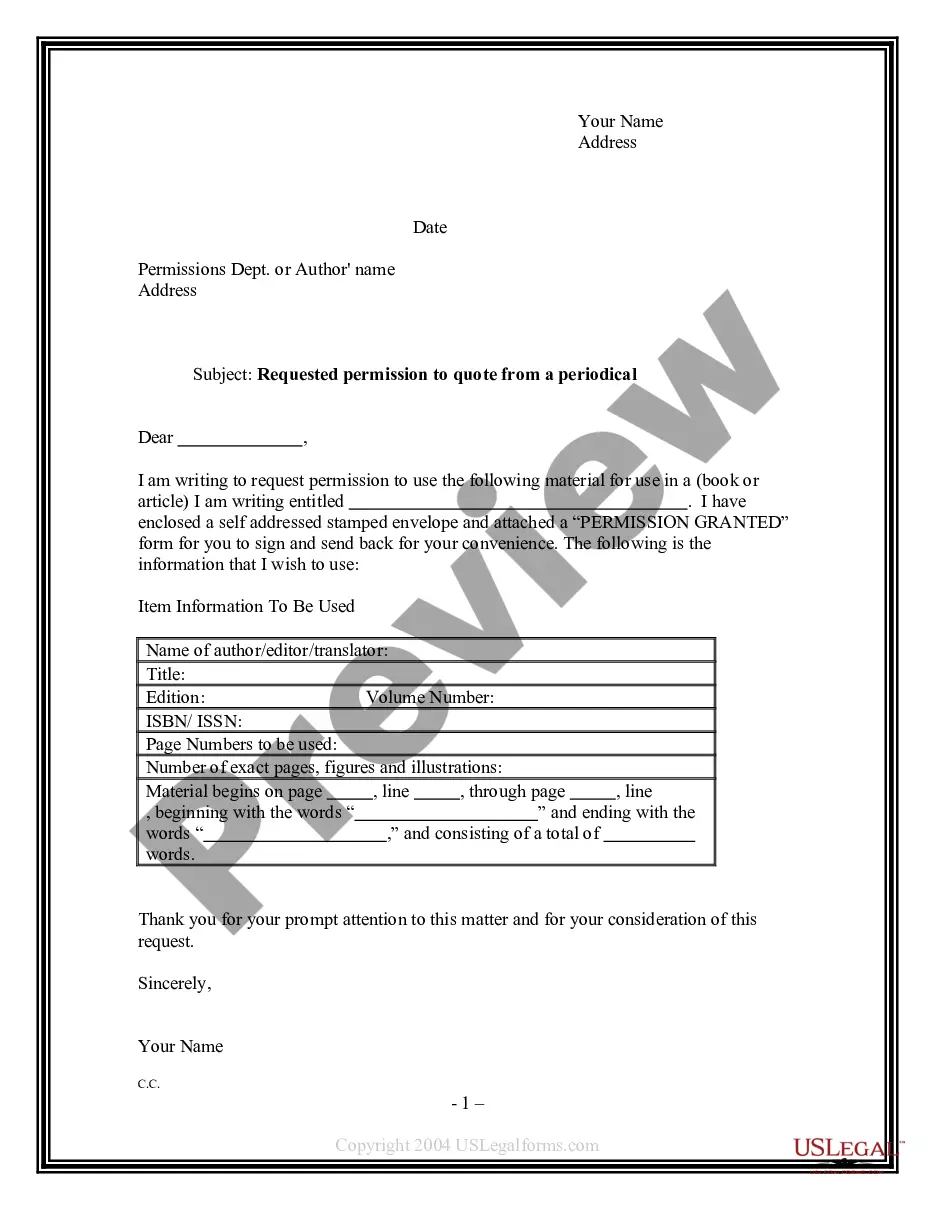
This is a request to the holder of a copyright asking permission to use the copyrighted material in a book or article. There is an attached addendum for the copyright holder to sign granting permission. The request can be granted for only a fixed period of time if the copyright holder does not want to grant the request to be used indefinitely.
Vermont Requested Permission to Quote From Interview or Internet Posting
Category:
State:
Multi-State
Control #:
US-PRM-06
Format:
Word;
Rich Text
Instant download
Description
Free preview

Get your form ready online
Our built-in tools help you complete, sign, share, and store your documents in one place.
Built-in online Word editor
Make edits, fill in missing information, and update formatting in US Legal Forms—just like you would in MS Word.
Export easily
Download a copy, print it, send it by email, or mail it via USPS—whatever works best for your next step.
E-sign your document
Sign and collect signatures with our SignNow integration. Send to multiple recipients, set reminders, and more. Go Premium to unlock E-Sign.
Notarize online 24/7
If this form requires notarization, complete it online through a secure video call—no need to meet a notary in person or wait for an appointment.
Store your document securely
We protect your documents and personal data by following strict security and privacy standards.

Make edits, fill in missing information, and update formatting in US Legal Forms—just like you would in MS Word.

Download a copy, print it, send it by email, or mail it via USPS—whatever works best for your next step.

Sign and collect signatures with our SignNow integration. Send to multiple recipients, set reminders, and more. Go Premium to unlock E-Sign.

If this form requires notarization, complete it online through a secure video call—no need to meet a notary in person or wait for an appointment.

We protect your documents and personal data by following strict security and privacy standards.
Looking for another form?



How to fill out Requested Permission To Quote From Interview Or Internet Posting?
Have you found yourself in a scenario where you require documentation for either organizations or specific purposes almost every time.
There are numerous legal document templates accessible online, yet obtaining reliable ones can be challenging.
US Legal Forms offers a vast collection of form templates, including the Vermont Requested Permission to Quote From Interview or Internet Posting, designed to meet both federal and state requirements.
- If you are already familiar with the US Legal Forms website and have an account, simply Log In.
- After that, you can download the Vermont Requested Permission to Quote From Interview or Internet Posting template.
- If you do not have an account and wish to start using US Legal Forms, follow these steps.
- Find the form you need and ensure it corresponds to the correct city/state.
- Utilize the Preview button to examine the form.
- Check the outline to confirm you have selected the correct form.
- If the form is not what you are looking for, use the Search section to locate the form that fits your needs and requirements.
- Once you find the appropriate form, click Get now.
- Choose the payment plan you prefer, fill in the necessary information to create your account, and purchase the order using your PayPal or credit card.
- Select a convenient file format and download your copy.
- Retrieve all the document templates you have purchased in the My documents menu. You can download an additional copy of Vermont Requested Permission to Quote From Interview or Internet Posting at any time, if needed. Just click on the desired form to download or print the document template.
- Use US Legal Forms, the most extensive collection of legal forms, to save time and avoid errors. The service provides properly crafted legal document templates that you can utilize for a variety of purposes. Create your account on US Legal Forms and start making your life easier.
Form popularity
FAQ
To legally post your property in Vermont, you must first ensure that you have the necessary permissions and follow local regulations. It is important to understand the Vermont Requested Permission to Quote From Interview or Internet Posting, which may apply to any information shared about your property. Utilizing platforms like uslegalforms can help you draft the required documents and obtain permissions efficiently. By following these steps, you can confidently post your property while staying compliant with Vermont laws.
Unfortunately, quoting or excerpting someone else's work falls into one of the grayest areas of copyright law. There is no legal rule stipulating what quantity is OK to use without seeking permission from the owner or creator of the material.
Quotes are considered intellectual property, which is protected under the law. This means that if you're not a quote's original author and you want to SELL something with the quote on it, one of two things must be true: 1. You have the author's written permission to use their words on your work.
As a common practice, all quotes are copyright to the author, which means that legally you should get permission from the author you hope to borrow from. This can sometimes be very difficult if the author is deceased or a public figure.
YES. You can legally use quotes in small business that are in the public domain. Generally, quotes said before 1923 are in public domain because the protection on them is now expired.
1 Answer. Show activity on this post. This would indicate that the quote is not yours, it's someone else's but you don't know the name of the person. Yes, it would count as plagiarism if you "lifted" someone else's quote without attributing them.
However, extensive quoting of text from a copyrighted source can constitute copyright infringement, whether the appropriated text is properly enclosed in quotation marks or correctly paraphrased, even if a citation is provided according to established scholarly conventions.
However, extensive quoting of text from a copyrighted source can constitute copyright infringement, whether the appropriated text is properly enclosed in quotation marks or correctly paraphrased, even if a citation is provided according to established scholarly conventions.
According to US copyright law, the legal rights to a quote belong by default to its author (or speaker). Quotes are considered intellectual property, which is protected under the law.
Every publisher sets their own threshold of fair use versus requiring permissions. One publisher requires permission for using 25 words or more from any one source, aggregate over the entirety of your book. This means if you quote 16 words in one place and 10 words in another, you must get written permission.