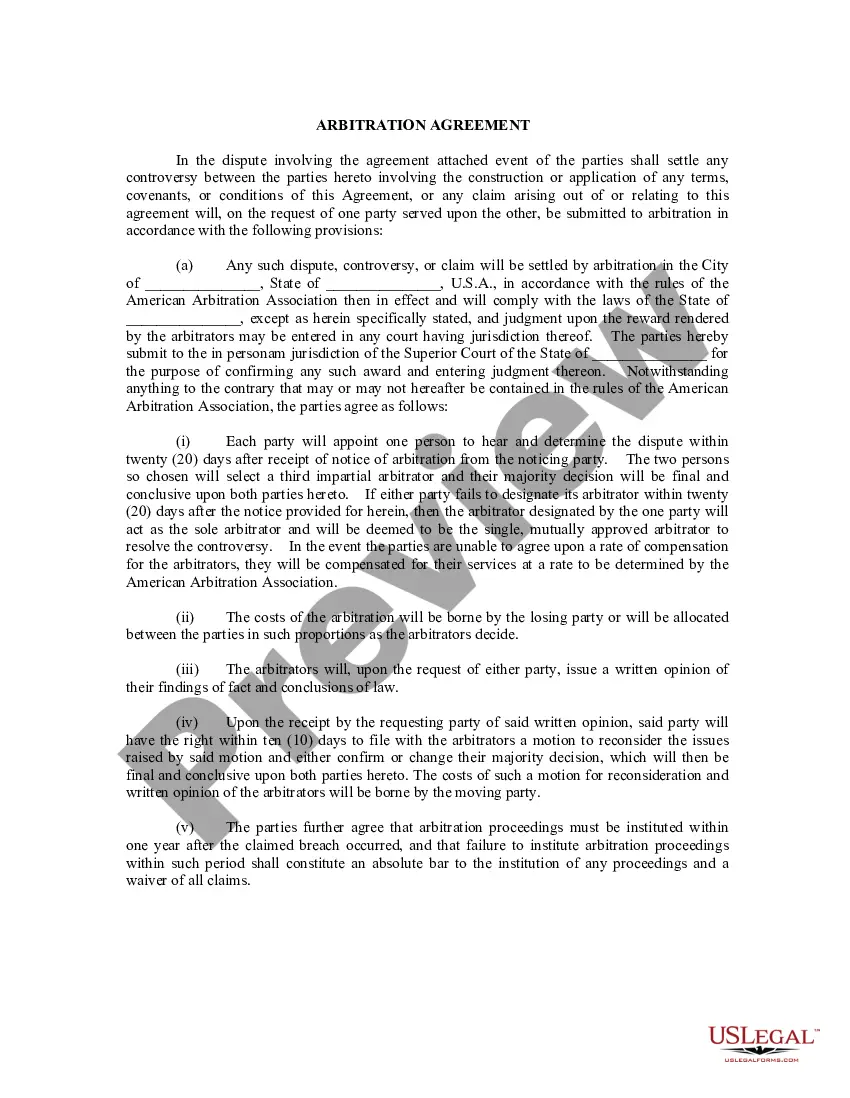
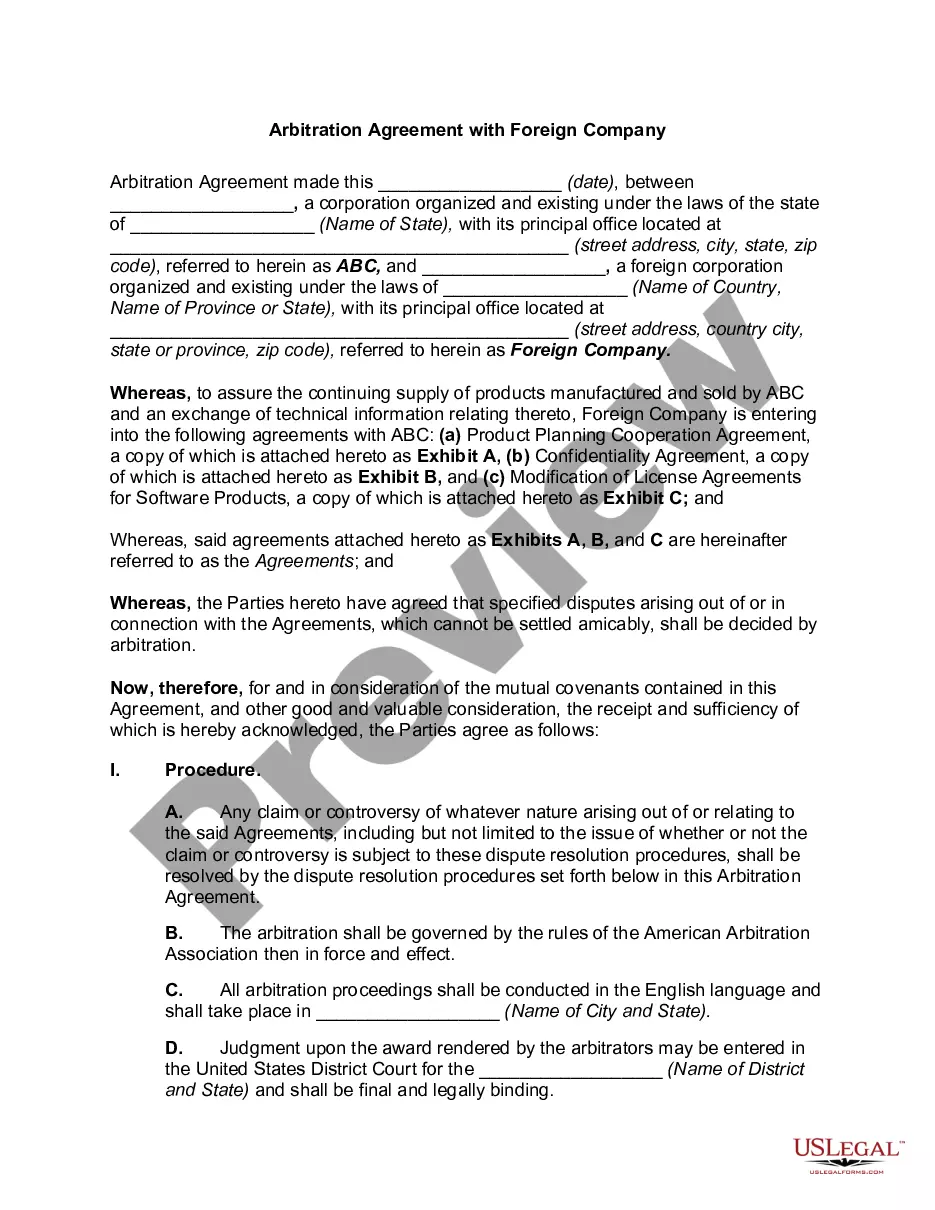
This form is an Arbitration Agreement. The form provides that each party will appoint one person to hear and determine the dispute within twenty days after receipt of notice of arbitration from the noticing party. The costs of the arbitration will be absorbed by the losing party or will be allocated between the parties in such proportions as the arbitrators decide.
Vermont OEM Arbitration Agreement
Category:
State:
Multi-State
Control #:
US-KWP-0046
Format:
Word;
Rich Text
Instant download
Description

Get your form ready online
Our built-in tools help you complete, sign, share, and store your documents in one place.
Built-in online Word editor
Make edits, fill in missing information, and update formatting in US Legal Forms—just like you would in MS Word.
Export easily
Download a copy, print it, send it by email, or mail it via USPS—whatever works best for your next step.
E-sign your document
Sign and collect signatures with our SignNow integration. Send to multiple recipients, set reminders, and more. Go Premium to unlock E-Sign.
Notarize online 24/7
If this form requires notarization, complete it online through a secure video call—no need to meet a notary in person or wait for an appointment.
Store your document securely
We protect your documents and personal data by following strict security and privacy standards.

Make edits, fill in missing information, and update formatting in US Legal Forms—just like you would in MS Word.

Download a copy, print it, send it by email, or mail it via USPS—whatever works best for your next step.

Sign and collect signatures with our SignNow integration. Send to multiple recipients, set reminders, and more. Go Premium to unlock E-Sign.

If this form requires notarization, complete it online through a secure video call—no need to meet a notary in person or wait for an appointment.

We protect your documents and personal data by following strict security and privacy standards.
Looking for another form?
How to fill out OEM Arbitration Agreement?
Selecting the appropriate legitimate document template can be challenging.
Clearly, there are countless templates accessible online, but how do you find the correct one you require.
Utilize the US Legal Forms website. This service offers thousands of templates, including the Vermont OEM Arbitration Agreement, which you can use for business and personal purposes.
You can preview the form using the Review button and read the form description to confirm that it is suitable for you.
- All of the forms are reviewed by professionals and adhere to state and federal regulations.
- If you are already registered, Log In to your account and click the Download button to obtain the Vermont OEM Arbitration Agreement.
- Use your account to browse the legal forms you have previously purchased.
- Go to the My documents section of your account and retrieve another copy of the document you need.
- If you are a new user of US Legal Forms, here are simple instructions you can follow.
- First, ensure that you have selected the correct form for your area/region.
Form popularity
FAQ
The zero tolerance law in Vermont pertains to strict penalties for operating a vehicle under the influence of alcohol or drugs. This law emphasizes the seriousness of impaired driving offenses. If you are concerned about the implications of an arbitration agreement in related cases, understanding this law can be crucial.
Arbitration outcomes can vary widely, but the party with clear evidence and strong arguments often prevails. In many cases, a well-prepared party can achieve favorable results. Understanding the nuances of a Vermont OEM Arbitration Agreement can also play a crucial role in influencing the decision.
An arbitration agreement is not a definitive red flag, but it can indicate a company's approach to resolving disputes. Understanding the specifics of the Vermont OEM Arbitration Agreement is key. It's advisable to consider how it impacts your rights and the potential outcomes.
Accepting a Vermont OEM Arbitration Agreement can be beneficial, but it's essential to review it carefully. Such agreements often limit your ability to take disputes to court, which may not align with your preferences. Always consider your personal situation and consult legal resources if needed.
Statute 4467 in Vermont pertains to the procedures for summary process actions. It outlines how courts handle eviction cases and tenant disputes. Engaging with resources related to the Vermont OEM Arbitration Agreement can offer further guidance on navigating these legal frameworks.
In Vermont, landlords must typically provide a 60-day notice if the tenant has lived in the property for more than 2 years. For shorter-term leases, the notice period may vary, often requiring less notice. Familiarizing yourself with the Vermont OEM Arbitration Agreement can help both landlords and tenants navigate their responsibilities effectively.
Yes, arbitration clauses are generally enforceable under both federal and state law, including Vermont. These clauses compel parties to resolve disputes through arbitration rather than litigation. Understanding the Vermont OEM Arbitration Agreement can clarify your rights and obligations regarding any included arbitration clause.
Evicting someone in Vermont can be a complex process, often requiring legal assistance. It typically involves filing a suit in court if the tenant contests eviction. Utilizing the Vermont OEM Arbitration Agreement can streamline dispute resolution, potentially avoiding lengthy evictions.
If a tenant fails to provide a 30-day notice in Vermont, they may still be responsible for paying rent until the end of the lease term. The landlord may also initiate eviction proceedings if the tenant remains in the rental property. Understanding your responsibilities and rights under the Vermont OEM Arbitration Agreement may help address such issues.
No, a man cannot marry his son in Vermont or in any state in the U.S. This type of relationship is not legally permitted due to laws against incest. If you have questions about family law in Vermont, the Vermont OEM Arbitration Agreement can provide a framework for resolving related disputes effectively.