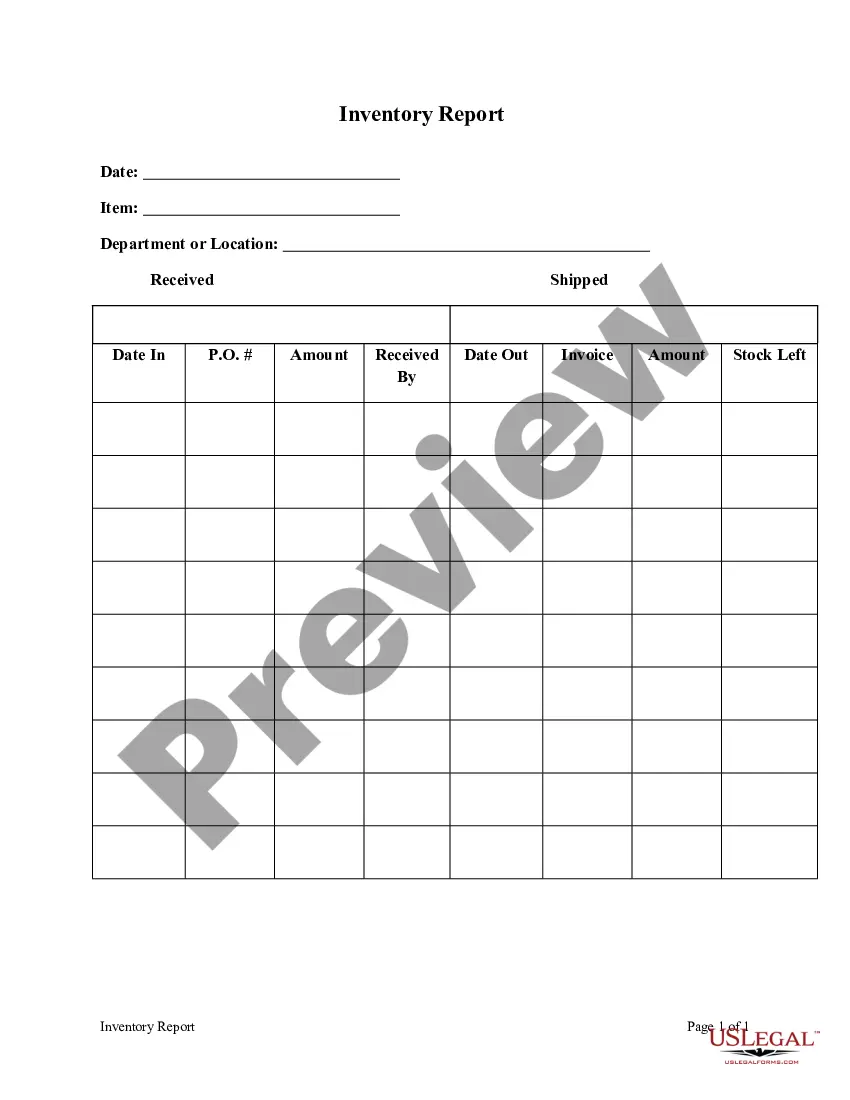
Vermont Inventory Report
Description
Get your form ready online
Our built-in tools help you complete, sign, share, and store your documents in one place.
Make edits, fill in missing information, and update formatting in US Legal Forms—just like you would in MS Word.
Download a copy, print it, send it by email, or mail it via USPS—whatever works best for your next step.
Sign and collect signatures with our SignNow integration. Send to multiple recipients, set reminders, and more. Go Premium to unlock E-Sign.
If this form requires notarization, complete it online through a secure video call—no need to meet a notary in person or wait for an appointment.
We protect your documents and personal data by following strict security and privacy standards.

Make edits, fill in missing information, and update formatting in US Legal Forms—just like you would in MS Word.

Download a copy, print it, send it by email, or mail it via USPS—whatever works best for your next step.

Sign and collect signatures with our SignNow integration. Send to multiple recipients, set reminders, and more. Go Premium to unlock E-Sign.

If this form requires notarization, complete it online through a secure video call—no need to meet a notary in person or wait for an appointment.

We protect your documents and personal data by following strict security and privacy standards.
Looking for another form?



How to fill out Inventory Report?
Finding the appropriate legal document template can be a challenge.
Certainly, there are countless templates accessible online, but how do you locate the legal form you require.
Utilize the US Legal Forms website.
First, ensure you have selected the correct form for your city/region. You can browse the document using the Review button and read the description to confirm it is appropriate for you. If the form does not meet your needs, utilize the Search field to find the right form. Once you are confident the form is suitable, click the Buy now button to obtain the form. Choose the pricing plan you desire and enter the required information. Create your account and complete the transaction using your PayPal account or credit card. Select the file format and download the legal document template to your device. Finally, complete, modify, print, and sign the acquired Vermont Inventory Report. US Legal Forms is the largest collection of legal documents where you can access various forms. Take advantage of the service to download professionally crafted paperwork that complies with state requirements.
- The service offers a vast array of templates, including the Vermont Inventory Report, which can be utilized for business and personal purposes.
- All the documents are verified by professionals and comply with federal and state regulations.
- If you are already registered, Log In to your account, and click the Obtain button to access the Vermont Inventory Report.
- Use your account to review the legal forms you have previously purchased.
- Navigate to the My documents tab in your account to download another copy of the document you need.
- If you are a new user of US Legal Forms, here are simple steps to follow.
Form popularity
FAQ
To fill out an inventory sheet, begin with creating a clear layout that includes sections for item description, quantity, and estimated value. List items methodically, ensuring accuracy as you compile data for the Vermont Inventory Report. Use a structured approach to keep the information organized, which makes the final review process straightforward. This practice provides a solid foundation for effective inventory management.
Assets like jointly owned property, life insurance policies with named beneficiaries, and funds in payable-on-death accounts typically do not go through probate. Understanding which assets bypass probate can simplify the estate planning process. Make sure to include this information in your Vermont Inventory Report for clarity and ease. This knowledge helps in managing the estate more efficiently.
Filling out an inventory and condition form for an apartment involves listing all furnishings and their condition. Start with major items like furniture and appliances, then include smaller items like linens and kitchenware. Clearly note the condition of each item on the Vermont Inventory Report to avoid disputes later. This process aids renters and landlords in maintaining accountability.
An example of an inventory of estate might include a house, a car, jewelry, and savings accounts. Each item should include a description and an estimated market value to provide a comprehensive view of the estate. When preparing for the Vermont Inventory Report, ensure that all assets are accounted for accurately. This example serves as a useful guide for anyone completing their inventory.
To fill out an inventory for a decedent's estate, start by listing all assets owned by the deceased. Include real estate, bank accounts, personal belongings, and any investments. Be thorough in documenting each item’s estimated value for the Vermont Inventory Report. This step ensures transparency and helps in the probate process.
The IN-111 form is the Vermont Individual Income Tax Return that residents use to file their annual state taxes. It includes various fields to report income, deductions, and taxable refunds. It’s beneficial to refer to your Vermont Inventory Report when filling out this form, ensuring all income and asset values are accurately represented.
VT form 113 is the Vermont Personal Property Tax Return used by individuals and businesses to report tangible personal property. This form helps the state assess property taxes based on the reported inventory values. Accurate completion of form 113 and referencing your Vermont Inventory Report ensures compliance and helps avoid penalties.
The property tax exemption form in Vermont allows certain individuals to apply for a reduction in property taxes based on specific criteria. This may include exemptions for veterans, the elderly, or certain types of income, among others. To maximize your benefits, it is helpful to review your Vermont Inventory Report and assess which exemptions you may qualify for.
To report inventory on your taxes, you must first determine the value of your inventory at the beginning and end of the tax year. Use a consistent method such as First-In-First-Out (FIFO) or Last-In-First-Out (LIFO) to calculate your inventory costs. Including this information in your Vermont Inventory Report simplifies reporting and ensures accuracy.
Filling out an estate inventory involves listing all assets the deceased owned at the time of their passing. You will need to assess the value of those assets, which may include real estate, bank accounts, and personal property. A Vermont Inventory Report is useful in this process, as it helps provide a clear picture of the estate’s worth and ensures you meet legal requirements.