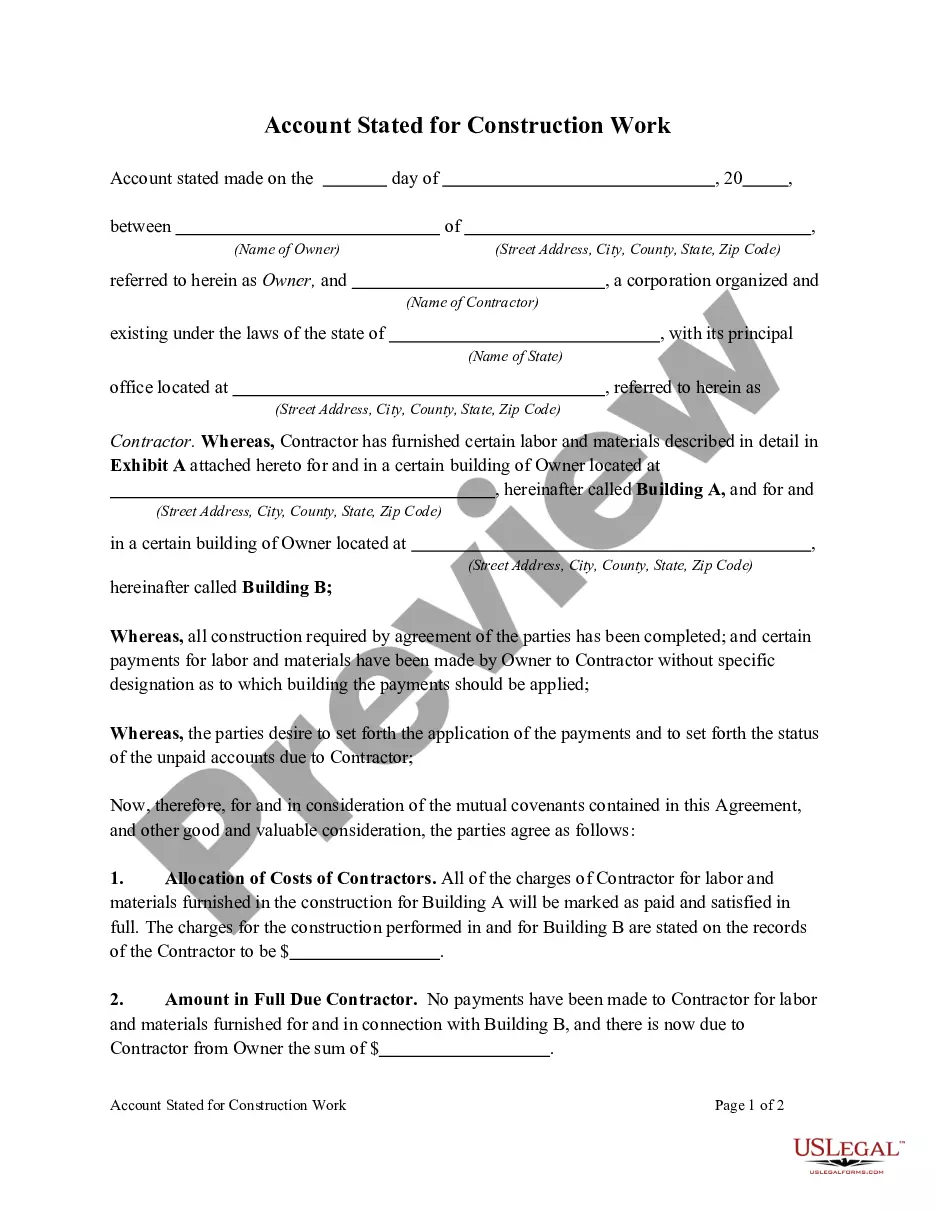
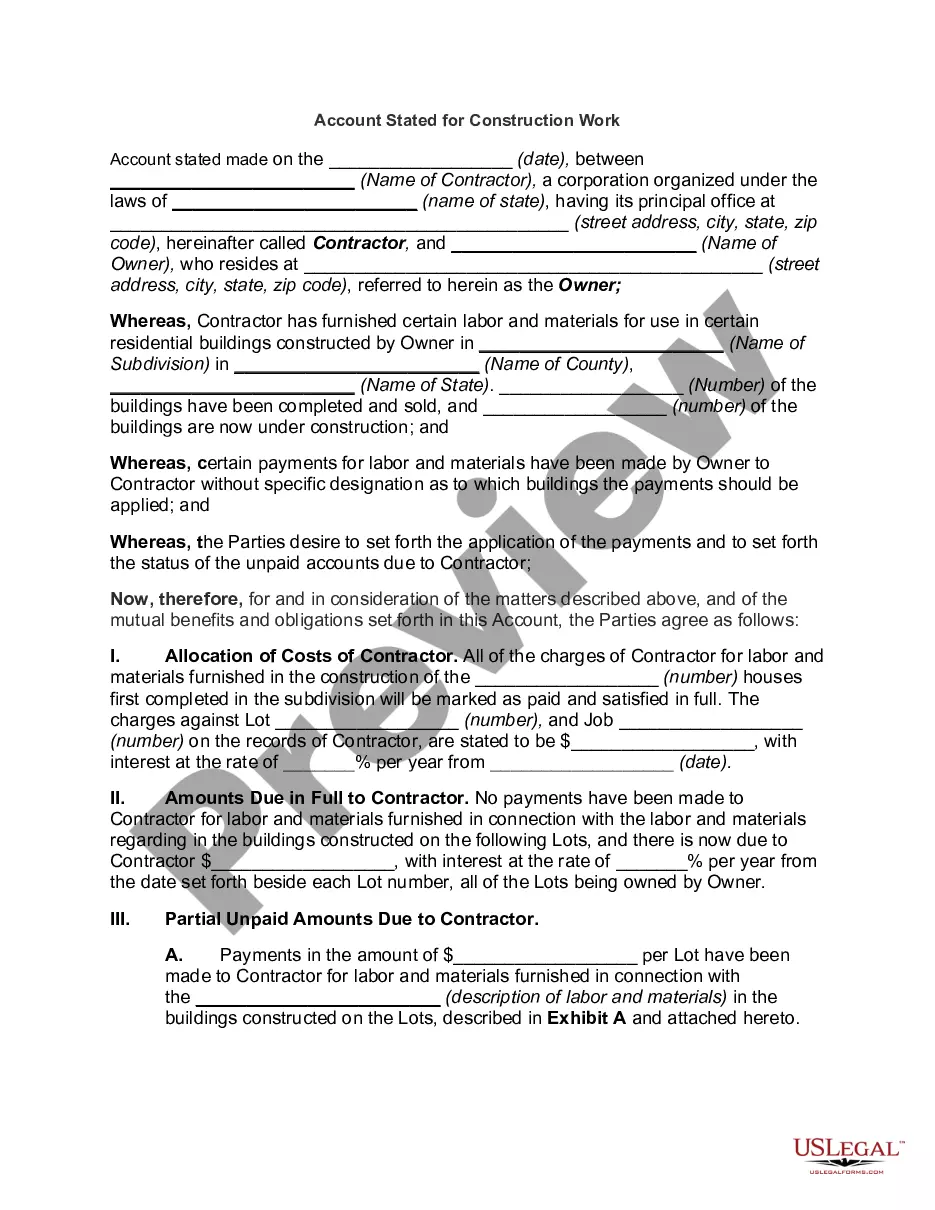
Vermont Account Stated for Construction Work
Description
Get your form ready online
Our built-in tools help you complete, sign, share, and store your documents in one place.
Make edits, fill in missing information, and update formatting in US Legal Forms—just like you would in MS Word.
Download a copy, print it, send it by email, or mail it via USPS—whatever works best for your next step.
Sign and collect signatures with our SignNow integration. Send to multiple recipients, set reminders, and more. Go Premium to unlock E-Sign.
If this form requires notarization, complete it online through a secure video call—no need to meet a notary in person or wait for an appointment.
We protect your documents and personal data by following strict security and privacy standards.

Make edits, fill in missing information, and update formatting in US Legal Forms—just like you would in MS Word.

Download a copy, print it, send it by email, or mail it via USPS—whatever works best for your next step.

Sign and collect signatures with our SignNow integration. Send to multiple recipients, set reminders, and more. Go Premium to unlock E-Sign.

If this form requires notarization, complete it online through a secure video call—no need to meet a notary in person or wait for an appointment.

We protect your documents and personal data by following strict security and privacy standards.
Looking for another form?






How to fill out Account Stated For Construction Work?
You can spend hours online searching for the legal document template that meets the federal and state requirements you need. US Legal Forms offers a vast array of legal forms that are reviewed by experts.
You can easily download or print the Vermont Account Stated for Construction Work from my services. If you already have a US Legal Forms account, you can Log In and click the Obtain button. After that, you can complete, modify, print, or sign the Vermont Account Stated for Construction Work. Each legal document template you purchase is yours permanently.
To obtain another copy of any purchased document, visit the My documents tab and click the corresponding option. If you are accessing the US Legal Forms website for the first time, follow the simple instructions below: First, ensure that you have selected the correct document template for your area/town that you choose. Review the document description to confirm that you have selected the right form. If available, use the Review option to examine the document template as well.
- If you wish to acquire another version of your document, use the Search section to find the template that suits your needs and requirements.
- Once you have located the template you need, click Buy now to proceed.
- Choose the pricing plan you prefer, enter your details, and register for your account on US Legal Forms.
- Complete the payment. You can use your credit card or PayPal account to pay for the legal document.
- Select the format of your document and download it to your device.
- Make modifications to your document if necessary. You can complete, modify, sign, and print the Vermont Account Stated for Construction Work.
- Access and print thousands of document templates using the US Legal Forms website, which offers the largest collection of legal forms. Utilize professional and state-specific templates to address your business or personal needs.
Form popularity
FAQ
Food, food products, and beverages are exempt from Vermont Sales and Use Tax under Vermont law 32 V.S.A. § 9741(13) with the exception of soft drinks.
Services are generally tax-exempt in Vermont, though there are exceptions: Services to tangible personal property. If labor is expended in producing a new or different item, a tax applies to the labor charge.
When contractors purchase, rent, or lease equipment and use it in Vermont, it is always subject to Vermont Sales Tax. Tax applies even when contractors use equipment on exempt projects. If the contractor does not pay 6% sales tax at the time of purchase, the contractor must pay Vermont Use Tax.
Vermont Sales Tax is charged on the retail sales of tangible personal property unless exempted by law. The sales tax rate is 6%. Vermont Use Tax is imposed on the buyer at the same rate as the sales tax.
Tax Rate. The Vermont Sales and Use Tax is 6%. To determine tax due, multiply the sales amount by 6% (or 7% if the sale is subject to local option tax), and round up to the nearest whole cent ing to the following rules: Tax computation must be carried to the third decimal place, and.