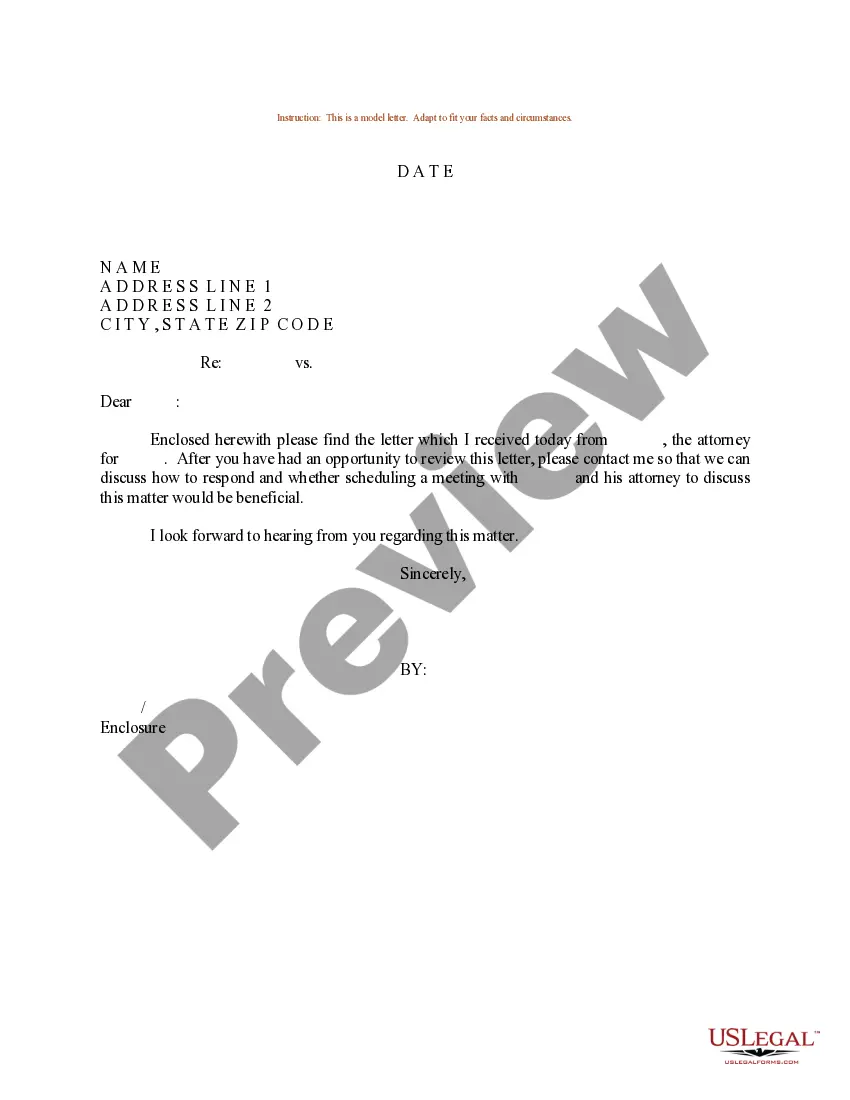
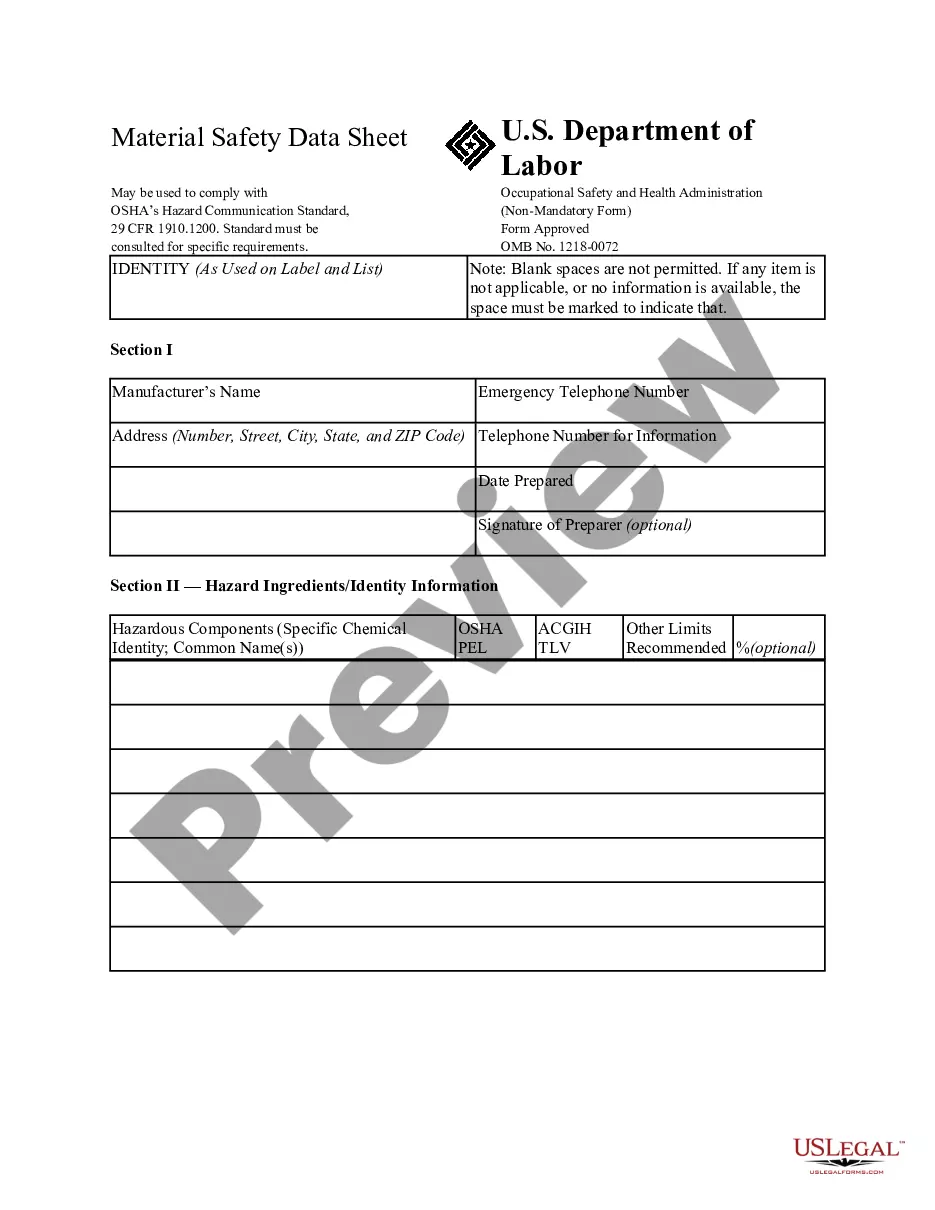
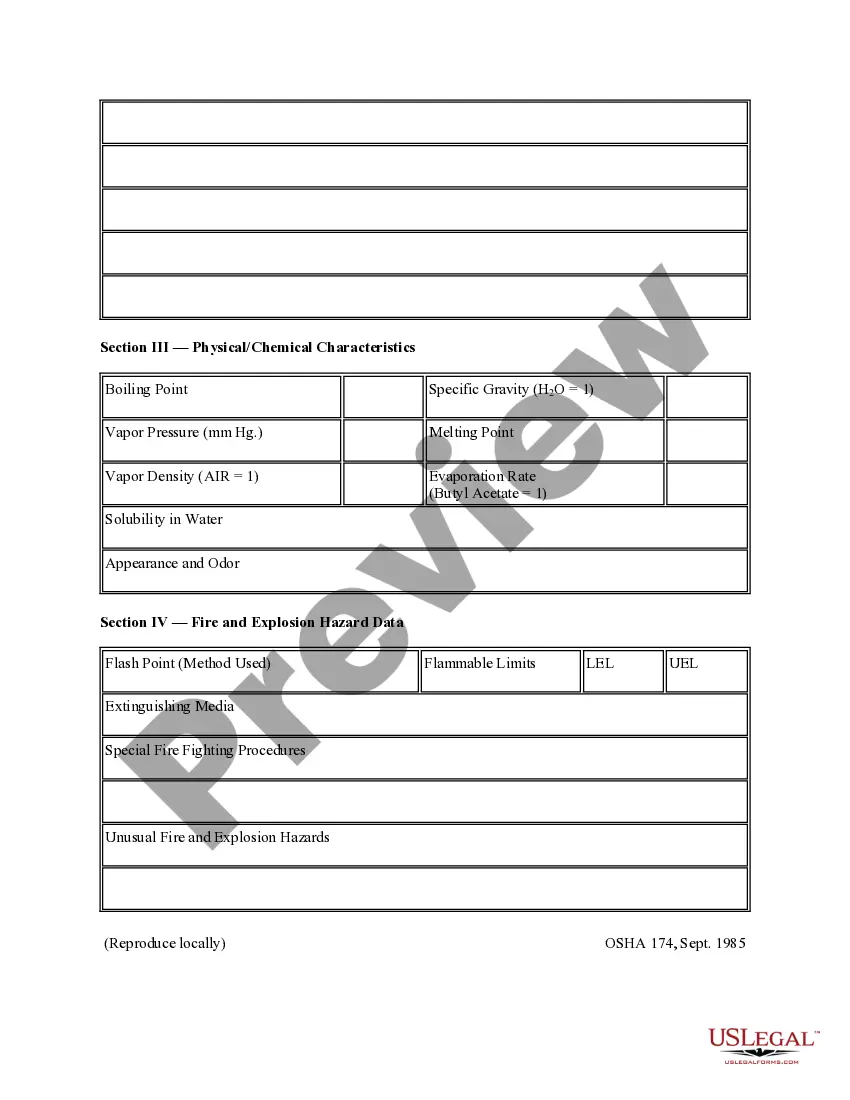
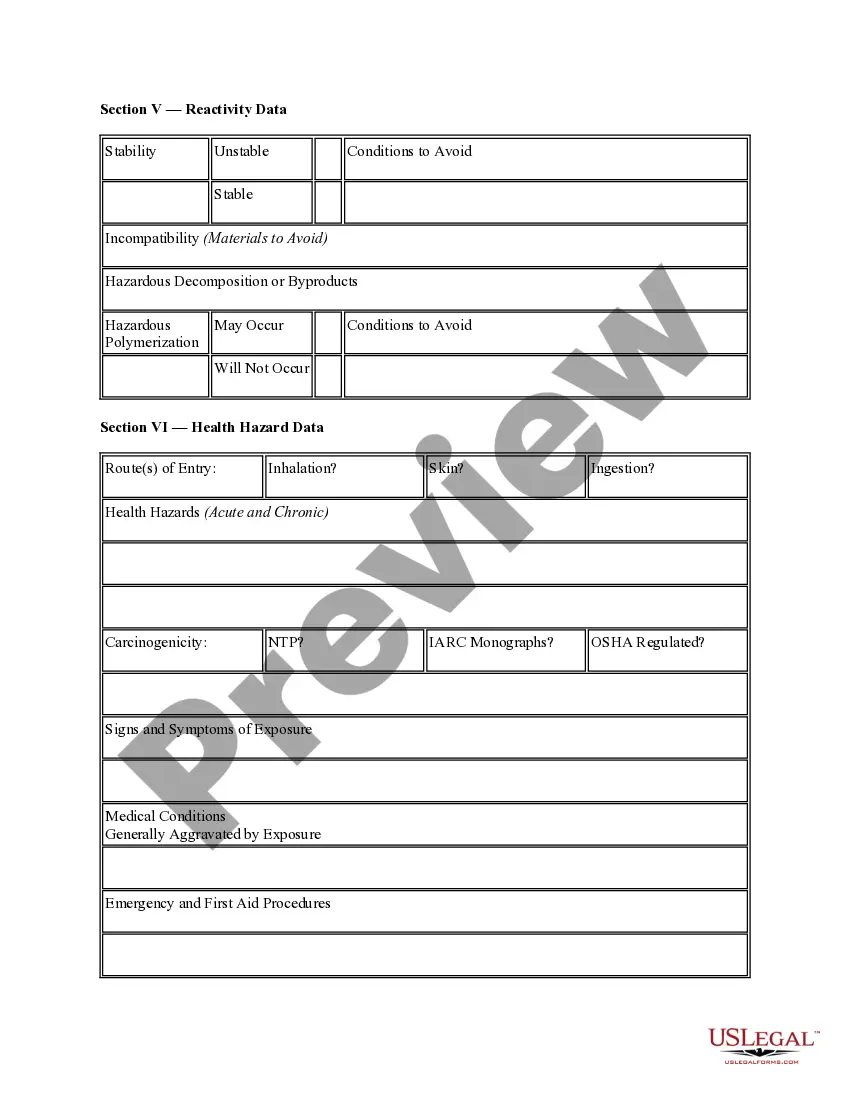
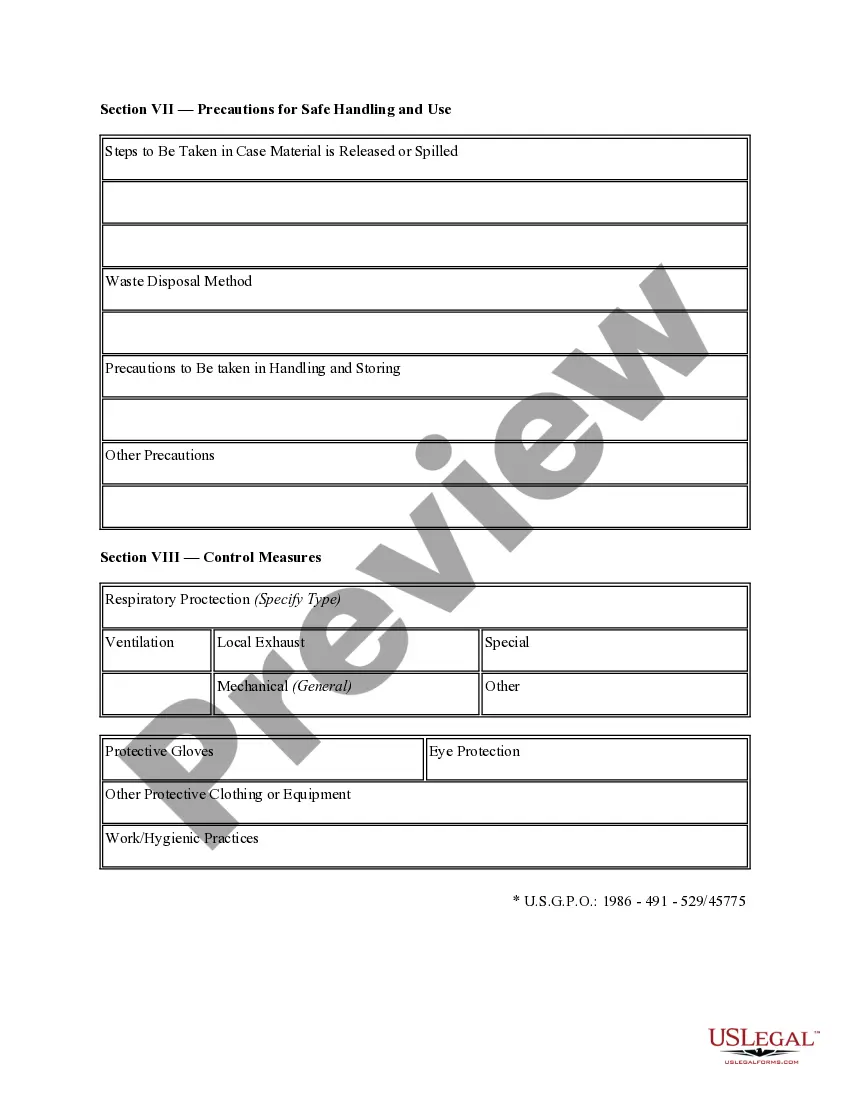
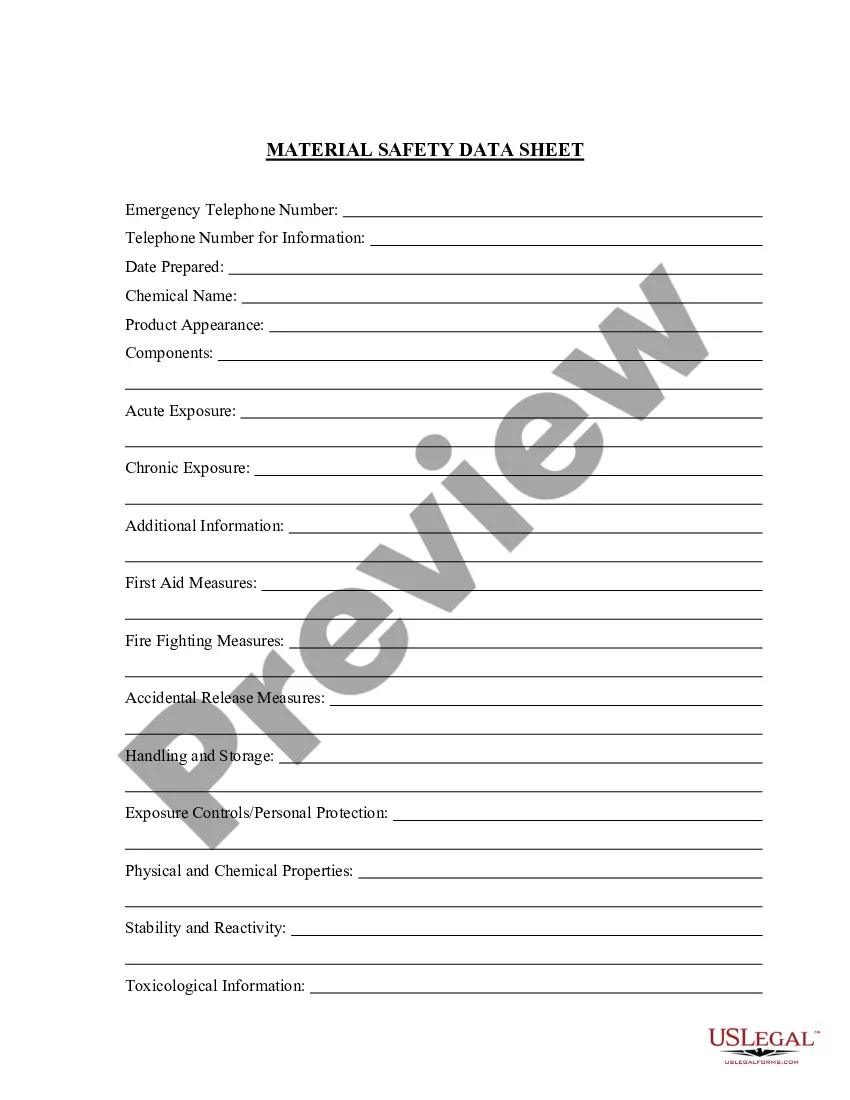
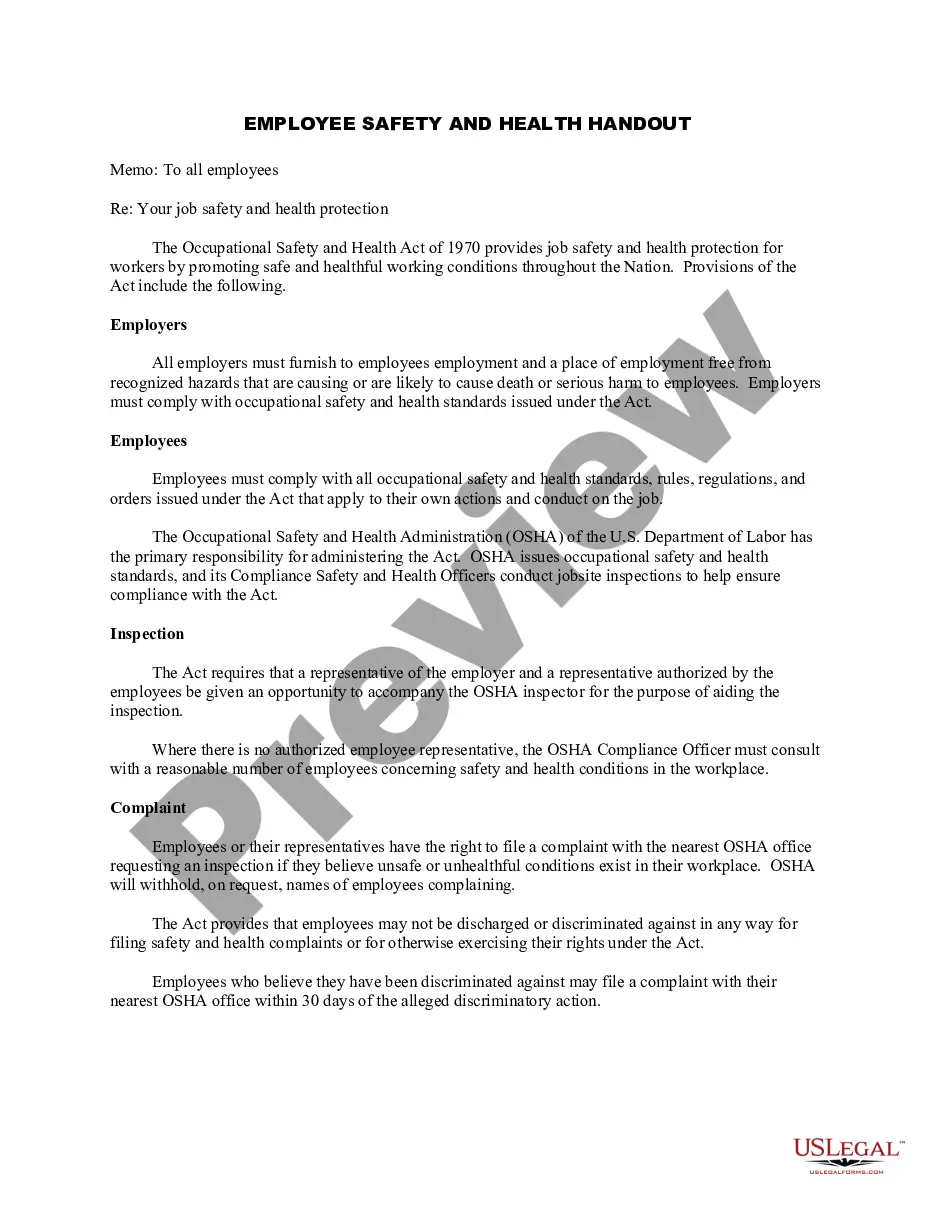
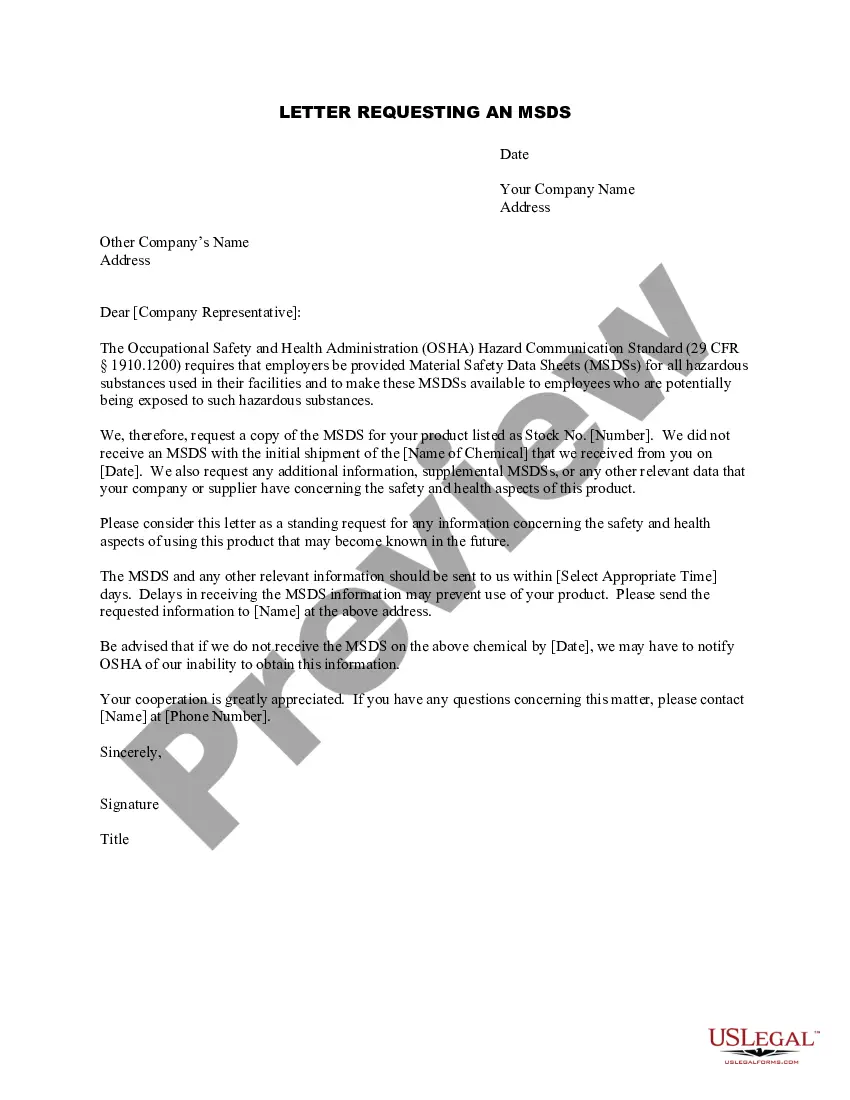
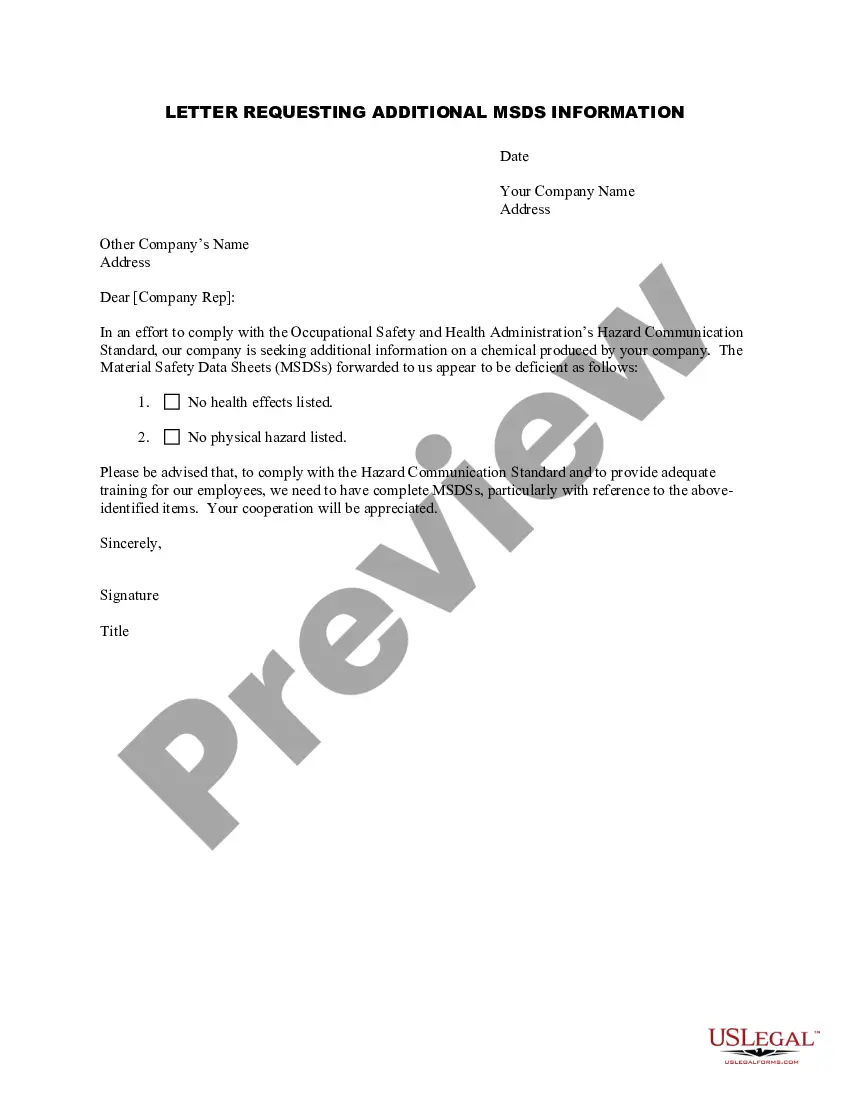
Virgin Islands Material Safety Data Sheet from the U.S. Dept. of Labor and OSHA
Description

Get your form ready online
Our built-in tools help you complete, sign, share, and store your documents in one place.
Make edits, fill in missing information, and update formatting in US Legal Forms—just like you would in MS Word.
Download a copy, print it, send it by email, or mail it via USPS—whatever works best for your next step.
Sign and collect signatures with our SignNow integration. Send to multiple recipients, set reminders, and more. Go Premium to unlock E-Sign.
If this form requires notarization, complete it online through a secure video call—no need to meet a notary in person or wait for an appointment.
We protect your documents and personal data by following strict security and privacy standards.

Make edits, fill in missing information, and update formatting in US Legal Forms—just like you would in MS Word.

Download a copy, print it, send it by email, or mail it via USPS—whatever works best for your next step.

Sign and collect signatures with our SignNow integration. Send to multiple recipients, set reminders, and more. Go Premium to unlock E-Sign.

If this form requires notarization, complete it online through a secure video call—no need to meet a notary in person or wait for an appointment.

We protect your documents and personal data by following strict security and privacy standards.
Looking for another form?
How to fill out Material Safety Data Sheet From The U.S. Dept. Of Labor And OSHA?
You might spend hours online searching for the legal document template that meets the federal and state criteria you require.
US Legal Forms offers a vast array of legal forms that have been reviewed by professionals.
You can download or print the Virgin Islands Material Safety Data Sheet from the U.S. Department of Labor and OSHA via their services.
If available, utilize the Preview button to view the document template as well. To find another version of the form, use the Search section to discover the template that fits your needs.
- If you possess a US Legal Forms account, you may Log In and select the Obtain button.
- Subsequently, you can complete, modify, print, or sign the Virgin Islands Material Safety Data Sheet from the U.S. Department of Labor and OSHA.
- Every legal document template you acquire is yours indefinitely.
- To obtain another copy of a purchased form, visit the My documents tab and click on the corresponding button.
- If you are using the US Legal Forms website for the first time, follow the simple steps detailed below.
- Firstly, ensure that you have selected the correct document template for the county/city of your choice.
- Review the form description to confirm you have chosen the appropriate form.
Form popularity
FAQ
Those not covered by the OSH Act include: self-employed workers, immediate family members of farm employers, and workers whose hazards are regulated by another federal agency (for example, the Mine Safety and Health Administration, the Department of Energy, Federal Aviation Administration, or Coast Guard).
The Occupational Safety and Health Act, and therefore the OSHA Recordkeeping Regulation, apply only within the jurisdictional boundaries of the United States as defined in Section 4(a) of the Act.
State Plans are OSHA-approved workplace safety and health programs operated by individual states or U.S. territories. There are currently 22 State Plans covering both private sector and state and local government workers, and there are six State Plans covering only state and local government workers.
No. Employers are only required to record injuries and illnesses if they occur within the geographic coverage of the OSH Act.
OSHA Coverage Those jurisdictions include the District of Columbia, Puerto Rico, the Virgin Islands, American Samoa, Guam, Northern Mariana Islands, Wake Island, Johnston Island, and the Outer Continental Shelf Lands as defined in the Outer Continental Shelf Lands Act.
The OSH Act covers most private sector employers and their workers, in addition to some public sector employers and workers in the 50 states and certain territories and jurisdictions under federal authority.
Have more questions about standards?U.S. Department of Labor - OSHA National Office. 1-800-321-OSHA (6742)Directorate of Standards & Guidance. 202-693-1950.Directorate of Construction. 202-693-2020.Ask a question by email.
The Virgin Islands State Plan covers all state and local government workers in the state. It does not cover federal government workers. Federal government workers, including those employed by the United States Postal Service and civilian workers on military bases, are covered by OSHA.
The Occupational Safety and Health Act, and therefore the OSHA Recordkeeping Regulation, apply only within the jurisdictional boundaries of the United States as defined in Section 4(a) of the Act.
Those not covered by the OSH Act include: self-employed workers, immediate family members of farm employers, and workers whose hazards are regulated by another federal agency (for example, the Mine Safety and Health Administration, the Department of Energy, Federal Aviation Administration, or Coast Guard).