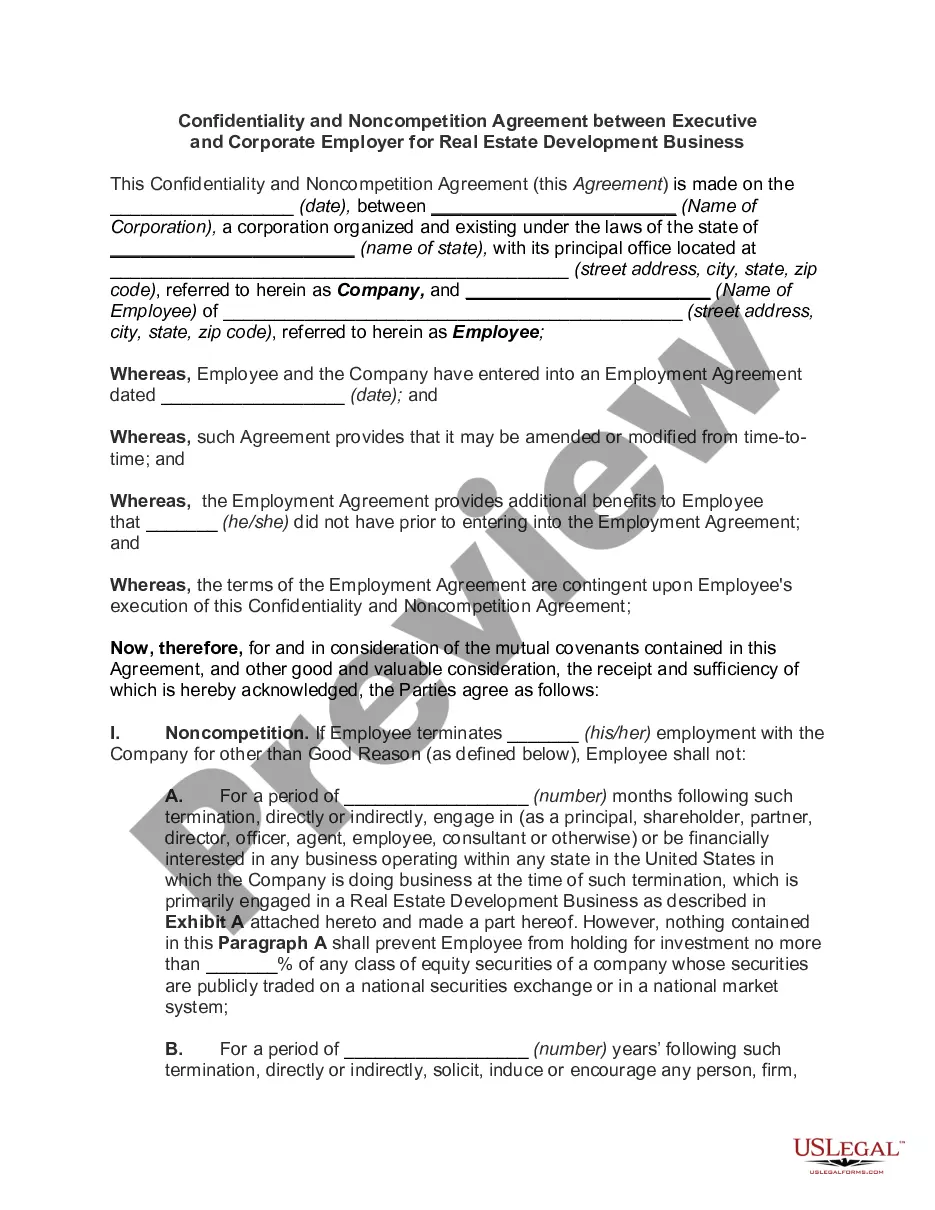
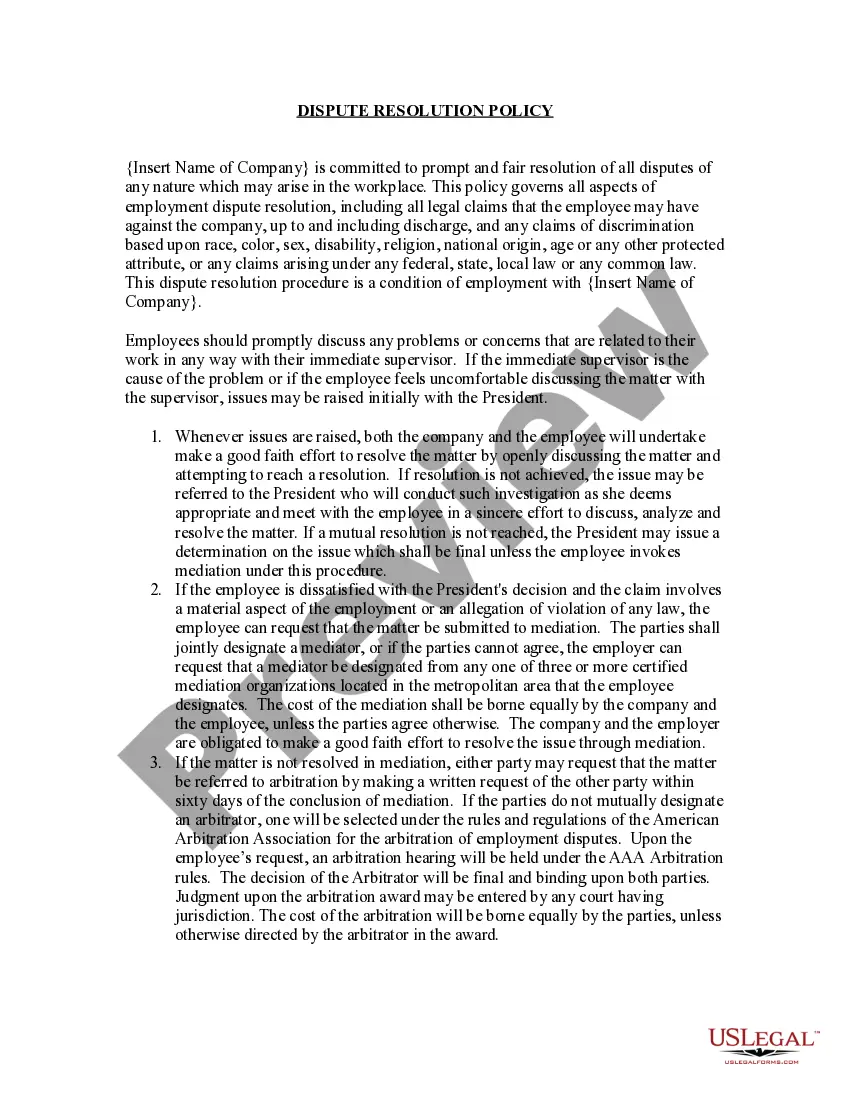
Virginia Dispute Resolution Policy
Description
Get your form ready online
Our built-in tools help you complete, sign, share, and store your documents in one place.
Make edits, fill in missing information, and update formatting in US Legal Forms—just like you would in MS Word.
Download a copy, print it, send it by email, or mail it via USPS—whatever works best for your next step.
Sign and collect signatures with our SignNow integration. Send to multiple recipients, set reminders, and more. Go Premium to unlock E-Sign.
If this form requires notarization, complete it online through a secure video call—no need to meet a notary in person or wait for an appointment.
We protect your documents and personal data by following strict security and privacy standards.

Make edits, fill in missing information, and update formatting in US Legal Forms—just like you would in MS Word.

Download a copy, print it, send it by email, or mail it via USPS—whatever works best for your next step.

Sign and collect signatures with our SignNow integration. Send to multiple recipients, set reminders, and more. Go Premium to unlock E-Sign.

If this form requires notarization, complete it online through a secure video call—no need to meet a notary in person or wait for an appointment.

We protect your documents and personal data by following strict security and privacy standards.
Looking for another form?


How to fill out Dispute Resolution Policy?
US Legal Forms - one of the most substantial collections of legal documents in the United States - provides an assortment of legal paper templates that you can download or print.
By utilizing the website, you can discover numerous forms for business and personal purposes, organized by categories, states, or keywords. You can obtain the latest versions of forms such as the Virginia Dispute Resolution Policy in moments.
If you already possess a membership, Log In and download the Virginia Dispute Resolution Policy from the US Legal Forms catalog. The Download button will appear on every form you access. You can find all previously downloaded forms in the My documents section of your profile.
Choose the format and download the form to your device.
Edit. Complete, modify, and print and sign the downloaded Virginia Dispute Resolution Policy. Each template you add to your account does not have an expiration date and is yours permanently. Therefore, if you need to download or print another copy, simply go to the My documents section and click on the form you need.
- If you want to utilize US Legal Forms for the first time, here are simple directions to assist you in getting started.
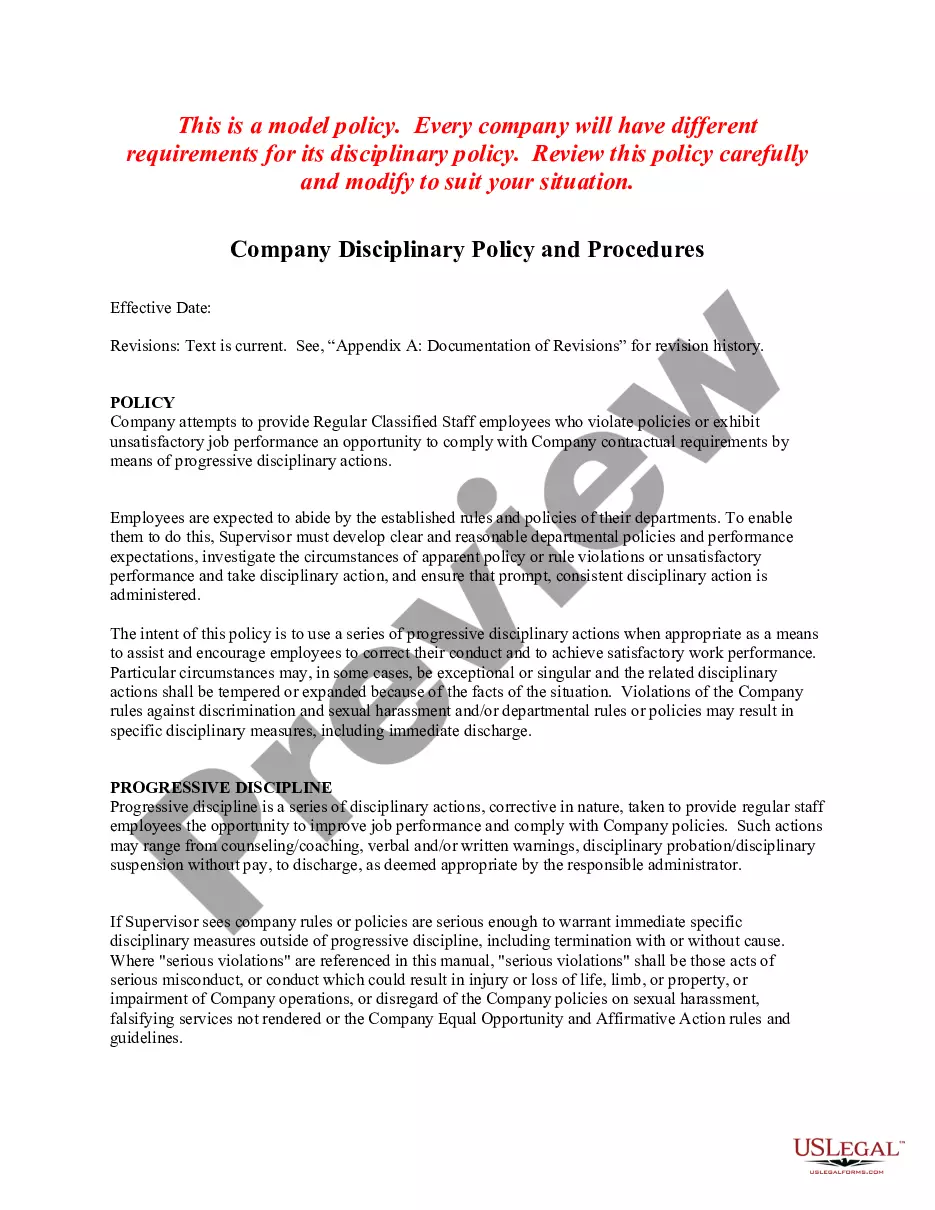
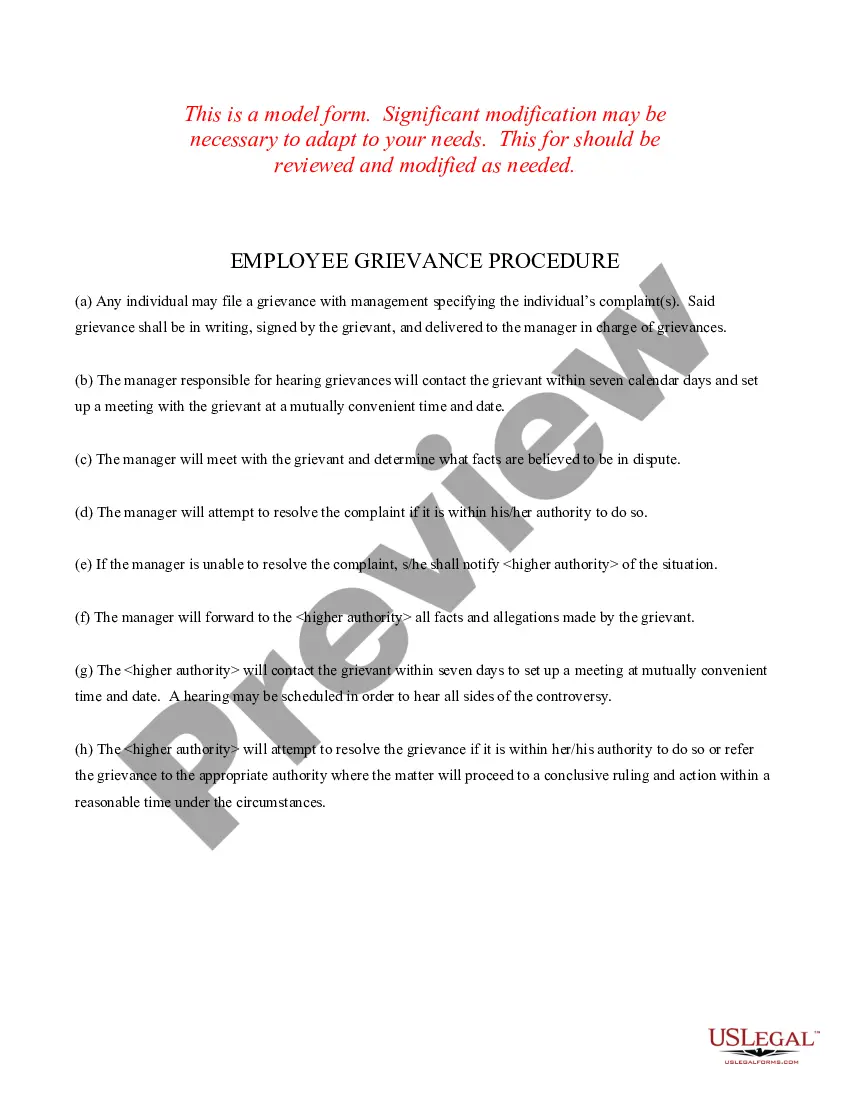
- Ensure you have selected the correct form for your area/state. Click on the Review button to examine the form’s details.
- Read the form summary to confirm that you have chosen the right document.
- If the document does not meet your requirements, use the Search area at the top of the screen to find one that does.
- Once you are satisfied with the form, confirm your choice by clicking the Buy now button. Then, select the payment plan you prefer and provide your information to register for the account.
- Process the payment. Use your Visa or Mastercard or PayPal account to finalize the transaction.
Form popularity
FAQ
Dispute resolution works by bringing the involved parties together to discuss their issues and seek a mutually acceptable solution. Initially, parties may enter negotiations, followed by mediation with a neutral third party, and, if unresolved, arbitration might occur. The Virginia Dispute Resolution Policy emphasizes collaboration and communication, encouraging all parties to find common ground.
Types of disputeArbitration.Competition.Construction.Employment.Enforcement and Asset Recovery.Financial services.Fraud.General commercial.More items...
The goal of the dispute resolution process is to exchange and review information in order to determine whether revision or rescission is warranted of discipline, end of employment or other application of policy.
Dispute resolution processes fall into two major types: Adjudicative processes, such as litigation or arbitration, in which a judge, jury or arbitrator determines the outcome. Consensual processes, such as collaborative law, mediation, conciliation, or negotiation, in which the parties attempt to reach agreement.
The most common types of ADR for civil cases are mediation, settlement conferences, neutral evaluation, and arbitration.
There are many types of dispute resolution processes, but arbitration; mediation; and negotiation are the three most common types of alternative dispute resolution. Negotiation is the least formal type of ADR.
Arbitration, Mediation, Conciliation, or Lok Adalat are the modes of Alternative Dispute Resolution provided in the Code of Civil Procedure.
The purpose of this policy is to provide a quick, effective and consistently applied method for a nonsupervisory employee to present his or her concerns to management and have those concerns internally resolved.
Dispute resolution is the process of resolving a dispute or conflict between different parties. Crucially, dispute resolution can be a way of solving a conflict without having to go to court.
The most common forms of ADR for civil cases are mediation, arbitration, neutral evaluation, settlement conferences and community dispute resolution programs.