Virginia Final Letter to Clerk
About this form
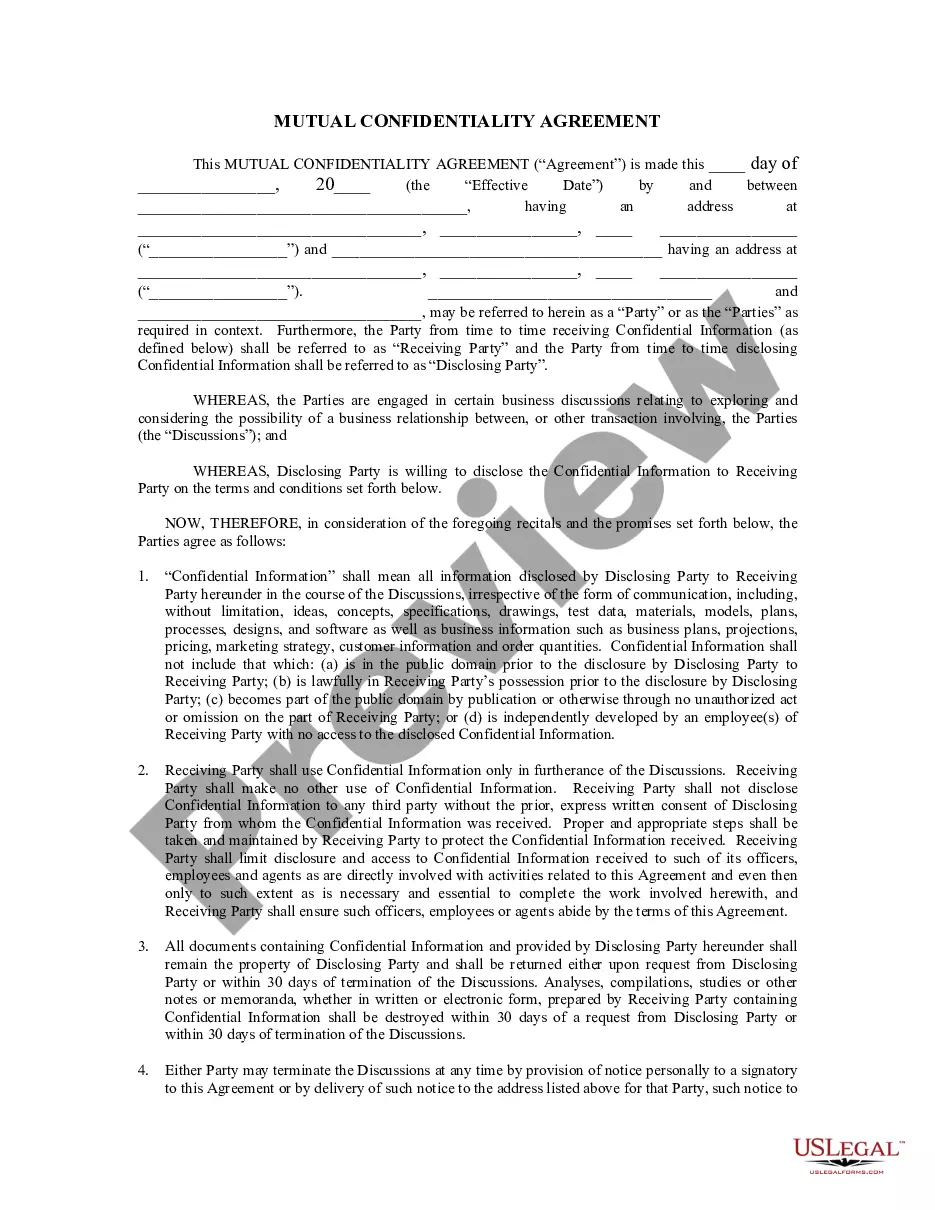
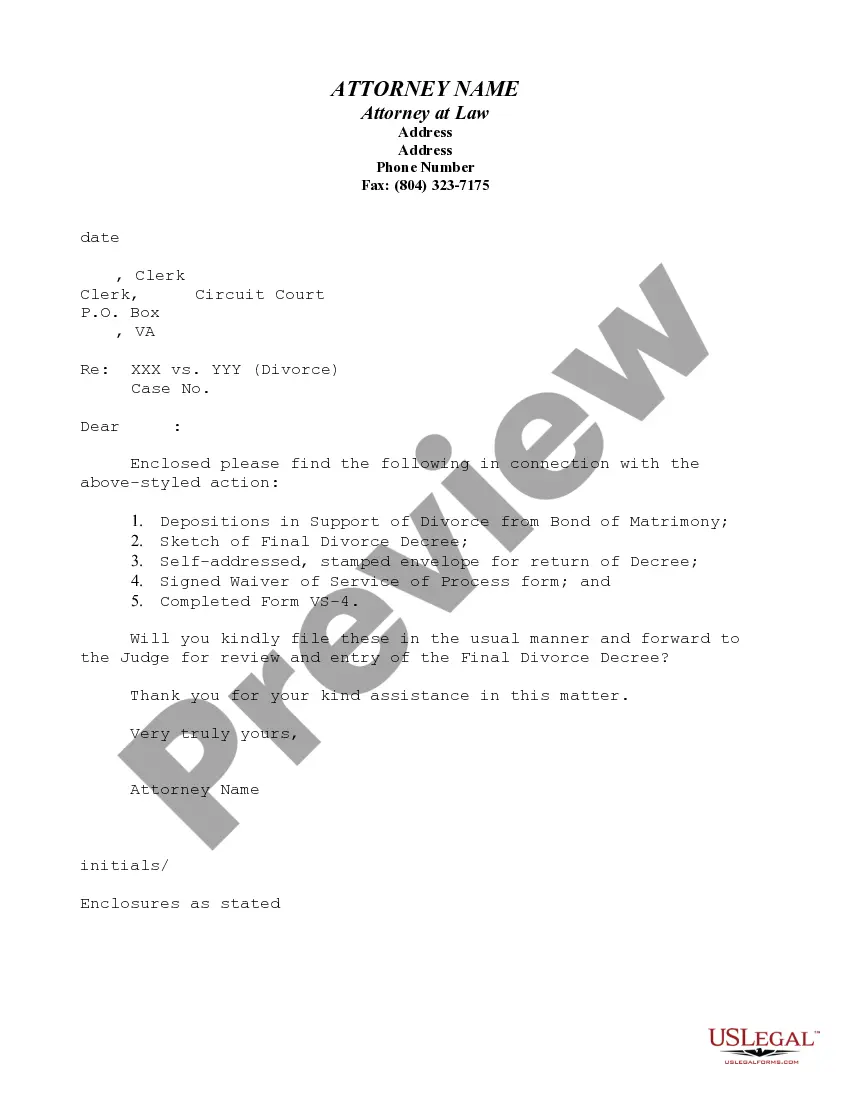
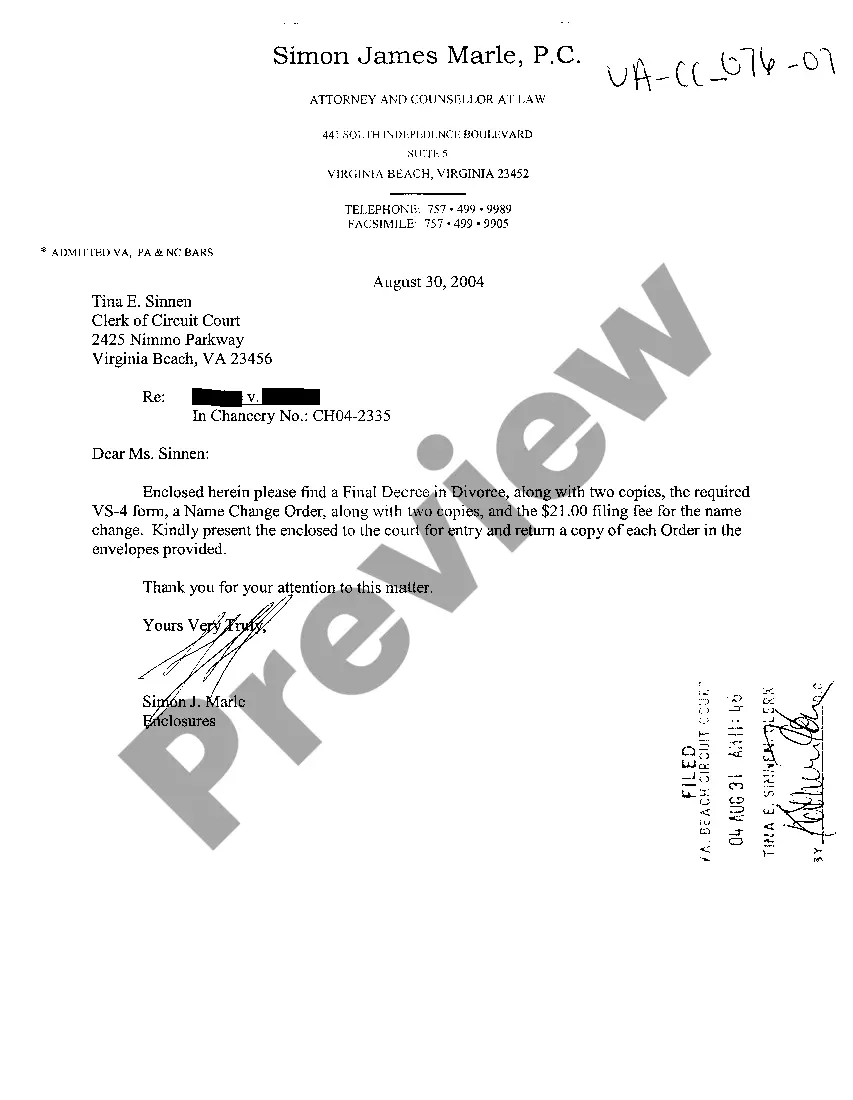
The Final Letter to Clerk is a cover letter used to submit all necessary documents to the court before the final divorce decree is issued. This form serves as a formal introduction for the attached paperwork, ensuring that the court has all required information to process the divorce case efficiently. It is distinct from other forms by providing a specific context for submitting multiple documents at once, streamlining the filing process.
Key components of this form
- Heading with your name and case number.
- List of enclosed documents, specifying each required form.
- Statement requesting the court to review and process the attached documents.
- Signature line for the submitting party.
- Date of submission.
Situations where this form applies
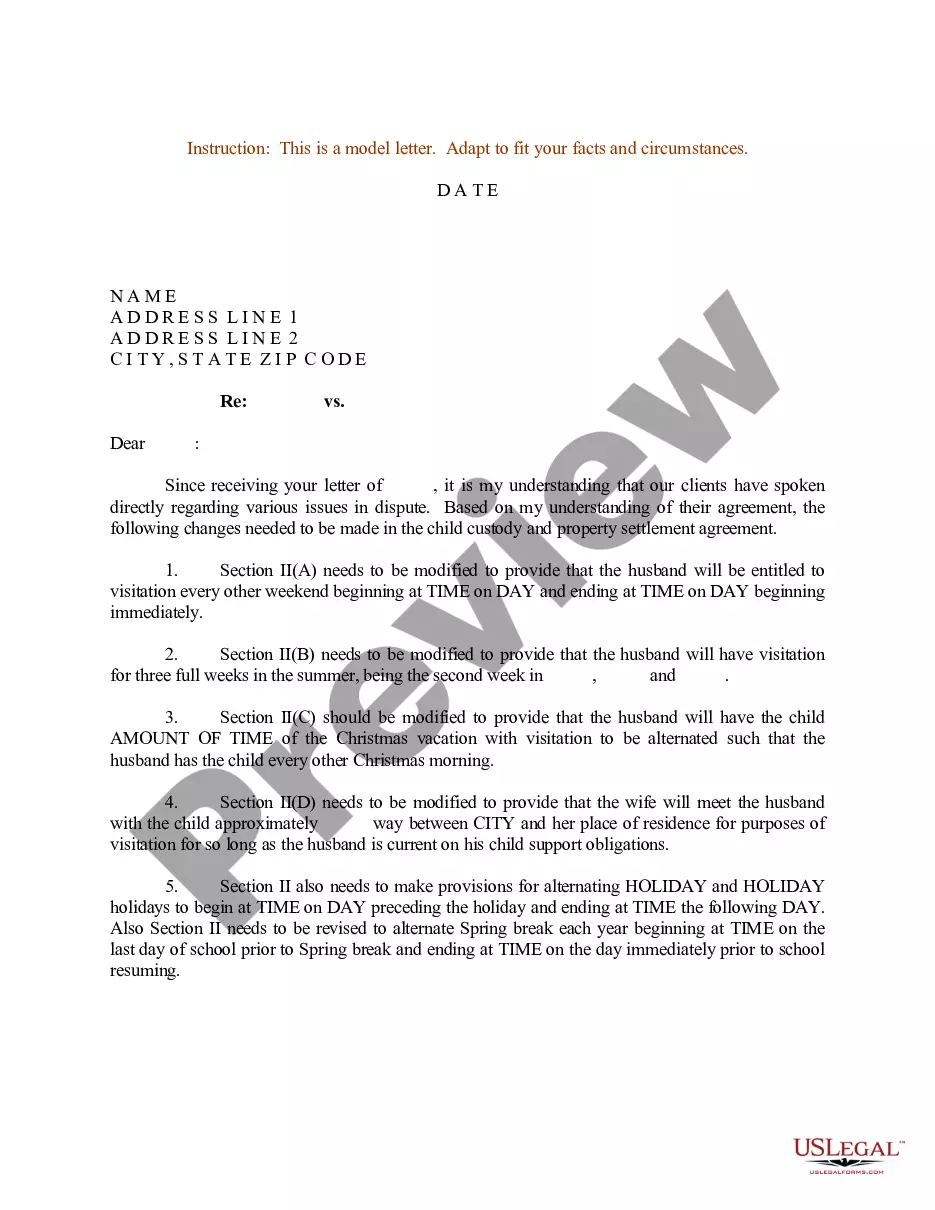
This form is needed when you are finalizing a divorce and need to submit all relevant documentation to the court. It is typically used after you have completed the necessary forms for your divorce case, such as property settlement agreements or child custody documents, and are ready for the court to review these for the final decree.
Who this form is for
This form is intended for individuals who are filing for divorce and have completed all other required paperwork for their case. It is suitable for those who want to ensure everything is submitted correctly and in one comprehensive package to the court.
Steps to complete this form
- Begin by entering your name and case number at the top of the letter.
- List out each document you are enclosing for the court's review.
- Clearly state your request for the court to review and process these documents.
- Add your signature at the end of the letter.
- Date the letter to indicate when it is being submitted.
Does this document require notarization?
This form does not typically require notarization unless specified by local law. It is advisable to check with your local court to confirm any specific requirements for notarizing documents related to your divorce.
Get your form ready online
Our built-in tools help you complete, sign, share, and store your documents in one place.
Make edits, fill in missing information, and update formatting in US Legal Forms—just like you would in MS Word.
Download a copy, print it, send it by email, or mail it via USPS—whatever works best for your next step.
Sign and collect signatures with our SignNow integration. Send to multiple recipients, set reminders, and more. Go Premium to unlock E-Sign.
If this form requires notarization, complete it online through a secure video call—no need to meet a notary in person or wait for an appointment.
We protect your documents and personal data by following strict security and privacy standards.

Make edits, fill in missing information, and update formatting in US Legal Forms—just like you would in MS Word.

Download a copy, print it, send it by email, or mail it via USPS—whatever works best for your next step.

Sign and collect signatures with our SignNow integration. Send to multiple recipients, set reminders, and more. Go Premium to unlock E-Sign.

If this form requires notarization, complete it online through a secure video call—no need to meet a notary in person or wait for an appointment.

We protect your documents and personal data by following strict security and privacy standards.
Common mistakes to avoid
- Failing to include all necessary documents with the letter.
- Omitting the case number or your contact information.
- Not signing or dating the letter.
- Listing documents inaccurately or failing to align them with court requirements.
Why use this form online
- Convenience of immediate downloads for completion at your pace.
- Editability allows for customization based on your specific case details.
- Reliable, attorney-drafted content ensures legal accuracy.
- Time-saving by providing all essential components in one simple package.
Looking for another form?
Form popularity
FAQ
The five stages of divorce follow the common five stages of grief: denial, anger, bargaining, depression, and acceptance. When a couple is going through a divorce, both people involved experience these stages at different times, in different ways.
You are not happy. Most of your interactions are not positive. You find reasons to avoid your partner. Your friends or family urge you to end the relationship. Your instincts are telling you to get out. You live like roommates. Everything is hard. One or both have changed values or priorities.
The most commonly reported major contributors to divorce were lack of commitment, infidelity, and conflict/arguing. The most common final straw reasons were infidelity, domestic violence, and substance use. More participants blamed their partners than blamed themselves for the divorce.
There are four main types of California divorce options that can be chosen: no-fault divorce, uncontested divorce, simplified divorce and limited divorce.