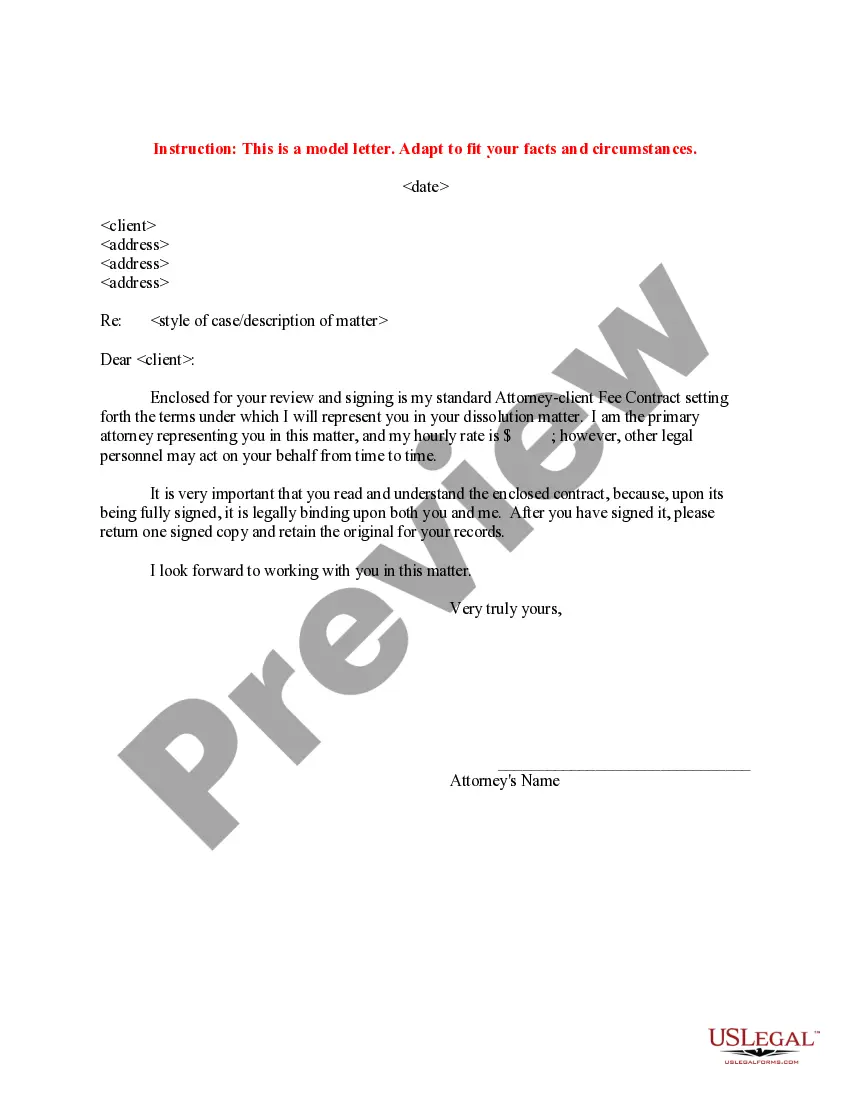
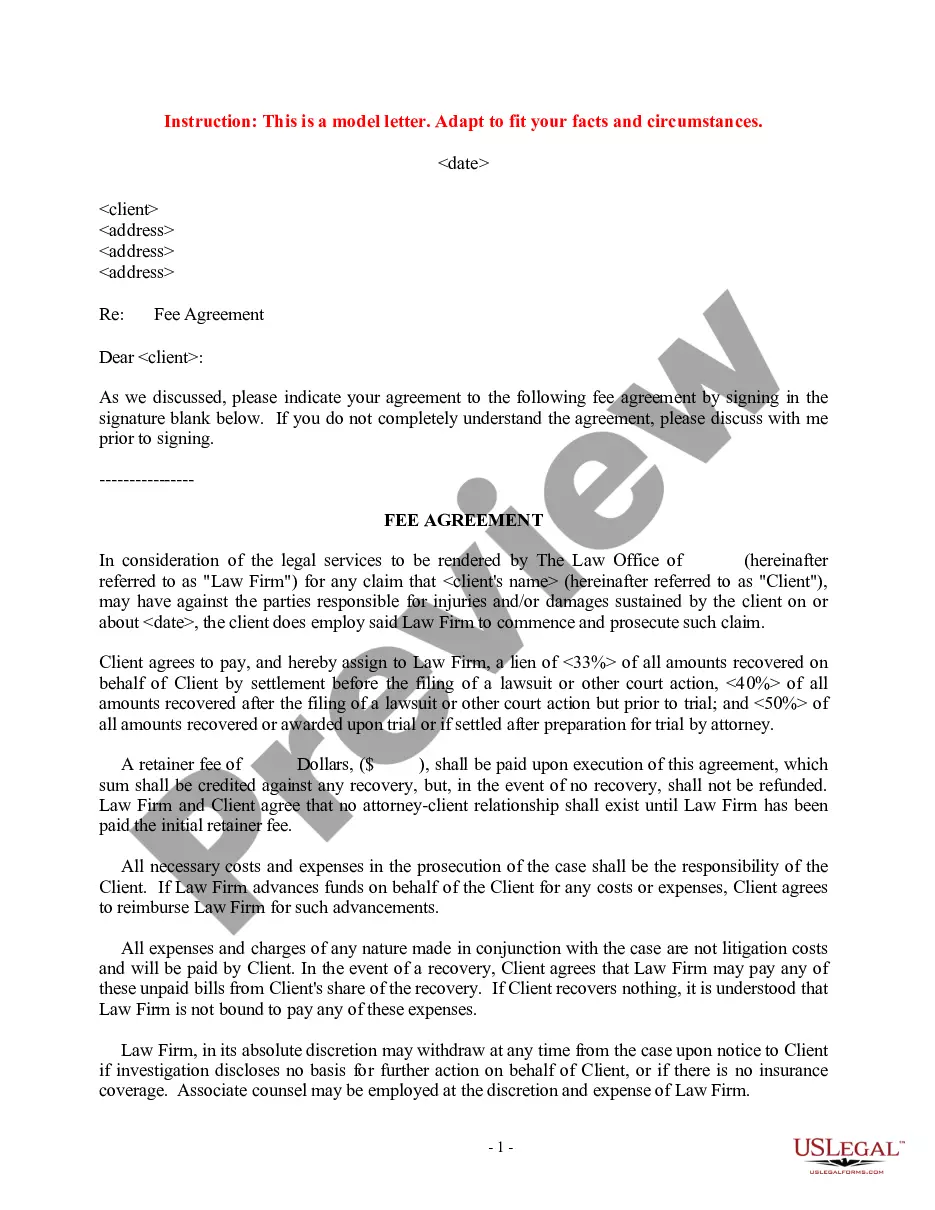
This form is a attorney-client contract agreement based upon a contingency fee. The amount of the contingency fee is left blank and should be filled in by the attorney prior to signing.
Utah Attorney Fee Letter for Personal Injury - Contingency Retainer
Category:
State:
Multi-State
Control #:
US-PI-0001
Format:
Word;
Rich Text
Instant download
This website is not affiliated with any governmental entity
Public form
Description





How to fill out Attorney Fee Letter For Personal Injury - Contingency Retainer?
It is possible to commit hours on the web looking for the authorized papers design that meets the federal and state demands you will need. US Legal Forms provides a huge number of authorized types that are analyzed by experts. You can easily acquire or print the Utah Attorney Fee Letter for Personal Injury - Contingency Retainer from your service.
If you already possess a US Legal Forms bank account, you may log in and then click the Down load button. Following that, you may full, change, print, or indication the Utah Attorney Fee Letter for Personal Injury - Contingency Retainer. Every single authorized papers design you purchase is yours forever. To acquire an additional duplicate for any acquired kind, visit the My Forms tab and then click the related button.
If you use the US Legal Forms website the very first time, stick to the straightforward recommendations below:
- Initially, ensure that you have chosen the best papers design to the state/area of your choice. Browse the kind description to make sure you have chosen the correct kind. If readily available, utilize the Review button to appear with the papers design at the same time.
- If you would like get an additional model from the kind, utilize the Search discipline to discover the design that suits you and demands.
- When you have discovered the design you desire, click Purchase now to proceed.
- Select the prices plan you desire, key in your qualifications, and register for a merchant account on US Legal Forms.
- Total the financial transaction. You should use your credit card or PayPal bank account to fund the authorized kind.
- Select the file format from the papers and acquire it to your device.
- Make modifications to your papers if needed. It is possible to full, change and indication and print Utah Attorney Fee Letter for Personal Injury - Contingency Retainer.
Down load and print a huge number of papers themes making use of the US Legal Forms website, which provides the most important variety of authorized types. Use expert and express-certain themes to take on your organization or person needs.
Form popularity
FAQ
The four types of retainer fees are true, nonrefundable chargeable, nonrefundable nonchargeable, and refundable. A true retainer is used to ensure an attorney's availability. A nonrefundable chargeable retainer is applied to the costs of an attorney's services but is not refundable if it is not used.
A contingent fee agreement is a legal agreement that allows you to hire a lawyer for your case without having to pay any out-of-pocket upfront fees unlike a retainer fee. The lawyer getting payment is contingent on you winning your case. If you do not win your case, you don't have to pay your contingency lawyer.
Contingent fee payment arrangements: With this fee arrangement, an attorney only gets paid if he/she wins a case. The attorney then gets paid a percentage, often between 25-33% of any monetary judgment or settlement.
Contingency Fee. The term ?contingency fee? refers to a type of fee arrangement in a case in which an attorney or firm agrees that the payment of legal fees will be contingent upon the successful outcome of the case.
The term ?contingency fee? refers to a type of fee arrangement in a case in which an attorney or firm agrees that the payment of legal fees will be contingent upon the successful outcome of the case.
This fee can range from 15% to 50%, depending on various circumstances surrounding the case. In most cases, a fee of 33% is established in a contingency agreement in Utah. In addition to the set percentage, victims may be required to pay other fees from the 66% of recoveries which they ultimately receive.
That said, the most common lawyer contingency fee average ends up being 33%, or ? of the total earnings of a case, but can go up to 40% (in some jurisdictions) as the complexity and risk involved in taking the case increases.
A typical contingency fee percentage is anywhere from 30 to 40% of your recovery. Your contingency fee agreement will set out the exact percentage. These percentages are often staggered so that your lawyer will get a higher percentage if the case goes to trial ? which requires more time and work for their law firm.
A retainer fee is an amount of money paid upfront to secure the services of a consultant, freelancer, lawyer, or other professional. A retainer fee is most commonly paid to third parties that the payer has engaged to perform a specific action on their behalf.