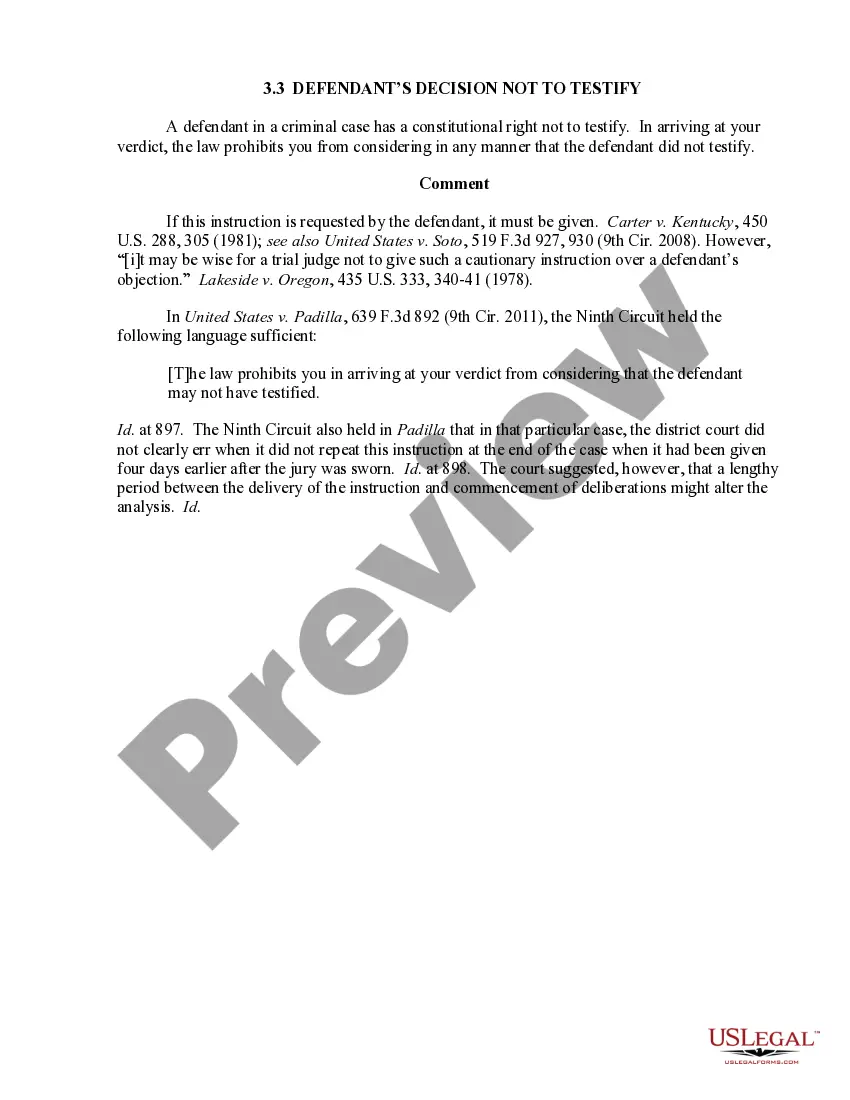
Utah Jury Instructions - Defendant's Failure to Testify
Description
Get your form ready online
Our built-in tools help you complete, sign, share, and store your documents in one place.
Make edits, fill in missing information, and update formatting in US Legal Forms—just like you would in MS Word.
Download a copy, print it, send it by email, or mail it via USPS—whatever works best for your next step.
Sign and collect signatures with our SignNow integration. Send to multiple recipients, set reminders, and more. Go Premium to unlock E-Sign.
If this form requires notarization, complete it online through a secure video call—no need to meet a notary in person or wait for an appointment.
We protect your documents and personal data by following strict security and privacy standards.

Make edits, fill in missing information, and update formatting in US Legal Forms—just like you would in MS Word.

Download a copy, print it, send it by email, or mail it via USPS—whatever works best for your next step.

Sign and collect signatures with our SignNow integration. Send to multiple recipients, set reminders, and more. Go Premium to unlock E-Sign.

If this form requires notarization, complete it online through a secure video call—no need to meet a notary in person or wait for an appointment.

We protect your documents and personal data by following strict security and privacy standards.
Looking for another form?

How to fill out Jury Instructions - Defendant's Failure To Testify?
It is feasible to spend countless hours online looking for the sanctioned document template that fulfills the state and federal requirements you need.
US Legal Forms provides thousands of legal forms that can be examined by specialists.
You can easily download or print the Utah Jury Instructions - Defendant's Failure to Testify from our service.
Avoid altering or removing any HTML tags. Only synonymize plain text outside of the HTML tags.
- If you possess a US Legal Forms account, you can Log In and click the Download button.
- Afterward, you can fill out, modify, print, or sign the Utah Jury Instructions - Defendant's Failure to Testify.
- Each legal document template you acquire is yours indefinitely.
- To obtain another copy of a purchased form, navigate to the My documents tab and click the corresponding button.
- If you are using the US Legal Forms website for the first time, follow the simple instructions provided below.
- First, ensure that you have selected the correct document template for the county/city of your choice.
- Review the form description to confirm you have chosen the right form.
- If available, utilize the Preview button to review the document template as well.
- If you wish to find another version of the form, use the Search area to locate the template that meets your needs and requirements.
- Once you have found the template you want, click Get now to proceed.
- Select the pricing plan you desire, enter your credentials, and register for an account on US Legal Forms.
- Complete the transaction.
- You may use your credit card or PayPal account to pay for the legal form.
- Choose the format of the document and download it to your device.
- Make adjustments to your document if necessary.
- You can fill, modify, sign, and print the Utah Jury Instructions - Defendant's Failure to Testify.
- Download and print thousands of document templates using the US Legal Forms website, which offers the largest selection of legal forms.
- Utilize professional and state-specific templates to address your business or personal needs.
Form popularity
FAQ
If the jury has a reasonable doubt, the defendant must be acquitted.
In a criminal case, the defendant is presumed to be innocent, and before (he)(she) may be found guilty, the People must prove (his)(her) guilt beyond a reasonable doubt. If the jury has a reasonable doubt, the defendant must be acquitted.
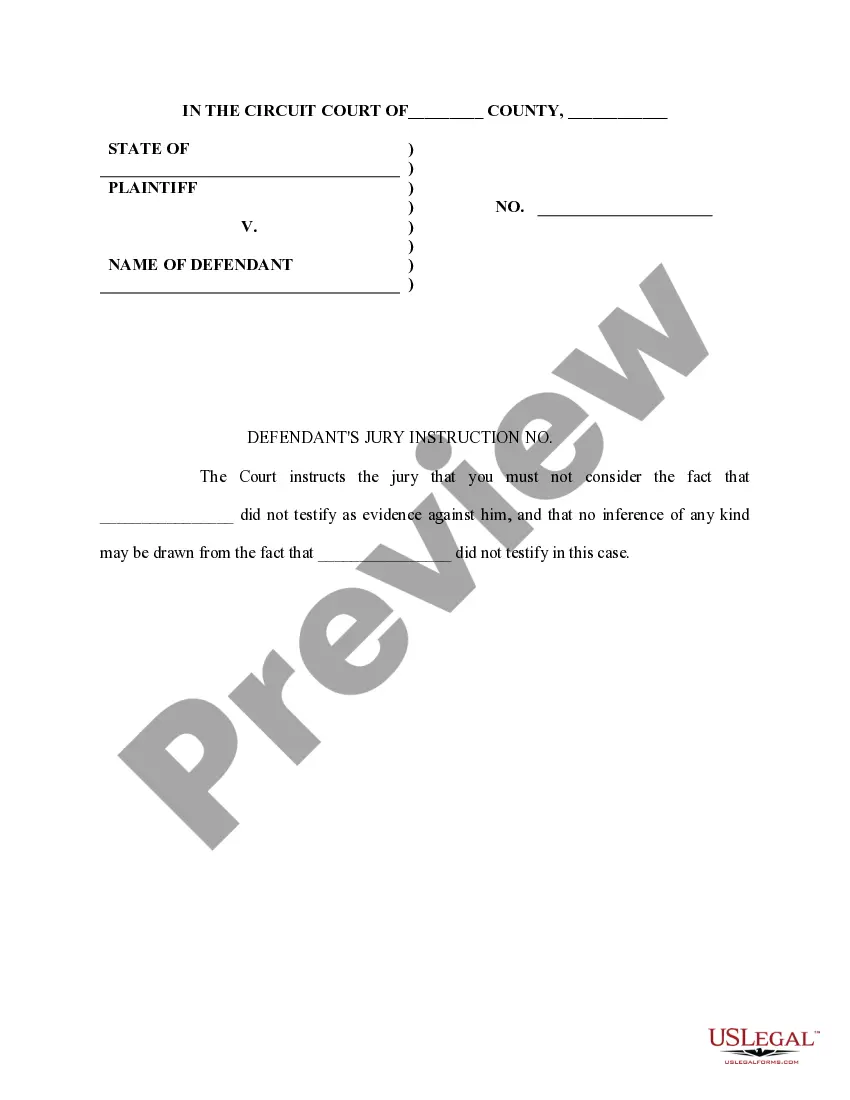
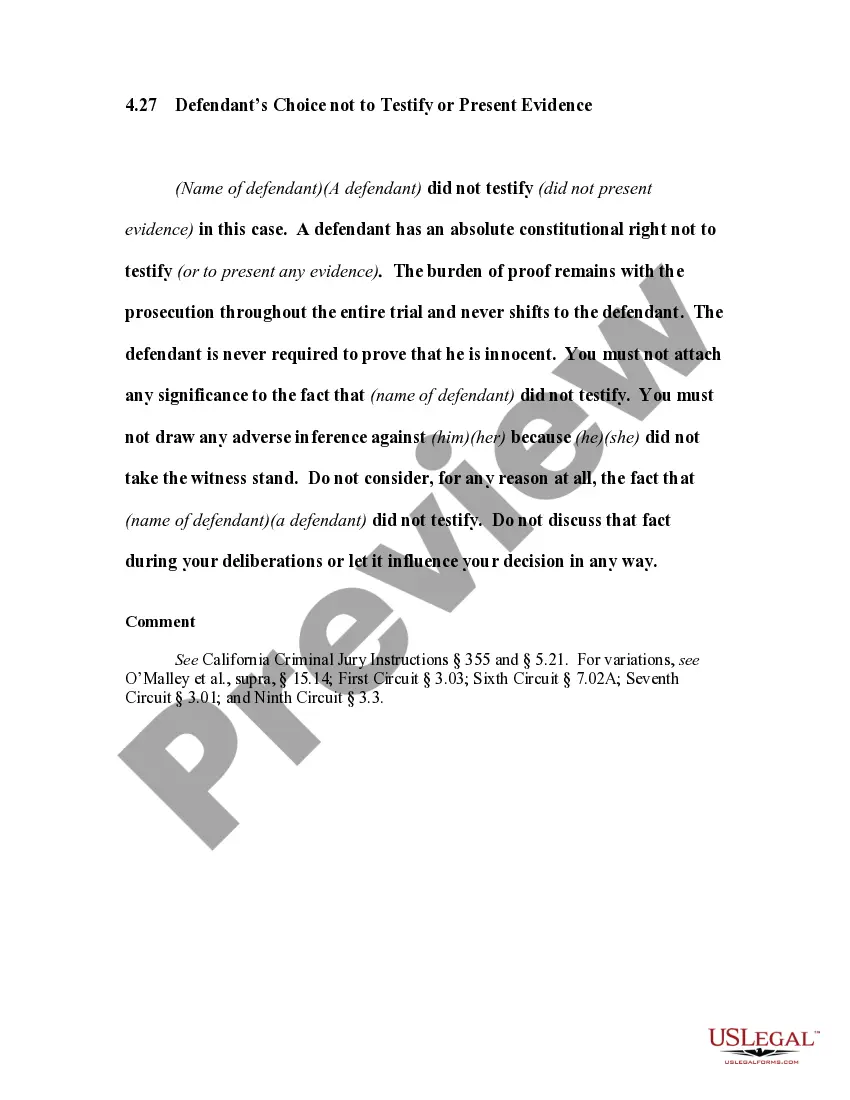
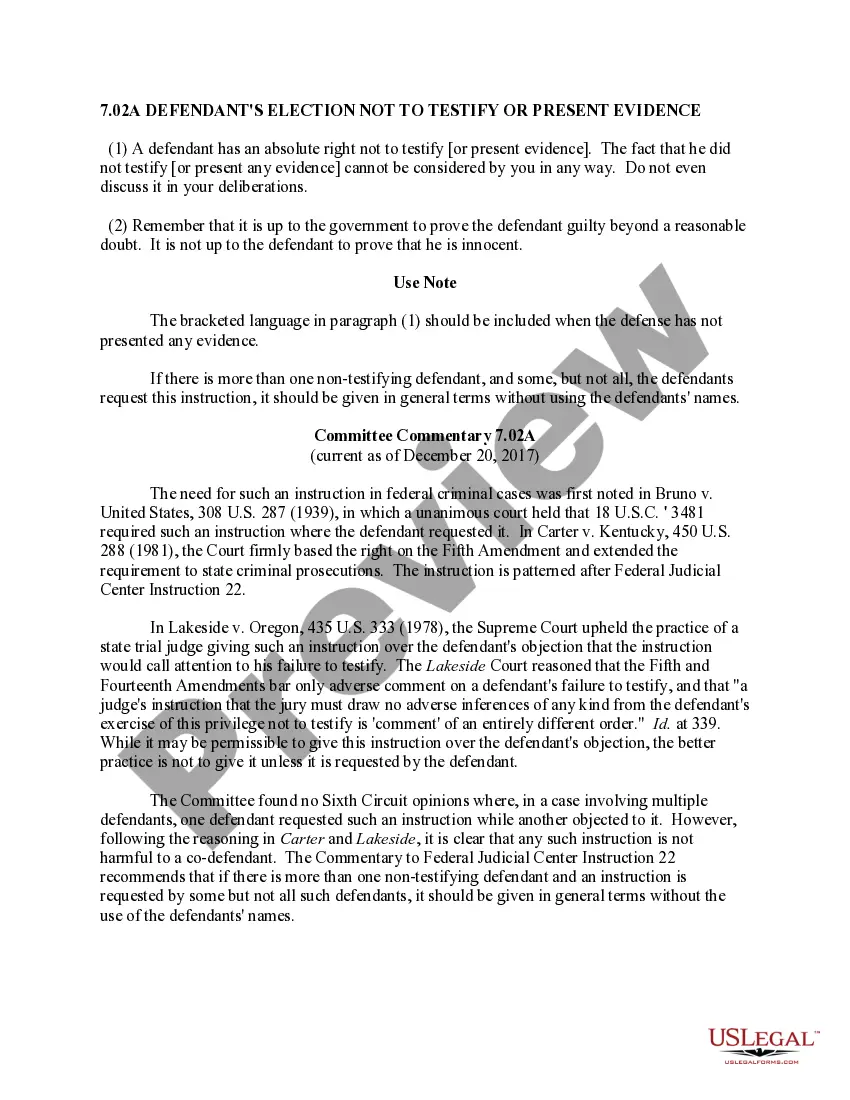
The fact that a defendant did not testify may not be considered by the jury as proof that the defendant committed the crime. The defense may also waive his case.
Everyone is inconvenienced to some degree by jury service, but for the system to work, people from all walks of life must be willing to serve. Those who refuse to complete the juror questionnaire or refuse to appear when called to serve are subject to fines and jail time for contempt of court.
It is the duty of jurors to assess all available evidence and determine if any reasonable person would have any doubts about the defendant's guilt. If the defense can successfully raise sufficient doubt regarding even one element of the alleged crime, the jurors must find the defendant innocent.
Jury nullification occurs when jurors, based on their own sense of justice, refuse to follow the law and acquit a defendant even when the evidence presented seems to point to an incontrovertible verdict of guilty.
It is not required that the government prove guilt beyond all possible doubt. A reasonable doubt is a doubt based upon reason and common sense and is not based purely on speculation. It may arise from a careful and impartial consideration of all the evidence, or from lack of evidence.
This means that the prosecution must convince the jury that there is no other reasonable explanation that can come from the evidence presented at trial. In other words, the jury must be virtually certain of the defendant's guilt in order to render a guilty verdict.