Statement By Applicant Regarding Proprietary Information of Others
Understanding this form
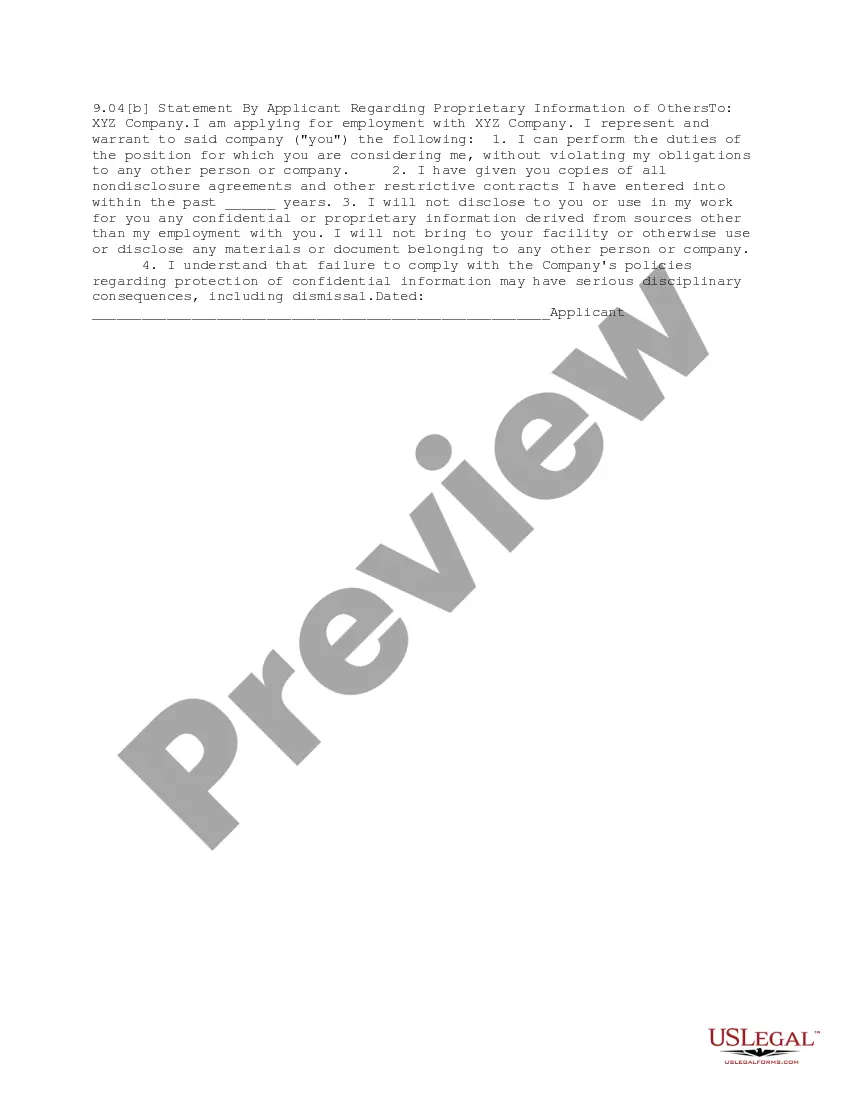
The Statement By Applicant Regarding Proprietary Information of Others is a legal document used by job applicants to affirm that they have disclosed all previous confidentiality and nondisclosure agreements. This form is crucial for ensuring that prospective employees will not use or disclose proprietary information from former employers in their new role, protecting both the applicant and the hiring company from potential legal issues related to intellectual property and confidentiality breaches.
What’s included in this form
- Introduction to the applicant and the intended employer.
- Warranties regarding the ability to fulfill job duties without violating previous obligations.
- Disclosure requirement for copies of all relevant nondisclosure agreements.
- Commitment to not disclose or use any confidential or proprietary information from previous employers.
- Understanding of the consequences of failing to comply with company policies on confidentiality.
Common use cases
This form should be used by job applicants whenever they are applying for a position that may involve access to confidential information or proprietary data. It is particularly important for roles in organizations that prioritize intellectual property protection or have stringent confidentiality policies. Additionally, prospective employees should use this form if they have previously entered into nondisclosure agreements that could affect their new employment.
Who should use this form
- Job applicants seeking positions that involve handling sensitive information.
- Individuals who have signed nondisclosure agreements with previous employers.
- Prospective employees who want to ensure compliance with confidentiality requirements.
- Any applicant interested in protecting themselves and the company from potential legal conflicts regarding proprietary information.
Instructions for completing this form
- Address the form to the intended employer or company.
- Provide your name and state that you are applying for employment.
- State your ability to fulfill the position without violating any prior agreements.
- List all nondisclosure and confidentiality agreements you have signed within a specified time frame.
- Select a date and sign the form, confirming your understanding of the company's policies.
Is notarization required?
This form does not typically require notarization unless specified by local law. However, it is crucial to ensure that all statements are accurate and that the document is signed appropriately to maintain its legal validity.
Get your form ready online
Our built-in tools help you complete, sign, share, and store your documents in one place.
Make edits, fill in missing information, and update formatting in US Legal Forms—just like you would in MS Word.
Download a copy, print it, send it by email, or mail it via USPS—whatever works best for your next step.
Sign and collect signatures with our SignNow integration. Send to multiple recipients, set reminders, and more. Go Premium to unlock E-Sign.
If this form requires notarization, complete it online through a secure video call—no need to meet a notary in person or wait for an appointment.
We protect your documents and personal data by following strict security and privacy standards.

Make edits, fill in missing information, and update formatting in US Legal Forms—just like you would in MS Word.

Download a copy, print it, send it by email, or mail it via USPS—whatever works best for your next step.

Sign and collect signatures with our SignNow integration. Send to multiple recipients, set reminders, and more. Go Premium to unlock E-Sign.

If this form requires notarization, complete it online through a secure video call—no need to meet a notary in person or wait for an appointment.

We protect your documents and personal data by following strict security and privacy standards.
Avoid these common issues
- Failing to disclose all previous nondisclosure agreements.
- Not providing accurate dates for past agreements.
- Overlooking the importance of fully understanding confidentiality obligations.
- Incorrectly signing the document without reviewing all sections.
Advantages of online completion
- Convenient access to a legally vetted template without needing to create one from scratch.
- Easy editing capabilities to ensure your details are accurate.
- Peace of mind knowing that the form was drafted by licensed attorneys to meet legal standards.
- Accessible from anywhere, allowing you to complete the form at your convenience.
- The form serves as a formal declaration of the applicant's compliance to protect the company's proprietary information.
- It may serve as a defense for employers if a legal dispute arises regarding confidentiality breaches.
- Non-compliance may result in employment termination based on company policy.
Summary of main points
- This form safeguards both the applicant and the employer from potential legal conflicts regarding proprietary information.
- Transparency about past nondisclosure agreements is essential for a smooth hiring process.
- Completing the form accurately is critical to avoid misunderstandings about confidentiality obligations.
Looking for another form?
Form popularity
FAQ
If you own something, especially something of value, then you have proprietary rights. The word is most often used in relation to new inventions or patents. Proprietary refers to property: things that are owned by individuals or businesses.A proprietary claim is usually protected by trademark or copyright.
Is proprietary/privileged information included in the application? This field is required. Patentable ideas; trade secrets; or privileged, confidential commercial, or financial information should be included in applications only when such information is necessary to convey an understanding of the proposed project.
Proprietary information, also known as a trade secret, is information a company wishes to keep confidential. Proprietary information can include secret formulas, processes, and methods used in production.
Proprietary information, also known as a trade secret, is information a company wishes to keep confidential. Proprietary information can include secret formulas, processes, and methods used in production.
Use a standard format for contracts. Decide what type of confidentiality statement you should use. Identify the involved parties in the agreement. Define the information to keep confidential. List the information excluded from the agreement.
Also, each line or paragraph containing proprietary information should be marked with a statement such as: The following contains proprietary/privileged information that (name of applicant) requests not be released to persons outside the Government, except for purposes of review and evaluation. Alternatively,
To label a document as confidential, ensure the cursor is at the top of the body of the document. Select Insert > Quick Part > Auto Text and select your saved "Confidential Label".
Grant applications are considered confidential, but federal grant applications constitute publications when a notice of award is issued, which may limit or destroy foreign patent rights.
Proprietary Information shall include, but not be limited to, domain names, trade secrets, copyrights, ideas, techniques, know-how, inventions (whether patentable or not), and/or any other information of any type relating to designs, configurations, toolings, documentation, recorded data, schematics, circuits, mask