Indemnity and Hold Harmless Affidavit for Use with Prior Survey on Commercial Propery
About this form
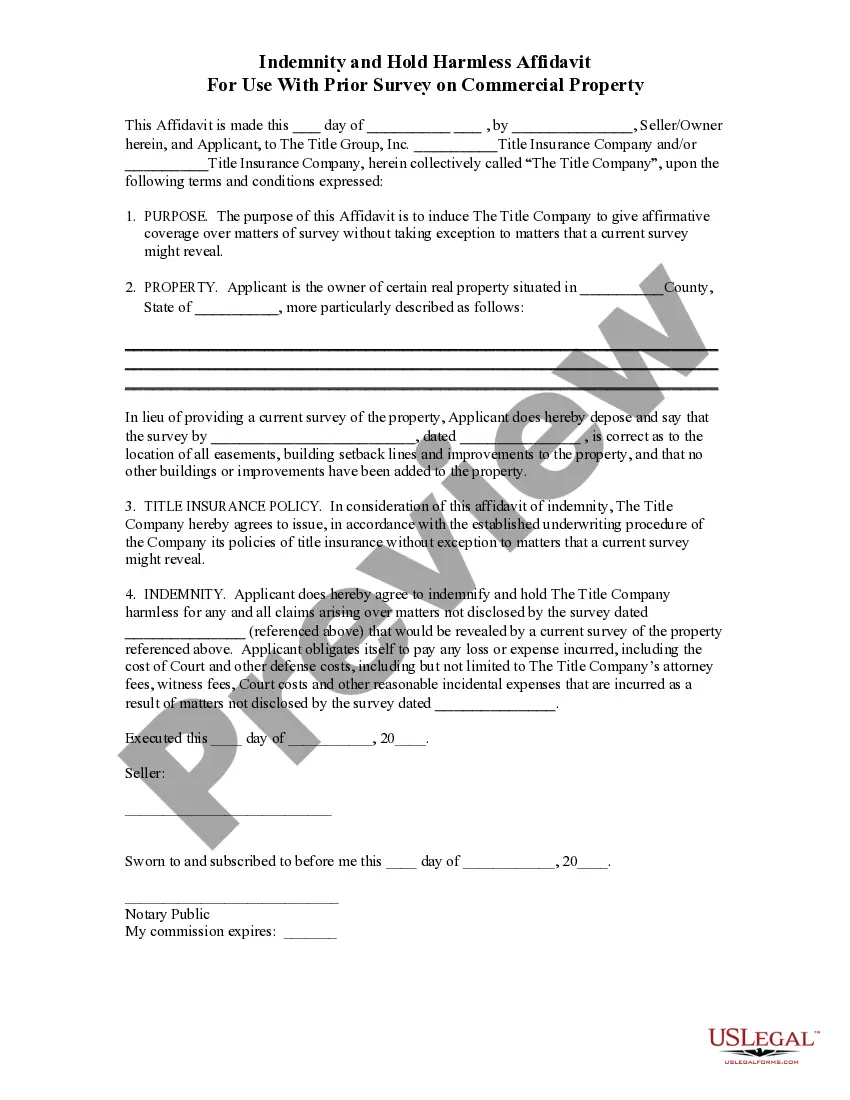
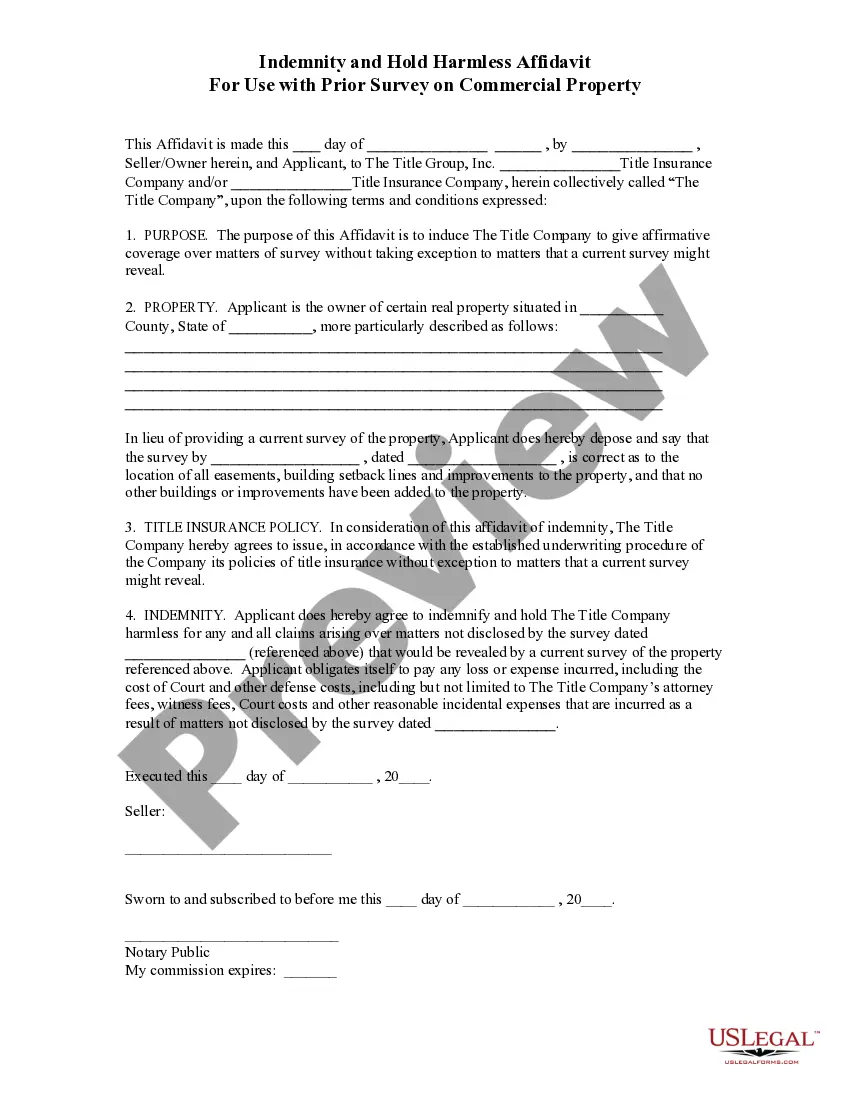
The Indemnity and Hold Harmless Affidavit for Use with Prior Survey on Commercial Property is a legal document that helps property owners secure title insurance without providing a new survey. By using this affidavit, the seller affirms the accuracy of a prior survey, enabling the title company to issue insurance without exceptions based on a current survey's findings. This form is particularly beneficial for commercial property transactions where a recent survey is not available or necessary.
Key components of this form
- Purpose: Induces the title company to issue insurance coverage over survey matters.
- Property Description: Specifies the location and details of the property in question.
- Title Insurance Policy: Details the insurance agreement without exceptions based on a current survey.
- Indemnity Clause: Obliges the applicant to cover any claims arising from undisclosed matters that may be revealed by a current survey.
- Execution: Requires signatures of the seller and notarization to validate the affidavit.
Situations where this form applies
This form is typically used in commercial property transactions where the seller does not have a current survey available. It is essential in situations where the seller is relying on a prior survey to affirm the propertyâs boundaries and existing easements. By utilizing this affidavit, property owners can streamline the title insurance process without the need for new surveys, which can be time-consuming and costly.
Who this form is for
- Commercial property owners needing to secure title insurance without a current survey.
- Sellers intending to confirm the accuracy of a previous survey.
- Real estate agents and title companies involved in commercial property transactions.
Steps to complete this form
- Identify the seller/owner by entering their name and the date at the top of the form.
- Specify the property details, including county and state, in the provided section.
- Enter information about the prior survey, including the surveyor's name and date.
- Review and fill in the indemnity clause to reflect any claims that may arise.
- Have the seller sign the affidavit and find a notary public for the required notarization.
Is notarization required?
Yes, this form must be notarized to be legally valid. The affidavit requires the seller's signature in the presence of a notary public. US Legal Forms offers integrated online notarization services, allowing you to complete the notarization via a secure video call at any time.
Get your form ready online
Our built-in tools help you complete, sign, share, and store your documents in one place.
Make edits, fill in missing information, and update formatting in US Legal Forms—just like you would in MS Word.
Download a copy, print it, send it by email, or mail it via USPS—whatever works best for your next step.
Sign and collect signatures with our SignNow integration. Send to multiple recipients, set reminders, and more. Go Premium to unlock E-Sign.
If this form requires notarization, complete it online through a secure video call—no need to meet a notary in person or wait for an appointment.
We protect your documents and personal data by following strict security and privacy standards.

Make edits, fill in missing information, and update formatting in US Legal Forms—just like you would in MS Word.

Download a copy, print it, send it by email, or mail it via USPS—whatever works best for your next step.

Sign and collect signatures with our SignNow integration. Send to multiple recipients, set reminders, and more. Go Premium to unlock E-Sign.

If this form requires notarization, complete it online through a secure video call—no need to meet a notary in person or wait for an appointment.

We protect your documents and personal data by following strict security and privacy standards.
Common mistakes to avoid
- Failing to accurately describe the property details, which can lead to legal issues.
- Not signing the document or skipping notarization, making the affidavit invalid.
- Providing incorrect information regarding the prior survey, leading to coverage problems.
Advantages of online completion
- Convenient access to legal forms that can be easily downloaded and filled out at your pace.
- Editable templates that can be tailored to specific property and transaction details.
- Guidance from licensed attorneys, ensuring the affidavit complies with legal standards.
Looking for another form?


Form popularity
FAQ
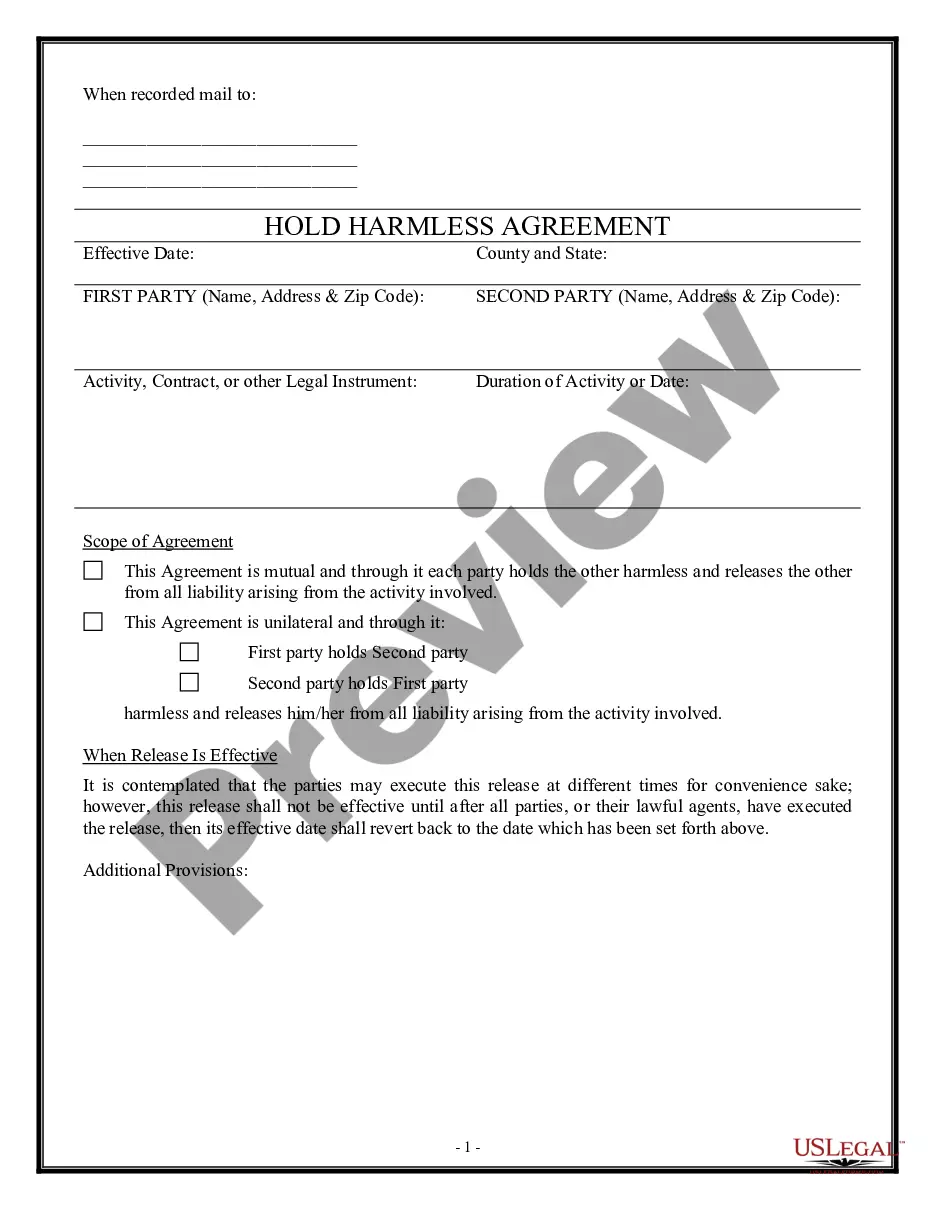
Three basic types of Hold Harmless Agreements are used: limited, intermediate, and broad. These forms are often seen in contracts in the construction industry.
The name of the person held harmless or protected, with their address. The name of the other party to the agreement, with their address. Details about the activity or event the agreement is about, such as horseback riding or country club membership. Details about the location and who's holding the activity or event.
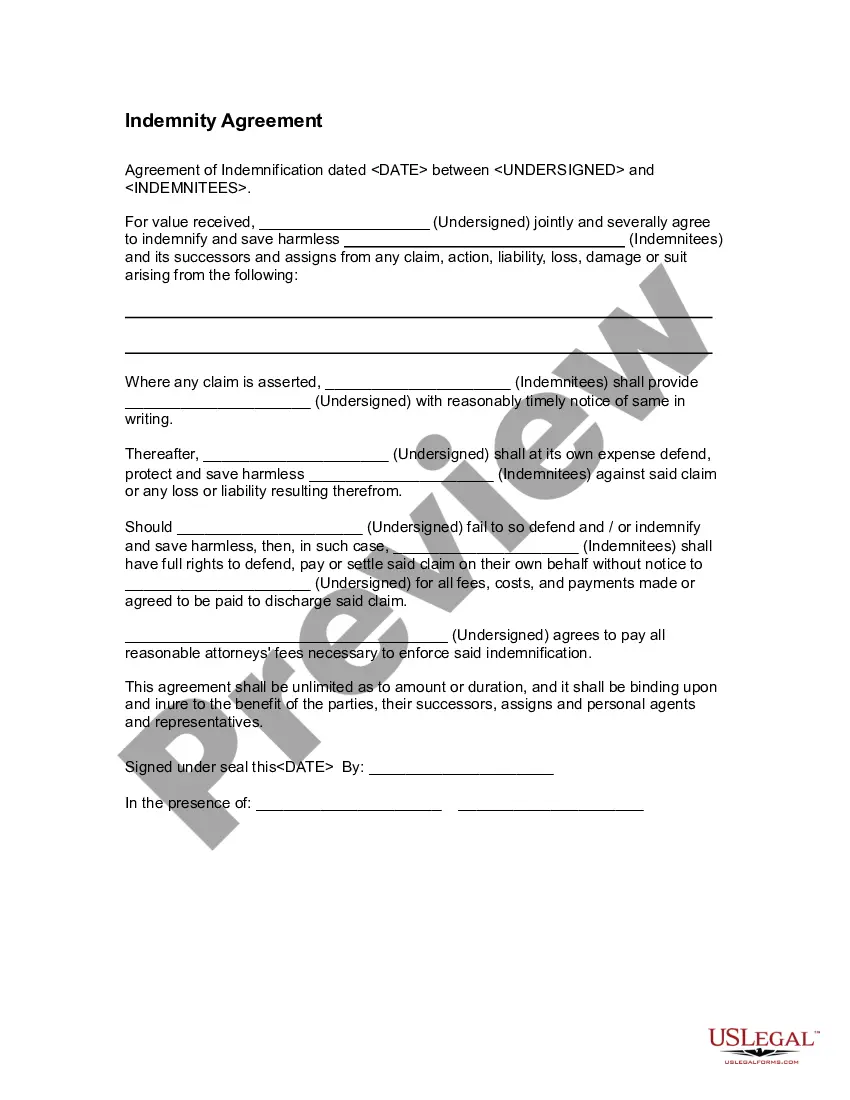
The Contractor shall defend, indemnify and hold the County, its officers, officials, employees and volunteers harmless from any and all claims, injuries, damages, losses or suits including attorney fees, arising out of or in connection with the performance of this Agreement, except for injuries and damages caused by
Hold harmless is defined as a promise in a contract, by one party not to hold the other party responsible if the other party carries out the contract in a way that causes damage to the first party.
What is an Indemnification And Hold Harmless Agreement? An indemnification and hold harmless agreement is an agreement that limits the liability of one or more parties to a contract. This agreement is used to establish protection from liabilities, losses, claims, or damages for one or both of the parties.
A hold harmless clause is also called a release of liability, a waiver of liability, a save harmless clause, or a hold harmless letter or release.
The prevailing interpretation is that ?hold harmless? and ?indemnify? are synonymous. However, under the minority view, ?hold harmless? requires payment of both actual losses and potential liabilities, while ?indemnify? protects against incurred losses only.
An apartment lease may have a hold harmless clause stating that the landlord is not responsible for any damage caused by the tenant. A homeowner hiring a roofer might request a hold harmless agreement to protect against a lawsuit if the roofer falls off the roof.