Clauses Relating to Defaults, Default Remedies
About this form
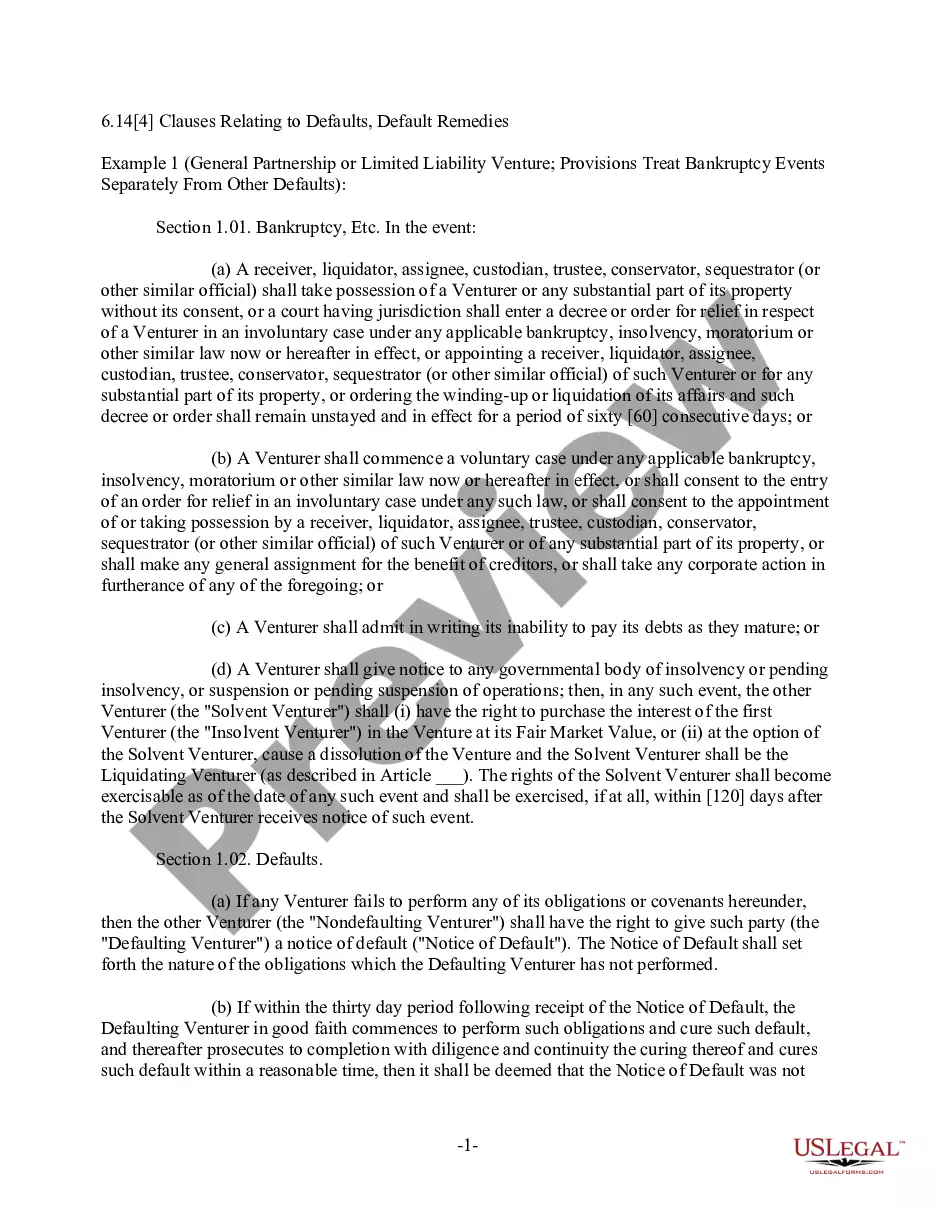
The Clauses Relating to Defaults and Default Remedies form is a legal document designed to outline the procedures and rights of partners in a business venture regarding defaults. This form is particularly useful in partnership agreements, helping to define actions and remedies in case one of the partners fails to meet their obligations. It differs from other partnership forms by specifically addressing bankruptcy events and other defaults, providing clear guidelines for remedying such situations. Utilizing this form can streamline the legal process, saving time and expenses associated with drafting bespoke solutions.
Form components explained
- Section 1.01 outlines the rights of the solvent partner in the event of a bankruptcy or insolvency of another partner.
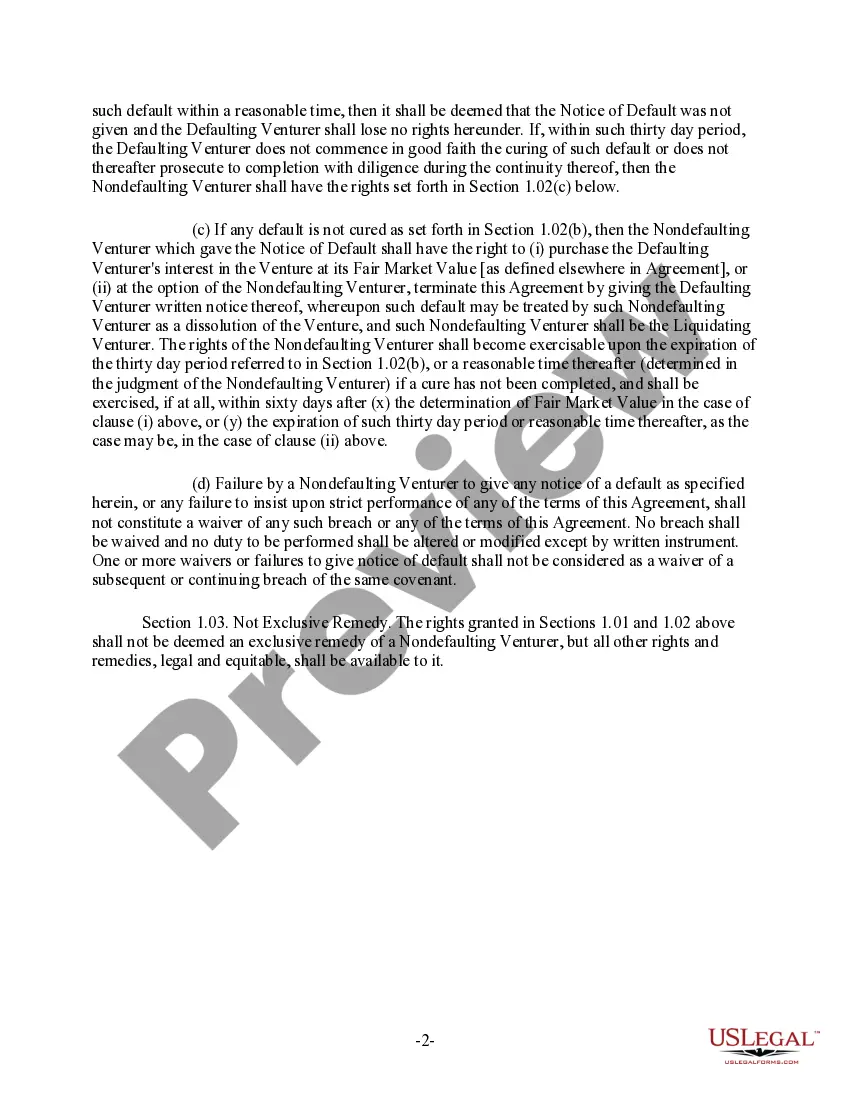
- Section 1.02 describes the process for managing defaults, including notification and the time frame for remedying a default.
- Section 1.02 specifies the rights of the nondefaulting partner following an unremedied default, including the options to purchase the defaulting partner's interest or terminate the agreement.
- Section 1.03 clarifies that the remedies listed are not exclusive, allowing for other legal remedies available to the nondefaulting partner.
When to use this document
This form is beneficial when entering into a partnership agreement that requires clear procedures for handling defaults, including bankruptcy or insolvency. It should be used when partners want to protect their interests and establish fair responses to defaults that may occur within their business relationship. Consider using this form before significant investments or when financial stability is a concern among partners.
Who can use this document
- Business partners involved in general partnerships or limited liability ventures.
- Lawyers and legal professionals drafting partnership agreements.
- Entrepreneurs seeking to clearly define responsibilities and remedies related to defaults.
- Individuals who are considering partnerships and want to preemptively address potential legal issues related to defaults.
Completing this form step by step
- Identify all parties involved in the partnership.
- Define the obligations and covenants of each partner.
- Detail the scenarios that would constitute a default, including bankruptcy and failure to perform obligations.
- Specify notice requirements for defaults and the timeline for remedying issues.
- Include clauses that outline the procedures for resolving defaults and the rights of the nondefaulting partner.
Is notarization required?
This form does not typically require notarization unless specified by local law. However, having it notarized may provide an added layer of verification for the signatures involved.
Get your form ready online
Our built-in tools help you complete, sign, share, and store your documents in one place.
Make edits, fill in missing information, and update formatting in US Legal Forms—just like you would in MS Word.
Download a copy, print it, send it by email, or mail it via USPS—whatever works best for your next step.
Sign and collect signatures with our SignNow integration. Send to multiple recipients, set reminders, and more. Go Premium to unlock E-Sign.
If this form requires notarization, complete it online through a secure video call—no need to meet a notary in person or wait for an appointment.
We protect your documents and personal data by following strict security and privacy standards.

Make edits, fill in missing information, and update formatting in US Legal Forms—just like you would in MS Word.

Download a copy, print it, send it by email, or mail it via USPS—whatever works best for your next step.

Sign and collect signatures with our SignNow integration. Send to multiple recipients, set reminders, and more. Go Premium to unlock E-Sign.

If this form requires notarization, complete it online through a secure video call—no need to meet a notary in person or wait for an appointment.

We protect your documents and personal data by following strict security and privacy standards.
Mistakes to watch out for
- Failing to clearly define what constitutes a default, which can lead to disputes.
- Not providing adequate notice requirements, making it difficult to enforce remedies.
- Overlooking to specify time frames for remedying defaults, which can prolong issues unnecessarily.
- Neglecting to consult legal advice for jurisdiction-specific adaptations of the form.
Why complete this form online
- Convenience of instant access to customizable templates.
- Editability allows users to tailor the form to their specific partnership needs.
- Reliability of attorney-drafted materials ensures legal compliance and validity.
Legal use & context
- The form allows partners to outline their rights and responsibilities clearly, which can enhance enforceability in disputes.
- It serves as a reference in potential bankruptcy or default situations, helping to mitigate risks in partnerships.
- Incorporating this form into a partnership agreement can reduce ambiguity and help maintain good relations among partners during challenging times.
What to keep in mind
- The Clauses Relating to Defaults and Default Remedies form clarifies partnersâ rights and obligations regarding defaults.
- It is essential for ensuring a fair and legally sound partnership agreement.
- Consult state-specific regulations to ensure compliance and adaptation of the form.
Looking for another form?
Form popularity
FAQ
Equitable relief, also referred to as an equitable remedy, is a type of court-ordered relief for an aggrieved party that is used when ordinary legal remedies such as awarding damages are considered inadequate justice for the suffering party.
Monetary awards (called damages), specific performance, and restitution are the three principle remedies.
Repudiation. If the other party breaches a condition of the contract, you may be able to 'repudiate' the contract to terminate it and claim damages for your loss - or to 'affirm' the contract and claim damages. Damages. Specific Performance.
Equitable defenses are usually affirmative defenses asking the court to excuse an act because the party bringing the cause of action has acted in some inequitable way.
A decree of specific performance is one of the most important equitable remedies. It is a court order directed to someone who is party to a contract to instruct them to perform their obligations under the contract.
The party who is injured by the breach of contract may bring an action of breach of contract either by remedy of specific performance or the damages available such as general or liquidated damages, nominal damage (no loss situation), compensatory, punitive and specific.
A legal remedy, also referred to as judicial relief or a judicial remedy, is the means with which a court of law, usually in the exercise of civil law jurisdiction, enforces a right, imposes a penalty, or makes another court order to impose its will in order to compensate for the harm of a wrongful act inflicted upon
A remedies clause sets forth the parties' intention to provide for equitable remedies for breach of contract, in addition to or instead of just monetary relief. A remedies clause can also be used to limit the relief the parties can obtain upon breach of the contract.
There are three types of equitable remedies: specific performance, injunction, and restitution.