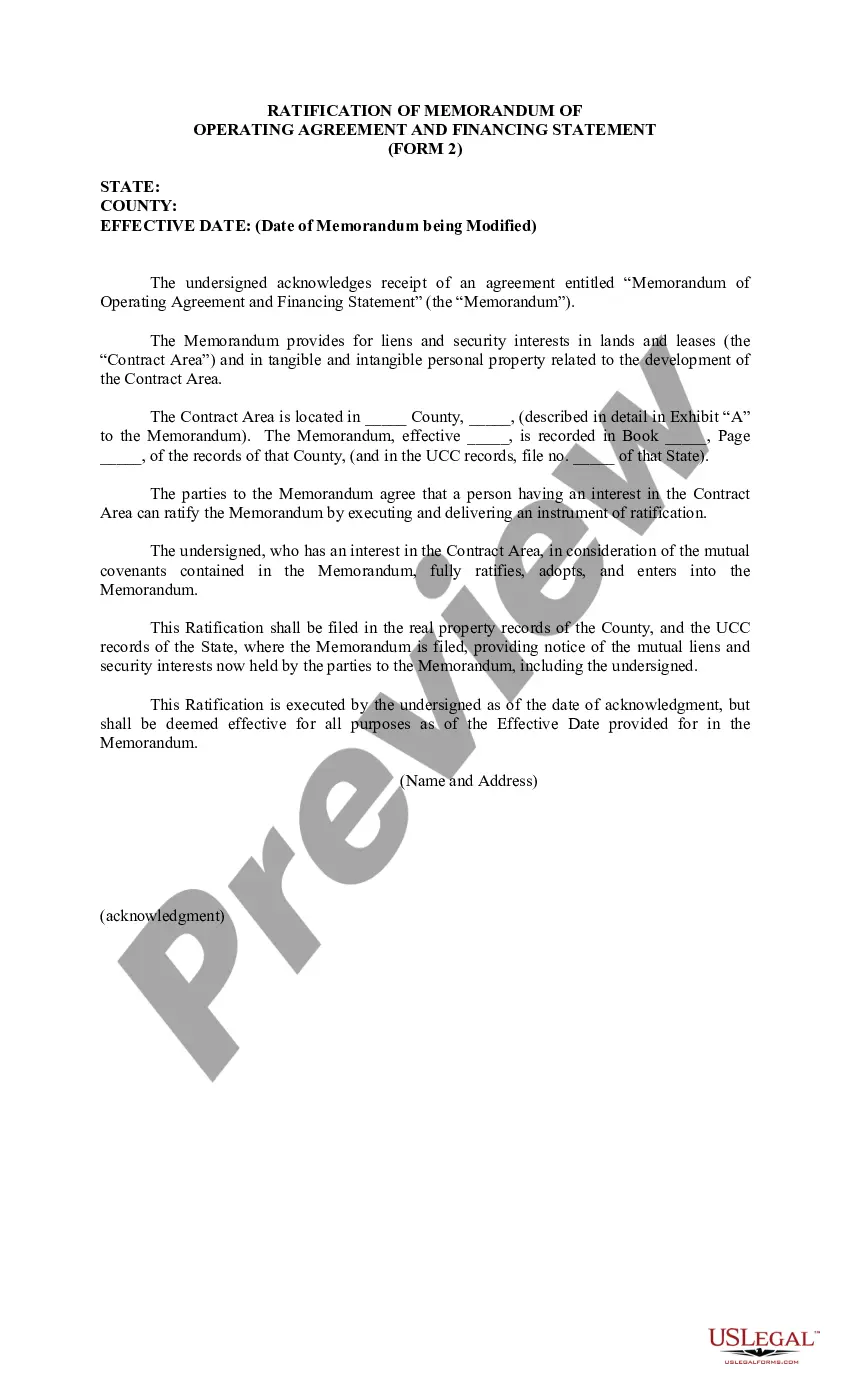
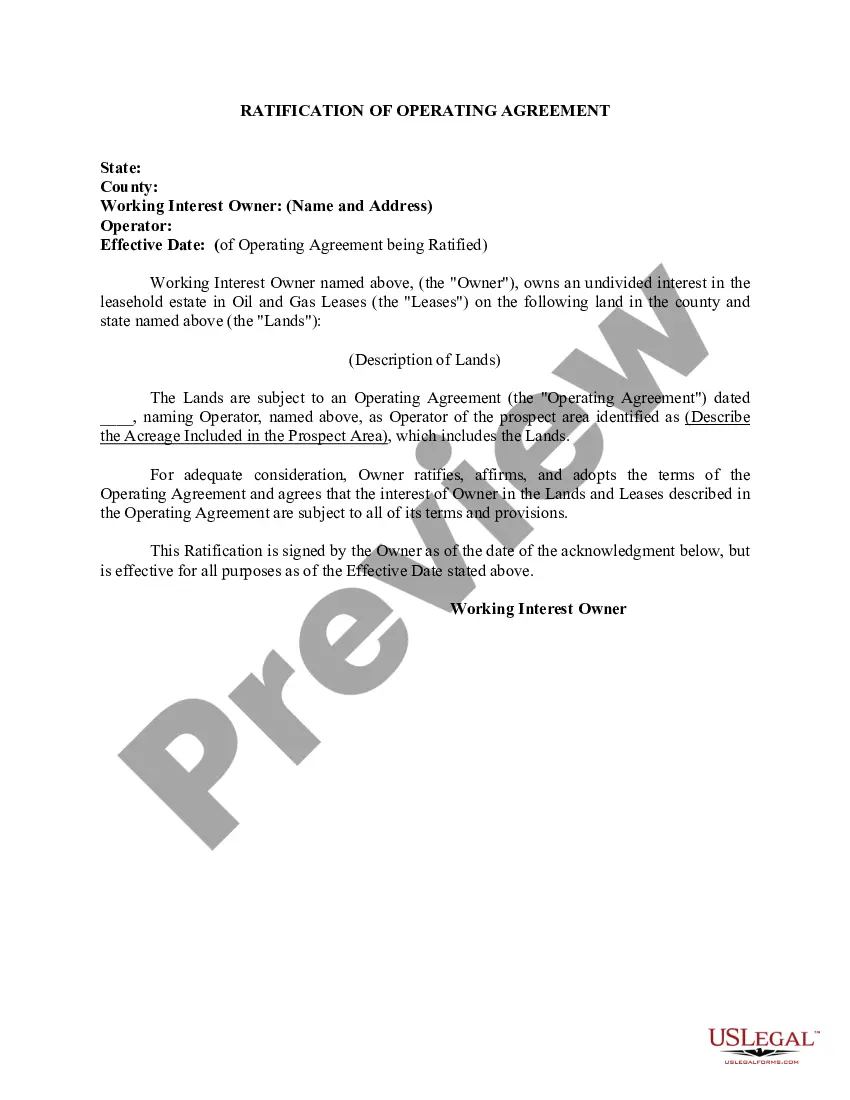
Ratification of Memorandum of Operating Agreement and Financing Statement - Form 2
What this document covers
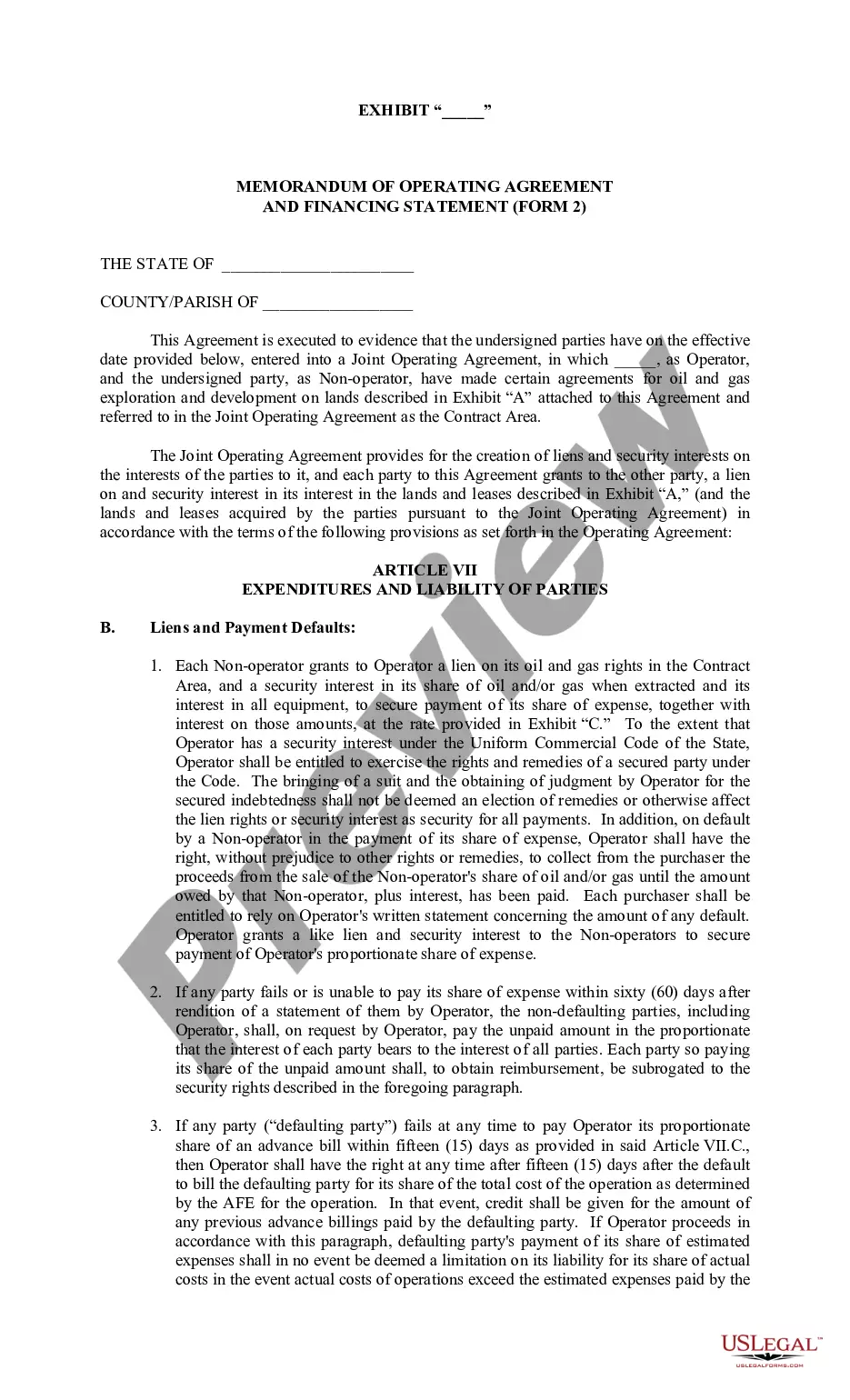
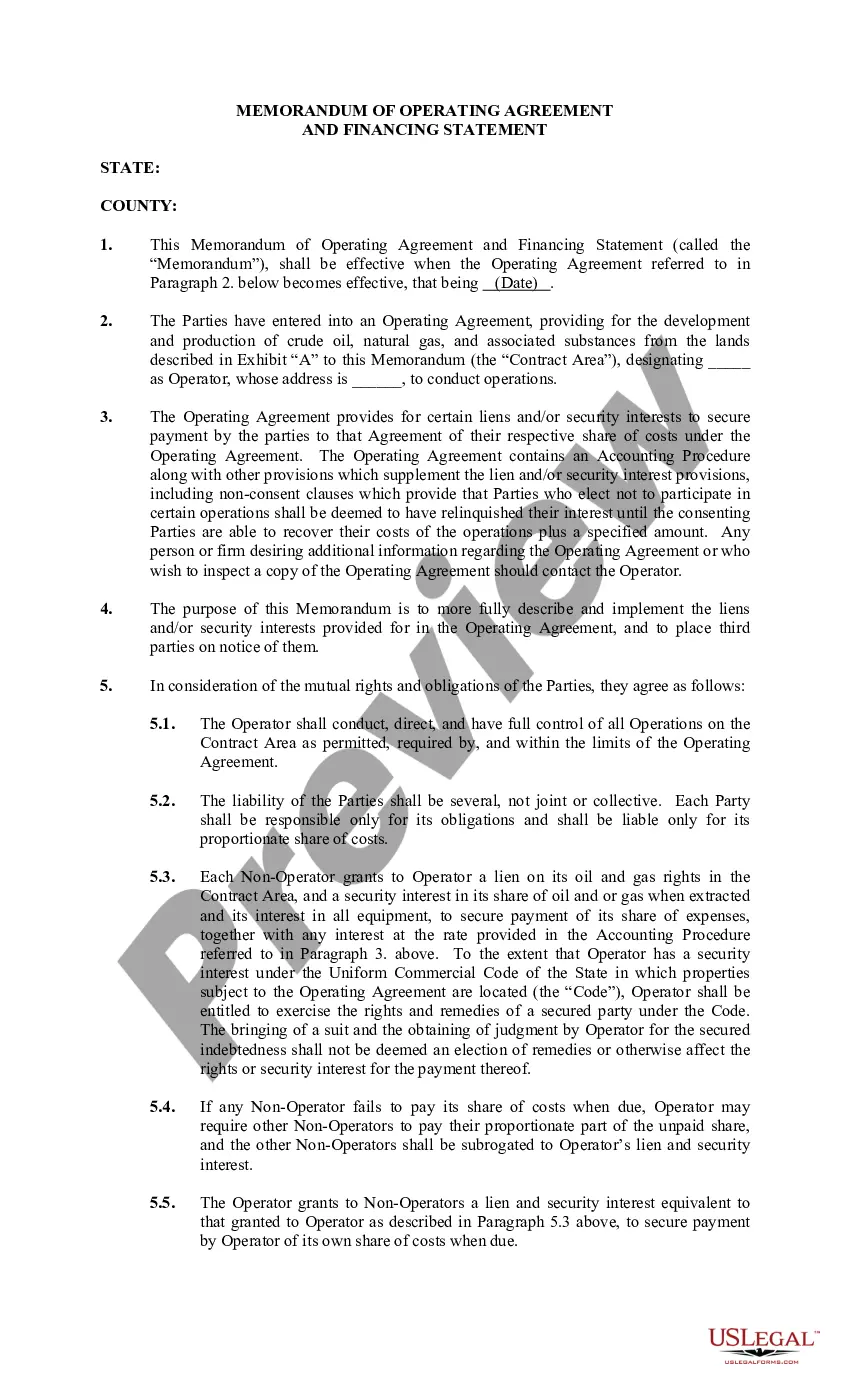
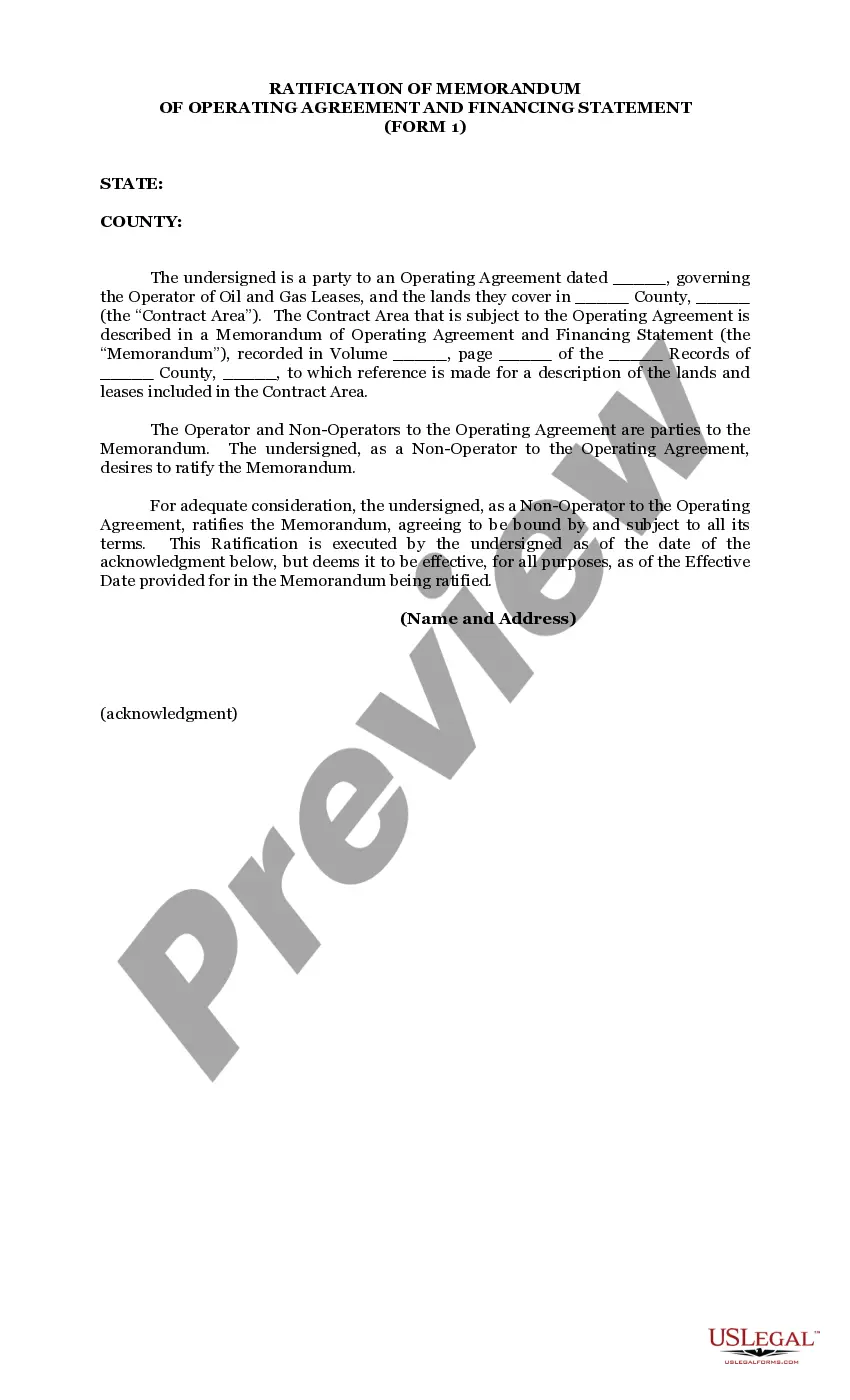
The Ratification of Memorandum of Operating Agreement and Financing Statement (Form 2) is a legal document that allows parties with an interest in a contractual area to formally adopt and ratify an existing memorandum. This form clarifies the responsibilities of the parties involved regarding the escrow of funds related to drilling activities, making it distinct from other agreements by focusing on financial obligations and the handling of escrow money.
What’s included in this form
- Identification of the First Party and Second Party.
- Details of the Operating Agreement and escrow deposit conditions.
- Investment guidelines for escrow funds managed by the Escrow Agent.
- Procedures for disbursement of escrow funds for billing statements.
- Provisions for the return of unspent escrow funds and interest.
- Liabilities and indemnities for the Escrow Agent.
When this form is needed
This form should be used when two parties are involved in an Operating Agreement where escrow funds are necessary for drilling projects. It is particularly relevant when an agreement exists, but one or both parties need to ratify their participation officially, ensuring clarity regarding deposits and fund management.
Who this form is for
- Individuals or entities involved in an Operating Agreement for drilling projects.
- Parties who wish to formalize their commitment to a memorandum related to a contract area.
- Escrow Agents managing funds for drilling activities who need clear guidelines.
How to complete this form
- Identify and enter the names of the First Party and Second Party.
- Specify the date of the Operating Agreement and the amount to be deposited into escrow.
- Detail the responsibilities of the Escrow Agent regarding fund management and disbursement.
- Include any election to participate in completion attempts and the associated deadlines for funds.
- Ensure both parties sign and date the form accurately before submission.
Does this document require notarization?
Notarization is generally not required for this form. However, certain states or situations might demand it. You can complete notarization online through US Legal Forms, powered by Notarize, using a verified video call available anytime.
Get your form ready online
Our built-in tools help you complete, sign, share, and store your documents in one place.
Make edits, fill in missing information, and update formatting in US Legal Forms—just like you would in MS Word.
Download a copy, print it, send it by email, or mail it via USPS—whatever works best for your next step.
Sign and collect signatures with our SignNow integration. Send to multiple recipients, set reminders, and more. Go Premium to unlock E-Sign.
If this form requires notarization, complete it online through a secure video call—no need to meet a notary in person or wait for an appointment.
We protect your documents and personal data by following strict security and privacy standards.

Make edits, fill in missing information, and update formatting in US Legal Forms—just like you would in MS Word.

Download a copy, print it, send it by email, or mail it via USPS—whatever works best for your next step.

Sign and collect signatures with our SignNow integration. Send to multiple recipients, set reminders, and more. Go Premium to unlock E-Sign.

If this form requires notarization, complete it online through a secure video call—no need to meet a notary in person or wait for an appointment.

We protect your documents and personal data by following strict security and privacy standards.
Avoid these common issues
- Failing to clearly identify the parties involved.
- Not entering accurate dates and amounts, which can lead to legal disputes.
- Overlooking signatures; both parties must sign the form for it to be binding.
- Neglecting to check for specific state requirements that may alter the form.
Why use this form online
- Easy access to downloadable templates that save time.
- Editability allows customization to fit specific needs without legal jargon.
- Reliability of forms drafted by licensed attorneys ensures legal compliance.
Legal use & context
- This form ratifies an existing agreement, providing legal standing to both parties.
- Clarifies financial obligations associated with drilling agreements.
- Used commonly in the energy sector where contracts and escrow arrangements are standard.
What to keep in mind
- The Ratification of Memorandum of Operating Agreement and Financing Statement is essential for parties involved in drilling agreements.
- Completing the form accurately promotes clear expectations regarding the handling of escrow funds.
- Understanding the specific requirements of your jurisdiction can prevent legal complications.
Looking for another form?
Form popularity
FAQ
To confirm by expressing consent, approval, or formal sanction: to ratify a constitutional amendment. to confirm (something done or arranged by an agent or by representatives) by such action.
Definition from Nolo's Plain-English Law Dictionary Approval or confirmation of a previous contract or other act that would not otherwise be binding in the absence of such approval.
To approve and give formal sanction to; confirm. The Senate ratified the treaty. When all the delegates sign a constitution, this is an example of a situation where they ratify the constitution.
: the act or process of ratifying something (such as a treaty or amendment) : formal confirmation or sanction Slavery officially ended in New Jersey in 1804, but in practice some people remained slaves until 1865, when the ratification of the 13th Amendment formally abolished slavery in the United States.
Look over the agreement and make sure you understand the terms and conditions. If you ratify one part of the contract, you have to ratify the entire agreement. Make an express or implied declaration that you accept the terms. Continue honoring the terms of the contract as normal.
Ratification is the official way to confirm something, usually by vote. It is the formal validation of a proposed law. We almost never use the word ratification except to talk about process by which proposed laws, treaties, and agreements are officially recognized.
Ratification is a principal's approval of an act of its agent that lacked the authority to bind the principal legally. Ratification defines the international act in which a state indicates its consent to be bound to a treaty if the parties intended to show their consent by such an act.
Ratification is a principal's approval of an act of its agent that lacked the authority to bind the principal legally. Ratification defines the international act in which a state indicates its consent to be bound to a treaty if the parties intended to show their consent by such an act.