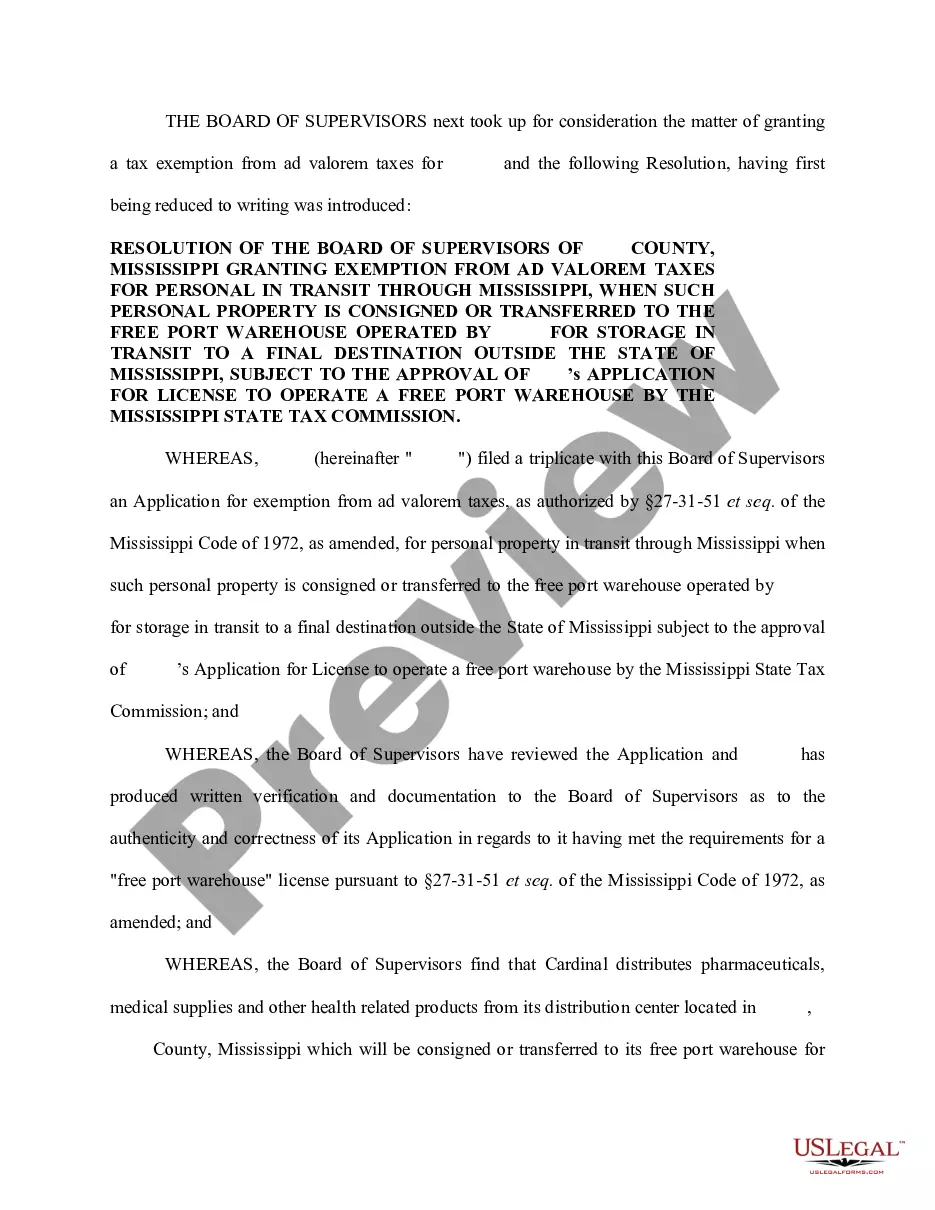
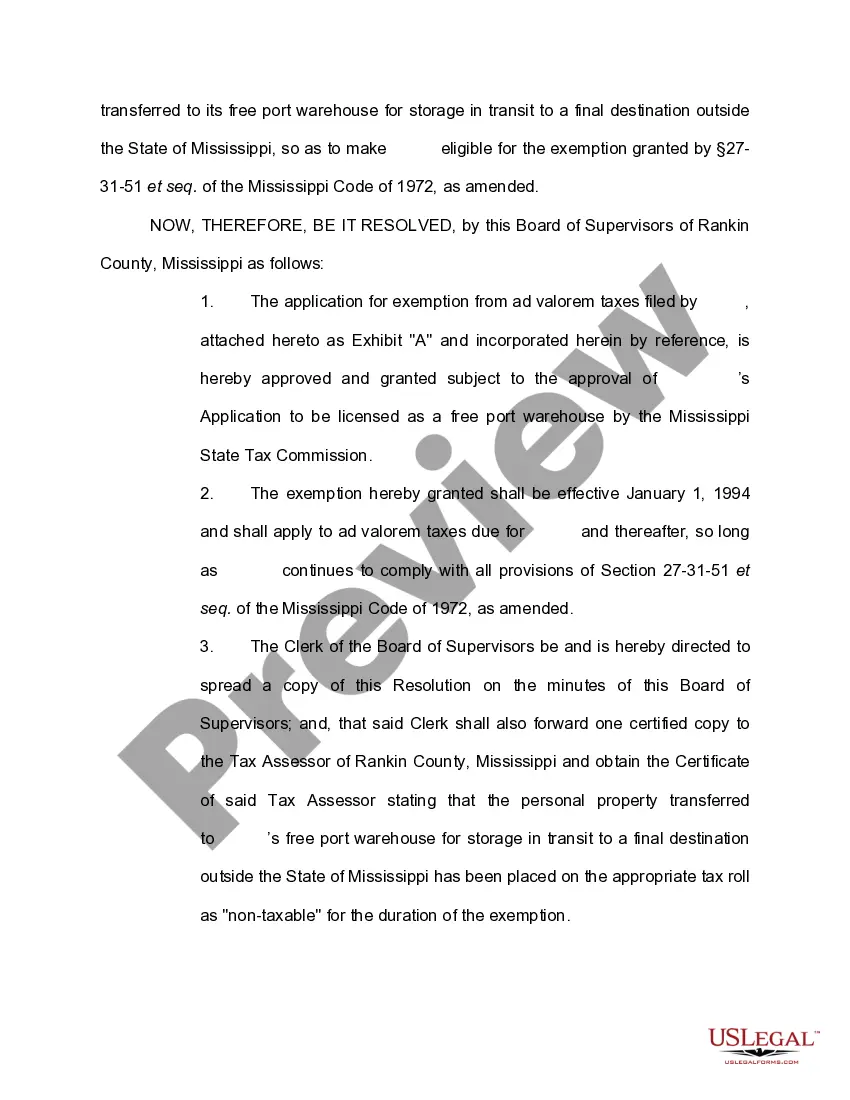
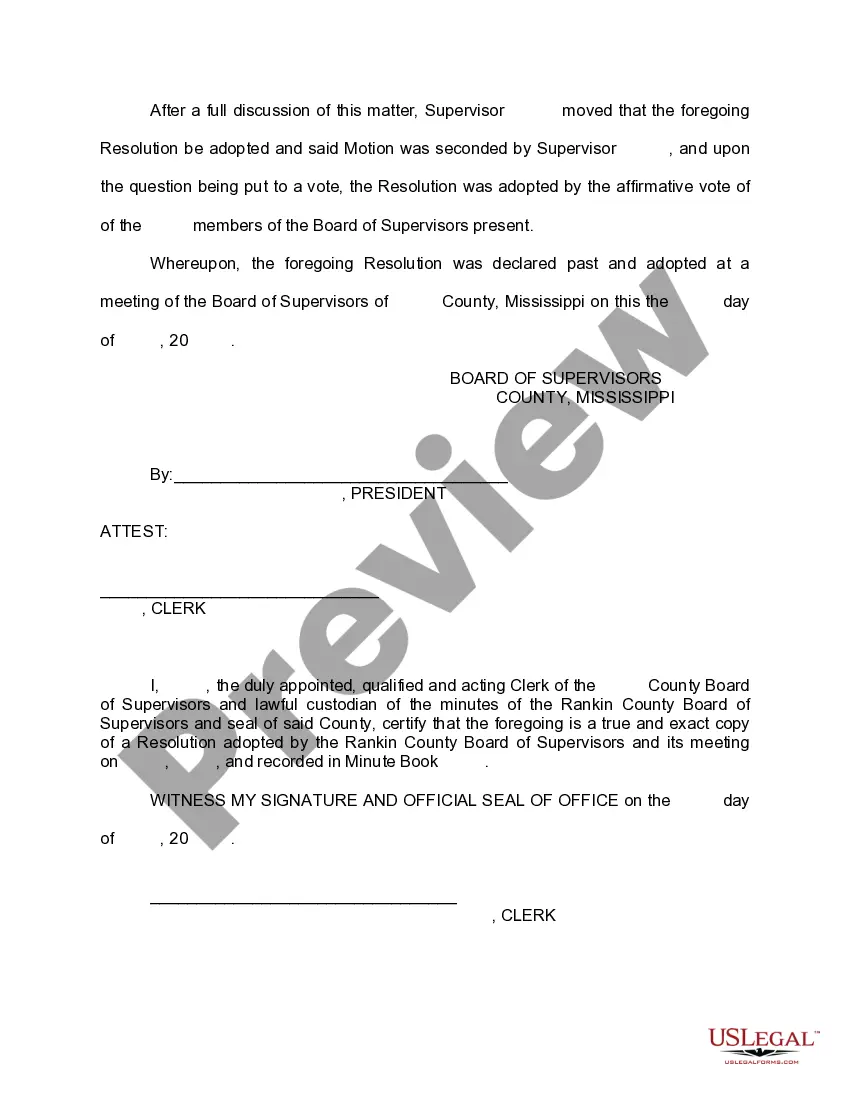
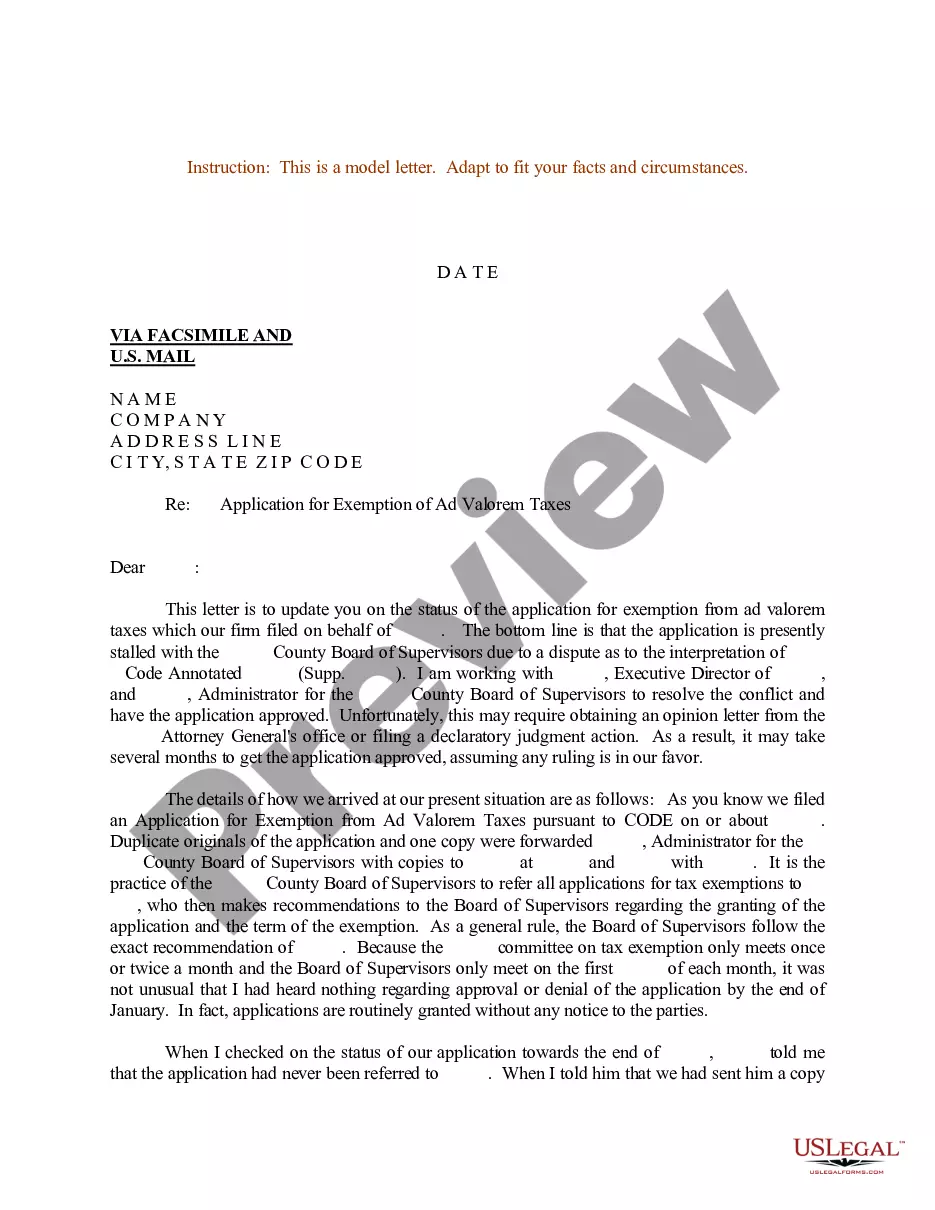
Mississippi Resolution of the Board of Supervisors Granting Exemption from Ad Valorem Taxes
What is this form?
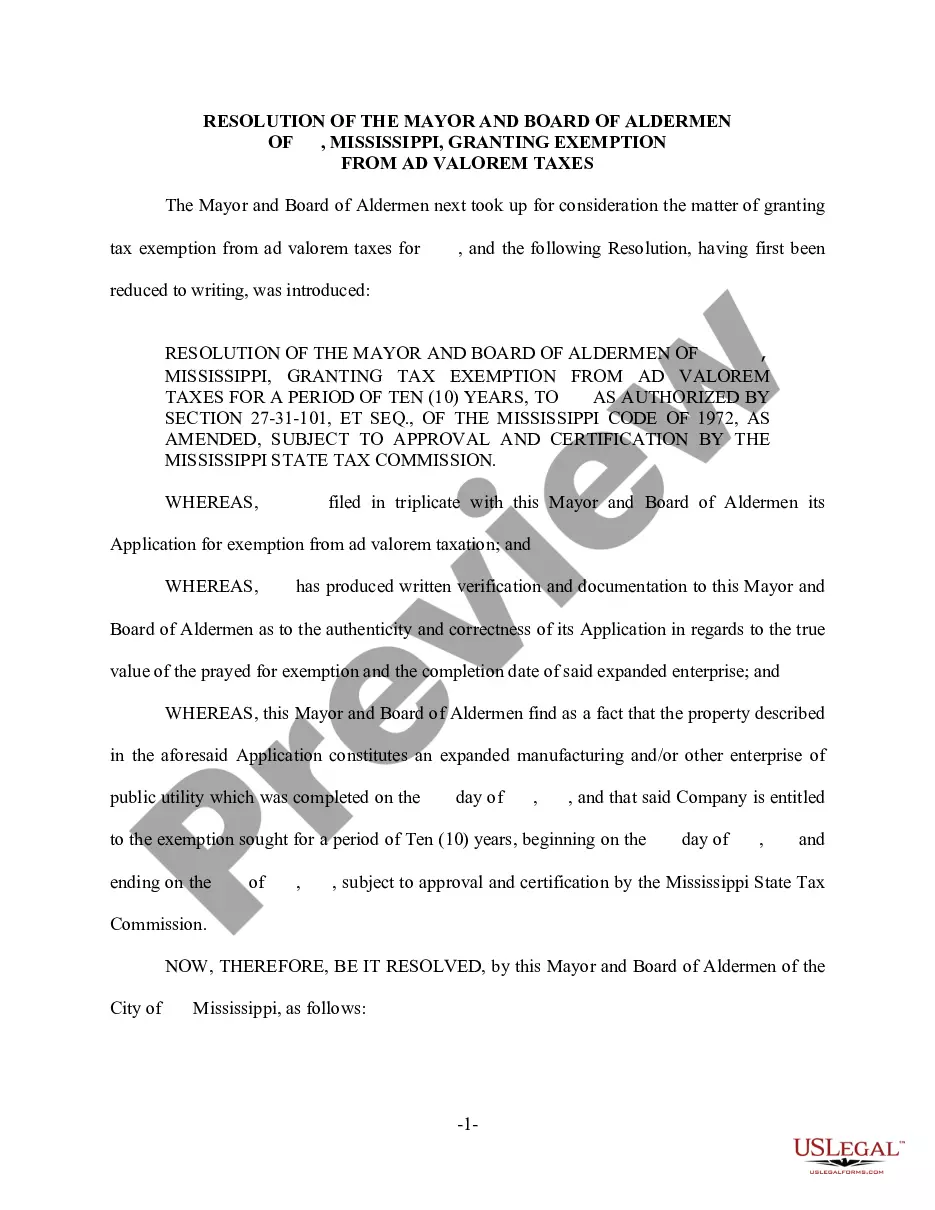
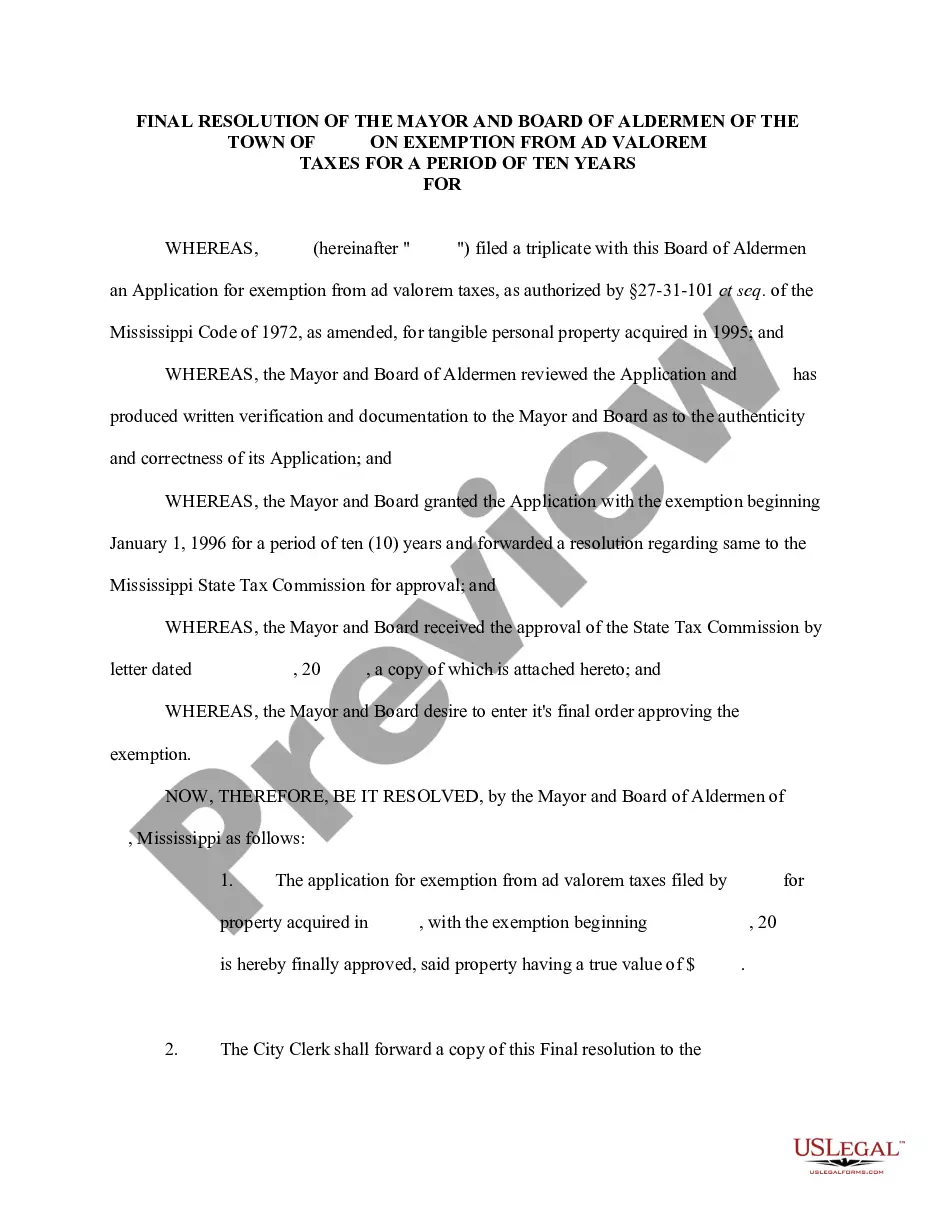
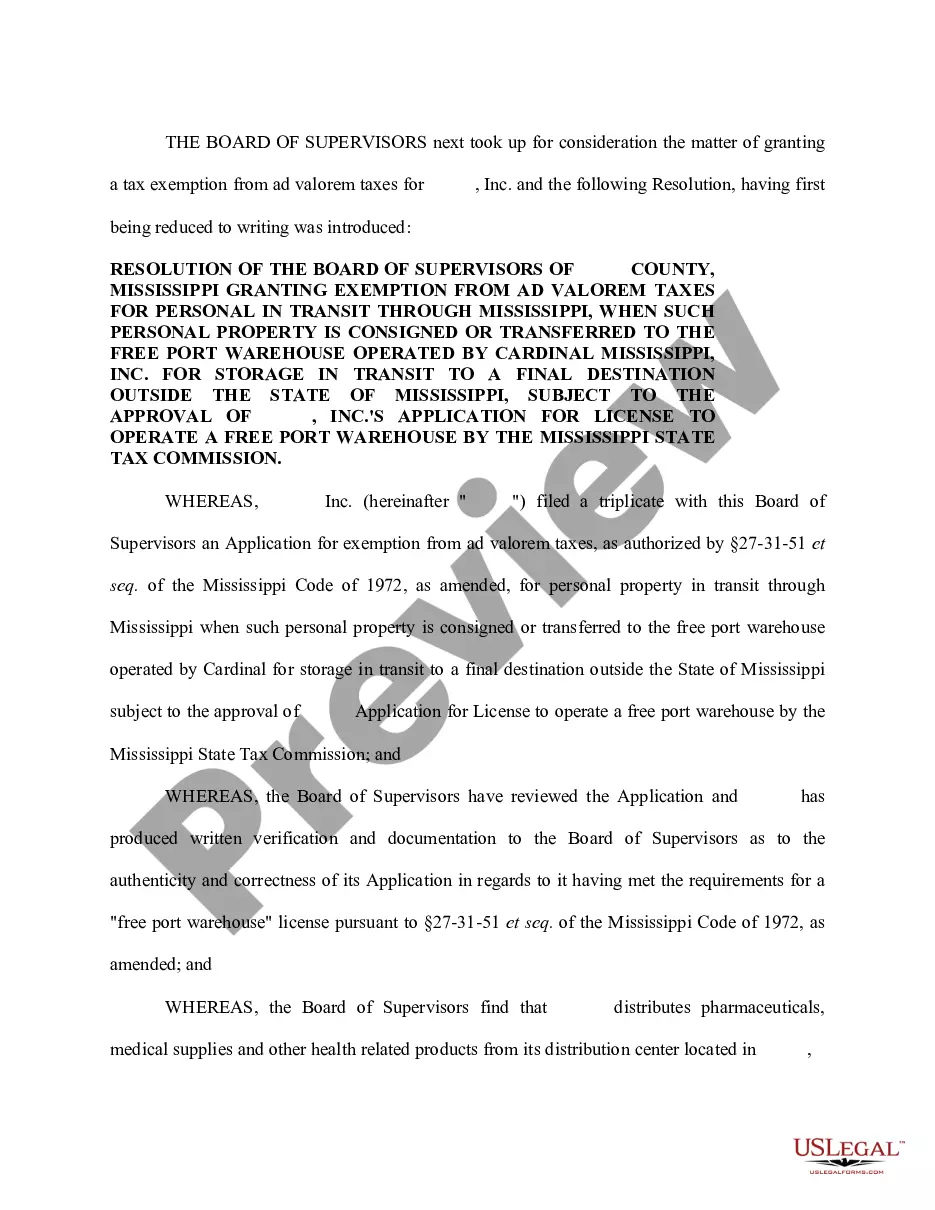
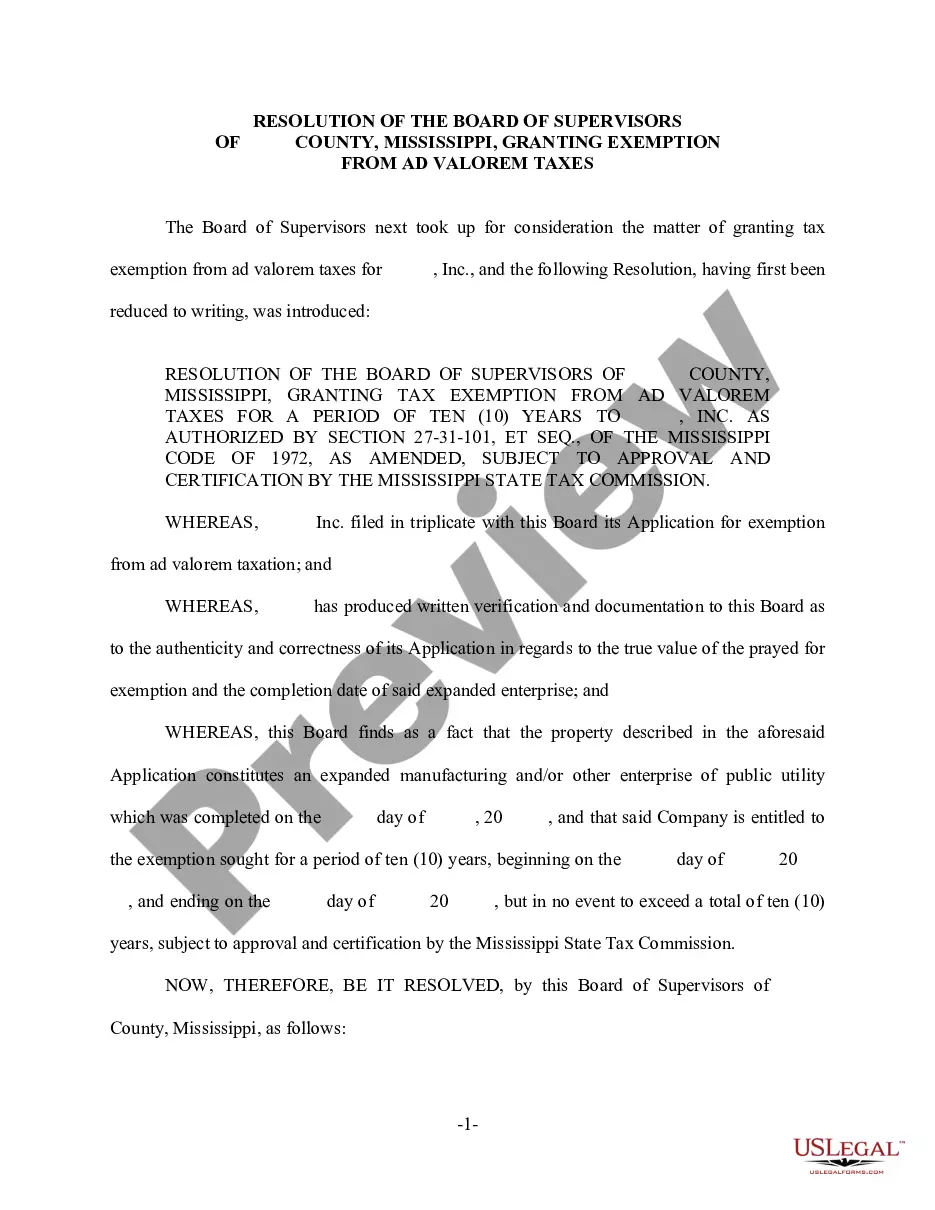
The Resolution of the Board of Supervisors Granting Exemption from Ad Valorem Taxes is a legal document that allows designated entities to be exempt from paying ad valorem taxes for a period of ten years. This resolution is approved by both the local Mayor and the Mississippi State Tax Commission, making it a formal legal process. It differs from other tax-related forms by specifically addressing exemptions granted by a county's governing body.
Key components of this form
- Title of the resolution and date
- Identification of the Board of Supervisors
- Statement of exemption from ad valorem taxes
- Duration of the exemption (ten years)
- Signatures of the Mayor and Board of Aldermen
- Approval from the Mississippi State Tax Commission
When to use this form
This resolution should be used when a county's Board of Supervisors decides to grant a tax exemption to encourage economic development or support specific entities within the county. It is often employed in situations involving businesses or industries that meet certain criteria, such as investments in infrastructure or job creation in the community.
Who needs this form
- County officials, including members of the Board of Supervisors
- Local government representatives looking to grant tax exemptions
- Business owners or developers seeking tax relief on their properties
- Advisors or consultants involved in local government processes
Steps to complete this form
- Enter the title of the resolution and date of passage.
- Clearly identify the Board of Supervisors and the county involved.
- State the specific exemption granted from ad valorem taxes.
- Specify the duration, confirming a ten-year period.
- Gather the necessary signatures from the Mayor and Board of Aldermen.
- Submit the completed resolution to the Mississippi State Tax Commission for approval.
Does this document require notarization?
Notarization is not commonly needed for this form. However, certain documents or local rules may make it necessary. Our notarization service, powered by Notarize, allows you to finalize it securely online anytime, day or night.
Get your form ready online
Our built-in tools help you complete, sign, share, and store your documents in one place.
Make edits, fill in missing information, and update formatting in US Legal Forms—just like you would in MS Word.
Download a copy, print it, send it by email, or mail it via USPS—whatever works best for your next step.
Sign and collect signatures with our SignNow integration. Send to multiple recipients, set reminders, and more. Go Premium to unlock E-Sign.
If this form requires notarization, complete it online through a secure video call—no need to meet a notary in person or wait for an appointment.
We protect your documents and personal data by following strict security and privacy standards.

Make edits, fill in missing information, and update formatting in US Legal Forms—just like you would in MS Word.

Download a copy, print it, send it by email, or mail it via USPS—whatever works best for your next step.

Sign and collect signatures with our SignNow integration. Send to multiple recipients, set reminders, and more. Go Premium to unlock E-Sign.

If this form requires notarization, complete it online through a secure video call—no need to meet a notary in person or wait for an appointment.

We protect your documents and personal data by following strict security and privacy standards.
Common mistakes
- Failing to include all required signatures on the resolution.
- Not specifying the correct duration of the exemption.
- Neglecting to provide an accurate date of passage.
- Using incorrect terminology that does not align with state requirements.
Benefits of completing this form online
- Convenience of downloading the form anytime and anywhere.
- Editable formats (Word and Rich Text) to customize the resolution as needed.
- Access to legal templates created by licensed attorneys, ensuring validity.
- Reduces errors by providing a structured format for completion.
Looking for another form?

Form popularity
FAQ
An ad valorem tax is a tax based on the assessed value of an item, such as real estate or personal property. The most common ad valorem taxes are property taxes levied on real estate. However, ad valorem taxes may also extend to a number of tax applications, such as import duty taxes on goods from abroad.
Arizona. California. Oklahoma. South Carolina. Texas. Wisconsin.
Assessed value has been established as 30% of the Manufacturer's Suggested Retail Price plus a reduction of a certain percentage for depreciation over 10 years. A minimum assessed value is set at $100.00 for passenger vehicles. This ad valorem tax is revenue used by the local governments.
Applications for homestead exemption must be filed between January 1 and April 1. Who is eligible for homestead exemption? Anyone owning a home in Mississippi may be eligible for homestead exemption.
Specifically, the law exempts 160 acres or $75,000 in equity, whichever is lower, from the reach of creditors. The sole requirement of a property owner to receive this exemption is to occupy the property as his or her primary residence.
Persons who are 65 years of age and older or who are disabled, upon application and proof of eligibility, are exempt from all ad valorem taxes up to $7,500.00 of assessed value.
Applications for homestead exemption must be filed between January 1 and April 1. Who is eligible for homestead exemption? Anyone owning a home in Mississippi may be eligible for homestead exemption. Contact your local Tax Assessor for further details.
To apply for Homestead Exemption for the first time, you need to come to the Tax Assessor's Office (365 Losher Street, Suite 100, Hernando, MS 38632) and bring the following: A copy of your recorded Warranty Deed. Your Mississippi car and/or truck tag numbers.
The answer is simple no. In Mississippi, paying the property taxes on someone else's land does not affect ownership in any manner. You simply cannot obtain title to someone's land by paying their taxes for them.