Joinder to Unit Operating Agreement and / or Unit Agreement
Understanding this form
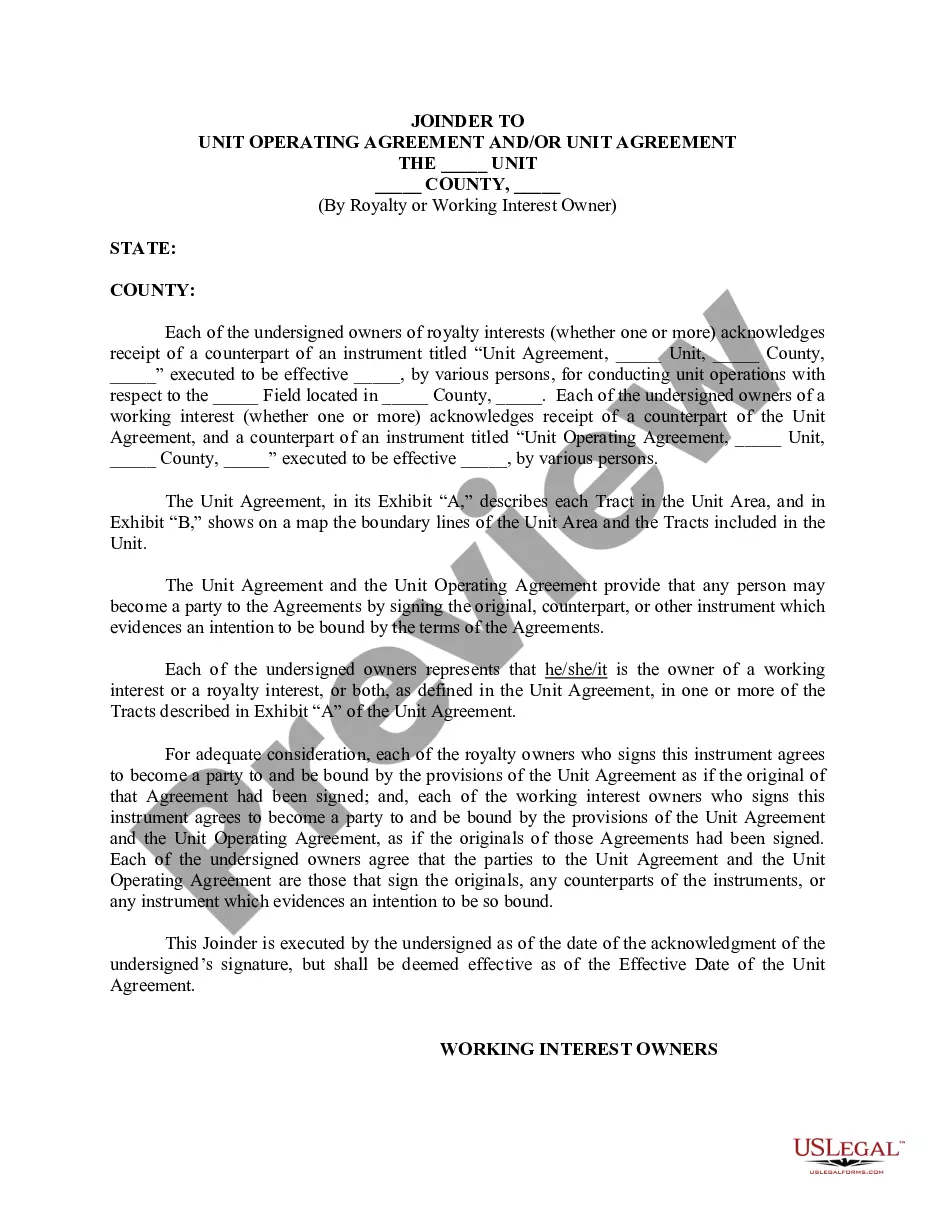
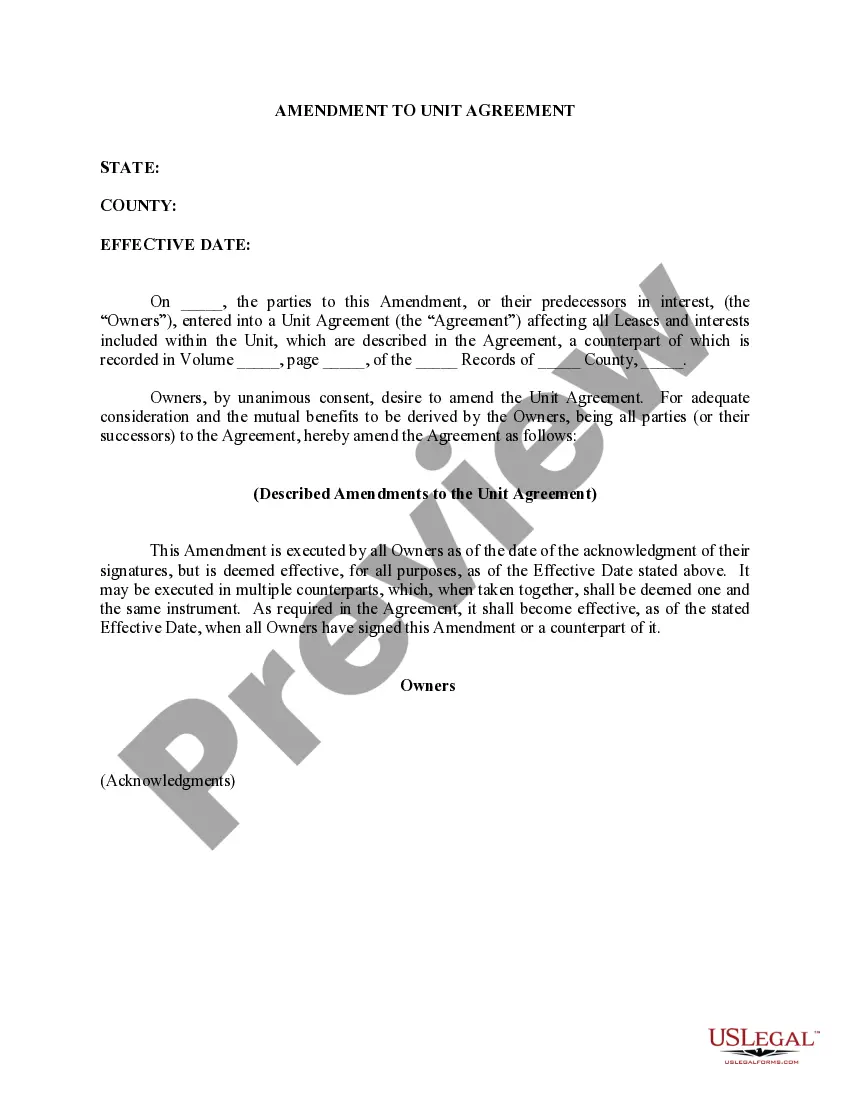
The Joinder to Unit Operating Agreement and/or Unit Agreement is a legal document that allows royalty and working interest owners to formally join existing unit agreements. This form ensures that signatories are bound by the terms of these agreements as if they were original signatories. It is essential for facilitating shared operations in oil, gas, or mineral exploration and production while clarifying rights and responsibilities among stakeholders.
Key components of this form
- Identification of the parties involved (royalty and working interest owners).
- Terms confirming acknowledgment of the Unit Agreement and Unit Operating Agreement.
- Detailed descriptions of the tracts involved, as referenced in the Unit Agreement.
- Provisions for the effective date of the agreement and acknowledgment of ownership interests.
- Signatures of all relevant parties, ensuring legal binding.
When to use this form
This form should be used when a new royalty owner or working interest owner intends to join an existing Unit Agreement or Unit Operating Agreement. It is necessary in scenarios such as mergers of interests, acquisition of rights, or when additional stakeholders need to be legally incorporated into joint operations in a specific unit of property.
Who needs this form
- Royalties and working interest owners looking to solidify their participation in a Unit Agreement.
- Individuals or entities engaged in oil, gas, or mineral extraction operations.
- Those who have acquired ownership rights in properties governed by a Unit Agreement and want to be legally recognized.
Steps to complete this form
- Identify and list the names of all royalty and working interest owners joining the agreement.
- Refer to the Unit Agreement to acknowledge the specific terms and conditions they are agreeing to.
- Fill in the effective date of the underlying Unit Agreement and other relevant details.
- Sign the document in accordance with any requirements specified in the Unit Agreement.
- Ensure all parties receive a copy of the signed Joinder for their records.
Notarization guidance
This form usually doesn’t need to be notarized. However, local laws or specific transactions may require it. Our online notarization service, powered by Notarize, lets you complete it remotely through a secure video session, available 24/7.
Get your form ready online
Our built-in tools help you complete, sign, share, and store your documents in one place.
Make edits, fill in missing information, and update formatting in US Legal Forms—just like you would in MS Word.
Download a copy, print it, send it by email, or mail it via USPS—whatever works best for your next step.
Sign and collect signatures with our SignNow integration. Send to multiple recipients, set reminders, and more. Go Premium to unlock E-Sign.
If this form requires notarization, complete it online through a secure video call—no need to meet a notary in person or wait for an appointment.
We protect your documents and personal data by following strict security and privacy standards.

Make edits, fill in missing information, and update formatting in US Legal Forms—just like you would in MS Word.

Download a copy, print it, send it by email, or mail it via USPS—whatever works best for your next step.

Sign and collect signatures with our SignNow integration. Send to multiple recipients, set reminders, and more. Go Premium to unlock E-Sign.

If this form requires notarization, complete it online through a secure video call—no need to meet a notary in person or wait for an appointment.

We protect your documents and personal data by following strict security and privacy standards.
Mistakes to watch out for
- Failing to include all necessary signatures from all royalty and working interest owners.
- Not referencing the correct Unit Agreement or providing inaccurate details about the effective date.
- Overlooking specific acknowledgments required in the Unit Agreement.
Why complete this form online
- Convenient access to downloadable templates, allowing for quick and easy completion.
- Editability enables customization to fit individual needs without needing legal assistance.
- Reliable templates drafted by licensed attorneys to ensure legal compliance.
Looking for another form?


Form popularity
FAQ
Most states do not require LLCs to have this document, so many LLCs choose not to draft one. While it may not be a requirement to have an operating agreement, it's actually in the best interest of an LLC to draft one.However, a written operating agreement defines in writing how the LLC is run.
A joinder is intended to be a simple document whose sole effect is to add an additional person or entity as a party to the original agreement and bind them to the terms of that agreement in their entirety.
The operating agreement outlines who owns the LLC and what percentage of ownership each party has. Most of the time the members of an LLC will own a percentage relative to the contribution they made to the formation of the business, such as cash investments, but you can divide up ownership however you like.
LLC ownership can be expressed in two ways: (1) by percentage; and (2) by membership units, which are similar to shares of stock in a corporation. In either case, ownership confers the right to vote and the right to share in profits.
A Statement of Organizer is a document that states the initial members or managers of an LLC. The authorized person/organizer at IncNow prepares this document. While the Operating Agreement should be sufficient proof of ownership, some banks require further assurance.
Does a single-member LLC need an Operating Agreement? In California, yes. It may seem counter intuitive, but a single-member LLC does need an LLC Operating Agreement.
The core elements of an LLC operating agreement include provisions relating to equity structure (contributions, capital accounts, allocations of profits, losses and distributions), management, voting, limitation on liability and indemnification, books and records, anti-dilution protections, if any, restrictions on
There is no requirement that the operating agreement is notarized. Even without being notarized, the document is still considered legally enforceable among the parties.