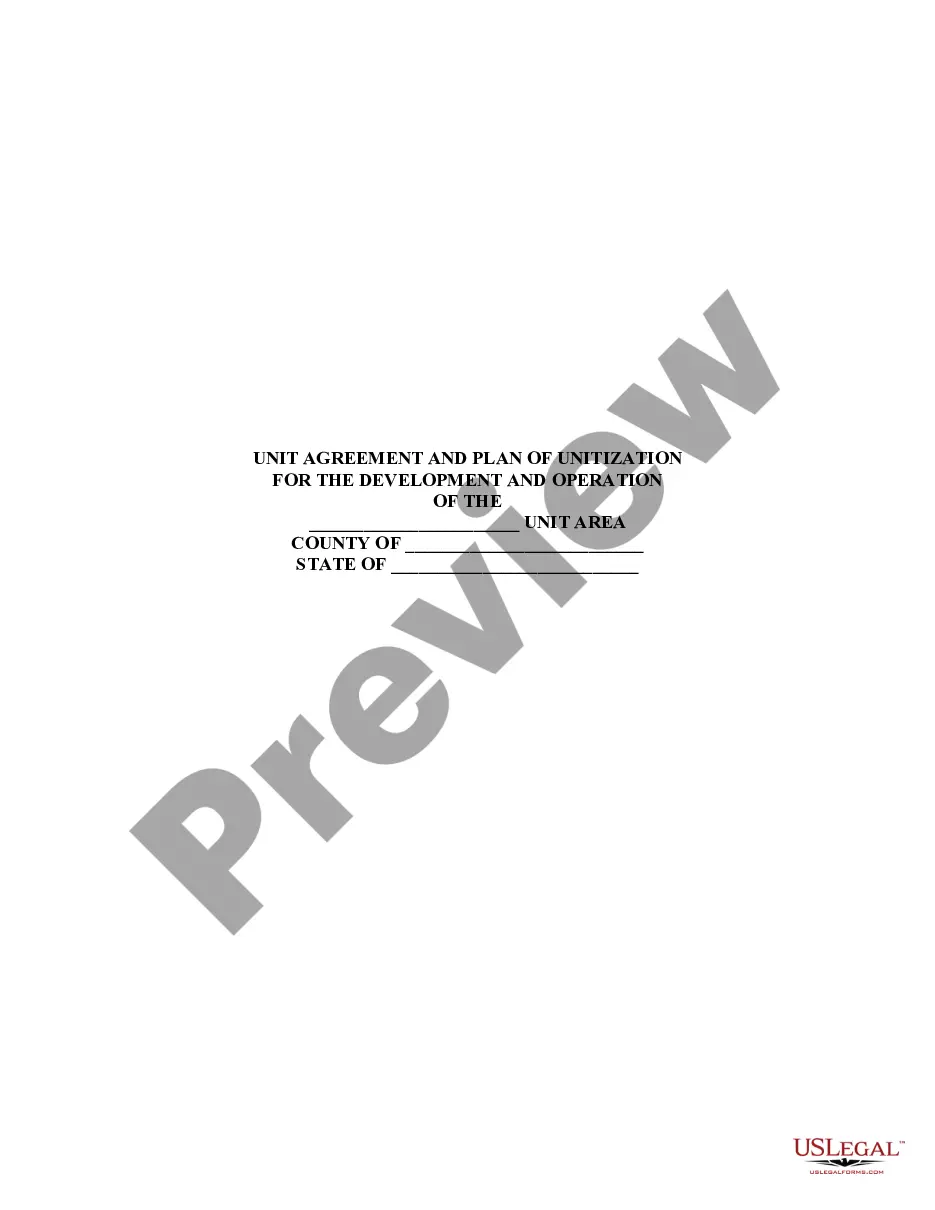
Unit Agreement and Plan of Unitization
What this document covers
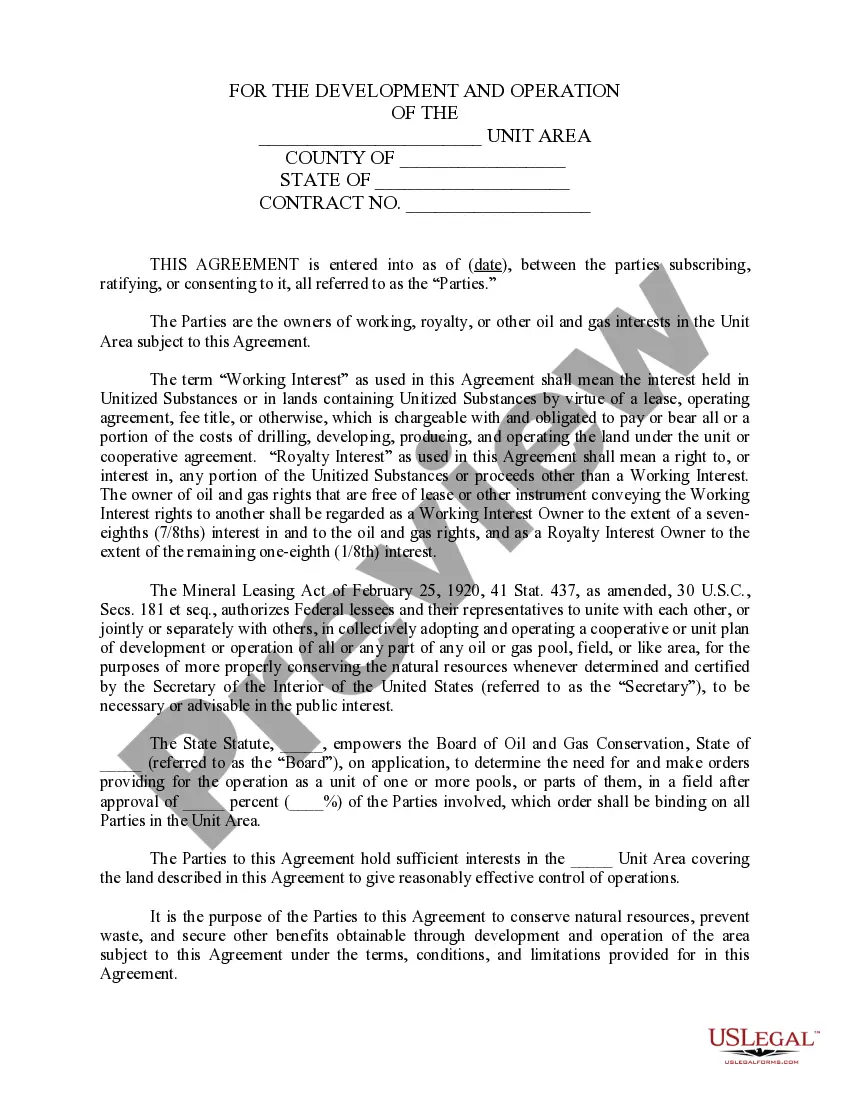
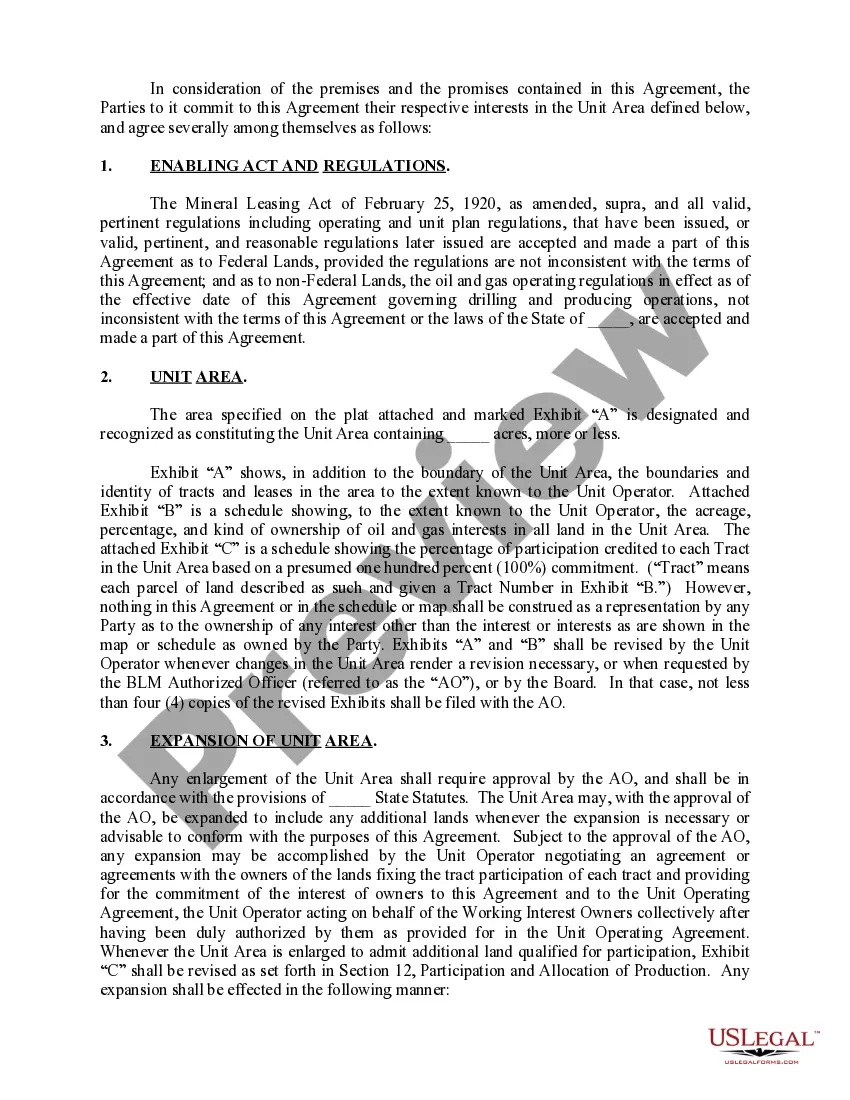
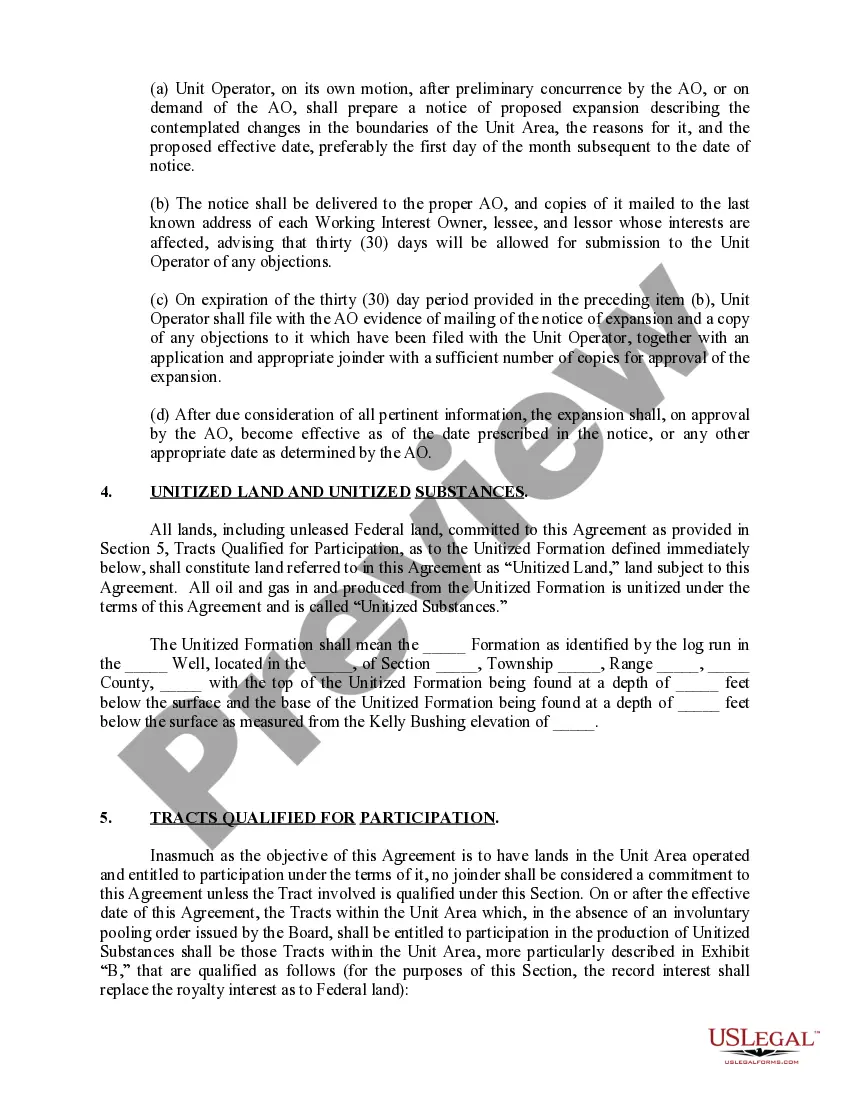
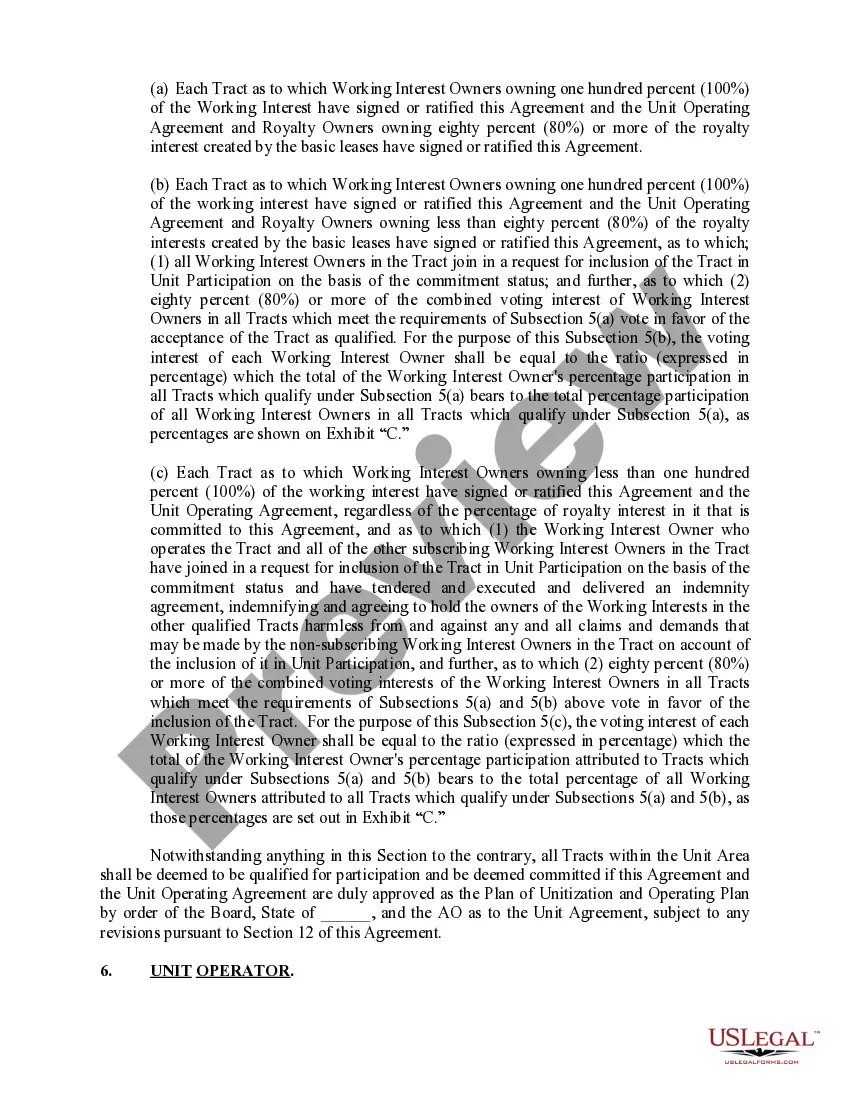
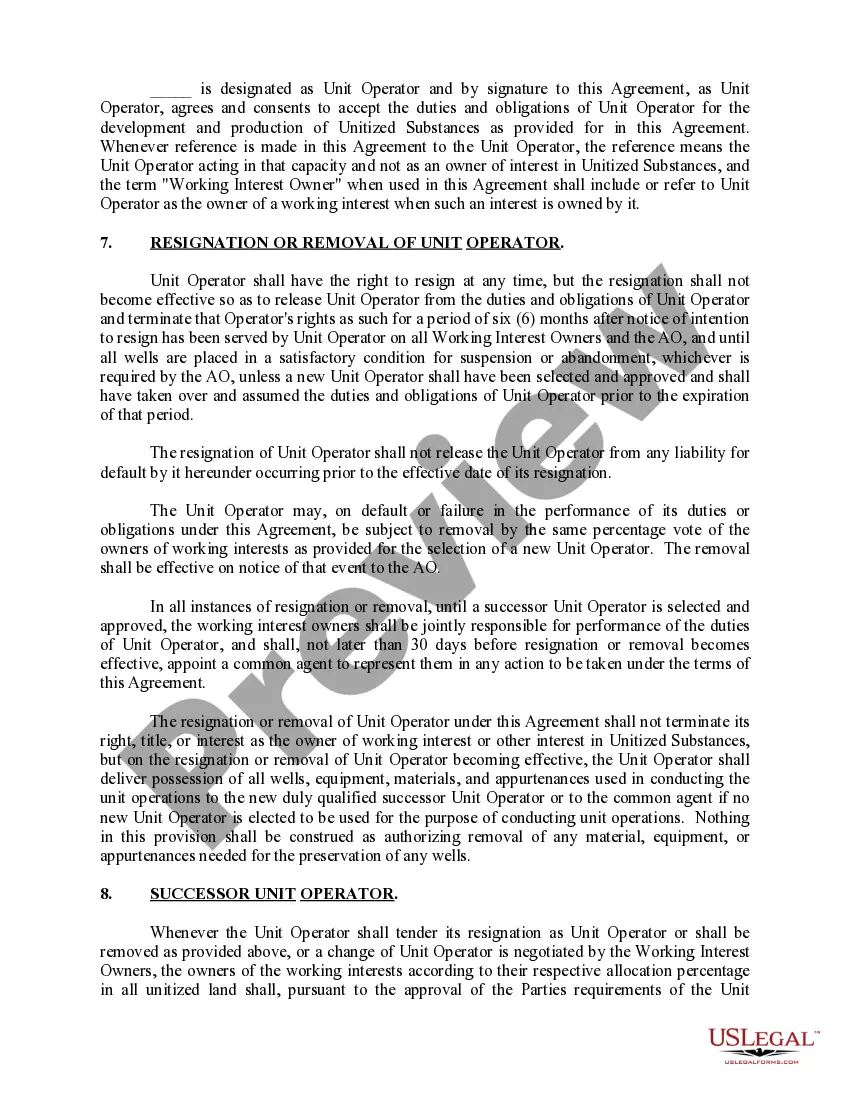
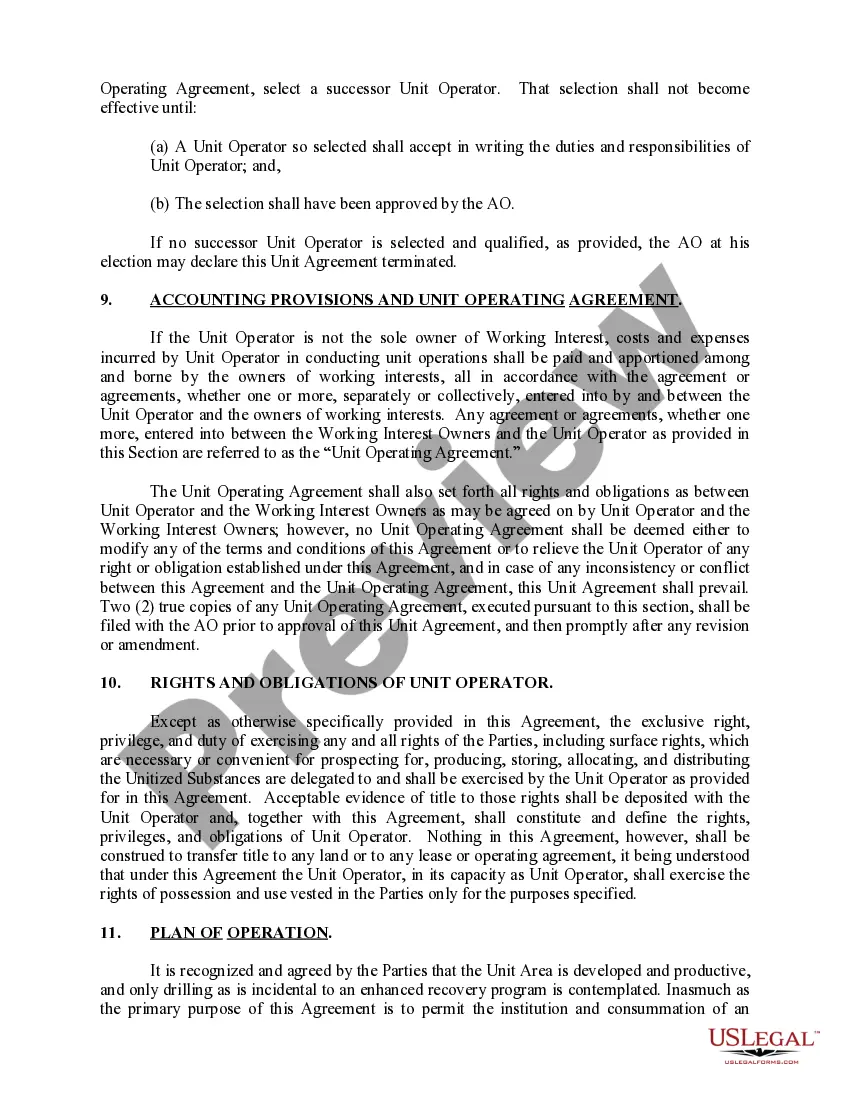
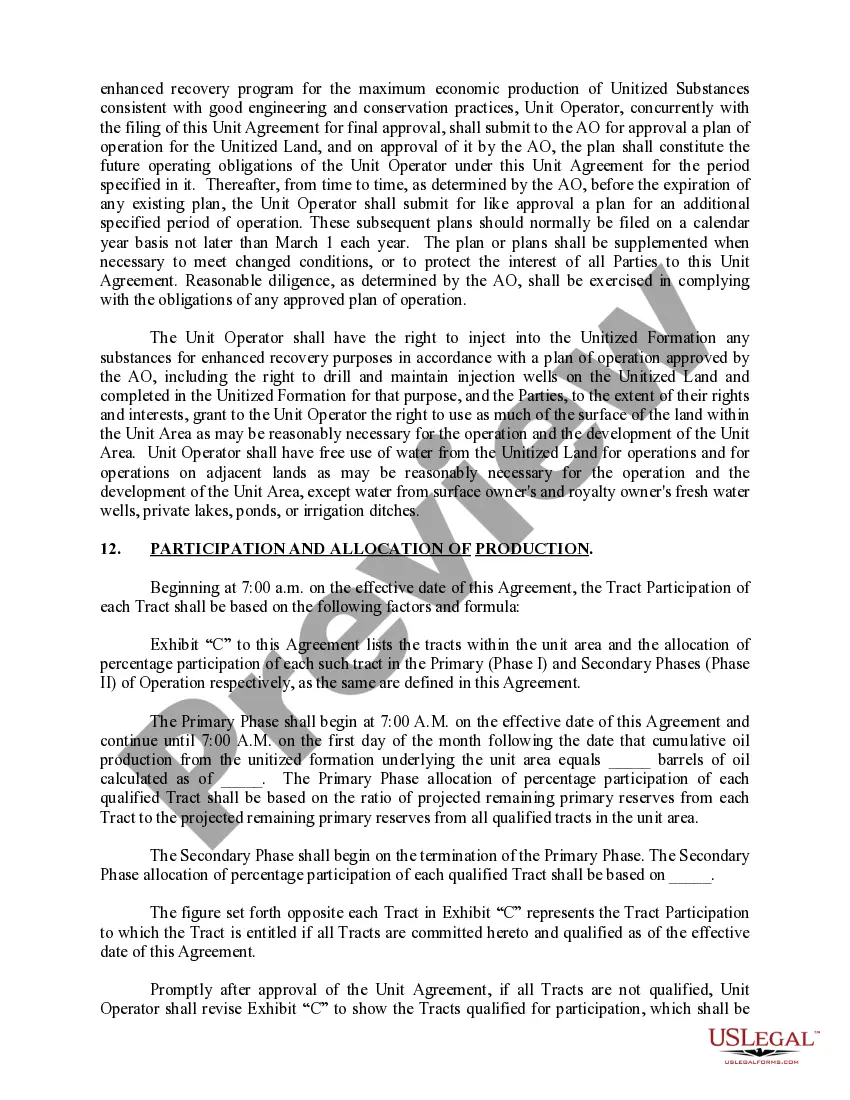
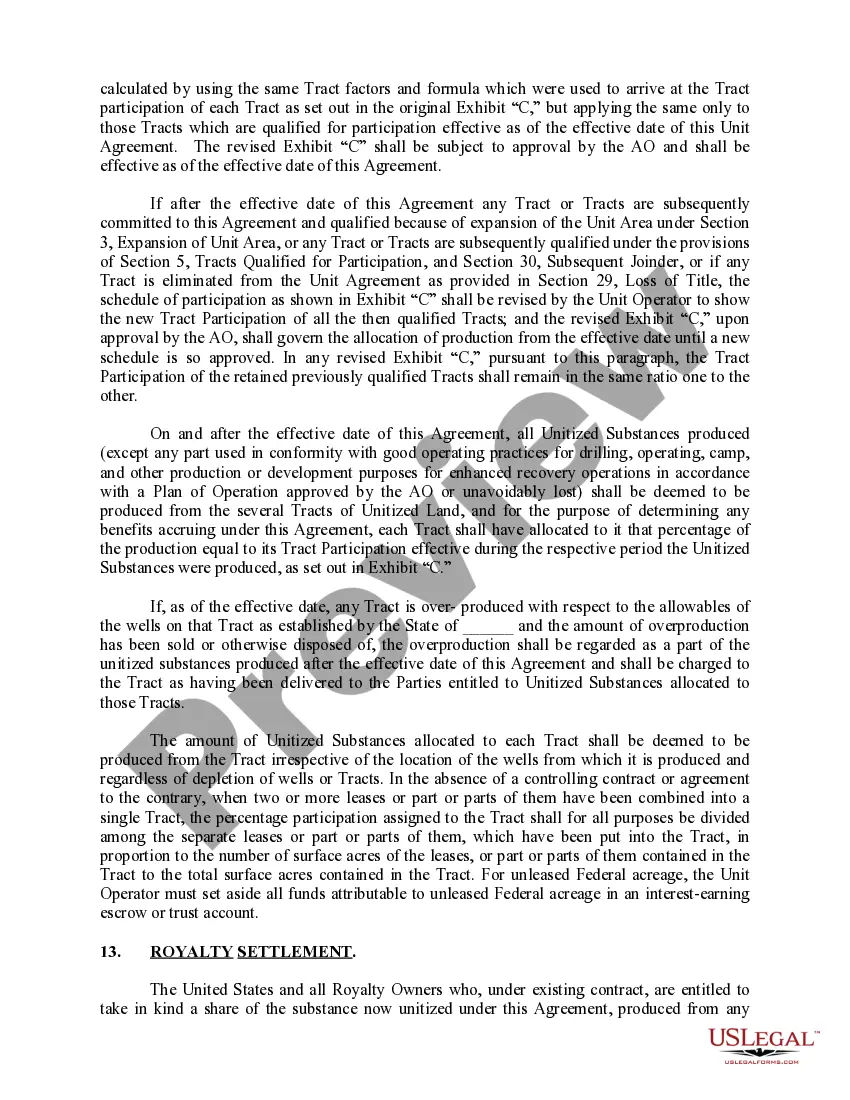
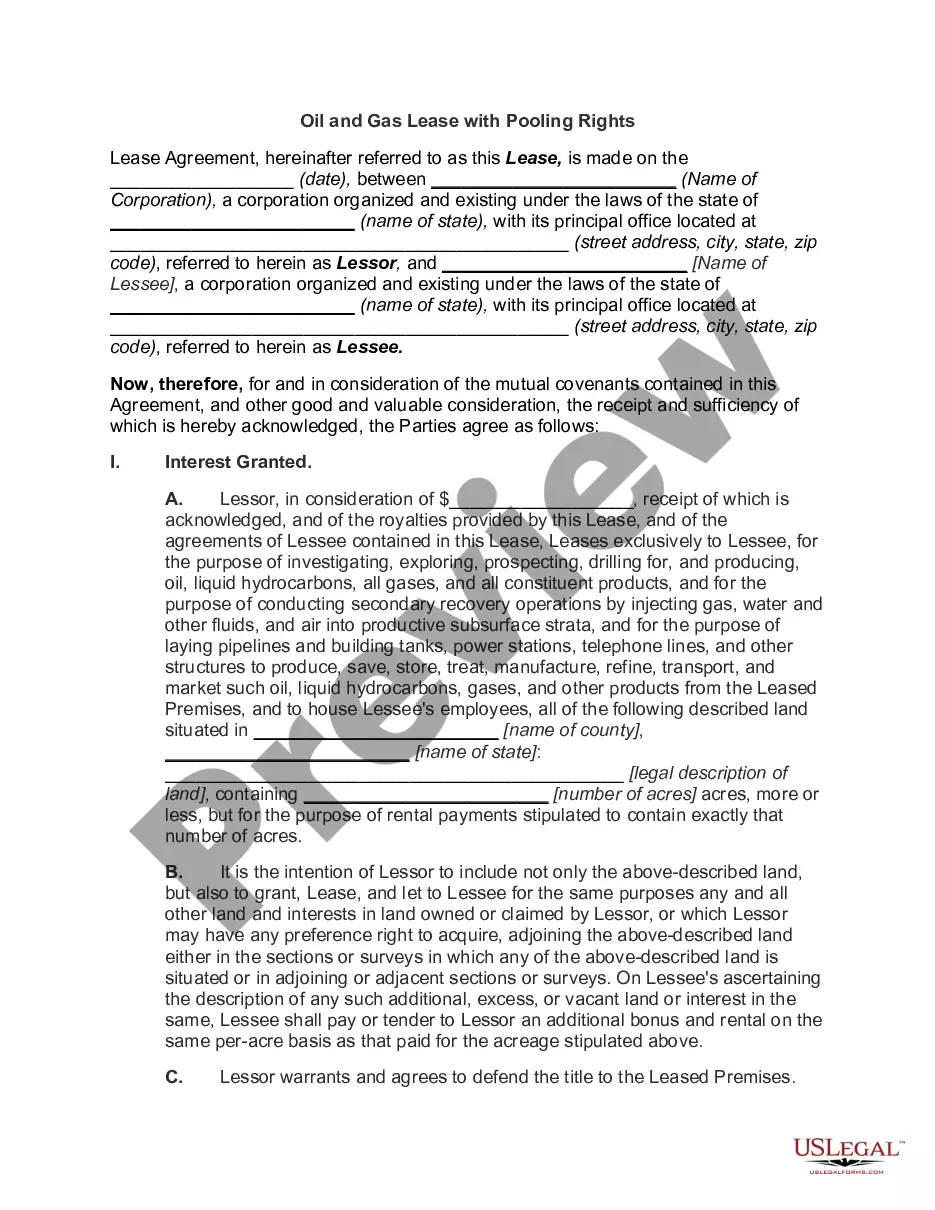
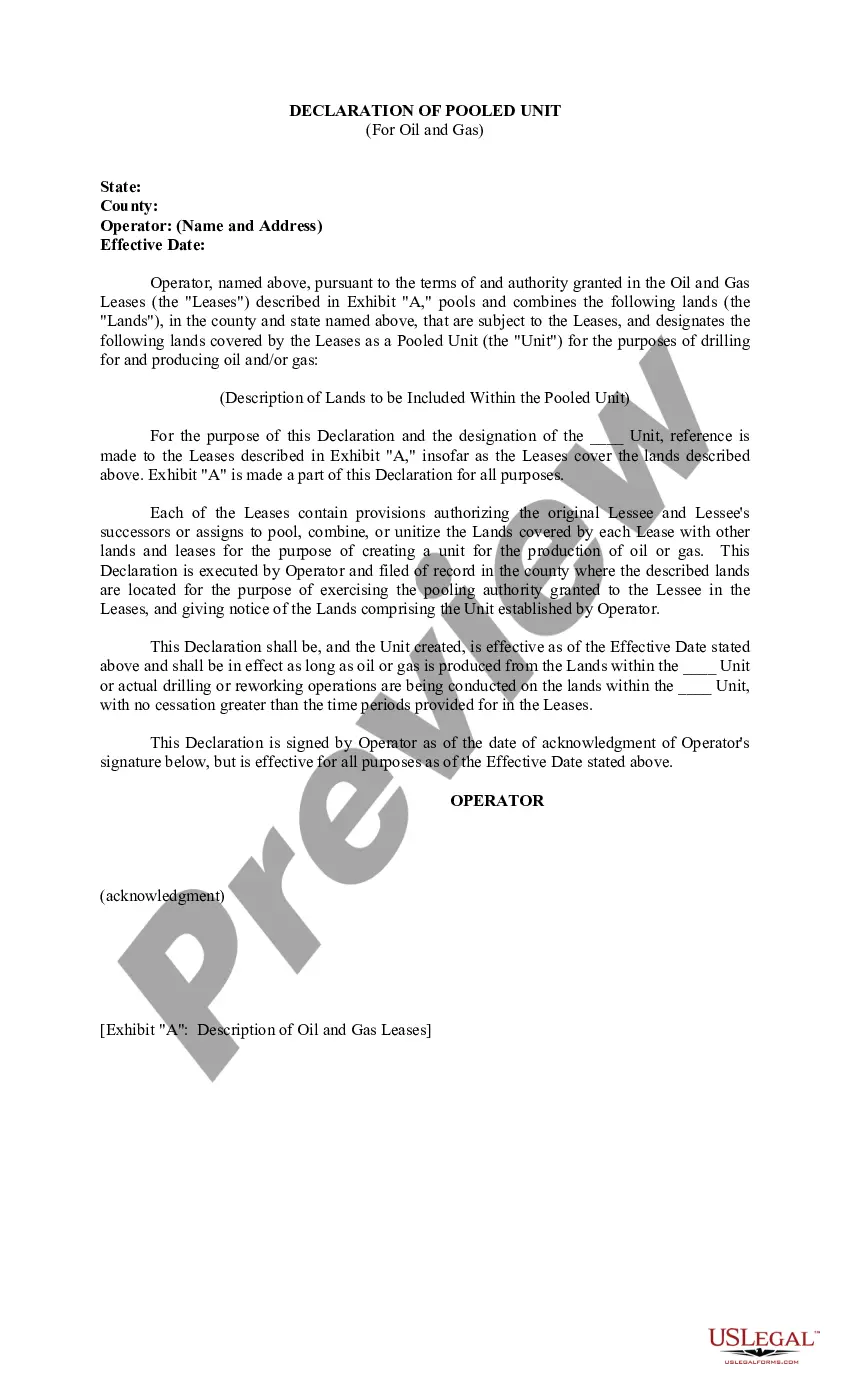
The Unit Agreement and Plan of Unitization is a legal document that outlines the terms and conditions under which the parties, who are owners of oil and gas interests, agree to pool their resources for the development and operation of a specified Unit Area. This agreement is distinct from regular lease agreements as it unites various interests to enhance resource conservation and production efficiency, thereby promoting better management of natural resources.
What’s included in this form
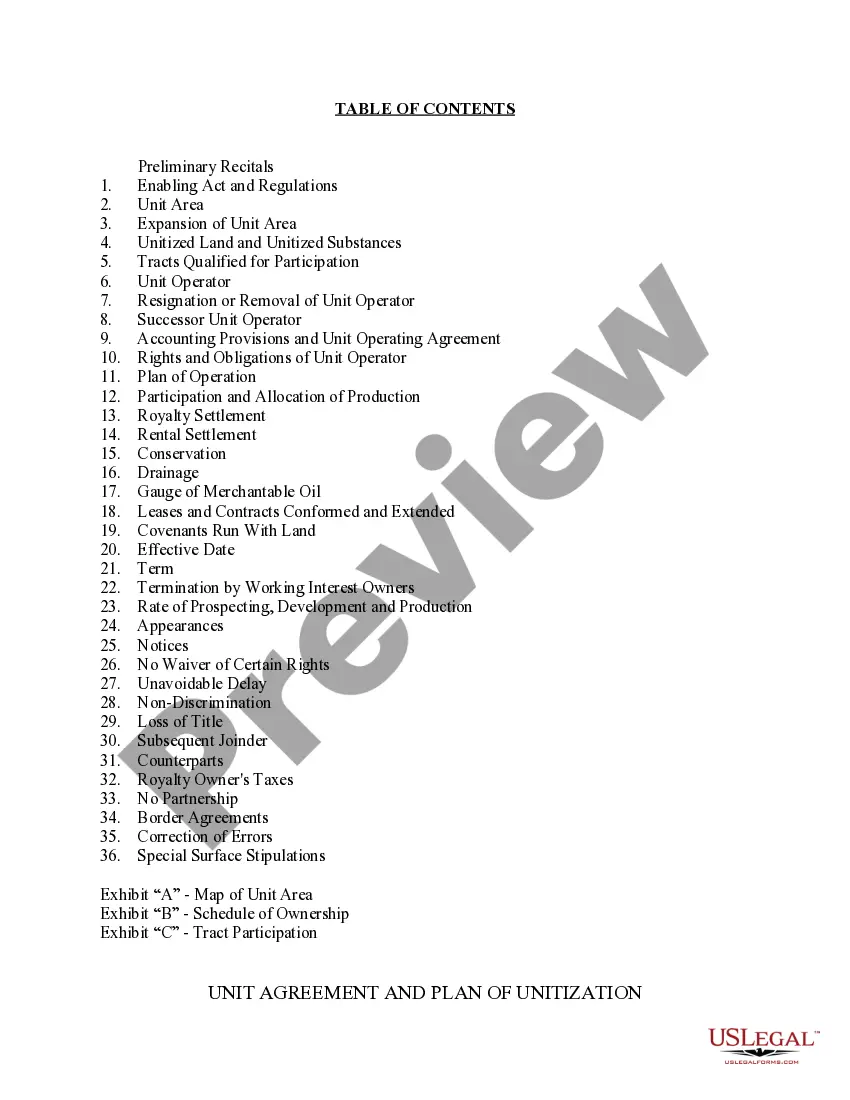
- Enabling Act and Regulations: Establishes the legal framework for the agreement.
- Unit Area: Defines the boundaries and specifications of the area covered by the agreement.
- Unit Operator: Designates an operator responsible for managing operations within the Unit Area.
- Plan of Operation: Outlines future operations for the development of the Unit Area.
- Participation and Allocation of Production: Details how production, royalties, and revenue will be shared among the parties.
- Termination: Specifies conditions under which the agreement can be ended.

When this form is needed
This form should be used when multiple parties, such as oil and gas interest owners, wish to collaborate on the development and operation of a specific area to enhance resource extraction. It is particularly useful in cases where individual interests may not be sufficient to develop the resources effectively or economically. This agreement helps prevent resource waste and ensures that interests are managed cohesively.
Who needs this form
- Owners of working interests in oil and gas, looking to maximize resource extraction through collaborative efforts.
- Royalty interest owners aiming to ensure equitable revenue sharing from oil and gas production.
- Operators responsible for managing oil and gas operations who need a clear framework to govern their activities.
Steps to complete this form
- Identify the parties involved, making sure to include all owners of the working and royalty interests.
- Clearly define the Unit Area by filling in the specifics of the location and boundaries.
- Designate the Unit Operator responsible for managing the operations within the Unit Area.
- Complete the Plan of Operation, outlining the intended activities and use of resources.
- Ensure all parties sign and date the agreement to validate their commitment and participation.
Is notarization required?
Notarization is not commonly needed for this form. However, certain documents or local rules may make it necessary. Our notarization service, powered by Notarize, allows you to finalize it securely online anytime, day or night.
Get your form ready online
Our built-in tools help you complete, sign, share, and store your documents in one place.
Make edits, fill in missing information, and update formatting in US Legal Forms—just like you would in MS Word.
Download a copy, print it, send it by email, or mail it via USPS—whatever works best for your next step.
Sign and collect signatures with our SignNow integration. Send to multiple recipients, set reminders, and more. Go Premium to unlock E-Sign.
If this form requires notarization, complete it online through a secure video call—no need to meet a notary in person or wait for an appointment.
We protect your documents and personal data by following strict security and privacy standards.

Make edits, fill in missing information, and update formatting in US Legal Forms—just like you would in MS Word.

Download a copy, print it, send it by email, or mail it via USPS—whatever works best for your next step.

Sign and collect signatures with our SignNow integration. Send to multiple recipients, set reminders, and more. Go Premium to unlock E-Sign.

If this form requires notarization, complete it online through a secure video call—no need to meet a notary in person or wait for an appointment.

We protect your documents and personal data by following strict security and privacy standards.
Mistakes to watch out for
- Failing to include all relevant parties, which can lead to disputes and complications.
- Not clearly defining the boundaries of the Unit Area, resulting in misunderstandings about the scope of the agreement.
- Neglecting to update the agreement as circumstances change, particularly regarding the Unit Area or Operator roles.
Why complete this form online
- Convenience: Access the form anytime and anywhere, making the process efficient.
- Editability: Customize the form to fit specific needs or situations without hassle.
- Reliability: Use a professionally drafted document that reflects current legal standards and requirements.
Legal use & context
- The Unit Agreement establishes a legal framework for collective oil and gas operations.
- It is governed by statutory laws, primarily under the Mineral Leasing Act.
- Ensures that each participating party's rights and interests are respected and clearly defined.
Looking for another form?

Form popularity
FAQ
Unitization is the agreement to jointly operate an entire producing reservoir or a prospectively productive area of oil and/or gas. The entire unit area is operated as a single entity, without regard to lease boundaries, and allows for the maximum recovery of production from the reservoir.
As noted above, while pooling focuses on efficiently combining lands for the purpose of obtaining a drilling permit to drill a single well, unitization focuses on the combination of interests covering a larger area to facilitate development of all or part of a common source of supply (i.e. a field/reservoir).
Unitization is essentially grouped or bundled cargo, wrapped into packages and loaded onto or inside a bigger unit. These bigger units can then be handled by machines such as forklifts and cranes.The efficiency of cargo handling increases as heavier units can combine many smaller packages into one large package.
Unit Agreement means any agreement for the development or operation of all or any portion of the Leased Lands with other lands as a single unit without regard to separate ownership and for the allocation of costs and benefits on a basis as defined in such agreement.
Transitive verb. 1 : to form or convert into a unit. 2 : to divide into units the added cost of unitizing bulk products.
Unitisation in the oil and gas industry is historically a US concept and is commonly defined as 'the joint, co-ordinated operation of a petroleum reservoir by all the owners of rights in the separate tracts overlying the. reservoir'.
It also records a "Declaration of Pooling" or similarly named document in the land records office at the local Courthouse. The declaration shows the boundaries of the pooling unit and identifies all the landowners and amount of property each landowner actually has in the unit.