Priority of Operations For 1982 Agreement
Understanding this form
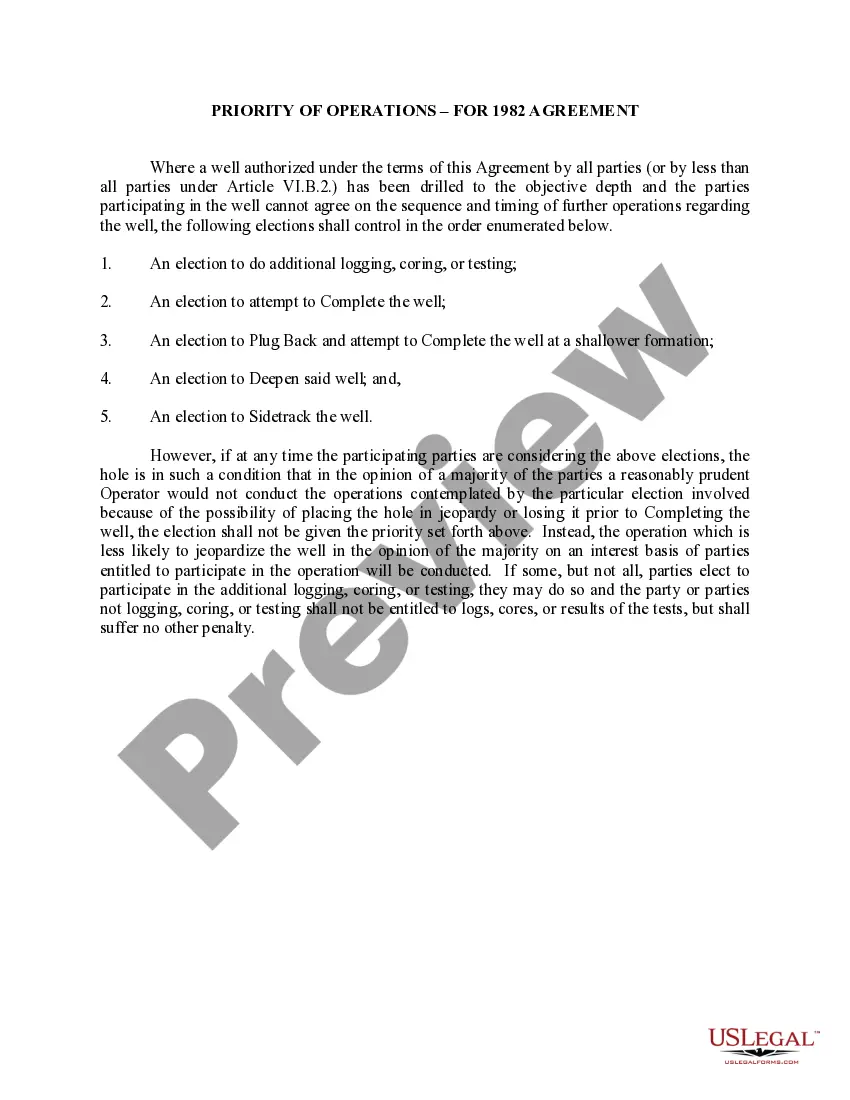
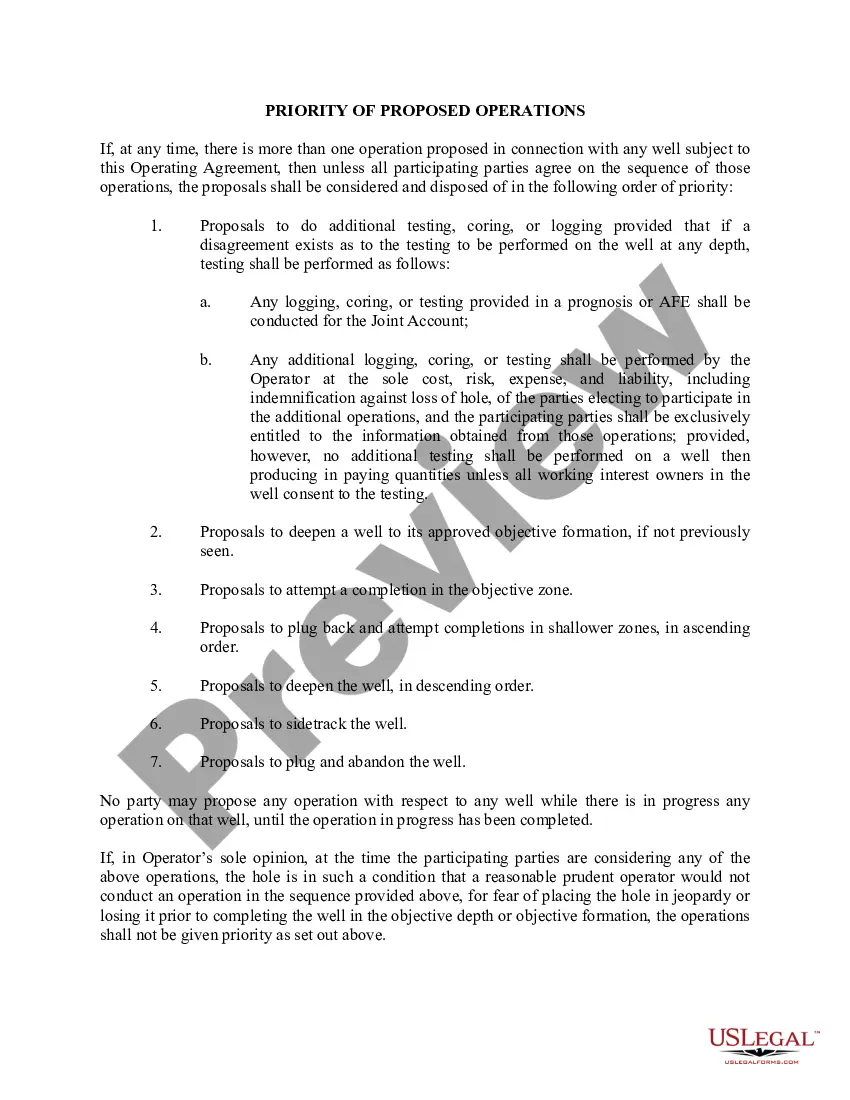
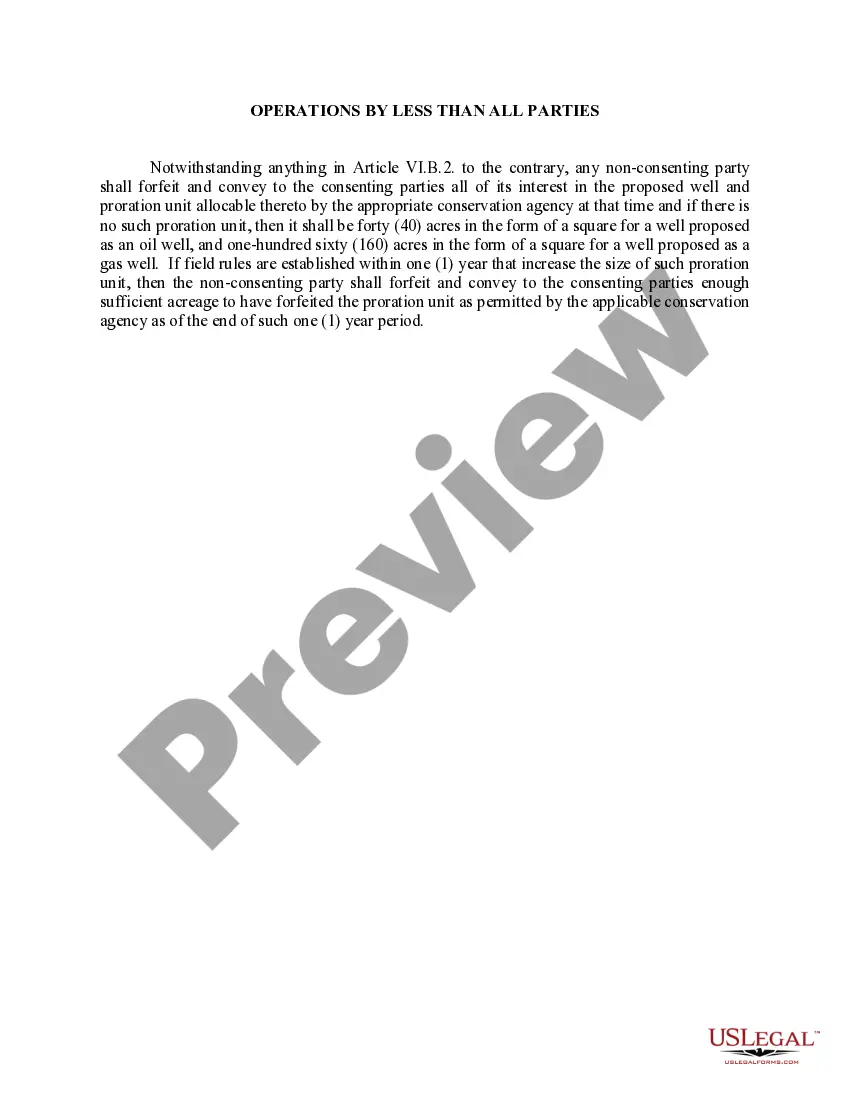
The Priority of Operations for 1982 Agreement is a legal document that establishes the rights and responsibilities of parties involved in the operation of a well. This form outlines the sequence of operations that can be conducted once a well has been drilled to the objective depth, specifying what happens if the parties cannot agree on further actions. It is distinct from other operational agreements as it prioritizes specific actions based on the condition of the well and the consensus of the participating parties.
Key components of this form
- Election options for further operations, including logging, coring, testing, completion, and deepening.
- Criteria for prioritization of operations based on the condition of the well.
- Provisions for parties not participating in additional operations and their rights regarding results.
When to use this form
This form should be used when multiple parties are involved in the drilling and operations of a well and cannot reach an agreement on the sequence and timing of further operations. It is essential in ensuring that the decision-making process regarding additional work is orderly and reflects the majority's opinion, thereby preventing disputes and promoting efficient operations.
Who can use this document
- Parties involved in oil or gas exploration and production.
- Operators and investors needing clear guidelines for well operation procedures.
- Legal professionals advising clients on resource extraction agreements.
Steps to complete this form
- Identify all parties involved in the agreement.
- Specify the well's details, including its location and intended depth.
- Document each party's election regarding additional operations in order of preference.
- Obtain signatures from all participating parties to validate the agreement.
Does this document require notarization?
This form does not typically require notarization to be legally valid. However, some jurisdictions or document types may still require it. US Legal Forms provides secure online notarization powered by Notarize, available 24/7 for added convenience.
Get your form ready online
Our built-in tools help you complete, sign, share, and store your documents in one place.
Make edits, fill in missing information, and update formatting in US Legal Forms—just like you would in MS Word.
Download a copy, print it, send it by email, or mail it via USPS—whatever works best for your next step.
Sign and collect signatures with our SignNow integration. Send to multiple recipients, set reminders, and more. Go Premium to unlock E-Sign.
If this form requires notarization, complete it online through a secure video call—no need to meet a notary in person or wait for an appointment.
We protect your documents and personal data by following strict security and privacy standards.

Make edits, fill in missing information, and update formatting in US Legal Forms—just like you would in MS Word.

Download a copy, print it, send it by email, or mail it via USPS—whatever works best for your next step.

Sign and collect signatures with our SignNow integration. Send to multiple recipients, set reminders, and more. Go Premium to unlock E-Sign.

If this form requires notarization, complete it online through a secure video call—no need to meet a notary in person or wait for an appointment.

We protect your documents and personal data by following strict security and privacy standards.
Avoid these common issues
- Failing to include all relevant parties in the agreement.
- Not clearly specifying election priorities, leading to confusion later.
- Neglecting to document the condition of the well, which can affect operation decisions.
Why use this form online
- Convenience of downloading and printing the form at any time.
- Editability allows for customization to fit specific circumstances.
- Reliability of professionally drafted templates to ensure compliance with legal standards.
Looking for another form?




Form popularity
FAQ
What it means in the Order of Operations is "Parentheses, Exponents, Multiplication and Division, and Addition and Subtraction". When using this you must remember that multiplication and division are together, multiplication doesn't come before division. The same rule applies to addition and subtraction.
The order of operations rule is an agreement among mathematicians, it simplifies notation. P stands for parentheses, E for exponents, M and D for multiplication and division, A and S for addition and subtraction.Similarly, A and S are positioned to suggest that addition and subtraction are equally strong.
First, we solve any operations inside of parentheses or brackets. Second, we solve any exponents. Third, we solve all multiplication and division from left to right. Fourth, we solve all addition and subtraction from left to right.
The order of operations tells us the order to solve steps in expressions with more than one operation. First, we solve any operations inside of parentheses or brackets. Second, we solve any exponents. Third, we solve all multiplication and division from left to right.
The order of operations is a rule that tells the correct sequence of steps for evaluating a math expression. We can remember the order using PEMDAS: Parentheses, Exponents, Multiplication and Division (from left to right), Addition and Subtraction (from left to right).
It stands for Parentheses, Exponents, Multiplication/Division, Addition/Subtraction.
The order of operations says that operations must be done in the following order: parentheses, exponents, multiplication, division, addition, and subtraction.