Contractor Agreement to Conduct Due Diligence
Overview of this form
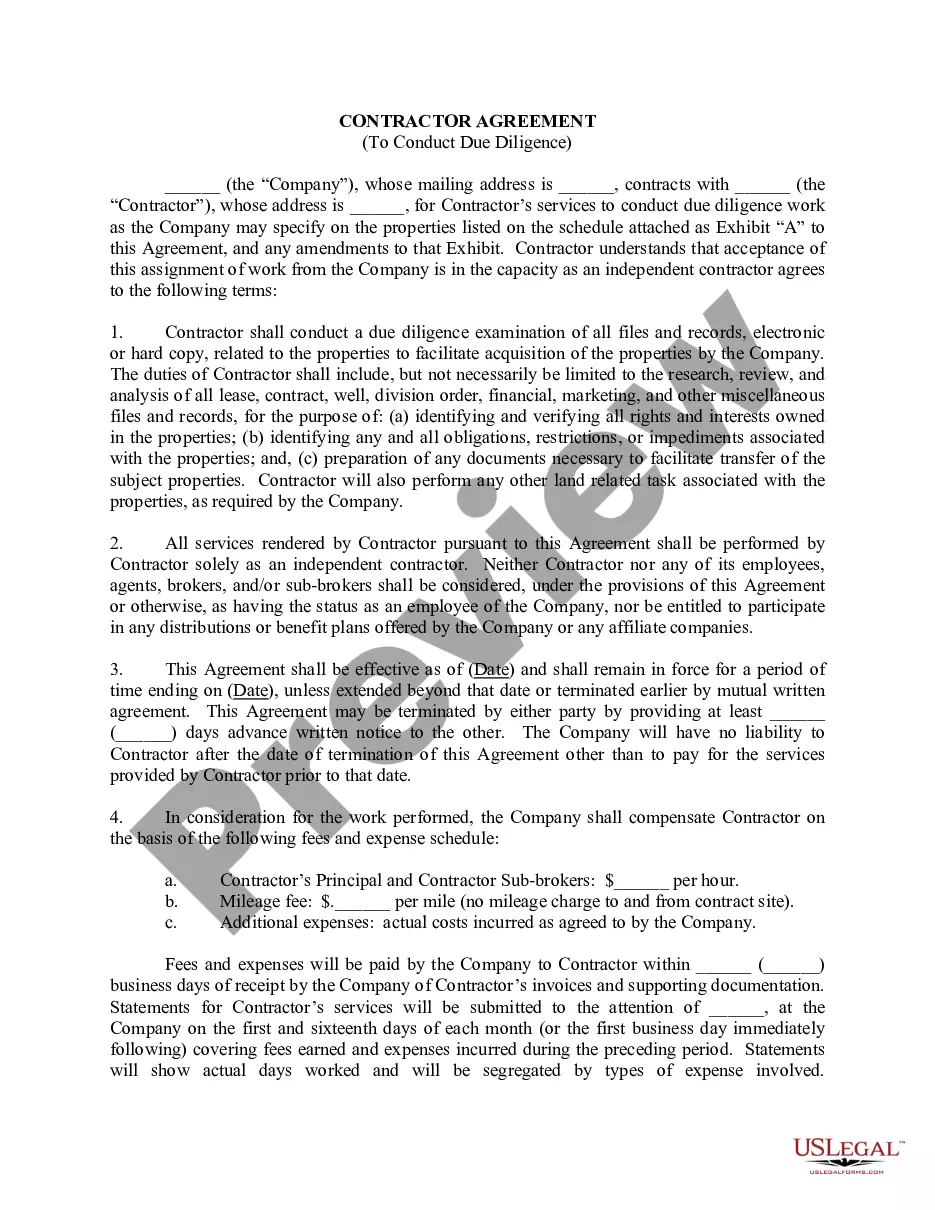
The Contractor Agreement to Conduct Due Diligence is a legal document that outlines the terms under which a contractor performs due diligence work for a company on specified properties. This agreement is crucial for defining the relationship between the company and the contractor as independent parties, ensuring clarity on the scope of work, compensation, and confidentiality provisions. Unlike generic contracts, this form is specifically tailored for conducting due diligence in real estate transactions, making it essential for both parties involved.
Main sections of this form
- Parties involved: Identification of the company and contractor, including their addresses.
- Scope of work: Description of the due diligence tasks the contractor will perform.
- Compensation structure: Fees for contractor services, including hourly rates and reimbursement of expenses.
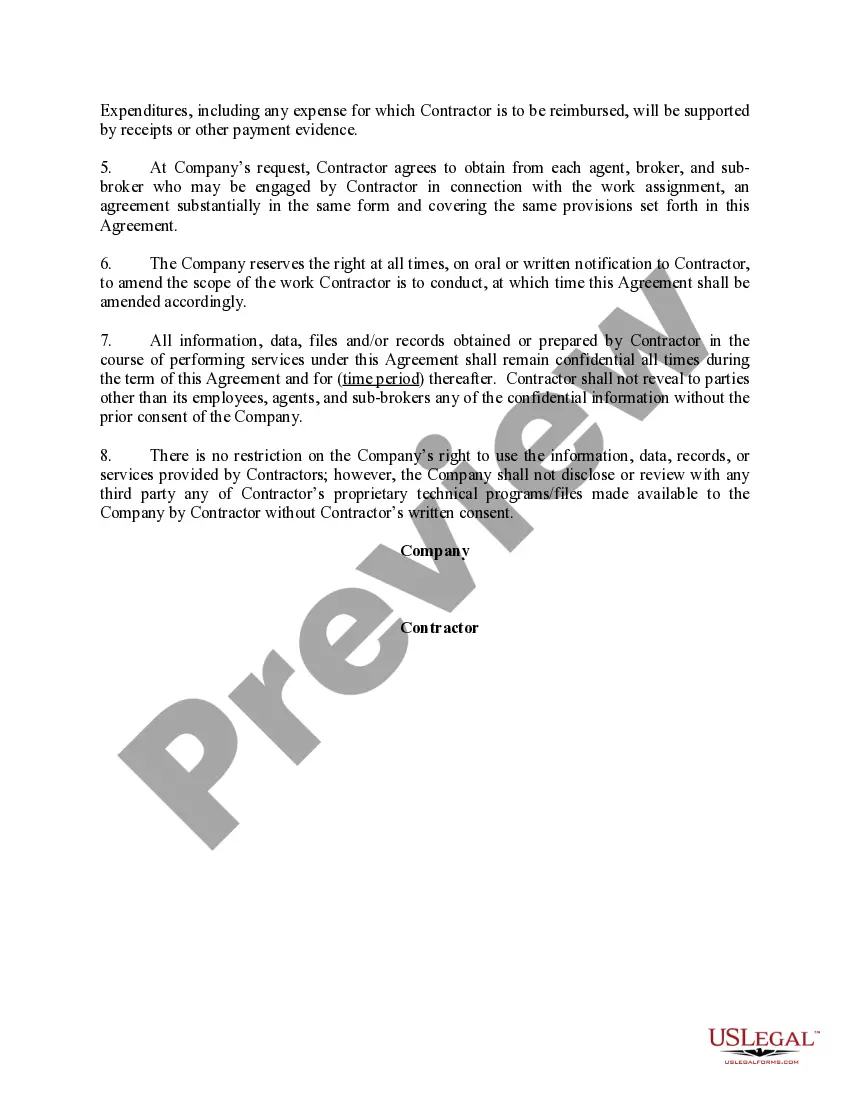
- Confidentiality clause: Obligations to maintain the confidentiality of information obtained during the agreement.
- Termination conditions: Provisions for ending the agreement, including notice requirements.
- Amendment rights: Rights of the company to change the scope of work and modify the agreement accordingly.
Situations where this form applies
This form should be used when a company hires a contractor to perform due diligence on specific properties. Scenarios may include real estate companies assessing potential acquisitions, investors requiring detailed property analyses, or any organization needing thorough reviews of property-related documentation and obligations. It is applicable whenever the company seeks to formalize the working relationship and ensure both parties understand their rights and responsibilities.
Who can use this document
- Real estate firms looking to contract independent due diligence services.
- Investors who require expert analysis of property records and obligations.
- Contractors providing specialized due diligence services on real estate properties.
- Companies needing to establish clear expectations and legal protections in their contractor relationships.
Instructions for completing this form
- Identify the parties: Fill in the names and contact addresses of the company and contractor.
- Specify the properties: List the properties involved in the due diligence under Exhibit A.
- Enter the effective dates: State the start and end dates of the agreement.
- Detail compensation: Fill in the hourly rates, mileage fees, and any agreed expense reimbursement.
- Sign the agreement: Ensure both parties sign and date the document to validate the contract.
Notarization guidance
In most cases, this form does not require notarization. However, some jurisdictions or signing circumstances might. US Legal Forms offers online notarization powered by Notarize, accessible 24/7 for a quick, remote process.
Get your form ready online
Our built-in tools help you complete, sign, share, and store your documents in one place.
Make edits, fill in missing information, and update formatting in US Legal Forms—just like you would in MS Word.
Download a copy, print it, send it by email, or mail it via USPS—whatever works best for your next step.
Sign and collect signatures with our SignNow integration. Send to multiple recipients, set reminders, and more. Go Premium to unlock E-Sign.
If this form requires notarization, complete it online through a secure video call—no need to meet a notary in person or wait for an appointment.
We protect your documents and personal data by following strict security and privacy standards.

Make edits, fill in missing information, and update formatting in US Legal Forms—just like you would in MS Word.

Download a copy, print it, send it by email, or mail it via USPS—whatever works best for your next step.

Sign and collect signatures with our SignNow integration. Send to multiple recipients, set reminders, and more. Go Premium to unlock E-Sign.

If this form requires notarization, complete it online through a secure video call—no need to meet a notary in person or wait for an appointment.

We protect your documents and personal data by following strict security and privacy standards.
Typical mistakes to avoid
- Failing to specify all properties in Exhibit A.
- Neglecting to provide accurate dates for the agreement.
- Omitting important confidentiality clauses.
- Leaving compensation fields blank or unclear.
- Not obtaining signatures from both parties.
Advantages of online completion
- Convenient and quick access to legally vetted contract templates.
- Editable fields allow customization to fit specific project needs.
- Online storage ensures easy retrieval and management of completed agreements.
- Follow-up reminders for contract deadlines can be easily set.
Legal use & context
- This agreement sets forth the legal framework for the independent contractor relationship.
- Ensures both parties are aware of their duties and rights regarding due diligence tasks.
- Protects sensitive information shared during the due diligence process.
- Clarifies payment structures and the process for invoicing services.
Key takeaways
- The Contractor Agreement to Conduct Due Diligence defines the working relationship between a company and a contractor for property evaluations.
- It is essential for ensuring clarity on roles, compensation, and confidentiality.
- Using this form can help prevent misunderstandings and disputes in contractual relations.
Looking for another form?

Form popularity
FAQ
Due diligence period usually refers to the time after signing a contract that the buyer has to inspect the property and make a decision whether they want to buy the property or lease the property or otherwise go forward with the transaction.
Sellers can place a contingency within a purchase and sale contract which allows them to back out without any penalty whatsoever. This contingency would be comparable to a buyers'' due diligence period, as the seller can exercise this contingency for any reason whatsoever.
Get A Professional Home Inspection. Have The Property Surveyed. Get Lead-Based Paint Testing. Pump And Inspect The Septic Tank. Mold & Air Quality Testing. Get A Termite Inspection. Test For Electromagnetic Fields. Check Flood Maps.
During the due diligence process, an investor will request information about your company that will inform their investment decision moving forward. In addition to asking questions of you and key members of your management team during meetings or phone calls, they will provide you with a request list.
Due Diligence Examples Conducting thorough inspections on a property before buying it in order to make sure that it is a good investment. An underwriter auditing an issuer's business and operations prior to selling it.
Reviewing and auditing financial statements. Scrutinizing projections for future performance. Analyzing the consumer market. Seeking operating redundancies that can be eliminated. Reviewing potential or ongoing litigation. Reviewing antitrust considerations.
Due diligence is the time a buyer has after signing a contract to assure themselves they are getting the asset they are paying for.
Due Diligence is the buyer's opportunity to engage in a process of further investigation of the property and the transaction as described in the Offer to Purchase form within a period of time agreed to by the seller and buyer.
Write for the target audience. Focus on the report objectives. Limit the report to information that has material impact to your company. Structure the information to be used as valuable reference material later.