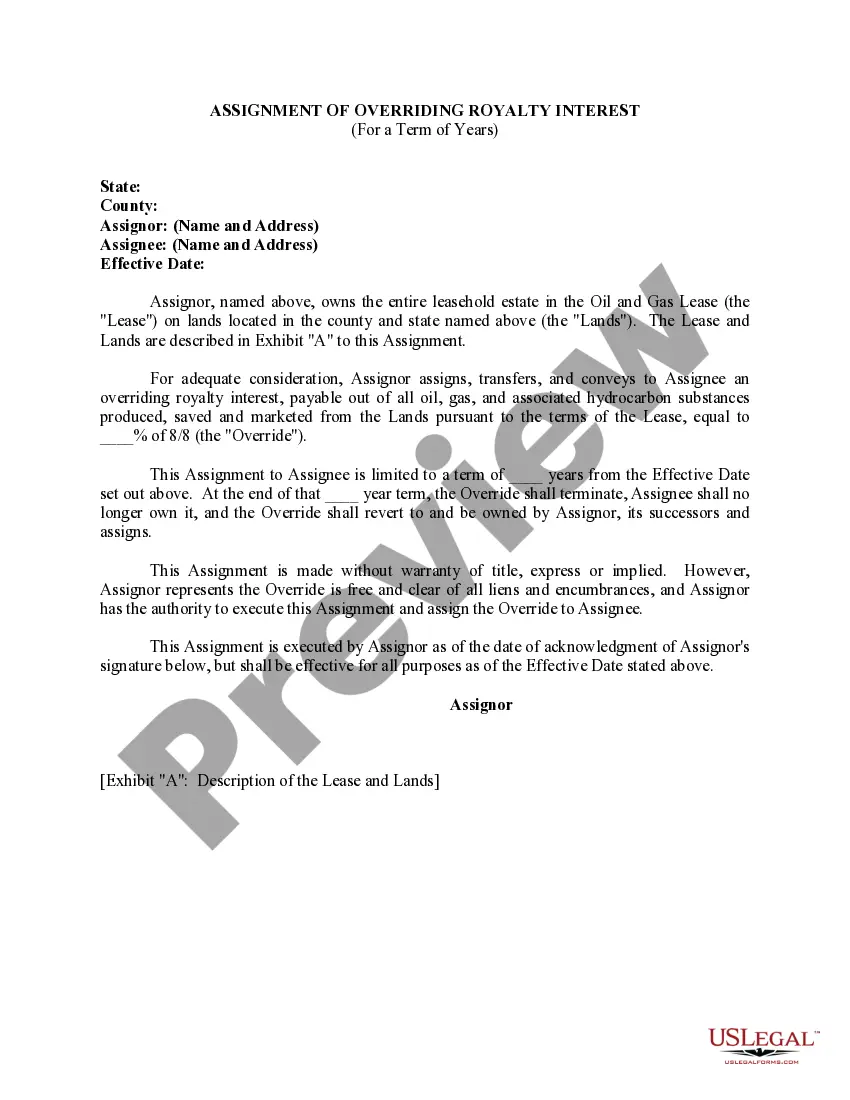
Assignment of Overriding Royalty Interest For A Term of Years
About this form
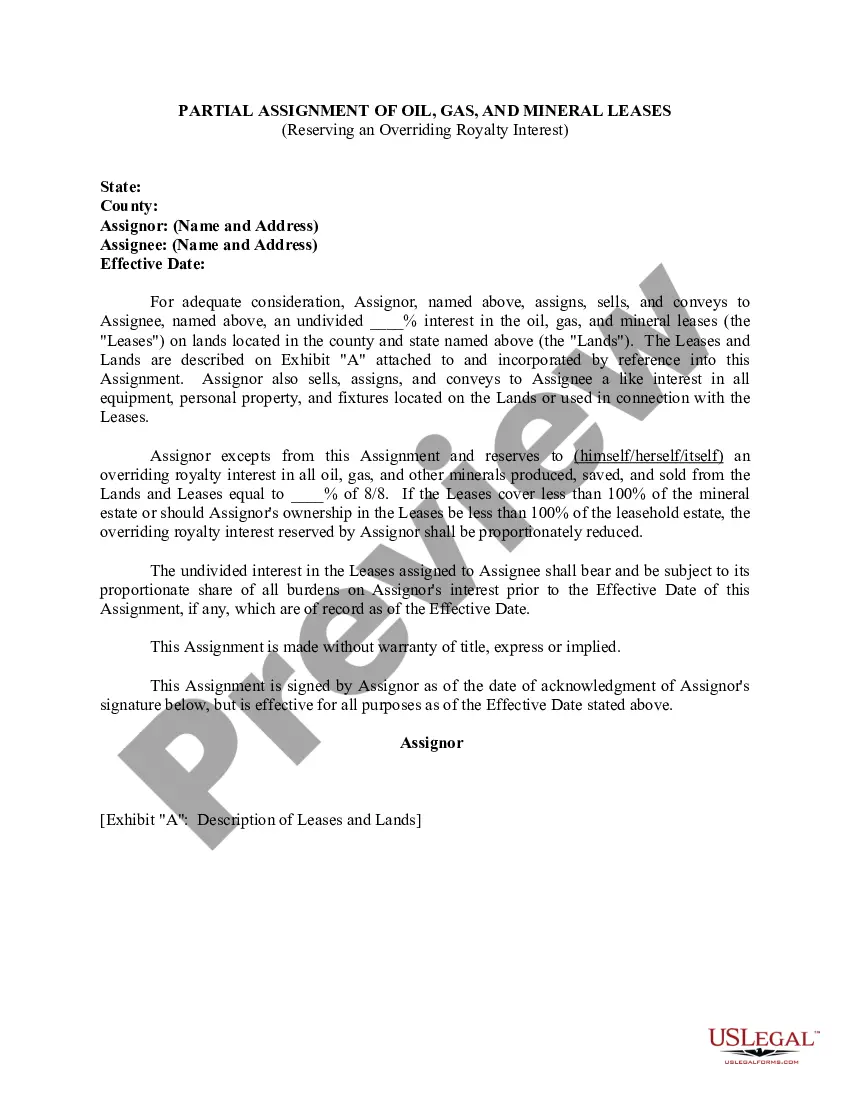
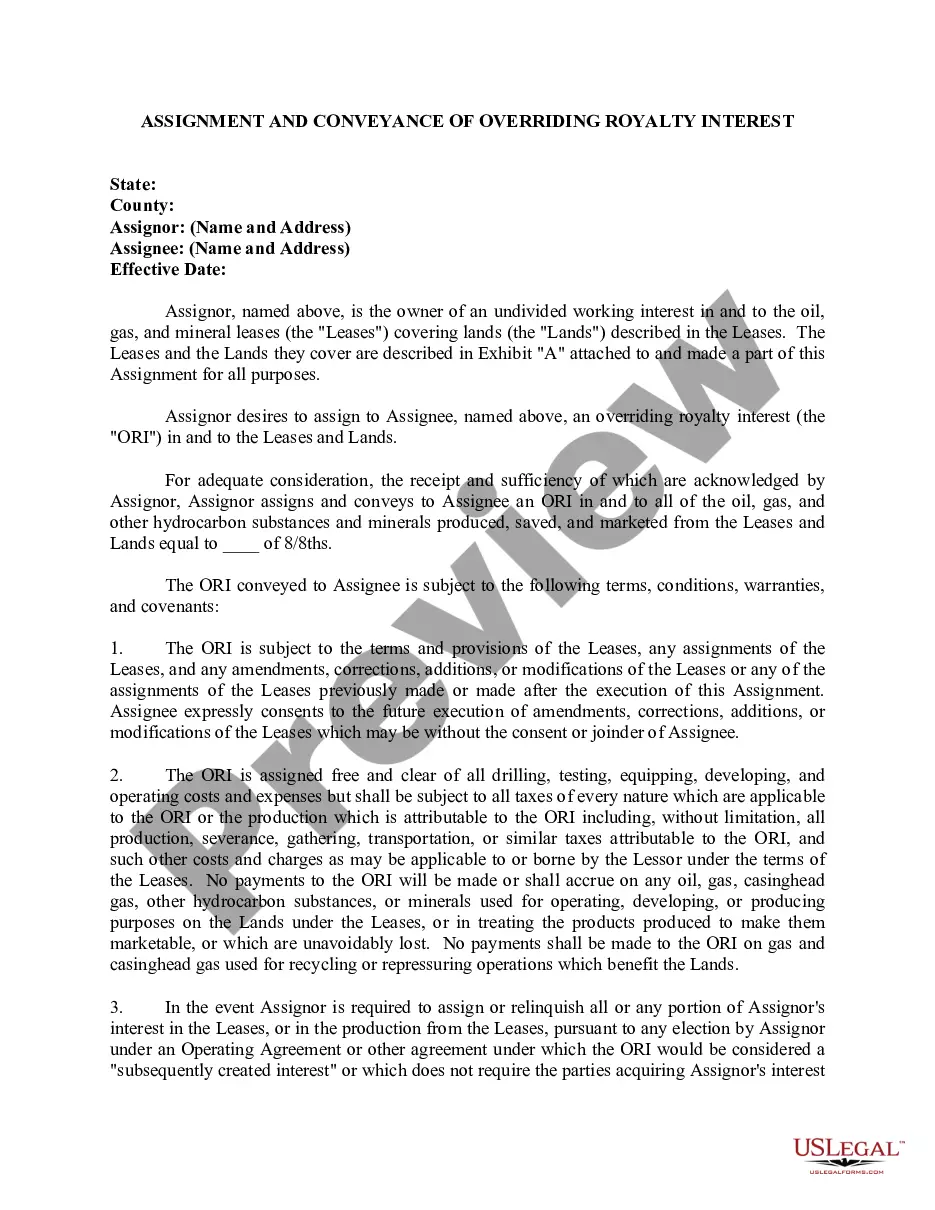
The Assignment of Overriding Royalty Interest For A Term of Years is a legal document that allows the Assignor to transfer their right to receive a portion of the royalties generated from oil, gas, and mineral production on a specific property. This form is distinct from other property assignment forms because it specifically addresses overriding royalty interests, meaning the payments are made before all other interests in the property. This assignment operates for a set period of time, after which rights revert back to the Assignor.
Key parts of this document
- Names and addresses of the Assignor and Assignee.
- Effective date of the assignment.
- Identification of the Lease and Lands in Exhibit A.
- Percentage of overriding royalty interest being assigned.
- Specified term duration for which the assignment is valid.
- Disclaimer of warranty of title by the Assignor.
When to use this form
This form is essential when an owner of oil and gas rights (the Assignor) wishes to allow another party (the Assignee) to receive a specified percentage of the royalties from production for a defined period. It is useful in circumstances where an owner wants immediate financial benefits from their rights while retaining ultimate ownership after the term expires. This form is often used in financial arrangements related to oil and gas operations or when negotiating partnerships in resource extraction.
Who should use this form
- Individuals or entities holding oil and gas leases seeking to assign their royalty interests.
- Investors interested in acquiring rights to receive royalties for a specific term.
- Landowners negotiating terms with oil and gas companies.
- Legal professionals drafting agreements involving mineral rights.
How to prepare this document
- Identify the Assignor and Assignee by entering their names and addresses.
- Enter the effective date for when the assignment starts.
- Reference Exhibit A to accurately describe the Lease and Lands.
- Specify the exact percentage of the overriding royalty interest being assigned.
- Determine and enter the term duration for which this assignment will remain effective.
- Have the Assignor sign the document, ensuring all necessary acknowledgments are made.
Notarization requirements for this form
This form does not typically require notarization unless specified by local law. However, confirming requirements and witnessing the signing may provide additional legal protection.
Get your form ready online
Our built-in tools help you complete, sign, share, and store your documents in one place.
Make edits, fill in missing information, and update formatting in US Legal Forms—just like you would in MS Word.
Download a copy, print it, send it by email, or mail it via USPS—whatever works best for your next step.
Sign and collect signatures with our SignNow integration. Send to multiple recipients, set reminders, and more. Go Premium to unlock E-Sign.
If this form requires notarization, complete it online through a secure video call—no need to meet a notary in person or wait for an appointment.
We protect your documents and personal data by following strict security and privacy standards.

Make edits, fill in missing information, and update formatting in US Legal Forms—just like you would in MS Word.

Download a copy, print it, send it by email, or mail it via USPS—whatever works best for your next step.

Sign and collect signatures with our SignNow integration. Send to multiple recipients, set reminders, and more. Go Premium to unlock E-Sign.

If this form requires notarization, complete it online through a secure video call—no need to meet a notary in person or wait for an appointment.

We protect your documents and personal data by following strict security and privacy standards.
Avoid these common issues
- Failing to specify the correct percentage of the overriding royalty interest.
- Not clearly identifying the Lease and Lands in Exhibit A.
- Omitting signatures or dates that validate the assignment.
- Not checking specific state requirements that may affect the assignment's enforceability.
Why complete this form online
- Convenient access to a professionally drafted legal document at any time.
- Editability allows you to make changes that fit your specific circumstances.
- Confidence that the form complies with legal standards, avoiding potential pitfalls.
Legal use & context
- This assignment becomes legally binding once executed and delivered between the parties involved.
- Enforceability may vary depending on state laws and the conditions set forth in the Lease.
- Parties should be aware of local statutes governing mineral rights and royalty assignments to ensure compliance.
Key takeaways
- The Assignment of Overriding Royalty Interest allows the transfer of royalty rights for a defined period.
- Accurate completion of the form is critical to avoid disputes in the future.
- Consult local laws to ensure all requirements are met for validity and enforceability.
Looking for another form?

Form popularity
FAQ
Overriding Royalty Interest (ORRI) a percentage share of production, or the value derived from production, which is free of all costs of drilling and producing, and is created by the lessee or working interest owner and paid by the lessee or working interest owner.
An overriding royalty interest is the right to receive revenue from the production of oil and gas from a well. The overriding royalty is carved out of the lessee's (operator's) working interest and entitles its owner to a fraction of production.
Net revenue is the amount that is shared among the property owners. To determine net revenue interest, multiply the royalty interest by the owner's shared interest. For example, if you have a 5/16 royalty, your net royalty interest would be 25% multiplied by 5/16, which equals 7.8125% calculated to four decimal places.
A royalty interest is a non-possessory real property interest in oil and gas production free of production and operating expenses, which may be created by grant or by reservation or exception.
A gross overriding royalty can be created on a mine which produces a product like petroleum in that it can be sold without alteration of its basic character.The costs of smelting and refining the gold will reduce the proceeds to the mine owner, a percentage of which will be paid as royalty.
An overriding royalty interest generally entitles the owner of the interest to a specified share of the oil and gas produced under the terms of the lease. In Texas and in many other oil-producing states, overriding royalty interests are generally treated as interests in real estate.
The value of an overriding royalty interest is simple to calculate since it is a percent of the working interest lease. The ORRI value is based on production on the acreage leased by the working interest.