Stipulation of Leasehold Ownership
What this document covers
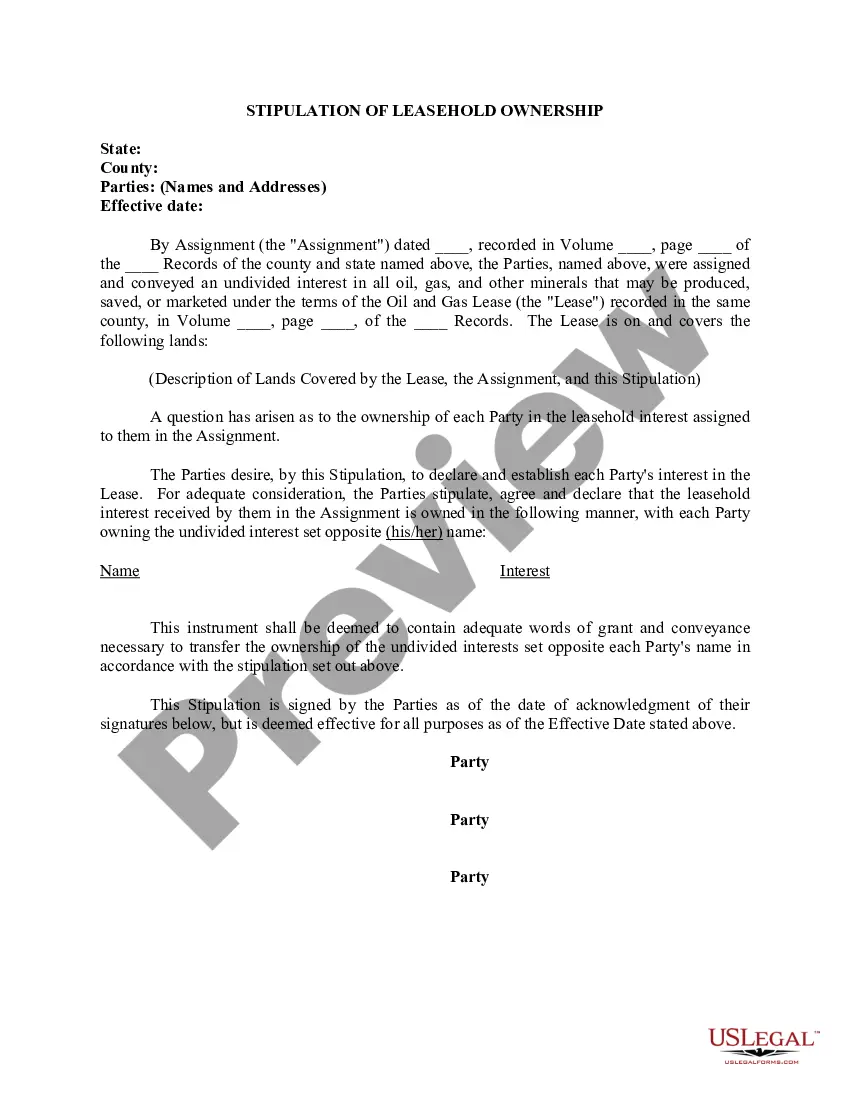
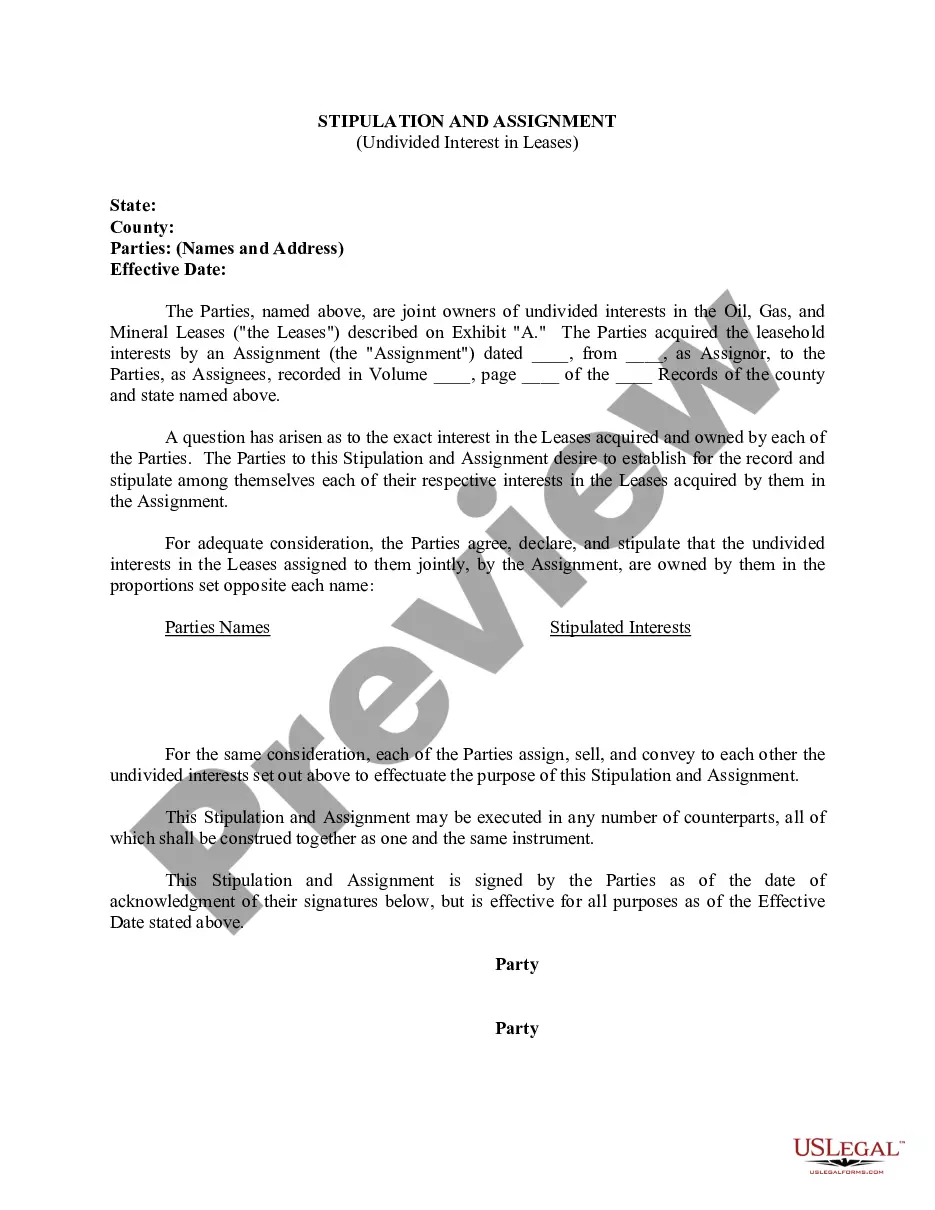
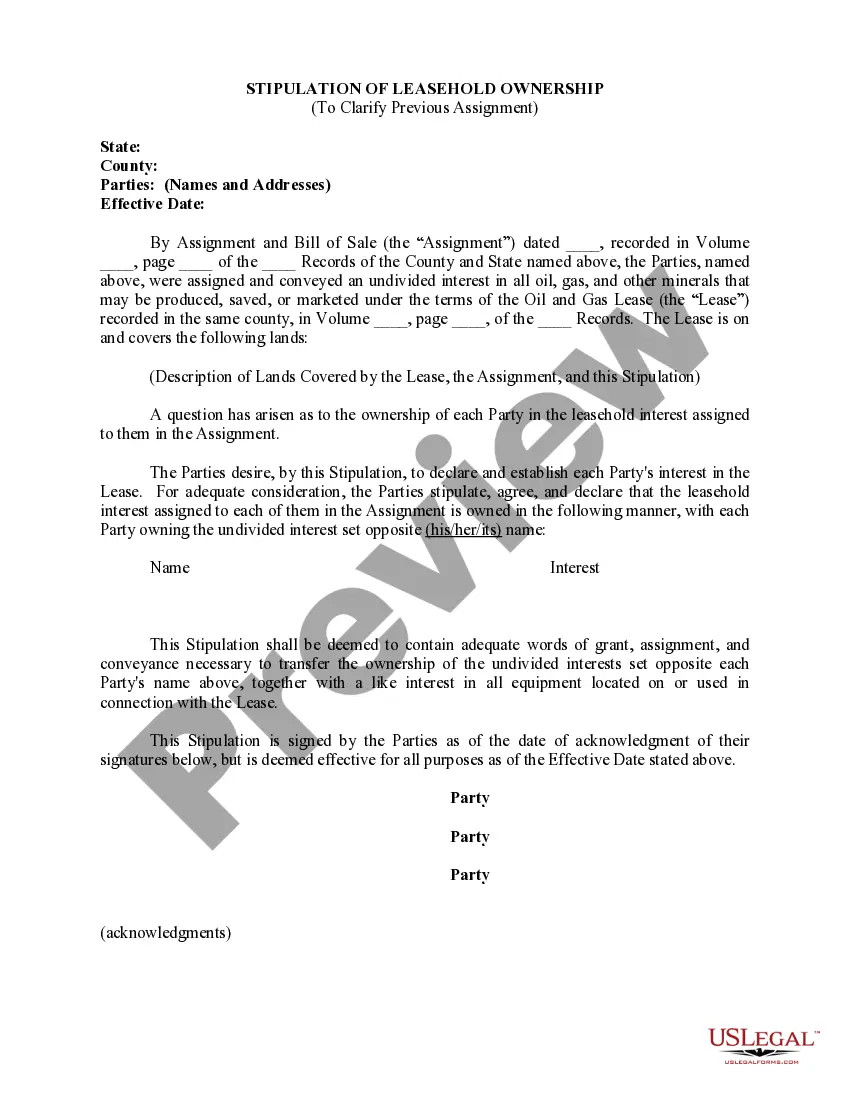
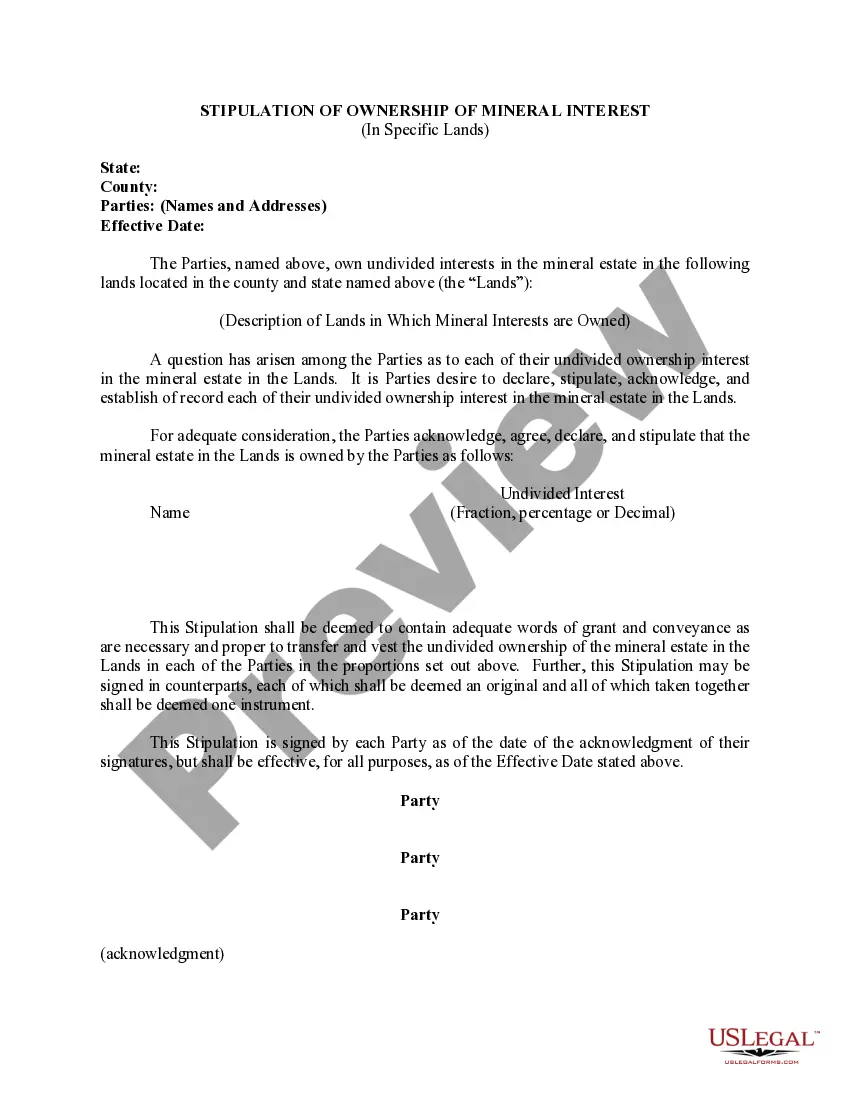
The Stipulation of Leasehold Ownership is a legal document used to clarify and establish ownership interests in a leasehold assignment. This form addresses situations where ownership questions arise among parties who have been assigned leasehold interests. Unlike lease agreements or assignments, this stipulation focuses specifically on the declaration of ownership interests in existing leases, particularly in oil and gas contexts.
Key components of this form
- Identification of the parties involved, including names and addresses.
- Effective date of the stipulation.
- Details of the assignment including recording information.
- Description of the lands covered by the lease and assignment.
- Declaration of each party's undivided interest in the leasehold.
- Signatures of the parties involved along with date of acknowledgment.
Common use cases
This form should be used when there is a dispute or uncertainty regarding the ownership of leasehold interests among parties involved in an oil and gas lease. It is particularly relevant when parties want to formally declare their respective interests following an assignment of leasehold rights. This legal document serves to mitigate any misunderstandings and provides clarity on the ownership interests of all parties involved.
Who needs this form
- Individuals or entities involved in oil and gas leasing who need to clarify ownership interests.
- Parties who have recently entered an assignment but are uncertain about ownership proportions.
- Lawyers or legal representatives of parties seeking to formalize ownership interests in lease agreements.
How to complete this form
- Identify and list all parties involved, including their names and addresses.
- Specify the effective date for the stipulation of ownership.
- Enter detailed information about the assignment, including recording details.
- Provide a clear description of the lands covered by the lease.
- Clearly outline each party's respective ownership interest in the leasehold.
- Ensure all parties sign the document and note the date of acknowledgment.
Does this document require notarization?
This form needs to be notarized to ensure legal validity. US Legal Forms provides secure online notarization powered by Notarize, allowing you to complete the process through a verified video call, available anytime.
Get your form ready online
Our built-in tools help you complete, sign, share, and store your documents in one place.
Make edits, fill in missing information, and update formatting in US Legal Forms—just like you would in MS Word.
Download a copy, print it, send it by email, or mail it via USPS—whatever works best for your next step.
Sign and collect signatures with our SignNow integration. Send to multiple recipients, set reminders, and more. Go Premium to unlock E-Sign.
If this form requires notarization, complete it online through a secure video call—no need to meet a notary in person or wait for an appointment.
We protect your documents and personal data by following strict security and privacy standards.

Make edits, fill in missing information, and update formatting in US Legal Forms—just like you would in MS Word.

Download a copy, print it, send it by email, or mail it via USPS—whatever works best for your next step.

Sign and collect signatures with our SignNow integration. Send to multiple recipients, set reminders, and more. Go Premium to unlock E-Sign.

If this form requires notarization, complete it online through a secure video call—no need to meet a notary in person or wait for an appointment.

We protect your documents and personal data by following strict security and privacy standards.
Typical mistakes to avoid
- Failing to accurately identify all parties involved.
- Not entering the effective date correctly, which can affect the validity.
- Omitting critical details of the assignment or the lands covered.
- Not having all parties sign the document, which may invalidate the agreement.
Why use this form online
- Convenience: Download the form anytime and fill it out at your own pace.
- Editability: Make necessary modifications easily before finalizing the document.
- Reliability: Obtain forms drafted by licensed attorneys, ensuring legal soundness.
Legal use & context
- This stipulation is legally binding once signed by all parties and effective as of the declared date.
- Clarification of ownership interests helps prevent future disputes and can be crucial in legal proceedings.
- Ensure compliance with local laws governing leasehold interests and property conveyance.
Summary of main points
- The Stipulation of Leasehold Ownership establishes and clarifies ownership of leasehold interests among parties.
- Use this form when ownership disputes arise in oil and gas leases.
- Follow the outlined steps carefully to ensure its proper completion and legal effectiveness.
Looking for another form?
Form popularity
FAQ
Leasehold means that you just have a lease from the freeholder (sometimes called the landlord) to use the home for a number of years. The leases are usually long term often 90 years or 120 years and as high as 999 years but can be short, such as 40 years.
Some of the cons of leasehold include: You might need to pay an annual ground rent or service charge, both of which could be expensive. You may not be allowed to carry out major refurbishment or extension works. Sometimes this will require consent from the freeholder, and there's no guarantee they'll say yes.
It might seem after reading this guide that buying a leasehold property isn't worth the hassle. But far from it. If you've fallen in love with a property that happens to be leasehold, there's no reason you shouldn't go ahead and purchase it. Leases themselves aren't an issue it's bad leases that are the issue.
Why would anyone buy a flat on this basis when you can buy a house and own it outright? All flats are leasehold. It's because they have to share communal areas and services and the fabric of the external building which therefore belongs to the freehold. You can pay to renew the lease.
A leasehold estate is an ownership of a temporary right to hold land or property in which a lessee or a tenant holds rights of real property by some form of title from a lessor or landlord.
Peace of mind that your communal areas are looked after and managed. Easy to raise issues, such as that of a noisy neighbour, directly with the freeholder. Your building insurance is taken care off you don't need to do anything.
Leasehold ownership of a flat is simply a long tenancy, the right to occupation and use of the flat for a long period the 'term' of the lease.Furthermore under right to manage (see below), the lessees may not own the freehold but are able to manage the building as if they were the landlord.
You only own a leasehold property for a fixed period of time. You'll have a legal agreement with the landlord (sometimes known as the 'freeholder') called a 'lease'. This tells you how many years you'll own the property. Ownership of the property returns to the landlord when the lease comes to an end.