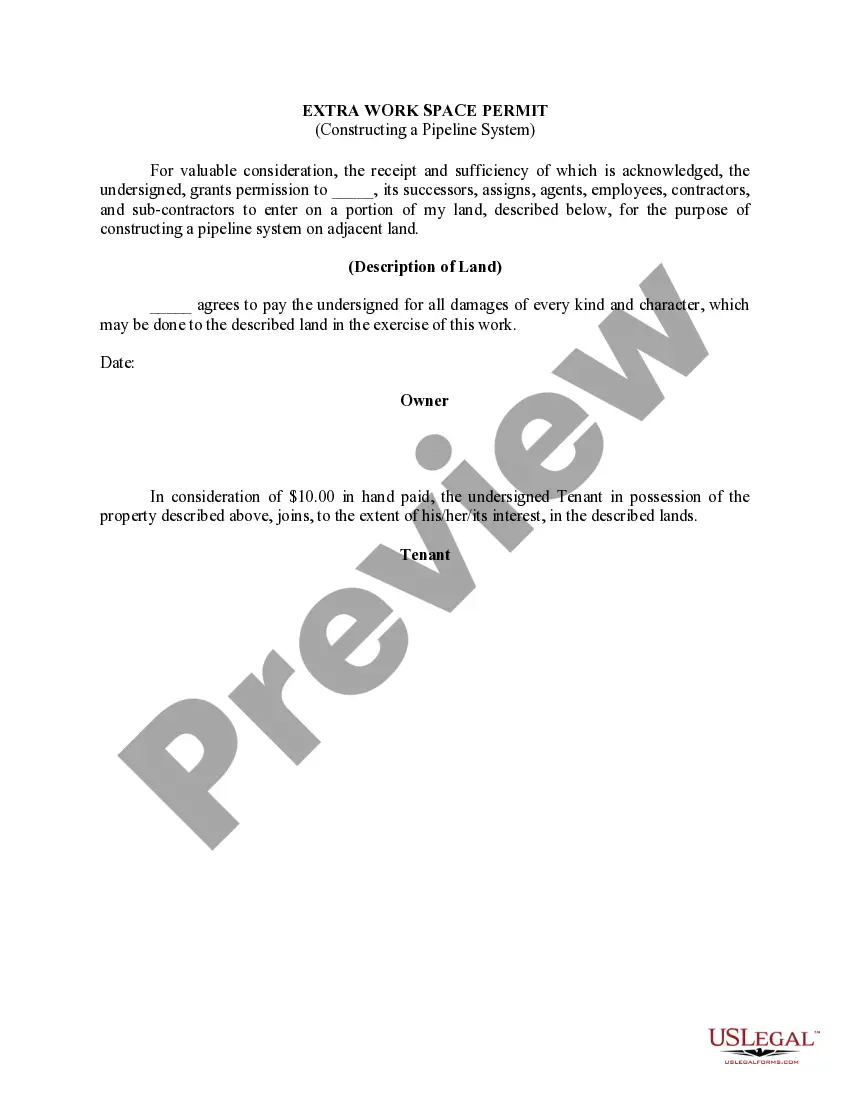
Extra Work Space Permit (Constructing a Pipeline System)
What is this form?
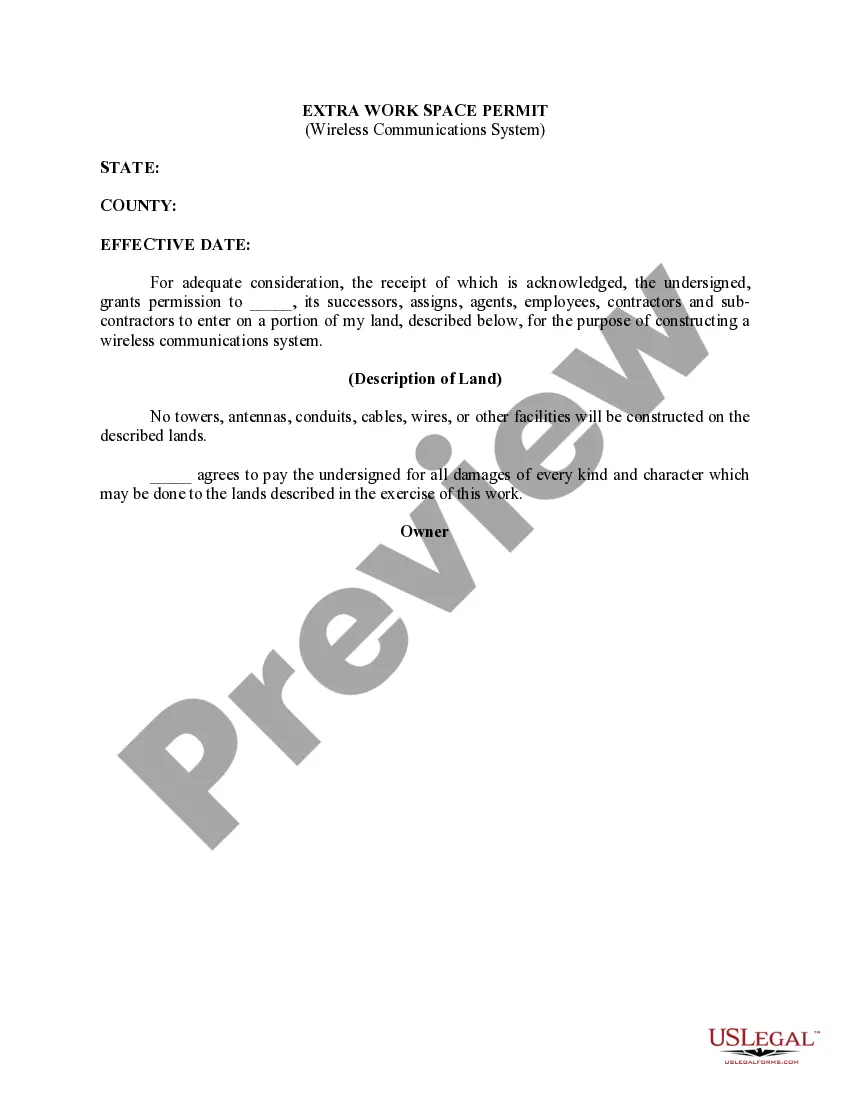
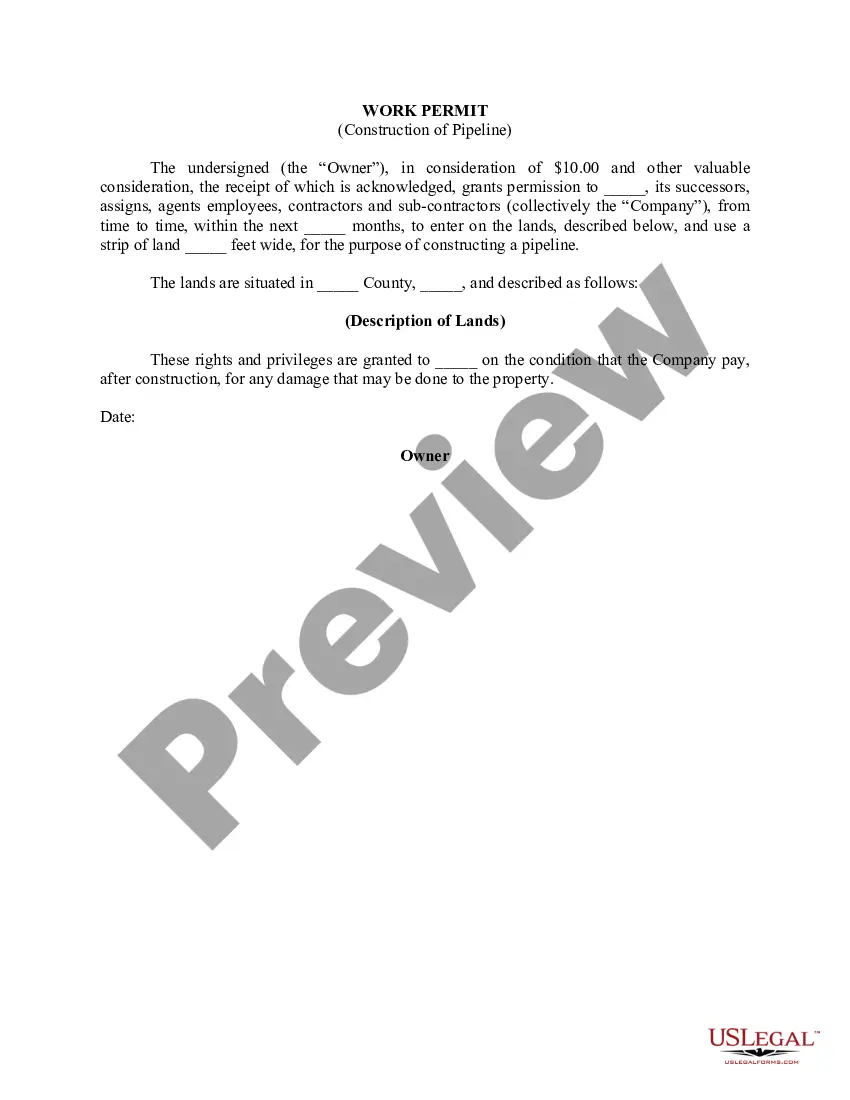
The Extra Work Space Permit is a legal document that grants permission to utilize additional land for the purpose of constructing a pipeline system. This form allows pipeline contractors to enter private property adjacent to their construction site while ensuring the property owner's rights are preserved. It distinguishes itself from similar forms by specifically addressing the allowance for extra work space in pipeline construction, highlighting both compensation for damages and identification of involved parties.
Form components explained
- Identification of the landowner and description of the property.
- Agreement to pay for any damages incurred during construction.
- Specifies the parties involved in the pipeline construction.
- Signature lines for both the property owner and tenant, if applicable.
- A nominal fee of Ten Dollars as consideration for granting permission.
Situations where this form applies
This form should be used when a pipeline construction company requires additional space not owned by them to carry out their construction work. It is particularly relevant when the construction may affect neighboring properties and enables the pipeline contractor to secure the necessary permissions from landowners. Use this form to establish legal permission, outline responsibilities, and protect against potential disputes over property damage.
Who can use this document
- Property owners who need to grant permission for pipeline construction on their land.
- Pipeline construction companies seeking legal access to extra work space.
- Contractors and subcontractors involved in pipeline projects.
- Tenants of properties adjacent to proposed construction sites who may have an interest in the process.
How to complete this form
- Identify all parties involved by entering the name of the landowner and pipeline contractor.
- Provide a clear description of the land where the extra work space is to be utilized.
- Specify the date of the agreement.
- Ensure both the landowner and tenant sign the form where indicated.
- Include a notation of payment (Ten Dollars) to confirm consideration has been given.
Does this document require notarization?
Notarization is not commonly needed for this form. However, certain documents or local rules may make it necessary. Our notarization service, powered by Notarize, allows you to finalize it securely online anytime, day or night.
Get your form ready online
Our built-in tools help you complete, sign, share, and store your documents in one place.
Make edits, fill in missing information, and update formatting in US Legal Forms—just like you would in MS Word.
Download a copy, print it, send it by email, or mail it via USPS—whatever works best for your next step.
Sign and collect signatures with our SignNow integration. Send to multiple recipients, set reminders, and more. Go Premium to unlock E-Sign.
If this form requires notarization, complete it online through a secure video call—no need to meet a notary in person or wait for an appointment.
We protect your documents and personal data by following strict security and privacy standards.

Make edits, fill in missing information, and update formatting in US Legal Forms—just like you would in MS Word.

Download a copy, print it, send it by email, or mail it via USPS—whatever works best for your next step.

Sign and collect signatures with our SignNow integration. Send to multiple recipients, set reminders, and more. Go Premium to unlock E-Sign.

If this form requires notarization, complete it online through a secure video call—no need to meet a notary in person or wait for an appointment.

We protect your documents and personal data by following strict security and privacy standards.
Common mistakes to avoid
- Failing to provide a clear and accurate description of the property.
- Not obtaining all necessary signatures before submitting the form.
- Overlooking the requirement to specify the exact nature of the rights granted.
Why use this form online
- Easy access to legally drafted templates prepared by licensed attorneys.
- Convenience of downloading and completing the form at your own pace.
- Ability to edit and save your information securely.
- Access to customer support for any questions during the completion process.
Summary of main points
- The Extra Work Space Permit is essential for legally accessing adjacent land for pipeline construction.
- Both property owners and pipeline contractors have responsibilities detailed in the form.
- It is crucial to provide accurate property descriptions and obtain necessary signatures.
Looking for another form?
Form popularity
FAQ
A pipeline easement specifically gives the easement holder the right to build and maintain a pipeline on a landowner's property. It doesn't grant the easement holder actual ownership of the land, just a right to use the land for pipeline purposes.
Oil pipelines are made from steel or plastic tubes which are usually buried. The oil is moved through the pipelines by pump stations along the pipeline. Natural gas (and similar gaseous fuels) are pressurized into liquids known as Natural Gas Liquids (NGLs). Natural gas pipelines are constructed of carbon steel.
STRINGING: Pipe is transported in to the easement and laid end to end next to where the trench will be dug.BENDING: Where required, specialized machinery is used to bend the pipe to conform with the contours of the land and the pipeline route. 6. WELDING AND NON-DESTRUCTIVE TESTING: Pipe sections are welded together.
Temporary buildings should not be placed above any gas pipe or within 3.0 metres of mains operating above 75mbar (medium, intermediate and high pressure mains) during construction activities and in no circumstances should permanent structures be built over any pipe transporting gas.
In like manner, statutes may prohibit locating buildings or undertaking any construction over a pipeline easement. Deteriorating or improperly maintained pipelines may create serious public safety issues and may be subject to dual state and federal regulatory authority.
The process from staking the right-of-way to beginning restoration of the site can take place in as little as 10 days.
A right-of-way is a strip of land typically about 50 feet wide (depending on location) containing a pipeline or other utility. Many rights-of-way contain more than one underground pipeline or utility and can be wider depending on the number of infrastructure assets within.
There are provisions in the Gas Safety (Installation and Use) Regulations 1998 (regulation 19), which include provisions that persons may not install gas pipes under buildings. There are however no provisions which deal conversely, with people not erecting buildings over existing gas service pipes.
API recommends setbacks of 50 feet from petroleum and hazardous liquids lines for new homes, businesses, and places of public assembly (API 2003). It also recommends 25 feet for garden sheds, septic tanks, and water wells and 10 feet for mailboxes and yard lights.