Royalty Owner's indemnity Agreement on Interest with Title Dispute
About this form
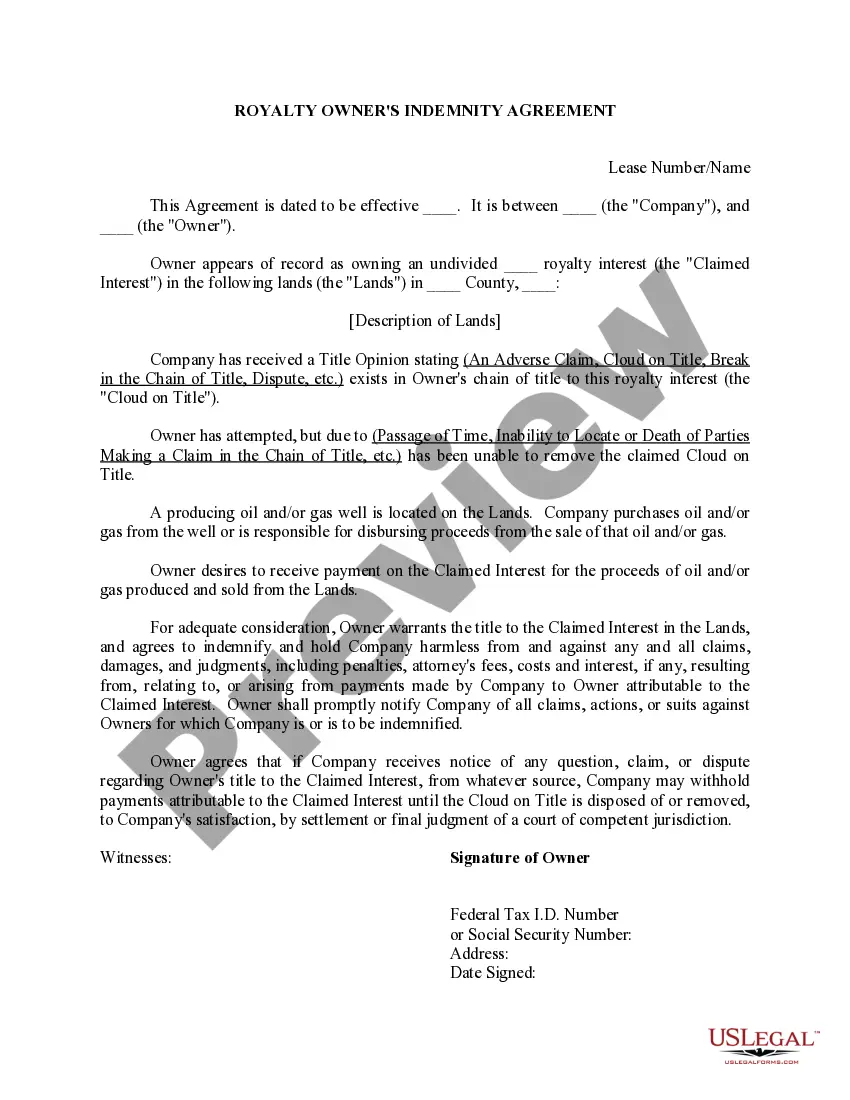
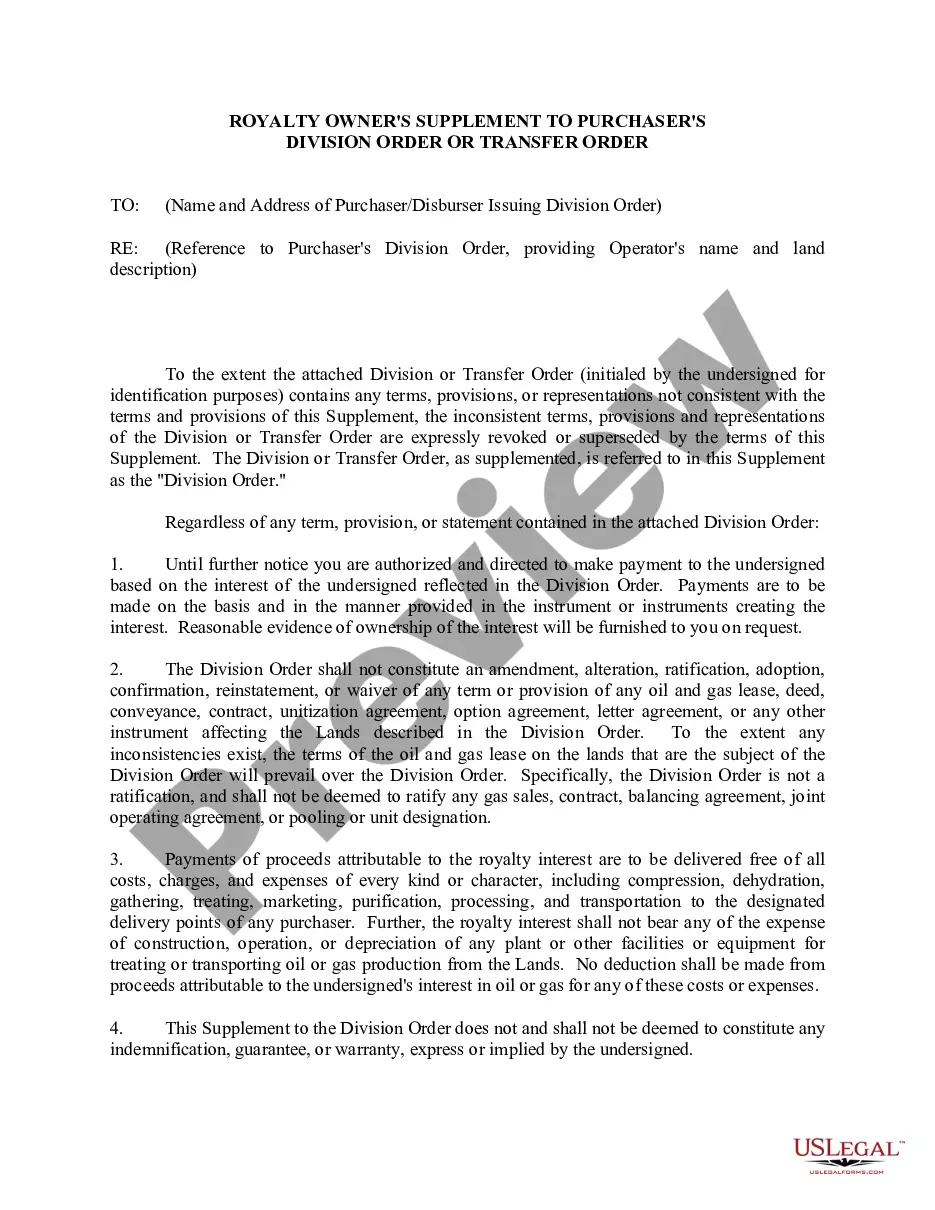
The Royalty Owner's Indemnity Agreement on Interest with Title Dispute is a legal document that addresses disputes related to ownership of royalty interests. This agreement ensures that an owner claiming an interest in disputed property can still receive payments for oil and gas produced from that property while protecting the company from any legal repercussions associated with the title dispute. It differs from other agreements by specifically focusing on indemnity regarding title issues, providing both parties with clear terms during uncertainty over property claims.
Key parts of this document
- Date of agreement effectiveness
- Identification of the company and owner
- Details of the royalty interest and lands involved
- Statement of the title dispute or claim against the owner's title
- Indemnification clause protecting the company from claims
- Procedure for notifying the company about any claims
- Signature lines for the owner and tax identification information
When to use this document
This form is used when a royalty owner is facing a title dispute regarding their claim to royalty payments. It is particularly useful in scenarios where there is an adverse claim or cloud on the title, and the owner wishes to receive payments for production while protecting both themselves and the company from legal liabilities. Use this form when you need to formalize the understanding between the owner and the company regarding the disputed interest.
Who should use this form
- Royalty owners involved in a title dispute over their interest
- Companies purchasing oil and gas from wells on disputed lands
- Legal representatives or attorneys assisting clients with title disputes
- Anyone needing to clarify payment arrangements in a contested ownership scenario
How to complete this form
- Enter the effective date of the agreement.
- Complete the names of the company and owner involved in the agreement.
- Specify the undivided royalty interest and description of the lands in question.
- Detail any known claims or issues affecting the owner's title.
- Ensure the owner indemnifies the company from any claims and agrees to notify the company of any disputes.
- Have the owner sign and provide their tax identification or social security number and address.
Is notarization required?
This form does not typically require notarization unless specified by local law. However, checking local requirements is advisable to ensure the document's enforceability in your jurisdiction.
Get your form ready online
Our built-in tools help you complete, sign, share, and store your documents in one place.
Make edits, fill in missing information, and update formatting in US Legal Forms—just like you would in MS Word.
Download a copy, print it, send it by email, or mail it via USPS—whatever works best for your next step.
Sign and collect signatures with our SignNow integration. Send to multiple recipients, set reminders, and more. Go Premium to unlock E-Sign.
If this form requires notarization, complete it online through a secure video call—no need to meet a notary in person or wait for an appointment.
We protect your documents and personal data by following strict security and privacy standards.

Make edits, fill in missing information, and update formatting in US Legal Forms—just like you would in MS Word.

Download a copy, print it, send it by email, or mail it via USPS—whatever works best for your next step.

Sign and collect signatures with our SignNow integration. Send to multiple recipients, set reminders, and more. Go Premium to unlock E-Sign.

If this form requires notarization, complete it online through a secure video call—no need to meet a notary in person or wait for an appointment.

We protect your documents and personal data by following strict security and privacy standards.
Avoid these common issues
- Failing to fully disclose all claims or issues related to the title.
- Not including necessary identification information for the owner.
- Omitting signatures or other required fields.
- Neglecting to specify the details related to the disputed interest and lands clearly.
Why use this form online
- Convenient access to a professionally drafted legal template.
- Editable format allows users to customize the agreement to their specific needs.
- Time-saving option for immediate use without waiting for legal consultation.
- Reliably drafted by licensed attorneys, ensuring legal compliance.
Summary of main points
- The Royalty Owner's Indemnity Agreement ensures royalty owners get paid despite ongoing title disputes.
- It provides protection for companies against potential claims related to the ownership of royalty interests.
- Completing this form accurately is crucial for legal protectiveness and clarity in transactions.
Looking for another form?
Form popularity
FAQ
The royalty mineral owner retains ownership of the interest after production stops. Holders of overriding royalty interests have no ownership rights to the minerals under the ground but a non-possessory undivided interest.
An overriding royalty interest is the right to receive revenue from the production of oil and gas from a well. The overriding royalty is carved out of the lessee's (operator's) working interest and entitles its owner to a fraction of production.
A royalty interest is a non-possessory real property interest in oil and gas production free of production and operating expenses, which may be created by grant or by reservation or exception.
An overriding royalty interest is the right to receive revenue from the production of oil and gas from a well. The overriding royalty is carved out of the lessee's (operator's) working interest and entitles its owner to a fraction of production.
The royalty mineral owner retains ownership of the interest after production stops. Holders of overriding royalty interests have no ownership rights to the minerals under the ground but a non-possessory undivided interest.
An overriding royalty interest generally entitles the owner of the interest to a specified share of the oil and gas produced under the terms of the lease. In Texas and in many other oil-producing states, overriding royalty interests are generally treated as interests in real estate.
Royalty Interest an ownership in production that bears no cost in production. Royalty interest owners receive their share of production revenue before the working interest owners. Working Interest an ownership in a well that bears 100% of the cost of production.
An overriding royalty interest (ORRI) is an undivided interest in a mineral lease giving the holder the right to a proportional share (receive revenue) of the sale of oil and gas produced. NRI = Working Interest Royalty Interests. 100 25 = 75 percent (NRI) $1,000,000 $250,000 = $750,000 (monthly NRI)
In most cases you report royalties on Schedule E (Form 1040), Supplemental Income and Loss. However, if you hold an operating oil, gas, or mineral interest or are in business as a self-employed writer, inventor, artist, etc., report your income and expenses on Schedule C or Schedule C-EZ (Form 1040).