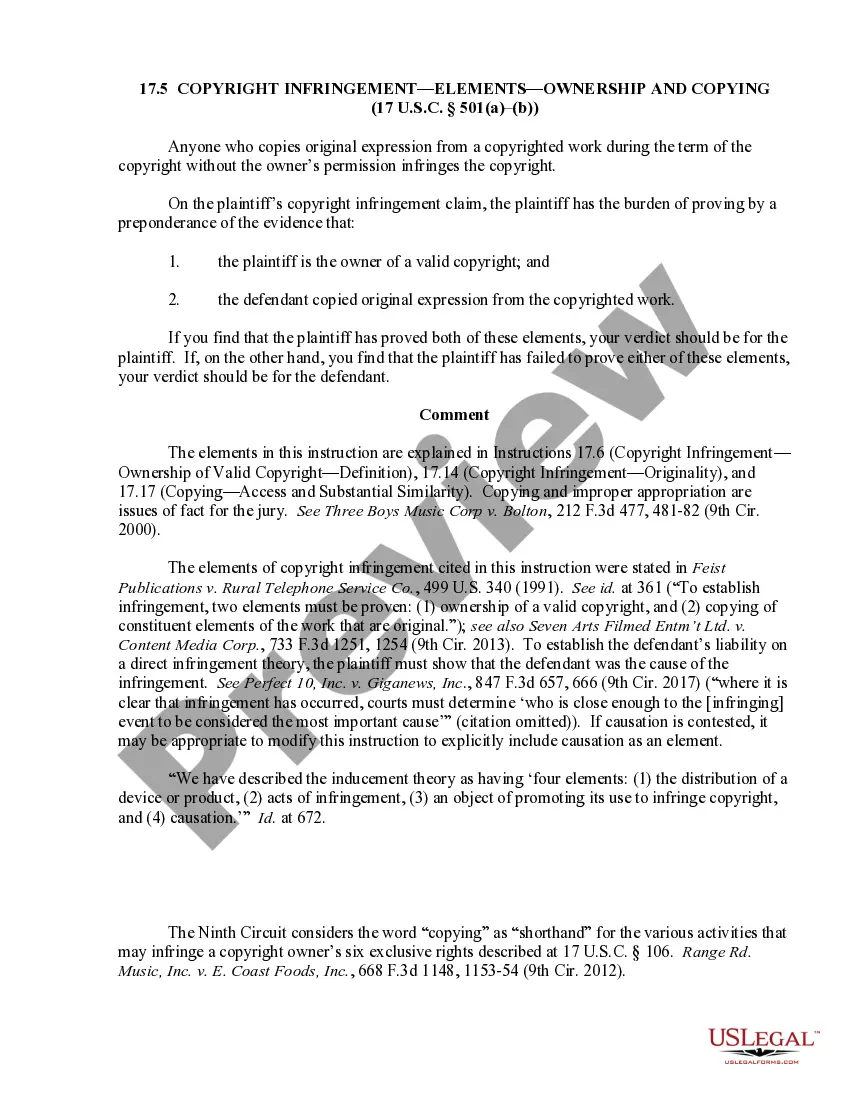
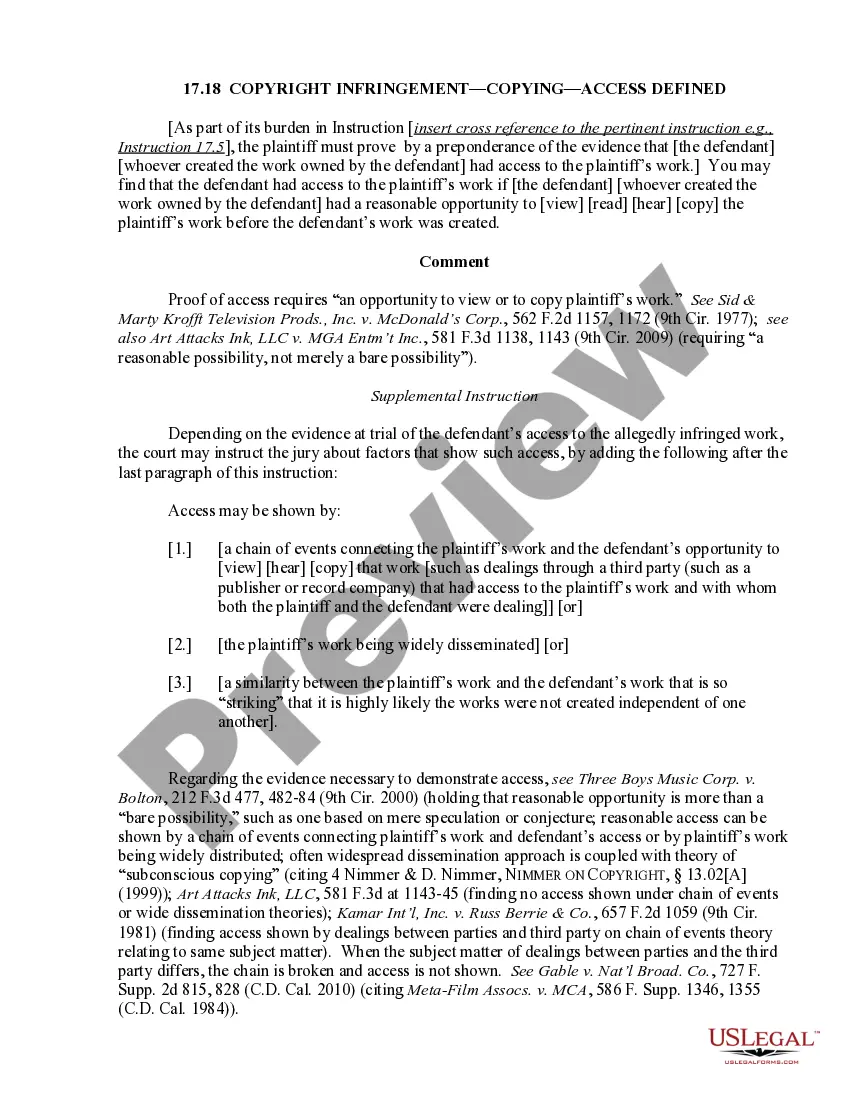
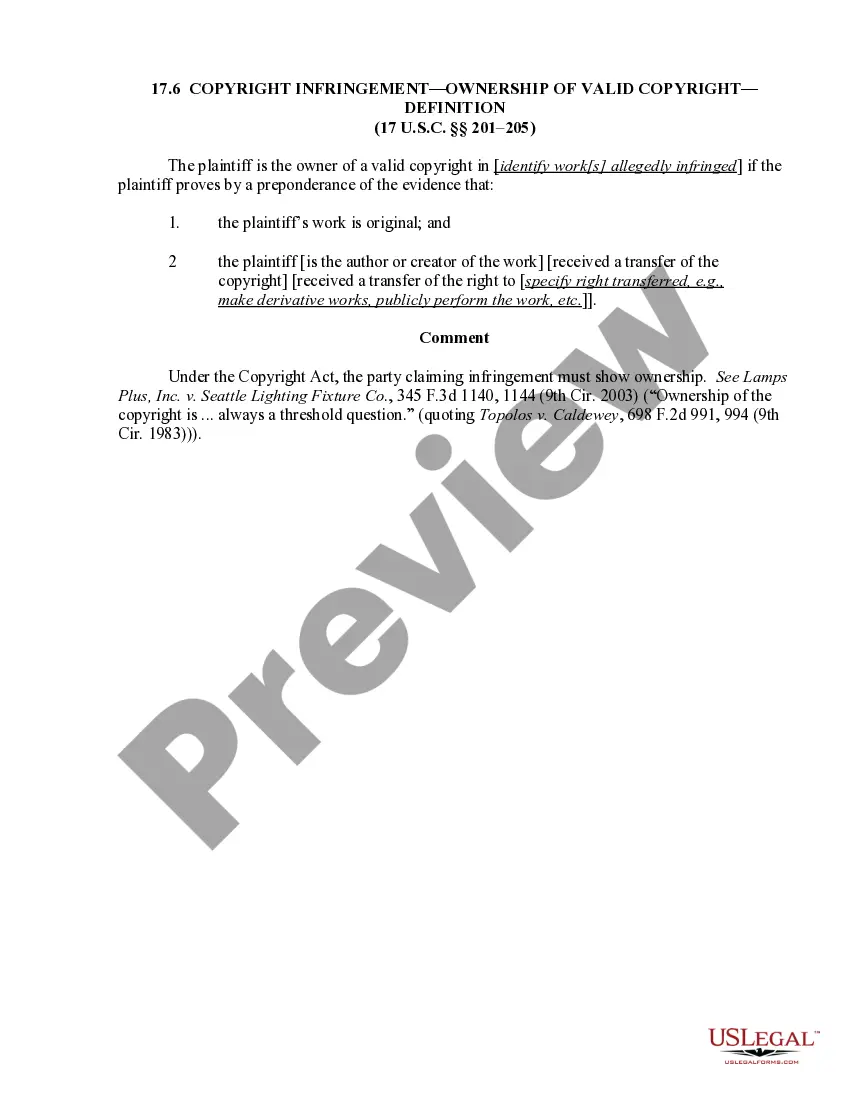
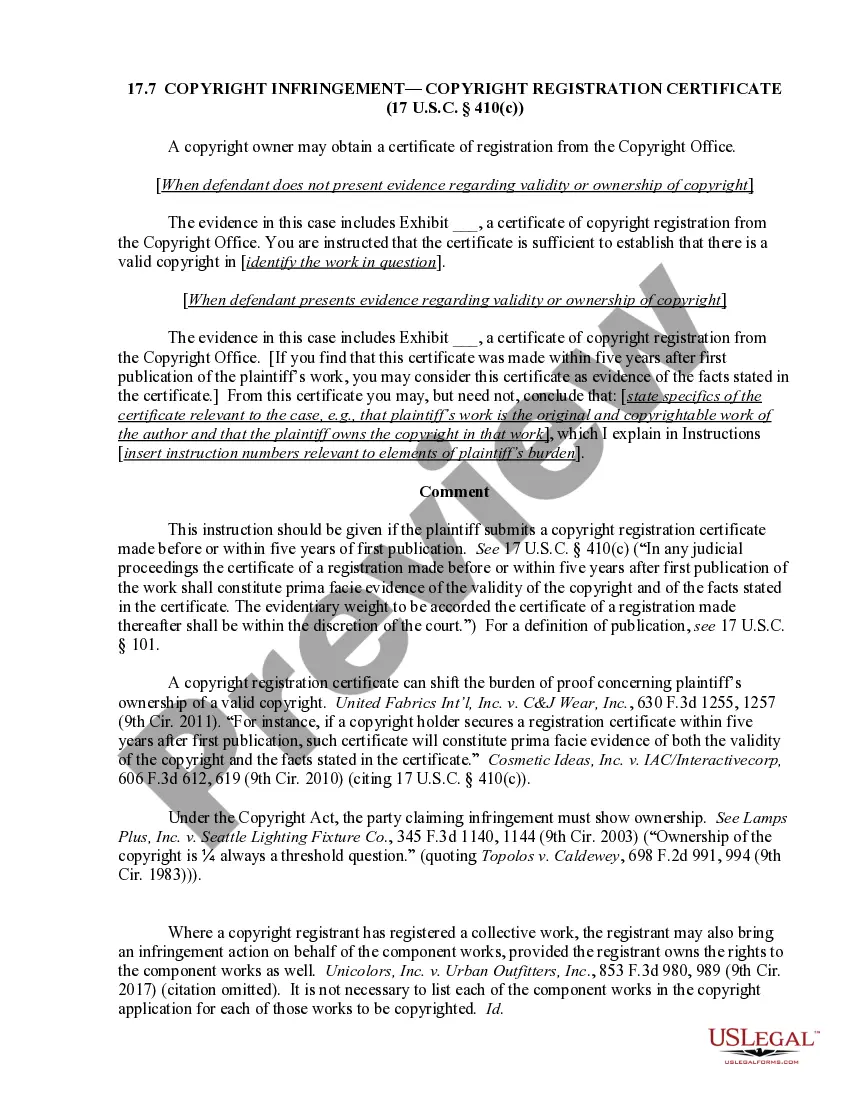
17.5 Copyright Infringement-Elements-Ownership and Copying (17 U.S.C. Sec. 501(a)-(B))
Is notarization required?
Notarization is not commonly needed for this form. However, certain documents or local rules may make it necessary. Our notarization service, powered by Notarize, allows you to finalize it securely online anytime, day or night.
Get your form ready online
Our built-in tools help you complete, sign, share, and store your documents in one place.
Make edits, fill in missing information, and update formatting in US Legal Forms—just like you would in MS Word.
Download a copy, print it, send it by email, or mail it via USPS—whatever works best for your next step.
Sign and collect signatures with our SignNow integration. Send to multiple recipients, set reminders, and more. Go Premium to unlock E-Sign.
If this form requires notarization, complete it online through a secure video call—no need to meet a notary in person or wait for an appointment.
We protect your documents and personal data by following strict security and privacy standards.

Make edits, fill in missing information, and update formatting in US Legal Forms—just like you would in MS Word.

Download a copy, print it, send it by email, or mail it via USPS—whatever works best for your next step.

Sign and collect signatures with our SignNow integration. Send to multiple recipients, set reminders, and more. Go Premium to unlock E-Sign.

If this form requires notarization, complete it online through a secure video call—no need to meet a notary in person or wait for an appointment.

We protect your documents and personal data by following strict security and privacy standards.
Looking for another form?
Form popularity
FAQ
In addition to cases involving divisibility of ownership in the same version of a work, section 501(b) is intended to allow a court to permit or compel joinder of the owners of rights in works upon which a derivative work is based.
Generally speaking, the greater amount of the work is used, the less likely it will be considered fair use. Previously, courts endorsed the 10% rule? if a person uses less than ten percent (10%) of the total work or one (1) chapter of a book if the book has ten (10) chapters or more, then it is a fair use.
Under those guidelines, a prose work may be reproduced in its entirety if it is less than 2500 words in length.
You can use up to 10%, but no more than 1000 words, of essays, articles, or stories, of a single copyrighted work. You can use up to 250 words of an entire poem, or a portion of a poem.
Section 501(a) identifies a copyright infringer as someone who "violates any of the exclusive rights of the copyright owner as provided by sections 106 through 118" of the bill, or who imports copies or phonorecords in violation of section 602.
The three basic elements of copyright: originality, creativity, and fixation. There are three basic elements that a work must possess in order to be protected by copyright in the US: Originality: To get a copyright, a work must be the original work of the author.
As a general rule, for works created after January 1, 1978, copyright protection lasts for the life of the author plus an additional 70 years.
Ingly, you cannot claim copyright to another's work, no matter how much you change it, unless you have the owner's consent.